
Your inside sales team made 847 outreach attempts last month. They booked 12 meetings. That’s a 1.4% conversion rate costing you $89 per meeting when you factor in salaries and tools.
The problem isn’t effort. It’s approach.
Inside sales lead generation has fundamentally changed. Buyers ignore single-channel outreach. They respond to coordinated, multi-touch sequences that meet them where they actually spend time—LinkedIn feeds, inboxes, and phone calls—not just one channel in isolation.
This guide walks you through the complete inside sales lead generation process: from defining your ideal customer profile to building sequences that generate 3.5x more responses, scaling your SDR team, and measuring what actually matters. Whether you’re a sales leader building your first inside sales function or optimizing an existing team, you’ll find actionable frameworks you can implement immediately.
By the end, you’ll understand exactly how to build a predictable, scalable inside sales lead generation engine that consistently fills your pipeline with qualified opportunities.
What is Inside Sales Lead Generation?
Inside sales lead generation is the systematic process of identifying, contacting, and qualifying potential customers remotely—primarily through digital channels like email, LinkedIn, and phone—to create sales-qualified opportunities for your pipeline.
Unlike traditional field sales where reps meet prospects in person, inside sales teams operate entirely remotely. They use technology to prospect at scale, relying on outreach automation, CRM systems, and sales intelligence platforms to connect with hundreds of potential buyers without leaving their desk.
The core distinction between inside and outside sales lead generation:
- Inside sales: Remote prospecting via phone, email, LinkedIn, video calls. Lower cost per lead ($45-$150), higher volume, shorter sales cycles (30-90 days for mid-market)
- Outside sales: In-person meetings, trade shows, field visits. Higher cost per lead ($200-$800), lower volume, longer cycles (90-180+ days for enterprise)
Most B2B companies with deal values between $5K-$250K use inside sales as their primary go-to-market motion. Even enterprise companies now use inside sales for initial prospecting before involving field reps.
Why inside sales lead generation matters in 2026
Buyers complete 67% of their purchase journey before talking to sales. They research solutions independently, compare alternatives on review sites, and enter sales conversations already informed. Inside sales teams must intercept buyers early in this journey with relevant, multi-channel outreach that earns attention rather than demands it.
Success metrics for inside sales lead generation typically include:
- Activity metrics: 80-120 outreach touches per SDR daily
- Response rates: 5-15% for cold outreach depending on channel mix
- Meeting conversion: 20-30% of responses converting to qualified meetings
- SQL generation: 8-15 sales-qualified leads per SDR monthly
- Pipeline contribution: $40K-$80K in pipeline generated per SDR per month
The teams that hit these benchmarks consistently share one trait: they’ve moved beyond single-channel email blasts to coordinated multi-channel sequences that engage prospects across multiple touchpoints.
The Inside Sales Lead Generation Framework
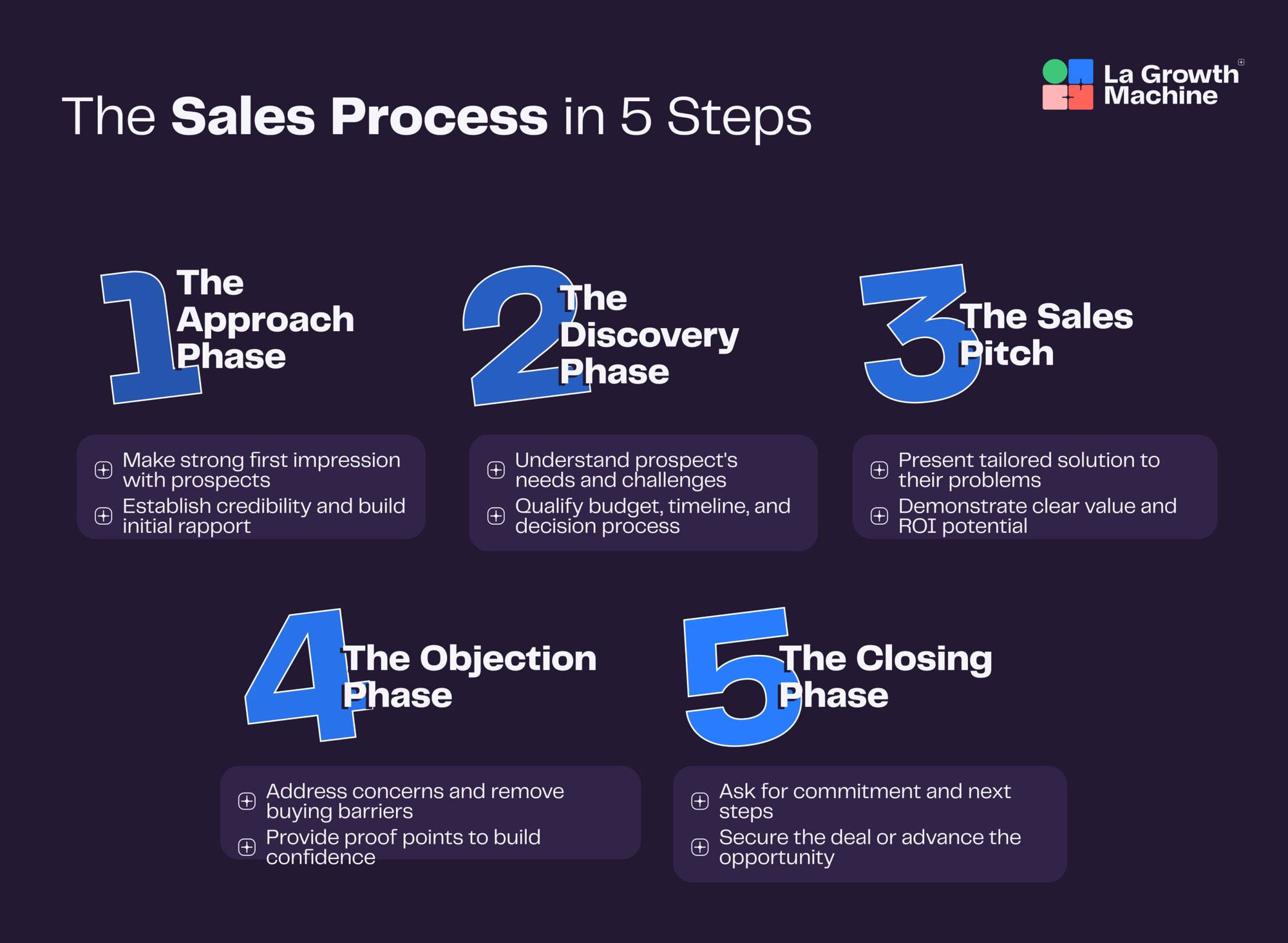
Effective inside sales lead generation isn’t random activity. It’s a systematic framework with five interconnected components that work together to generate predictable pipeline.
The 5 Core Pillars
#1 – Target Market Definition
Everything starts with clarity on who you’re selling to. Inside sales teams need precisely defined ICPs including firmographics (company size, industry, revenue), technographics (tech stack signals), and behavioral indicators (hiring, funding, expansion signals). Vague targeting kills inside sales productivity faster than any other factor.
#2 – Multi-Channel Outreach Strategy
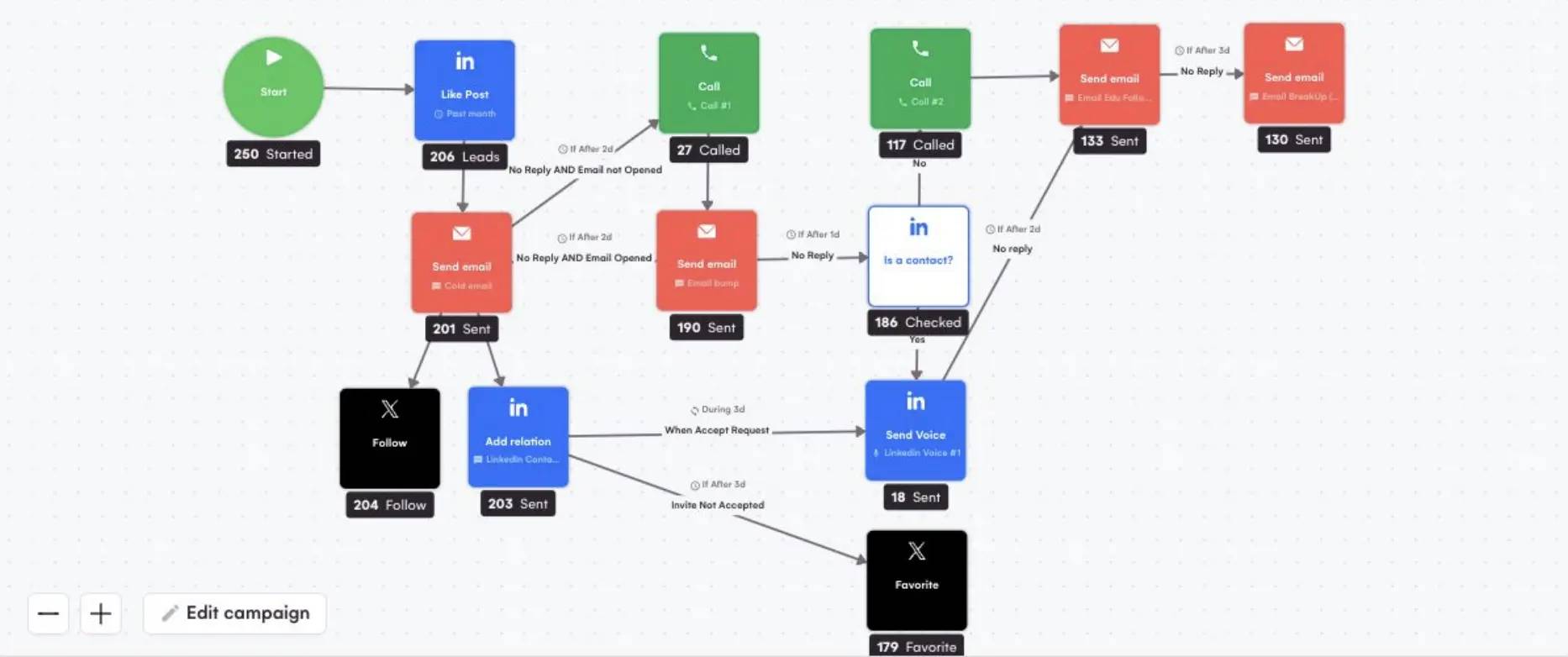
Modern buyers exist across multiple channels simultaneously. Your inside sales approach must mirror this reality. Effective sequences combine LinkedIn connection requests, profile engagement, personalized emails, and strategic phone calls in a coordinated cadence. Single-channel approaches (email-only or LinkedIn-only) achieve 40-60% lower response rates than multi-channel sequences.
#4 – Prospecting Technology Stack
Inside sales teams require specialized tools for four functions: lead data and enrichment, multi-channel outreach automation, CRM for pipeline management, and analytics for optimization. The right stack amplifies productivity; the wrong stack creates tool sprawl where reps spend more time managing software than talking to prospects.
#5 – Qualification and Handoff Process
Not every response becomes a sales-qualified lead. Inside sales teams need clear qualification frameworks (BANT, MEDDIC, or custom) and defined handoff criteria to sales. Without this clarity, SDRs waste time nurturing unqualified contacts while qualified opportunities languish.
#6 – Measurement and Optimization
What gets measured improves. Inside sales lead generation requires tracking both activity metrics (outreach volume) and outcome metrics (response rates, meeting quality, SQL generation). Teams that review metrics weekly and adjust tactics based on data consistently outperform teams operating on intuition.
How These Components Work Together
Your target market definition drives your prospecting technology choices (you need data sources covering your ICP). Your tech stack enables your multi-channel outreach strategy. Your outreach generates responses that feed your qualification process. Your measurement system identifies what’s working and what needs adjustment.
Break any single pillar and the entire framework weakens. Nail all five and you build a predictable, scalable pipeline generation engine that consistently delivers results regardless of market conditions.
Building Your Inside Sales Tech Stack
Your inside sales technology stack directly impacts productivity. Choose well and each SDR can manage 120+ prospects simultaneously with personalized multi-channel outreach. Choose poorly and they drown in manual tasks, switching between 8+ tools just to send a sequence.
The Four Essential Tool Categories
#1 – CRM System (Pipeline Management)
Your CRM is the foundation—it tracks all prospect interactions, pipeline stages, and deals. For inside sales, you need a CRM with strong task management, email integration, and reporting capabilities.
Requirements:
- Contact and account management with custom fields
- Activity logging (calls, emails, meetings)
- Pipeline visualization and reporting
- Integration capabilities with other tools
Popular choices:
- HubSpot (free-$800/month)
- Salesforce ($25-$300/user/month)
- Pipedrive ($15-$99/user/month)
#2 – Lead Intelligence and Data Enrichment
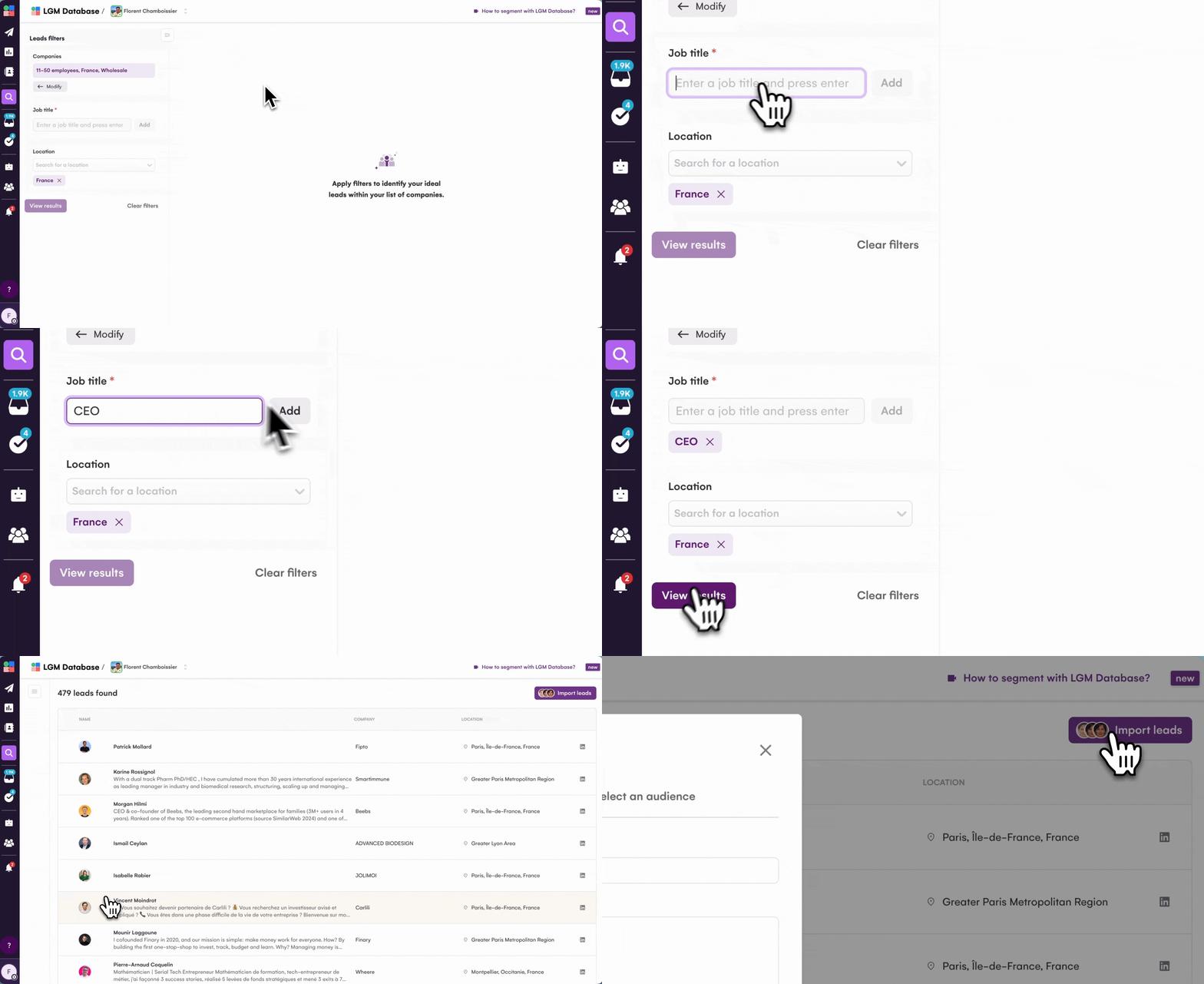
Inside sales teams need accurate contact data and company intelligence. Manually researching each prospect doesn’t scale when you’re targeting hundreds of accounts.
Requirements:
- Email finding with verification
- Direct dial phone numbers
- Company technographic data
- Intent signals (funding, hiring, tech adoption)
Realistic costs: $50-$200 per user monthly depending on data volume.
Most tools charge per contact enriched or searched.
#3 – Multi-Channel Outreach Automation
This is where most inside sales teams face a critical decision: single-channel email tools or true multi-channel platforms.
Single-channel tools (Lemlist, Instantly, Mailshake) automate email sequences but require manual work or separate tools for LinkedIn outreach. They cost $30-$99/user/month but force your team into email-only strategies—exactly what buyers have learned to ignore.
Multi-channel platforms integrate LinkedIn automation with email sequences in unified workflows. La Growth Machine takes this approach: SDRs build sequences that automatically send LinkedIn connection requests, engage with prospect posts, send personalized messages, and follow up via email—all from one platform.
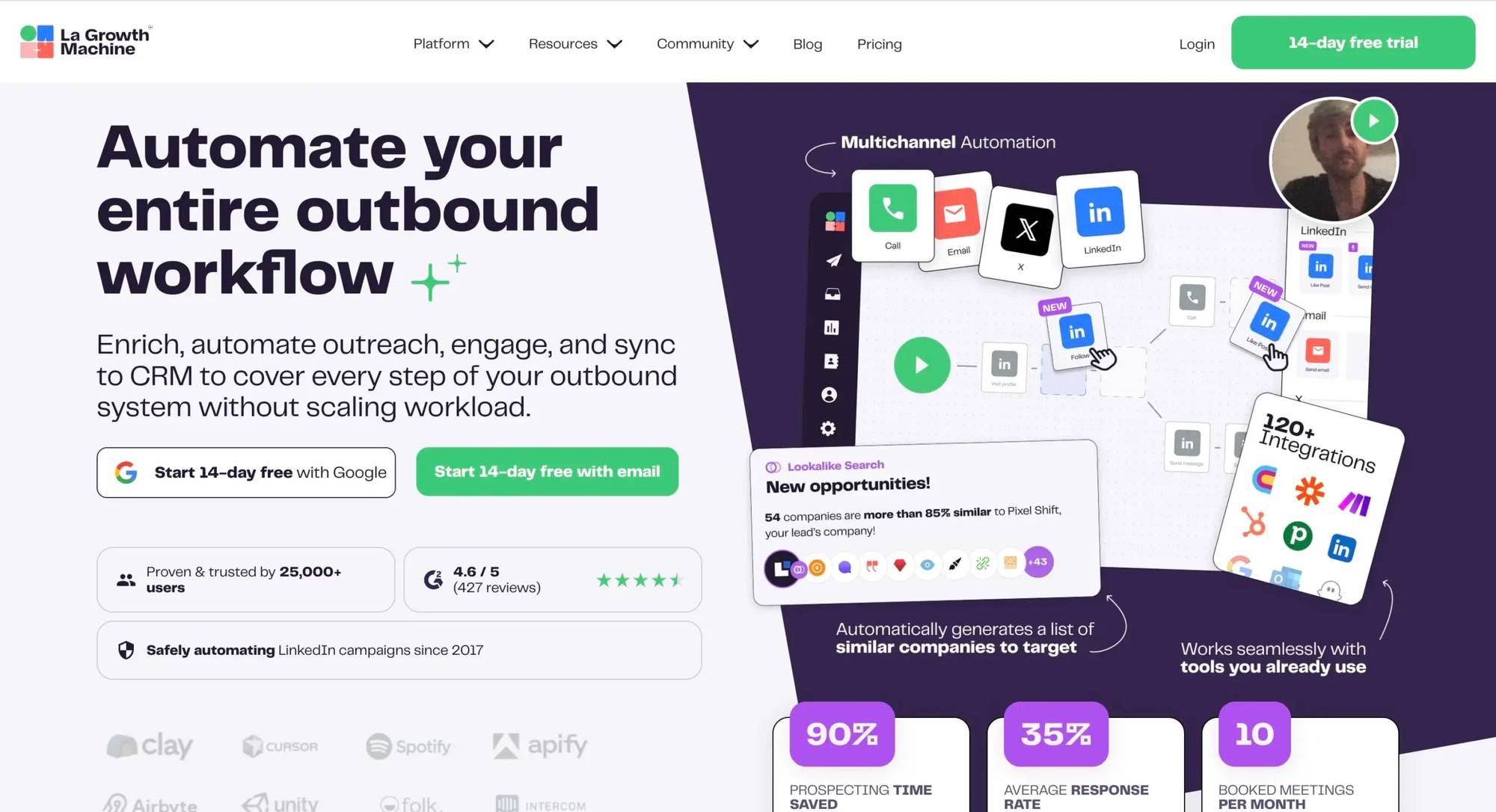
Why multi-channel matters: Data from 40,000+ sequences shows multi-channel outreach (LinkedIn + Email) generates 3.5x more responses than email-only campaigns. Buyers see your name across multiple platforms, creating pattern recognition that single-channel outreach never achieves.
Multi-channel platform requirements:
- Email sending with deliverability optimization
- LinkedIn automation (connections, messages, engagement)
- Unified sequence builder combining both channels
- A/B testing capabilities
- Safety features preventing LinkedIn blocks
La Growth Machine pricing:
- Basic plan starts at €50/month (annual billing) with LinkedIn + Email automation, 250 enriched leads/month, and up to 3 identities.
- Pro plan (€100/month annual) adds calls channel, 400 enriched leads/month, and 6 active campaigns.
- Ultimate plan (€150/month annual) includes all channels (LinkedIn, Email, X, Calls), 1,000 enriched leads/month, and unlimited campaigns with CRM sync.
The key advantage: your SDRs work from one interface instead of juggling separate email and LinkedIn tools, manual data enrichment, and disconnected workflows. This consolidation saves 45-60 minutes daily per rep—time redirected to personalization and research.
#4 – Analytics and Reporting
You need visibility into what’s working. Look for tools that track metrics across your entire stack and surface insights without requiring data science degrees.
Requirements:
- Activity tracking (emails sent, calls made, LinkedIn actions)
- Outcome metrics (response rates, meeting bookings, SQL generation)
- Attribution (which sequences/channels drive results)
- Team performance comparison
Integration is Everything
The best inside sales tech stacks have fewer, better-integrated tools rather than 12 disconnected point solutions. When evaluating any tool, ask:
- Does it integrate natively with our CRM?
- Can we export data easily if we switch tools?
- Does it eliminate another tool we’re currently using?
- Will it slow down our workflow or speed it up?
Budget Considerations
Realistic monthly costs per SDR for a complete stack:
- CRM: $50-$100
- Lead intelligence: $75-$150
- Multi-channel outreach: $50-$150 (consolidated) or $80-$150 (separate email + LinkedIn tools)
- Analytics: $30-$80 (if not included in other tools)
Total: $200-$350 per SDR monthly
Compare this to the cost of the rep ($4,000-$6,000/month fully loaded). Your tech stack represents 5-7% of rep cost but can double or triple productivity. This isn’t where you cut costs.
Teams that try to save money with disconnected free tools end up losing more in SDR productivity than they save in software costs.
Crafting Your Inside Sales Strategy
Technology enables execution, but strategy determines what you execute. Before building a single sequence, you need four strategic decisions locked down.
Decision 1: Define Your Ideal Customer Profile (ICP)
Inside sales teams cannot prospect effectively without a precisely defined ICP. “B2B companies that need our solution” isn’t an ICP—it’s a death sentence for productivity.
Your ICP must specify:
Firmographics:
- Company size (employee count ranges)
- Revenue range (if targeting enterprise vs mid-market)
- Industry and sub-industries
- Geographic location
- Funding stage (if targeting startups)
Technographics:
- Current technology stack signals
- Competitor usage
- Integration requirements
Behavioral signals:
- Recent funding rounds
- Leadership changes
- Expansion indicators (hiring, new offices)
- Product launches or rebrands
Example precise ICP: “B2B SaaS companies, 50-250 employees, $5M-$50M ARR, selling to mid-market or enterprise, headquartered in US/UK/Germany, using Salesforce, currently hiring sales development roles, raised Series A/B within last 18 months.”
This specificity lets SDRs personalize outreach meaningfully and allows your data tools to build accurate prospect lists.
Conclusion
Inside sales lead generation isn’t about sending more emails or making more calls. It’s about systematic, multi-channel engagement with precisely targeted prospects, delivering value at every touchpoint, and measuring what matters.
The teams generating predictable pipeline in 2026 share these characteristics:
- They’ve moved beyond email-only to coordinated multi-channel sequences combining LinkedIn and email
- They lead with problems solved and outcomes delivered, not product features
- They qualify rigorously, passing only genuinely fit opportunities to sales
- They measure both activity and outcomes, optimizing continuously
- They’ve documented repeatable processes that scale beyond individual top performers
Start with the fundamentals: define your ICP precisely, build your tech stack thoughtfully, and create sequences that deliver value. Test everything. Measure relentlessly. Optimize based on data, not intuition.
The difference between 5% response rates and 20% response rates isn’t luck or market conditions—it’s the systematic application of proven inside sales lead generation principles: multi-channel coordination, personalized value delivery, and continuous optimization.
Your prospects are overwhelmed with generic outreach. Stand out by doing the opposite: relevant messages on the right channels at the right time, demonstrating you understand their challenges and can help solve them.
Implement the framework outlined in this guide. Start small, validate what works for your ICP, then scale with confidence. Your pipeline depends on it.