
TL;DR
Clay aggregates 75+ providers at $134/month while Cognism offers proprietary data with custom pricing.
– Clay uses waterfall enrichment with AI research across dozens of third-party sources
– Cognism provides Diamond Data with phone verification and proprietary European database
– Clay delivers 14-day Pro trial with workflow automation and flexible integrations
– Cognism requires custom quote with data samples and on-demand verification
– Clay suits flexible enrichment needs while Cognism guarantees verified direct dials
Choosing the right B2B data provider can make or break your sales team’s performance. Clay and Cognism represent two distinct approaches to solving the contact data challenge: Clay focuses on flexible, waterfall-based enrichment that aggregates data from dozens of providers, while Cognism built its reputation on proprietary, phone-verified contact data with strong European coverage.
Clay vs. Cognism – side-by-side comparison table
Here’s a quick reference comparing the key differences:
| Feature | Clay | Cognism | La Growth Machine |
|---|---|---|---|
| Starting price | $134/month (annual) | Custom pricing | €50/user/month (annual) |
| Free trial | 14-day (Pro plan) | Data samples only | 14 days (no credit card required) |
| Key features | Waterfall enrichment, AI research, workflow automation, 75+ provider integrations | Diamond Data (phone-verified), intent data, on-demand verification, Sales Companion | LinkedIn + Email sequences, enrichment, warmup, AI voice |
| Data source | Aggregates from 75+ third-party providers | Proprietary database with manual verification | Native enrichment (27M+ companies) |
| Integration options | 75+ data providers; CRM integrations on higher tiers | Salesforce, HubSpot, MS Dynamics, Pipedrive, Salesloft, Outreach (all plans) | Native: HubSpot, Salesforce, Pipedrive + API |
| Support options | Email support, help center, community | Dedicated support included, responsive customer success team | Email, chat, knowledge base, dedicated strategist (4+ seats) |
| Best for | Growth teams wanting flexible workflow automation and multi-provider data access | Sales teams needing verified contact data with strong EMEA coverage | Scaling teams needing multichannel automation |
This comparison examines both platforms across features, pricing, data quality, and usability to help you determine which aligns better with your team’s needs. We’ll break down the key differences, analyze the strengths and limitations of each tool, and provide a clear decision framework based on your specific use case.
Clay vs. Cognism – quick overview
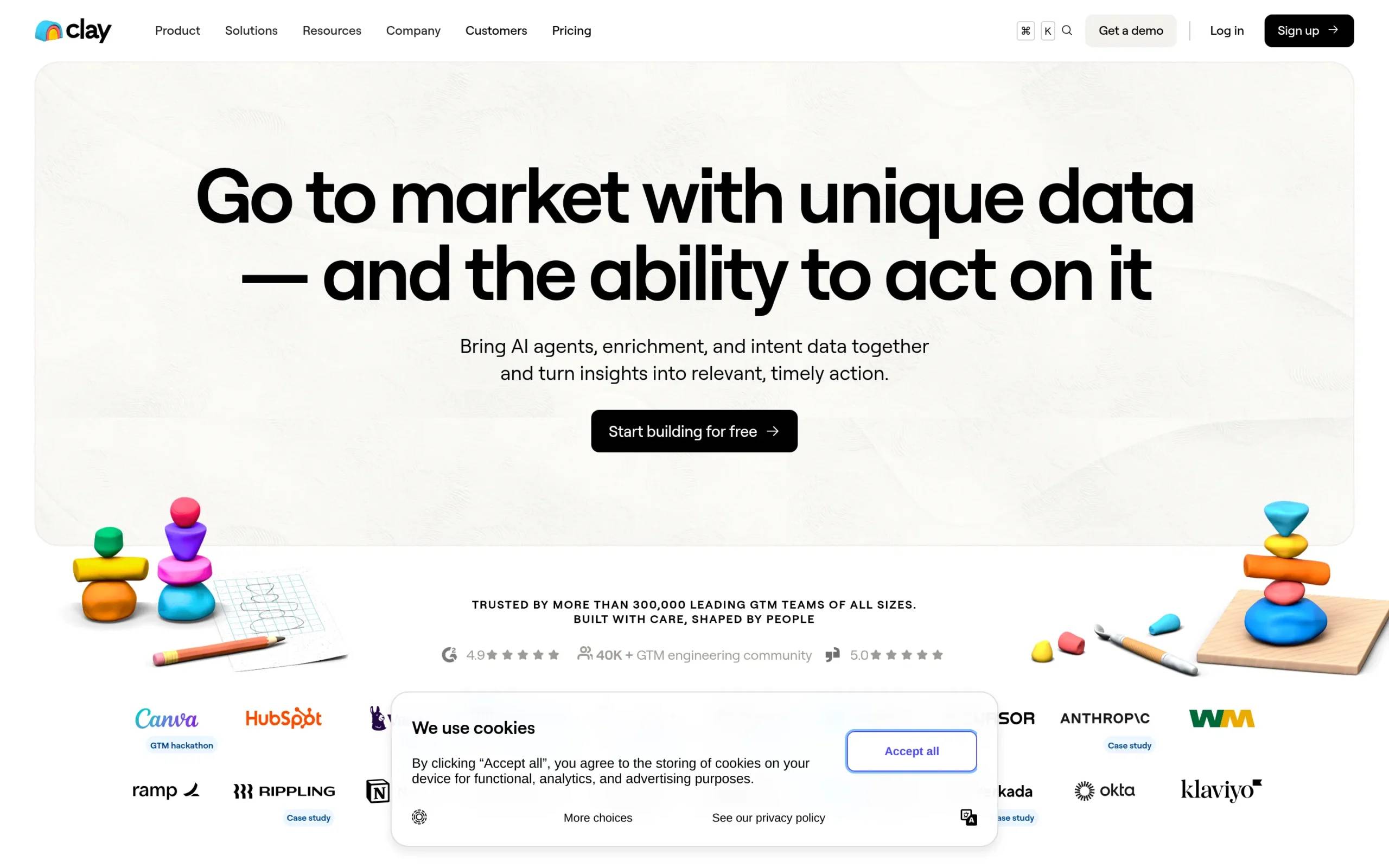
Clay is a data enrichment and GTM workflow automation platform that connects to over 75 data providers through its waterfall enrichment method. Rather than maintaining its own database, Clay pulls contact information from multiple sources sequentially until it finds a match. The platform includes AI-powered research tools like Claygent for company intelligence and Sculptor for building outreach workflows using natural language. Clay integrates with major sales tools and CRMs, making it popular among growth teams who want flexibility in their data sourcing and automation setup.
Starting price: $134/month (billed annually)
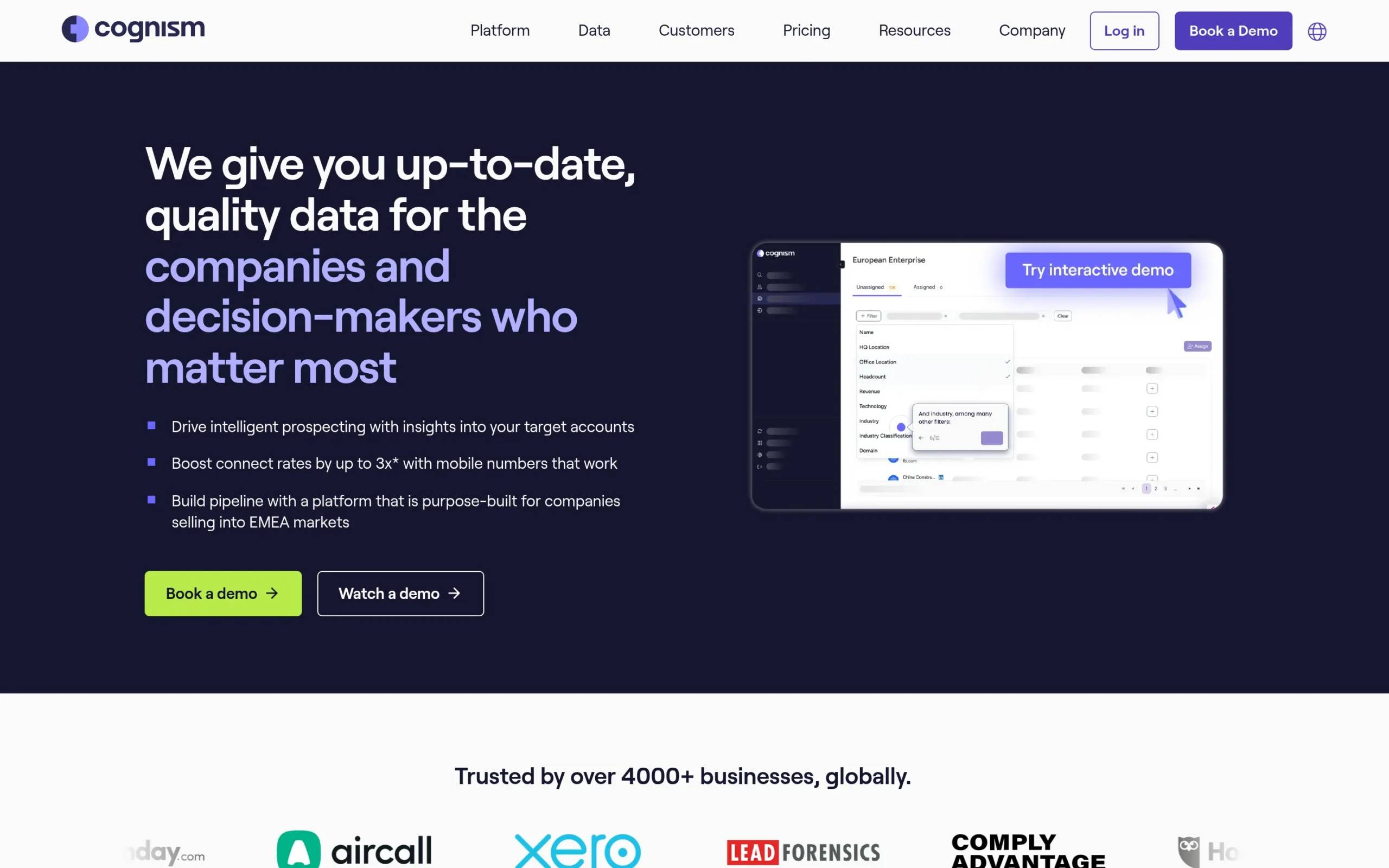
Cognism provides verified B2B contact data with a focus on phone-verified mobile numbers and email addresses. The platform maintains its own proprietary database, supplemented by third-party sources and manual research teams. Cognism’s Diamond Data feature offers phone-verified mobile numbers, specifically targeting decision-makers in EMEA and NAM markets. The tool includes intent data through Bombora integration, an on-demand verification service, and native CRM integrations. Cognism positions itself as a premium data provider prioritizing accuracy over volume.
Starting price: Custom pricing (contact sales)
Clay vs. Cognism – head-to-head comparison
Let’s examine how these platforms compare across the most important factors for B2B sales teams.
Features & capabilities
Clay’s core strength lies in its waterfall enrichment approach and workflow automation. The platform connects to over 75 data providers including Apollo, Hunter, Clearbit, and others, searching each source sequentially until it finds the contact information you need. Key features include:
- Claygent: AI research agent that surfaces company insights and contact details
- Waterfall enrichment: Aggregates data from multiple providers to maximize coverage
- GTM workflow builder: Create automated sequences using natural language
- CRM enrichment: Automatically update and clean existing CRM records
- Intent data: Access buying signals through third-party provider integrations
Clay functions as both a data enrichment tool and a workflow automation platform, letting teams build custom prospecting processes without extensive technical knowledge.
Cognism takes a different approach, focusing on proprietary data quality rather than aggregation. The platform’s features include:
- Diamond Data: Phone-verified mobile numbers with 87% connect rates
- Sales Companion: Browser extension that works across LinkedIn, Salesforce, and company websites
- Signal data: Real-time insights on hiring trends, funding rounds, and technographic changes
- On-demand verification service: Request manual verification for specific contacts
- Unrestricted data access: Unlimited profile views and page-level exporting (subject to fair use policy)
Cognism emphasizes data accuracy and compliance, particularly for teams targeting European markets where GDPR requirements are strict.
Winner: Tie. Clay wins on flexibility and automation capabilities, while Cognism excels at verified contact data quality and compliance.
Ease of use
Clay offers a spreadsheet-like interface that feels familiar to anyone who’s used Excel or Google Sheets. However, the learning curve can be steep. The platform’s flexibility means there are multiple ways to accomplish tasks, and new users often need time to understand how different data providers and enrichment waterfalls work together. Reviews mention that building effective workflows requires experimentation and sometimes trial-and-error with different data sources.
The platform includes templates to help teams get started, and once you understand the logic, the interface becomes powerful. The 5,000-connection limit when enriching from LinkedIn can be frustrating, and users report that integrations with CRMs could be more seamless.
Cognism receives consistently positive feedback for its user-friendly interface and straightforward usability. The Sales Companion browser extension integrates directly into existing workflows, letting reps access contact data without switching between tools. The platform requires minimal training, and most teams become productive within days rather than weeks.
The search functionality is intuitive, and the data export process is simple. Users praise the clean interface and responsive customer support team, which helps with onboarding and ongoing questions.
Winner: Cognism. While Clay offers more flexibility, Cognism’s focused approach and intuitive design make it easier for sales teams to adopt quickly.
Pricing & value
Clay uses a credit-based pricing model with five tiers:
- Free: $0/month, 1,200 credits annually (100/month), up to 100 searches
- Starter: $134/month (billed annually), 24,000 credits annually (2,000/month), up to 2,000 searches
- Explorer: $314/month (billed annually), 120,000 credits annually (10,000/month), up to 10,000 searches
- Pro: $720/month (billed annually), 600,000 credits annually (50,000/month), up to 25,000 searches
- Enterprise: Custom pricing with unlimited API rows and custom features
Credits get consumed with each enrichment action, and costs vary depending on which data provider is used. Some users report that credits deplete faster than expected, especially when enriching large lists. Email sequencing and CRM integrations are only available on higher-tier plans.
Clay offers a 14-day free trial for the Pro plan.
Cognism uses custom pricing based on your company’s needs and data volume. The platform offers two main packages:
- Grow: Essential contact and company data with Diamond Data access
- Elevate: Everything in Grow plus advanced intelligence, signal data, and 12 Bombora intent topics
Cognism includes unlimited profile views and page-level exporting across all plans (subject to fair use policy). All integrations come standard, unlike Clay where certain integrations require higher-tier plans. Cognism does not offer a free trial but provides data samples upon request.
Winner: It depends. Clay offers more transparent pricing tiers and a free option to test the platform. Cognism’s custom pricing lacks transparency but includes more features at every level without credit restrictions.
Integrations
Clay integrates with numerous data providers and sales tools, including:
- Data providers: Apollo, Hunter, Clearbit, Lusha, Snov.io, and 70+ others
- CRMs: Salesforce, HubSpot, MS Dynamics (higher-tier plans only)
- Sales engagement: Outreach, Salesloft
- Other: HTTP API webhooks for custom integrations
The platform’s strength is its extensive data provider integrations, but CRM and sales engagement tool integrations are limited to higher-priced plans.
Cognism includes integrations across all pricing packages:
- CRMs: Salesforce, HubSpot, MS Dynamics, Pipedrive
- Sales engagement: Salesloft, Outreach, Bullhorn
- Other: Zapier for custom workflows
All integrations come standard regardless of which package you choose, and the Sales Companion browser extension works seamlessly across LinkedIn, Sales Navigator, and major CRMs.
Winner: Cognism. While Clay connects to more data providers, Cognism includes all CRM and sales tool integrations at every pricing level.
Data quality & coverage
Clay doesn’t maintain its own database. Instead, it uses waterfall enrichment to search across multiple data providers sequentially. This approach can improve coverage since you’re pulling from dozens of sources, but data quality varies depending on which provider returns results first. The aggregation method also introduces compliance complexity since not all third-party providers follow the same data standards.
Coverage is broad across NAM, EMEA, and APAC markets, but accuracy depends entirely on the underlying data providers. Some users report inconsistent results, particularly for European contacts where GDPR requirements affect data availability.
Cognism maintains its own proprietary database built from public sources, third-party providers, manual research, and strategic partnerships. The platform’s Diamond Data feature includes phone-verified mobile numbers, which undergo manual verification to ensure accuracy. Cognism reports 87% connect rates using Diamond Data contacts.
The platform excels in EMEA coverage and offers strong mobile number data for NAM markets (2x more mobile coverage than competitors, according to Cognism). Customer case studies report 30-80% better data quality compared to alternatives. Machine learning processes check millions of data points daily, and research teams verify data continuously.
Winner: Cognism. Phone-verified data and proprietary research teams result in more consistent accuracy, particularly for mobile numbers and European contacts.
Clay vs. Cognism – pros and cons
Clay strengths & weaknesses
Pros
- Waterfall enrichment provides access to 75+ data providers in one platform
- Flexible workflow automation lets you build custom prospecting processes
- AI research tools help surface company intelligence and personalization data
- Spreadsheet-like interface feels familiar to most users
- Free tier available to test the platform
Cons
- Credit-based pricing can be difficult to predict and manage
- Steep learning curve for building effective workflows
- Data quality varies depending on which provider returns results
- CRM integrations only available on higher-tier plans
- Compliance complexity due to multiple data sources with different standards
User Rating: G2: 4.9/5 (based on 400+ reviews) Capterra: 3.8/5 (based on limited reviews)
Cognism strengths & weaknesses
Pros
- Phone-verified Diamond Data with 87% connect rates
- Strong EMEA coverage with GDPR-compliant data sourcing
- Consistent data quality due to proprietary database and manual verification
- User-friendly interface with minimal learning curve
- All integrations included at every pricing level
Cons
- Custom pricing lacks transparency and requires sales conversations
- No free trial available (data samples only)
- More expensive than some alternatives
- Limited flexibility compared to Clay’s multi-provider approach
- Long annual contract commitments
User Rating: G2: 4.5/5 (based on 1,200+ reviews) Capterra: 4.7/5 (based on reviews)
Which should you choose?
Your decision should be based on your specific needs, team structure, and target markets. Here are the key factors to consider:
Choose Clay if:
- You want flexibility to pull data from multiple sources and aren’t locked into one provider
- Your team needs workflow automation and GTM process building capabilities
- You’re comfortable with a learning curve and want to customize your data sourcing strategy
- You operate primarily in NAM markets where data availability is higher
- You need AI-powered research tools to surface company intelligence
Choose Cognism if:
- You need verified mobile numbers and high-quality contact data
- Your team targets EMEA markets where GDPR compliance is critical
- You want a straightforward, easy-to-use platform that requires minimal training
- You prioritize data accuracy over breadth of sources
- You need on-demand verification for specific high-value contacts
- Your sales process relies heavily on phone outreach
Consider both if:
- You have a larger revenue team with different needs (SDRs, AEs, RevOps)
- You want Clay’s workflow automation but need Cognism’s verified data quality
- You operate across multiple regions with varying data requirements
Need something different? Check out La Growth Machine
Clay and Cognism are solid choices if your primary need is finding accurate contact information. But once you have that data, the real work begins: actually reaching those prospects and starting conversations.
This is where La Growth Machine takes a different approach. Instead of focusing on data enrichment, our platform helps you execute multichannel sales campaigns that combine LinkedIn, email, calls, and Twitter from a single workflow.
What La Growth Machine does
La Growth Machine is a multichannel sales automation platform designed to help teams turn contact lists into conversations. While Clay and Cognism focus on the “who” and “what” (finding contacts and their information), we handle the “how” (engaging those contacts effectively across multiple channels).
Our platform automates your entire prospecting sequence: send LinkedIn connection requests, follow up via email if they don’t respond, add personalized voice messages to stand out, and track all conversations in a unified inbox. Teams using multichannel sequences see up to 3.5x more replies compared to email-only outreach.
Key capabilities:
- Multichannel sequences combining LinkedIn, email, calls, and Twitter
- Waterfall Email Enrichment using 10 providers with double validation
- LinkedIn Voice Messages that double reply rates
- Social Warming (automated likes and follows before outreach)
- Unified Inbox for managing all conversations in one place
- Native CRM sync with HubSpot, Pipedrive, and Breakcold
How it fits into your stack
Think of it this way: Clay or Cognism gives you the contact information. La Growth Machine helps you use it effectively.
You might use Cognism to build targeted lists of prospects with verified phone numbers and emails, or Clay to enrich your existing CRM data. Then you’d import those contacts into La Growth Machine to run automated campaigns that reach prospects across their preferred channels.
The tools serve different purposes in your sales stack. Data providers like Clay and Cognism excel at finding and verifying contact information. La Growth Machine focuses on engagement and conversation generation once you have that data.
Pricing
La Growth Machine offers straightforward plans starting at €50/month per identity:
- Pro plan: €100/month (includes advanced features)
- 14-day free trial
- No hidden fees or credit systems
Worth considering if
You already have (or plan to use) a data enrichment tool and need:
- A way to execute multichannel outreach campaigns at scale
- Automation that goes beyond just email to include LinkedIn, calls, and voice messages
- A unified system for managing conversations across channels
- Tools to improve reply rates through Social Warming and personalization
Clay vs. Cognism – FAQs
What’s the main difference between Clay and Cognism?
Clay aggregates data from 75+ third-party providers using waterfall enrichment, while Cognism maintains its own proprietary database with phone-verified contacts. Clay offers more flexibility and workflow automation, while Cognism prioritizes data accuracy and quality, especially for mobile numbers and EMEA markets.
Which has better data quality?
Cognism generally provides more consistent data quality due to its phone-verified Diamond Data and manual verification processes. Clay’s quality varies depending on which data provider returns results first, though its multi-provider approach can offer broader coverage.
Is Clay or Cognism better for European markets?
Cognism is the stronger choice for EMEA markets. The platform specializes in GDPR-compliant European data and has dedicated EU research teams. Cognism is widely recognized as the leading provider for European B2B contacts. Clay can access European data through its providers, but compliance and accuracy are less consistent.
Conclusion
Clay and Cognism serve different needs within the B2B data space. Clay offers flexibility, extensive provider integrations, and workflow automation that appeals to growth teams who want to customize their data sourcing strategy. Cognism provides verified, high-quality contact data with phone verification and strong compliance, making it ideal for sales teams that prioritize accuracy and connect rates over breadth.
Neither tool is objectively “better”—your choice depends on whether you value flexibility and automation (Clay) or verified data quality and ease of use (Cognism). Many teams find that the best approach involves using specialized tools for each stage of the sales process: data providers to find contacts, and engagement platforms like La Growth Machine to turn those contacts into conversations.
If your focus extends beyond finding contact information to actually executing multichannel campaigns and generating replies, exploring tools that complement your data provider can help you build a more complete sales stack.
Get 3.5X more leads!
Do you want to improve the efficiency of your sales department? With La Growth Machine you can generate on average 3.5x more leads while saving an incredible amount of time on all your processes.
By signing up today, you’ll get a free 14-day trial to test our tool!