

TL;DR
Apollo focuses on prospecting at $49/user monthly while Pipedrive specializes in pipeline management at $14/user.
– Apollo provides B2B database with sequences, intent signals, and call recording
– Pipedrive delivers visual pipeline management with deal tracking and automation workflows
– Apollo includes enrichment capabilities with 14-day trial plus free plan available
– Pipedrive offers 500+ app integrations with AI reports and email sync
– Choose Apollo for prospecting or Pipedrive for deal flow management
Choosing the right sales software can shape how your team works day to day. Apollo and Pipedrive both help sales teams close more deals, but they take different approaches. Apollo focuses on prospecting and outreach with a massive B2B database, while Pipedrive centers on visual pipeline management and deal tracking.
Apollo vs. Pipedrive: Side-by-side comparison table
| Feature | Apollo | Pipedrive | La Growth Machine |
|---|---|---|---|
| Starting price | $49/user/month (annual) | $14/user/month (annual) | €50/user/month (annual) |
| Free trial | 14 days + free plan available | 14 days | 14 days (no credit card required) |
| Key features | B2B database, sequences, intent signals, call recording, enrichment | Visual pipelines, deal tracking, automation, email sync, AI reports | LinkedIn + Email sequences, enrichment, warmup, AI voice |
| Integration options | CRM, email, sales engagement platforms, API | 500+ apps, CRM, email, accounting, marketing tools | Native: HubSpot, Salesforce, Pipedrive + API |
| Support options | Email, chat (Professional+), priority email (Organization) | Email, live chat (Growth+), extended phone support (Ultimate) | Email, chat, knowledge base, dedicated strategist (4+ seats) |
| Best for | Teams needing prospecting data and outreach automation | Teams wanting visual deal management and pipeline tracking | Scaling teams needing multichannel automation |
This guide breaks down what each tool does well, where they fall short, and which situations call for one over the other.
Apollo vs. Pipedrive: Quick overview
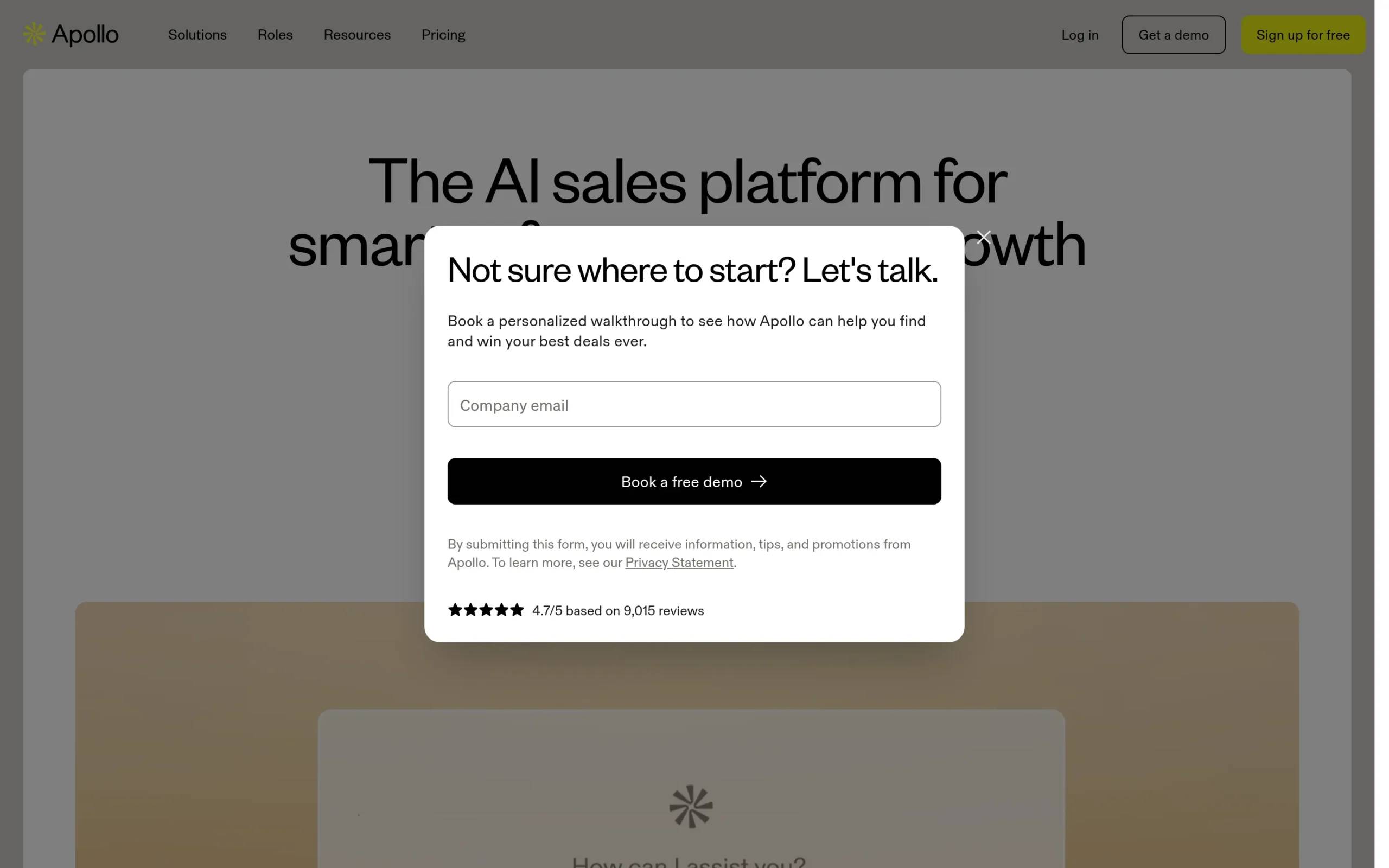
Apollo: Apollo.io is an all-in-one sales intelligence platform that combines prospecting, outreach, and data enrichment. It offers access to over 210 million contacts and 30 million companies, along with features like email sequencing, buying intent signals, call recording, and AI-powered research. Main selling point: comprehensive B2B database with integrated outreach tools. Starting price: Free plan available, paid plans start at $49/user/month (billed annually).
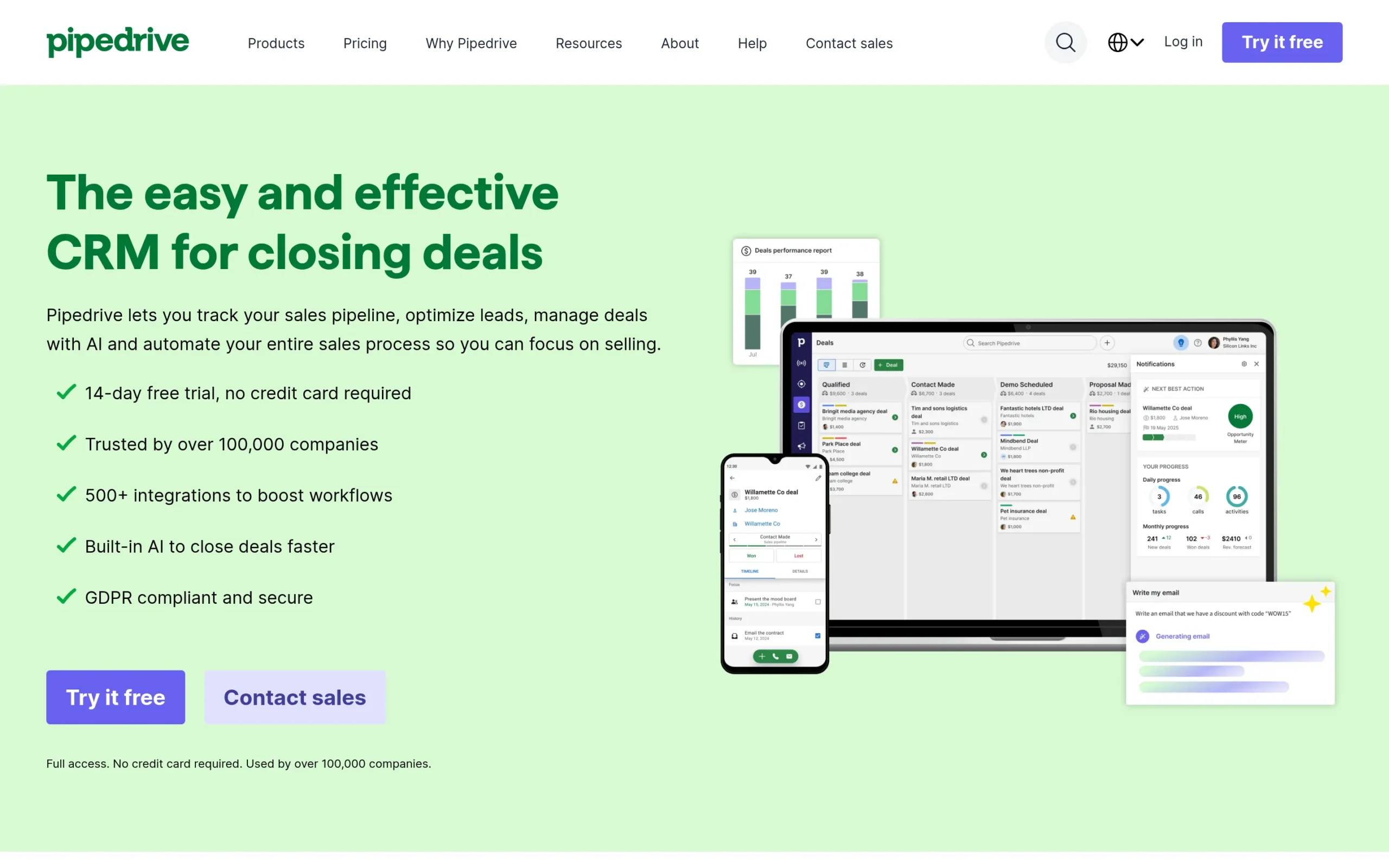
Pipedrive: Pipedrive is a visual CRM platform designed around activity-based selling. It provides customizable sales pipelines, deal tracking, email integration, automation workflows, and reporting tools to help teams manage their sales process from lead to close. Main selling point: intuitive visual pipeline management that’s easy to learn. Starting price: $14/user/month (billed annually).
Apollo vs. Pipedrive: Head-to-head comparison
Here’s how these two platforms stack up across the categories that matter most to sales teams.
Features & capabilities
Apollo: Apollo packs a wide range of sales intelligence features into one platform. The B2B database gives you verified email addresses and phone numbers for millions of contacts, with advanced filtering by job title, company size, industry, technographics, and buying intent. The sequencing engine automates multi-step email campaigns with A/Z testing and AI-assisted writing. You also get conversation intelligence with call recording and AI insights, workflow automations to scale what works, and enrichment capabilities to clean your CRM data. Intent signals help you identify prospects actively researching solutions like yours.
Pipedrive: Pipedrive makes deal management visual and straightforward. The core feature is customizable pipelines that let you drag deals through stages as they progress. Activity tracking keeps follow-ups from falling through the cracks, while automation handles repetitive tasks like deal rotation and data updates. Email sync brings conversations into your CRM timeline, and the mobile app keeps everything accessible on the go. AI features generate reports from text prompts, summarize email threads, and draft responses. Projects and Campaigns add-ons extend functionality for post-sale delivery and email marketing.
Winner: Tie. Apollo wins if you need prospecting data and outreach automation. Pipedrive wins if you need visual deal management and pipeline tracking. They solve different problems.
Ease of use
Apollo: Apollo offers a lot of power, which means a steeper learning curve. The interface is functional but can feel overwhelming at first with its many features and settings. Finding the right prospects requires understanding the search filters and syntax. Setting up sequences, connecting mailboxes, and configuring deliverability settings takes some technical knowledge. Once you’re over the initial hump, the platform becomes more intuitive. The Chrome extension simplifies prospecting from LinkedIn. Support includes tutorials and webinars to help with onboarding.
Pipedrive: Pipedrive is consistently praised for being easy to adopt. The visual pipeline design makes sense immediately, even for non-technical team members. Dragging deals between stages feels natural, and setting up basic workflows doesn’t require training. The interface is clean and uncluttered. New users can typically start managing deals within hours rather than days. The mobile app matches the desktop experience. Customization options are straightforward without being overwhelming.
Winner: Pipedrive. Its intuitive design and visual approach make it easier to learn and faster to adopt across teams of varying technical skills.
Pricing & value
Apollo: Apollo uses a credit-based pricing model. The Free plan includes 1,200 credits annually (granted monthly) plus basic features. Basic ($49/month per user, billed annually) includes 30,000 credits annually, unlimited sequences, CRM integrations, and advanced filters. Professional ($79/month per user) adds 48,000 credits, A/Z testing, unlimited mailboxes, call recordings, and analytics. Organization ($119/month per user, minimum 3 users) provides 72,000 credits, advanced security, custom reports, and international dialing. Credits are consumed when revealing emails (1 credit), phone numbers (8 credits), or enriching data (1-8 credits). Heavy users may need to purchase additional credits at $0.20 each, which can increase costs beyond the base subscription.
Pipedrive: Pipedrive offers straightforward per-user pricing with no credit system. Lite ($14/month per user, billed annually) covers lead and pipeline management, AI report creation, and 500+ integrations. Growth ($39/month per user) adds email sync with tracking, automation, and forecasting. Premium ($59/month per user) includes lead generation, custom scoring, AI email tools, contracts, and e-signatures. Ultimate ($79/month per user) adds data enrichment, enhanced security, sandbox testing, and extended support. Add-ons like LeadBooster, Projects, Campaigns, Web Visitors, and Smart Docs are available starting at $6.67-$41 per month per company. Annual billing provides up to 42% savings compared to monthly.
Winner: Pipedrive for predictable budgeting. Apollo may offer more value if you need the database and outreach features, but the credit system makes costs less predictable for high-volume users.
Integrations
Apollo: Apollo integrates with major CRMs including Salesforce, HubSpot, Pipedrive, Zoho, MS Dynamics, and Bullhorn. It also connects with engagement platforms like Outreach and Salesloft, email providers beyond Gmail and Microsoft (on paid plans), and workflow automation through Zapier. API access allows custom integrations on higher-tier plans. The Chrome extension brings Apollo data into LinkedIn and other web pages. Email deliverability integrations with SendGrid and Mailgun help protect sender reputation.
Pipedrive: Pipedrive offers 500+ integrations through its marketplace covering video calls (Zoom, Teams), phone solutions, accounting and invoicing, marketing tools, lead generation, e-signatures, and more. Native integrations include Gmail, Microsoft, Google Calendar, and major business apps. Zapier integration connects to thousands of additional tools. The open API allows custom development. Add-ons like Campaigns, Projects, and LeadBooster extend functionality without leaving the platform.
Winner: Pipedrive. The marketplace offers broader integration options across more categories, making it easier to build a connected tech stack.
Reporting & analytics
Apollo: Apollo provides dashboards tracking sequence performance, email open and reply rates, call activity, and pipeline metrics. You can analyze which messages perform best, identify top-performing sequences, and track team activity. Call recordings with AI insights highlight key moments and action items. Custom reports and dashboards are available on Organization plans. Analytics focus heavily on outreach effectiveness and data accuracy metrics.
Pipedrive: Pipedrive emphasizes sales performance visibility with pre-built and customizable reports. AI can generate reports from text prompts (“show me deals stuck in negotiation longer than 30 days”). Track conversion rates at each pipeline stage, forecast revenue, monitor individual and team performance, and identify bottlenecks. Dashboards visualize key metrics at a glance. Advanced customization and calculated fields are available on Premium and Ultimate plans.
Winner: Tie. Apollo provides better outreach analytics, while Pipedrive offers more robust sales pipeline reporting. Your winner depends on which metrics matter most to your team.
Apollo vs. Pipedrive: Pros and cons
Apollo strengths & weaknesses
Pros
- Massive B2B database with 210M+ contacts and verified email/phone data
- All-in-one platform combining prospecting, outreach, and enrichment
- Buying intent signals help identify prospects actively researching solutions
- Automated sequences with AI writing assistance save time on outreach
- Call recording and conversation intelligence improve rep performance
Cons
- Credit system makes costs unpredictable for high-volume prospecting
- Steeper learning curve due to feature complexity
- Data accuracy varies, with some users reporting outdated information
- Customer support quality receives mixed reviews, especially on lower-tier plans
User rating:
- G2: 4.7/5 (based on 9,015 reviews)
- Capterra: 4.5/5 (based on 381 reviews)
Pipedrive strengths & weaknesses
Pros
- Extremely intuitive visual pipeline that teams adopt quickly
- Clean, uncluttered interface focused on core sales activities
- Predictable per-user pricing with no credit limits
- Strong automation capabilities even on mid-tier plans
- Excellent mobile app that mirrors desktop functionality
Cons
- Limited native marketing automation requires add-ons or integrations
- Reporting features are basic on lower-tier plans
- Essential features like email tracking only available on Growth plan and above
- Can feel restrictive for complex enterprise sales processes
User rating:
- G2: 4.2/5 (based on 3,700+ reviews)
- Capterra: 4.5/5 (based on 3,040 reviews)
Which should you choose?
Here are specific scenarios to help guide your decision:
Choose Apollo if you:
- Need access to a large B2B contact database for prospecting
- Want prospecting, outreach, and enrichment in one platform
- Require buying intent signals to prioritize warm leads
- Need to clean and enrich existing CRM data
- Run high-volume email sequences with advanced automation
Choose Pipedrive if you:
- Already have lead sources and need to manage the sales process
- Want a simple, visual way to track deals through your pipeline
- Need a CRM that non-technical team members can adopt quickly
- Prefer predictable per-user pricing without credit limitations
- Focus more on deal management than prospecting
Consider both if you:
- Need comprehensive prospecting capabilities plus visual deal tracking
- Have budget for multiple specialized tools
- Want Apollo for top-of-funnel and Pipedrive for deal management (they integrate together)
Need something different? Check out La Growth Machine
Apollo and Pipedrive are solid choices for sales intelligence and CRM respectively. If you’re looking for a different function, La Growth Machine takes a different approach.
What La Growth Machine does
La Growth Machine is a multichannel sales automation platform built for teams that want to reach prospects across multiple channels with personalized outreach. Where Apollo focuses on data and Pipedrive focuses on deal management, our platform automates conversations across LinkedIn, email, Twitter/X, calls, and voice messages from unified sequences.
Our platform helps sales and growth teams automate prospecting without losing the human touch. You can create sequences that combine LinkedIn connection requests, messages, profile visits, emails, and call reminders in one flow. LinkedIn Voice Messages with AI voice cloning let you send personalized voice notes at scale, doubling response rates compared to text-only outreach. Lead Enrichment finds and verifies professional emails using 9 providers with double validation. The Multichannel Inbox consolidates all conversations (LinkedIn, email, calls) into single threads per lead.
How it fits into your stack
If you’re using Apollo for contact data and need a way to reach those prospects across multiple channels, La Growth Machine picks up where data providers leave off. Export your lists from Apollo and import them into La Growth Machine to run multichannel sequences. Or use Pipedrive to manage your deals while running prospecting campaigns through La Growth Machine. The tools serve different parts of your sales process.
Apollo gives you the contact data, Pipedrive manages your deals, and La Growth Machine automates personalized outreach across the channels where your prospects actually engage. The platforms integrate through native connections and Zapier.
Pricing
- Basic Plan: €50/month per identity (includes 250 enriched leads, multichannel campaigns, unlimited lead imports)
- Pro Plan: €100/month per identity (includes 400 enriched leads, Lookalike Search, LinkedIn Intent Data, Inbox Rotation, advanced integrations)
- Ultimate Plan: €150/month per identity (includes 1,000 enriched leads, CRM integrations, Twitter outreach, unlimited campaigns)
All plans include a 14-day free trial with no credit card required.
Worth considering if
- You need multichannel outreach automation across LinkedIn, email, and Twitter
- You want to personalize messages at scale without sounding robotic
- Your prospects don’t respond well to single-channel approaches
- You need a platform that combines outreach automation with lead enrichment
Apollo vs. Pipedrive: FAQs
Can Apollo and Pipedrive work together?
Yes, they integrate. Apollo enriches contact data and handles prospecting, while Pipedrive manages deals. Many teams use both, with Apollo feeding leads into Pipedrive for deal management.
Which tool is better for small teams?
Pipedrive is generally easier for small teams to adopt due to its intuitive design and lower starting price. Apollo makes more sense if prospecting and finding new contacts is your primary challenge.
Do these tools replace each other?
Not really. Apollo is primarily a sales intelligence and prospecting platform, while Pipedrive is a CRM focused on deal management. They solve different problems and many companies use both.
Conclusion
Apollo and Pipedrive both improve sales productivity, but they tackle different parts of the process. Apollo excels at prospecting with its massive contact database and automated outreach capabilities. Pipedrive shines at visual deal management with intuitive pipelines that teams actually enjoy using. Your choice depends on whether finding prospects or managing deals is your bigger challenge.
If you’re looking for a different type of solution focused on multichannel outreach automation, La Growth Machine offers an alternative approach. Our platform automates conversations across LinkedIn, email, Twitter, calls, and voice messages to help you reach prospects where they’re most active. With features like AI voice cloning for LinkedIn messages, waterfall email enrichment, and a unified multichannel inbox, we help teams book more meetings without the manual grunt work.
Get 3.5X more leads!
Do you want to improve the efficiency of your sales department? With La Growth Machine you can generate on average 3.5x more leads while saving an incredible amount of time on all your processes.
By signing up today, you’ll get a free 14-day trial to test our tool!