

TL;DR
Apollo provides 275M+ contacts starting free while Salesloft costs ~$125-150/user monthly for engagement.
– Apollo includes unlimited email sequences with built-in database and prospecting tools
– Salesloft delivers advanced cadence automation with native conversation intelligence built-in
– Apollo offers 14-day trial with basic dialer and 4,000-8,000 conversation minutes
– Salesloft requires demo with power dialer and call recording included
– Apollo suits prospecting focus while Salesloft targets mid-market and enterprise sales
Apollo vs. Salesloft: Which Sales Engagement Platform to Choose?
If you’re comparing Apollo and Salesloft, you’re deciding between a data-rich prospecting platform and an enterprise-grade sales engagement tool. Both have strong positions in the sales tech stack, but they serve different functions and work best for different teams.
Apollo vs Salesloft: Side-by-side comparison table
| Feature | Apollo | Salesloft | La Growth Machine |
|---|---|---|---|
| Starting price | Free (paid from $49/month) | ~$125-150/user/month | €50/user/month (annual) |
| Free trial | 14 days (paid plans) | 14 days (demo required) | 14 days (no credit card required) |
| Contact database | 275M+ contacts built-in | No (requires integration) | Native enrichment (27M+ companies) |
| Email sequences | Unlimited on paid plans | Yes, advanced cadence automation | Yes, native |
| Conversation intelligence | Basic (4,000-8,000 mins included) | Advanced (native feature) | No |
| Built-in dialer | Yes (local presence, recording) | Yes (power dialer, recording) | No (LinkedIn + Email focus) |
| CRM integration | API-based (Salesforce, HubSpot, Pipedrive) | Native Salesforce, API others | Native: HubSpot, Salesforce, Pipedrive |
| LinkedIn automation | Yes | Limited (requires Sales Navigator) | Yes, native |
| AI features | Lead scoring, research, email writing | Deal prioritization, next actions | Yes |
| Best for | SMBs, startups, all-in-one prospecting | Mid-market to enterprise sales teams | Scaling teams needing multichannel automation |
This article breaks down the key differences between Apollo and Salesloft—features, pricing, usability, and value—so you can make an informed decision.
Apollo vs. Salesloft: Quick overview
Apollo
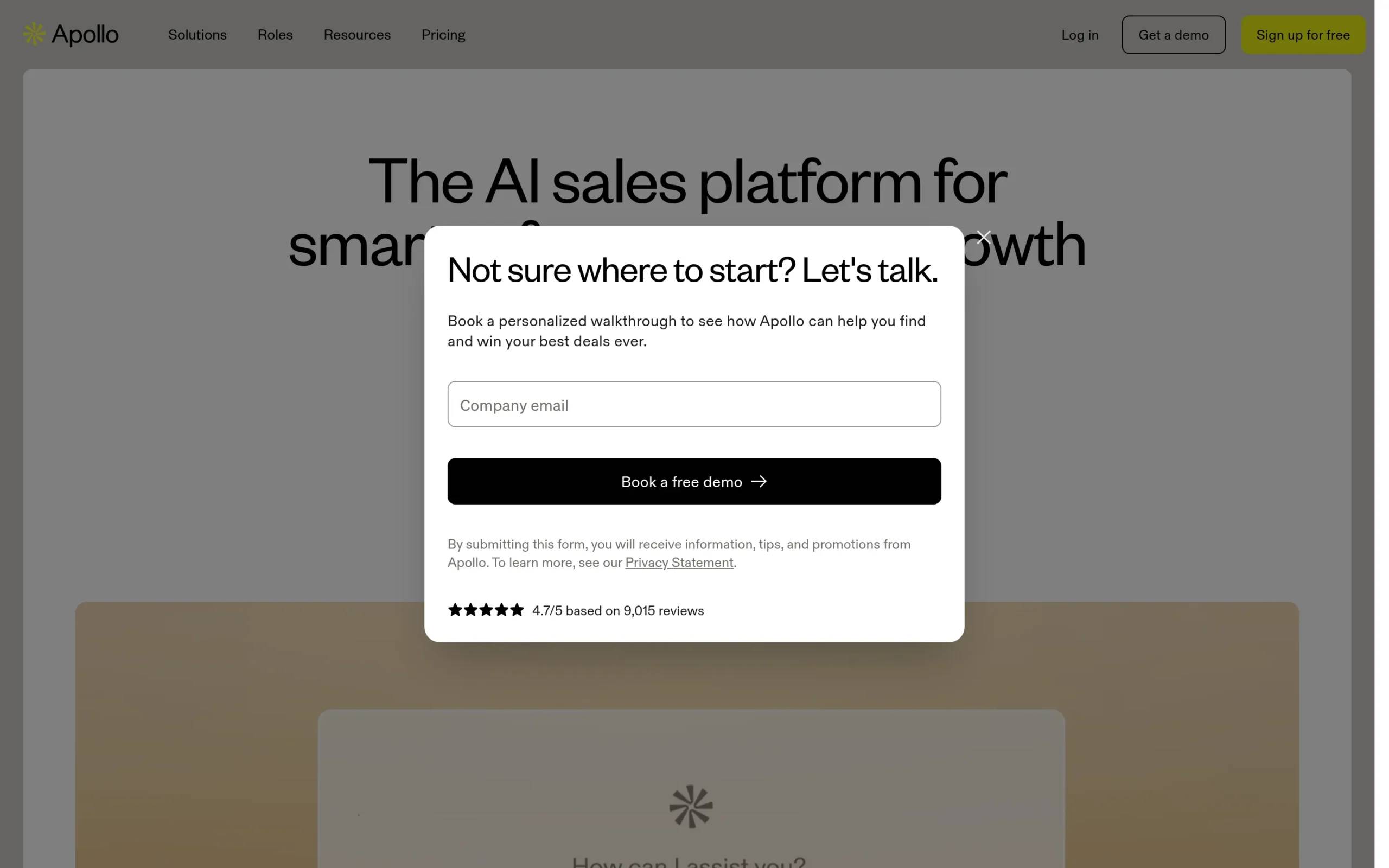
Apollo is a sales intelligence and engagement platform that combines a B2B database with outreach automation tools. The platform gives you access to over 275 million contacts and 73 million companies, making it useful for teams that need both prospecting data and engagement tools in one place. Apollo helps you identify leads, enrich contact information, and run campaigns across email, phone, and LinkedIn.
Starting price: Free plan available, paid plans from $49/user/month
Salesloft
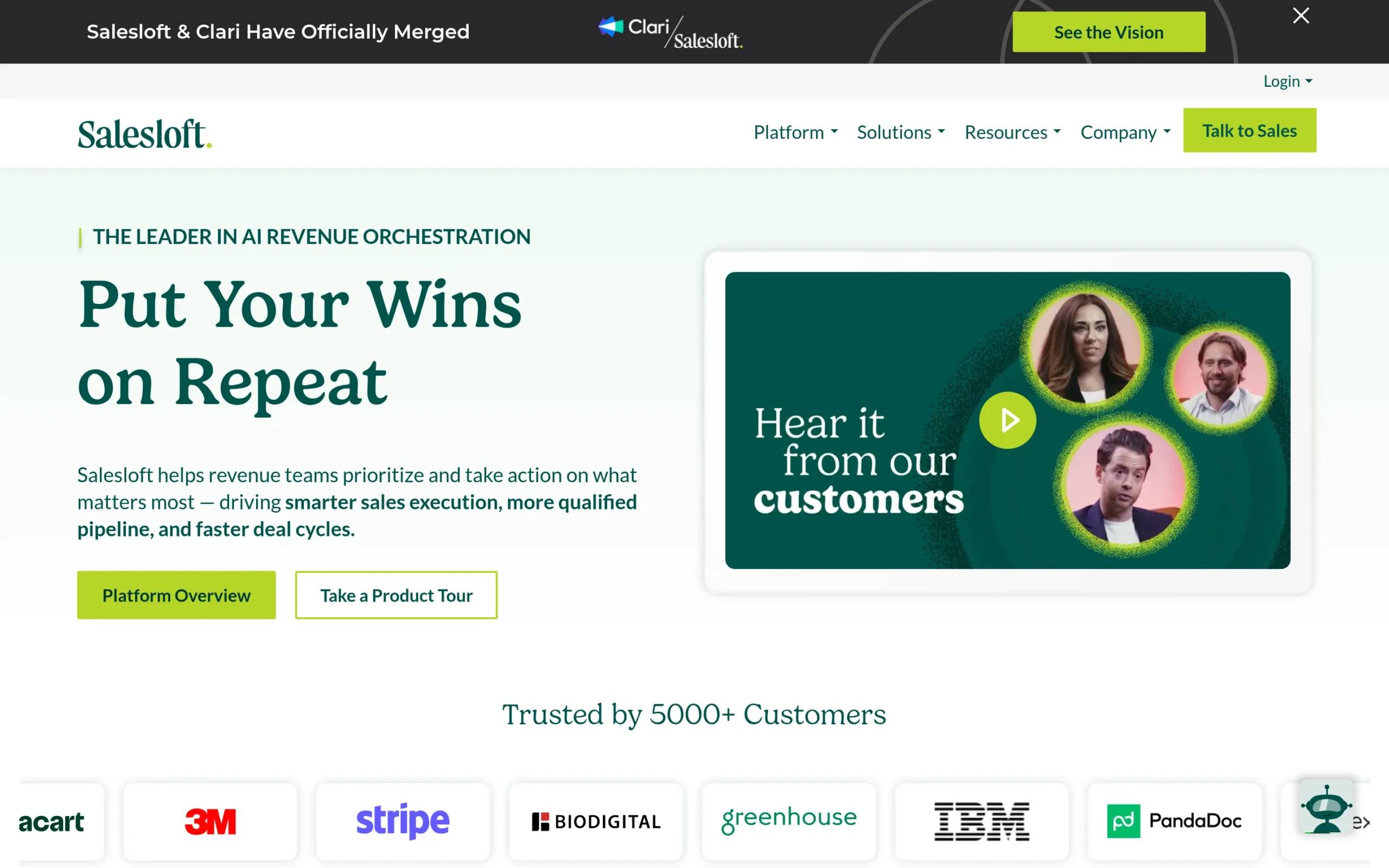
Salesloft is a Revenue Orchestration Platform built for mid-market and enterprise sales teams. It unifies sales engagement, conversation intelligence, deal management, and forecasting into one system. Rather than providing its own contact database, Salesloft helps teams coordinate activities across the entire revenue cycle, with strong emphasis on cadence automation, call coaching, and pipeline visibility. It integrates deeply with existing CRM systems, particularly Salesforce.
Starting price: Pricing not publicly available, typically starts around $125+/user/month for mid-market teams
Apollo vs. Salesloft: Head-to-head comparison
Let’s break down how these two platforms compare across the categories that matter most to sales teams.
Features & capabilities
Apollo:
Apollo’s standout strength is its integrated B2B database with 275+ million contacts and 73 million companies. The platform offers advanced search filters to identify decision-makers based on industry, company size, geography, job title, and more. Beyond data, Apollo provides AI-powered email sequencing, built-in calling with local presence dialing, LinkedIn automation, and workflow automation. The platform also includes deal management features, meeting scheduling, and analytics to track campaign performance. Apollo’s AI assistant helps with lead scoring, research, and message personalization.
Salesloft:
Salesloft excels at sales engagement orchestration and coaching. Its Cadence feature automates multi-touch sequences across email, calls, LinkedIn, and other channels with sophisticated workflows and conditional logic. The platform’s Conversations tool (conversation intelligence) records, transcribes, and analyzes sales calls to provide coaching insights and track deal intelligence. Salesloft also offers Deals for pipeline management, Forecast for revenue prediction, and Rhythm which uses AI to prioritize high-value actions based on buyer signals. The platform emphasizes team coordination and manager visibility into sales activities.
Winner: Tie. Apollo wins if you need prospecting data and all-in-one functionality. Salesloft wins if you have existing data sources and need advanced engagement coordination, conversation intelligence, and revenue orchestration features.
Ease of use
Apollo:
Apollo offers an intuitive interface that makes it easy for new users to start prospecting and building campaigns. The search functionality is straightforward, and creating email sequences doesn’t require extensive training. The platform provides Chrome extensions for Gmail and LinkedIn that streamline prospecting workflows. However, there’s a learning curve when it comes to mastering Apollo’s more advanced features like workflow automation and AI research tools, especially given how feature-rich the platform has become.
Salesloft:
Salesloft’s interface is generally praised for being clean and user-friendly, particularly its cadence builder which uses drag-and-drop functionality. However, the platform’s comprehensive feature set means there’s a steeper learning curve—typically taking 2-3 weeks for reps to become proficient with advanced features. The upside is that once learned, the platform offers powerful automation and coordination capabilities. Salesloft also provides strong onboarding support and training resources to help teams get up to speed.
Winner: Apollo. While both platforms require some learning investment, Apollo is more intuitive for teams getting started, especially for basic prospecting and outreach tasks.
Pricing & value
Apollo:
Apollo offers transparent tiered pricing starting with a free plan that includes 1,200 credits per year. Paid plans include:
- Basic: $49/user/month (30,000 credits/year)
- Professional: $79/user/month (48,000 credits/year)
- Organization: $119/user/month (72,000 credits/year, 3-user minimum)
All paid plans include unlimited email sequences, AI features, CRM integrations, and the full contact database. Apollo offers a 14-day free trial for paid plans. The all-in-one nature of Apollo (data + engagement) provides strong value, especially for teams that would otherwise pay separately for a data provider and engagement platform.
Salesloft:
Salesloft does not publish pricing on its website. Based on market research and user reports, pricing typically starts around $125-150/user/month for mid-market teams, with enterprise pricing going higher. Salesloft offers two main tiers (Advanced and Elite) with features like conversation intelligence and forecasting reserved for higher tiers. The platform requires a demo to get specific pricing. While more expensive than Apollo, Salesloft’s pricing reflects its enterprise positioning and advanced features like native Salesforce integration and conversation intelligence.
Winner: Apollo. The transparent, more affordable pricing and all-in-one value make Apollo the better choice for budget-conscious teams and those under 25 reps. Salesloft’s premium pricing is easier to justify for larger teams that need enterprise-grade features.
Integrations
Apollo:
Apollo integrates with major CRMs including Salesforce, HubSpot, and Pipedrive, as well as sales engagement platforms like Outreach and SalesLoft. The platform also connects with Sendgrid, Mailgun, Zapier, and various other tools. While Apollo’s integrations are functional, they’re generally API-based rather than native, which can occasionally lead to sync issues or limitations in data flow.
Salesloft:
Salesloft is known for its industry-leading Salesforce integration, which is native and bidirectional with seamless sync. The platform also integrates with HubSpot, Microsoft Dynamics, and other CRMs, though Salesforce is clearly the priority. Beyond CRM, Salesloft connects with LinkedIn Sales Navigator, ZoomInfo, Cognism, video tools like Vidyard, and dozens of other sales tools through its marketplace. The quality and depth of Salesloft’s integrations are a major selling point for enterprise buyers.
Winner: Salesloft. The native Salesforce integration and overall integration quality make Salesloft the stronger choice for teams with complex tech stacks and Salesforce as their CRM.
Data quality & prospecting
Apollo:
With 275+ million contacts built into the platform, Apollo is fundamentally a prospecting-first tool. The database includes verified emails and phone numbers with data accuracy scoring. However, data quality is a common complaint, with users noting inconsistent accuracy and occasional outdated information. Apollo does offer waterfall enrichment (pulling from multiple data sources) and continuous data updates, but it’s not as reliable as dedicated data providers like ZoomInfo or Cognism.
Salesloft:
Salesloft does not include its own contact database. Instead, it’s designed to integrate with third-party data providers like ZoomInfo, Cognism, and others. This means you’ll need a separate subscription to a data provider, adding $5,000-15,000+ annually to your total cost. The advantage is you can choose best-in-class data sources and aren’t locked into Apollo’s database quality.
Winner: Apollo. If built-in prospecting data is important to your workflow, Apollo is the only option here. However, teams with existing data subscriptions may prefer Salesloft’s flexibility to integrate with their preferred providers.
Apollo vs Salesloft: Pros and cons
Apollo strengths & weaknesses
Pros
- All-in-one platform with B2B database (275M+ contacts)
- Affordable pricing with transparent tiers starting at $49/month
- Strong email sequencing and multichannel outreach
- AI-powered features for lead scoring, research, and personalization
- Built-in dialer with call recording and local presence
Cons
- Data accuracy can be inconsistent compared to premium providers
- Limited third-party integrations compared to enterprise platforms
- Conversation intelligence features are basic compared to specialized tools
- Platform can slow down during high-usage periods
- CRM functionality is basic compared to dedicated sales engagement platforms
User Rating:
- G2: 4.7/5 (based on 9,000+ reviews)
- Capterra: 4.5/5 (based on 381 reviews)
Salesloft strengths & weaknesses
Pros
- Best-in-class cadence automation with sophisticated conditional logic
- Conversation intelligence provides coaching insights and call analytics
- Native Salesforce integration with seamless bidirectional sync
- Strong revenue orchestration and forecasting
- Purpose-built for enterprise with advanced security and governance
Cons
- No built-in contact database (requires separate data provider subscription)
- Pricing is significantly higher than competitors ($125-150+/user/month)
- Steeper learning curve due to comprehensive feature set
- Some users report occasional platform glitches and performance issues
- Not ideal for small teams or startups due to cost and complexity
User Rating:
- G2: 4.5/5 (based on 3,891 reviews)
- Capterra: 4.3/5 (based on 229 reviews)
Which should you choose?
Here are specific scenarios and use cases to help you decide:
Choose Apollo if:
- You need both prospecting data and engagement tools in one platform
- Your team is under 25 reps or has a limited budget
- You want transparent, affordable pricing starting at $49/month
- You’re building your sales process from scratch and need an all-in-one solution
- You value having contact data, email, calling, and LinkedIn in one place
Choose Salesloft if:
- You’re a mid-market or enterprise team (25+ reps) with Salesforce as your CRM
- You already have a data provider (ZoomInfo, Cognism) and need advanced engagement
- Conversation intelligence and coaching are critical to your sales process
- You need sophisticated revenue orchestration and forecasting
- Your budget allows for $125-150+/user/month and you can justify the ROI
Consider both if:
You’re a larger team with complex needs that might benefit from Apollo’s data for prospecting and Salesloft for advanced engagement (some teams use both)
Need something different? Check out La Growth Machine
Apollo and Salesloft are both strong choices for their specific use cases—all-in-one prospecting with built-in data (Apollo) or enterprise sales engagement with advanced orchestration (Salesloft).
But if you’re looking for a different approach to outbound sales, La Growth Machine offers multichannel sales automation with a focus on personalization and efficiency.
What La Growth Machine does:
La Growth Machine is a multichannel prospecting platform that automates outreach across LinkedIn, email, phone, and Twitter. Unlike Apollo (which focuses on data + engagement) or Salesloft (which focuses on enterprise orchestration), La Growth Machine specializes in creating personalized, multichannel sequences that get up to 3.5x more replies than email-only outreach.
Key differentiators include:
- Multichannel sequences: Combine LinkedIn messages, voice notes, emails, and calls in automated workflows that feel personal.
- Lead enrichment: Automatically find and verify email addresses using 9 different providers with double validation.
- LinkedIn intent data: Import prospects who liked your posts, commented on competitor content, or signed up for LinkedIn events.
- Lookalike Search: Upload your best customer, and La Growth Machine finds similar companies and contacts using its built-in ABM solution.
- Social Warming: Automatically like posts and follow prospects before reaching out to warm up interactions.
- Voice messages: Send automated LinkedIn voice messages (or even clone your voice) to double reply rates.
- Unified inbox: Manage all conversations from LinkedIn, email, and other channels in one thread with team collaboration features.
La Growth Machine is particularly valuable if you’re focused on relationship-building through relevant, multi-touch sequences rather than high-volume email blasts. The platform helps you work smarter by reaching prospects where they’re most active and receptive.
Pricing:
- Basic Plan: €50/month per identity
- Pro Plan: €100/month (includes Lookalike Search, LinkedIn Intent Data, Social Warming, Inbox Rotation)
- Ultimate Plan: €150/month (advanced CRM integrations, webhooks, custom sequences)
All plans include a 14-day free trial with no credit card required
Worth considering if:
- You want to reach prospects across multiple channels (LinkedIn, email, phone, Twitter) in coordinated sequences
- Personalization and relationship-building are more important than mass outreach volume
- You need strong LinkedIn automation and intent data for timing your outreach
- You’re looking for an alternative that combines prospecting automation with multichannel engagement at a transparent price point
Apollo vs. Salesloft: FAQs
Can Apollo replace Salesloft?
Apollo can replace Salesloft for teams that need basic sales engagement and value having prospecting data built-in. However, Apollo lacks Salesloft’s advanced features like native Salesforce integration, sophisticated conversation intelligence, and enterprise-grade revenue orchestration. Teams with complex sales processes and larger budgets typically find Salesloft’s features worth the premium.
Is Salesloft worth the higher price compared to Apollo?
For mid-market and enterprise teams (25+ reps) with Salesforce as their CRM, yes. Salesloft’s native integration, conversation intelligence, and revenue orchestration features typically generate enough efficiency gains and pipeline improvement to justify the $75-100/user/month premium. For smaller teams or those without Salesforce, Apollo offers better value.
Do I need a separate data provider with Salesloft?
Yes. Unlike Apollo, Salesloft doesn’t include a contact database. You’ll need to subscribe to a third-party data provider like ZoomInfo, Cognism, or Apollo (ironically) to get contact information. This adds $5,000-15,000+ annually to your total cost but allows you to choose best-in-class data sources.
Conclusion
Apollo and Salesloft serve different needs in the sales engagement landscape. Apollo is the all-in-one choice for teams that want prospecting data, engagement tools, and affordability in one package. It’s particularly well-suited for SMBs, startups, and teams under 25 reps who need to build their entire sales stack from scratch.
Salesloft is the enterprise powerhouse for teams that already have data sources and need sophisticated engagement orchestration, conversation intelligence, and revenue management. Its premium pricing is justified by advanced features and native Salesforce integration that drive efficiency at scale.
Both tools have earned their strong reputations and user ratings. The right choice depends on your team size, budget, existing tech stack, and whether you prioritize built-in data (Apollo) or advanced engagement features (Salesloft).
If neither quite fits your needs, consider exploring La Growth Machine for a multichannel approach that emphasizes personalization and relationship-building across LinkedIn, email, and other channels.
Get 3.5X more leads!
Do you want to improve the efficiency of your sales department? With La Growth Machine you can generate on average 3.5x more leads while saving an incredible amount of time on all your processes.
By signing up today, you’ll get a free 14-day trial to test our tool!