

Finding qualified B2B leads remains the number one challenge for 85% of marketers, according to Forbes. While marketing automation and AI tools have evolved dramatically, the core problem persists: how do you consistently generate leads that actually convert into customers?
The issue isn’t volume. Most companies can blast thousands of cold emails or scrape LinkedIn profiles. The real challenge is quality and timing. A B2B lead is only valuable if they match your ideal customer profile, have a genuine need for your solution, and are ready to engage in a buying conversation.
This is where understanding the difference between Marketing Qualified Leads (MQLs) and Sales Qualified Leads (SQLs) becomes critical. An MQL has shown interest through content downloads or website visits. An SQL has been vetted by sales, meets your qualification criteria (budget, authority, need, timeline), and is ready for direct outreach.
This guide breaks down 14 actionable B2B lead generation strategies you can implement today. We’ll cover everything from modern cold outreach tactics to inbound content engines, with real cost benchmarks, response rate data, and implementation timelines. No theory, just methods that work in 2026.
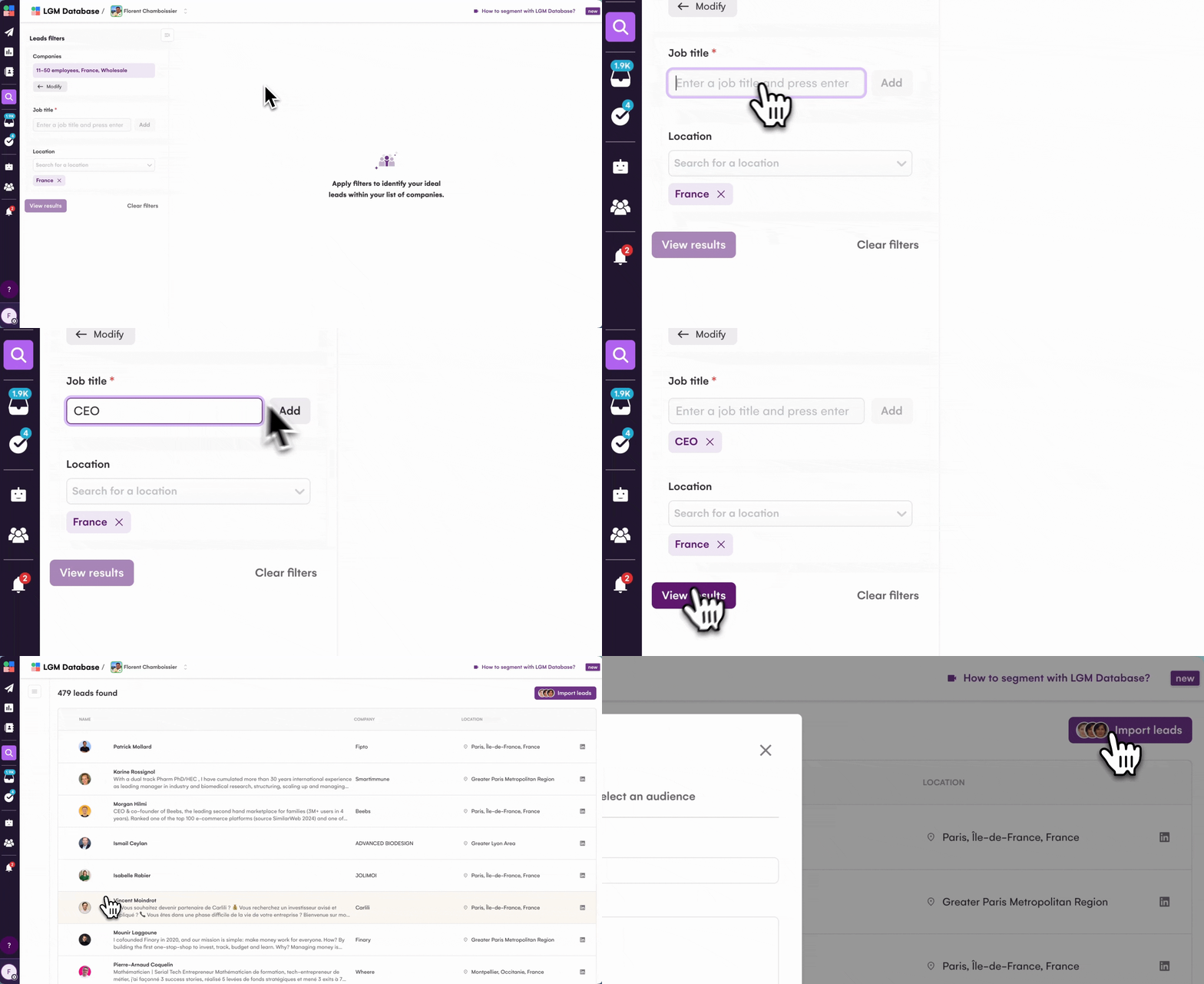
2. Cold Email Outreach with AI Personalization
Why: Cold email still delivers an average 17% response rate when properly personalized, according to Woodpecker. The cost per lead ranges from $5-15, making it one of the most scalable B2B channels.
How:
- Build targeted lists: Use tools like Hunter.io or Apollo to find verified email addresses of decision-makers
- Research triggers: Identify companies with hiring sprees, funding rounds, or technology changes
- Write value-first copy: Lead with their problem, not your solution. Keep emails under 125 words
- A/B test subject lines: Test curiosity vs value-driven subjects (avg 5-8% open rate difference)
- Follow up 3-5 times: 80% of sales require 5+ touchpoints, but 44% of reps give up after one email
Pro Tip: Send emails Tuesday-Thursday between 10-11 AM for 23% higher open rates. Avoid Mondays (inbox overload) and Fridays (weekend mode).
Mistakes to Avoid: Generic “I hope this email finds you well” openers, pitching in the first email, and sending attachments (spam filter trigger).
Tools: LaGrowthMachine (multi-channel)
3. Multi-Channel Sequences: LinkedIn + Email + Phone
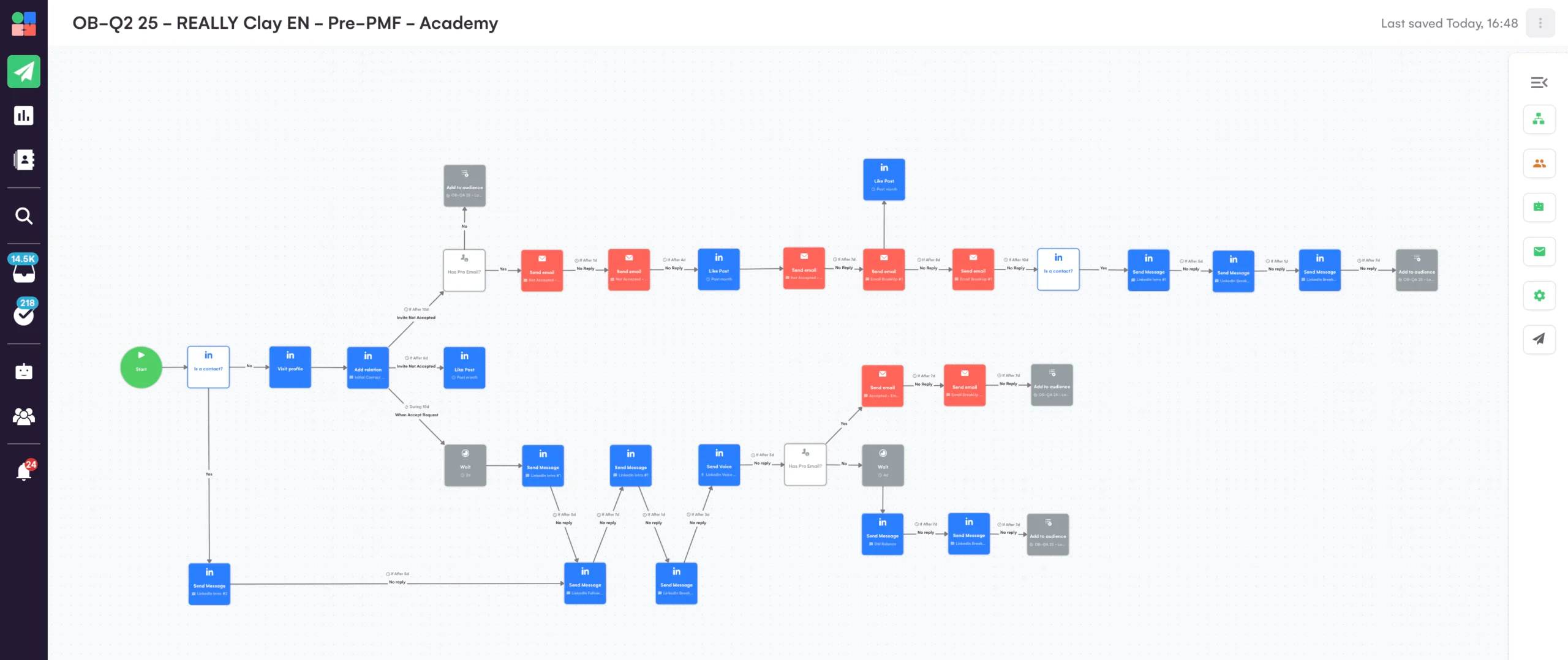
What: Coordinated outreach campaigns that combine LinkedIn connection requests, InMail, email, and phone calls in a strategic sequence over 10-14 days, rather than relying on a single channel.
Why: Multi-touch campaigns improve conversion rates by 3.5x compared to single-channel outreach. Prospects need an average of 8 touchpoints before responding, and different people prefer different channels.
How:
- Day 1: Send LinkedIn connection request with personalized note (mention mutual connection or shared interest)
- Day 3: Once connected, engage with their recent post (thoughtful comment, not generic “Great post!”)
- Day 5: Send first email referencing LinkedIn interaction (“Loved your take on [topic]…”)
- Day 7: LinkedIn InMail with specific value proposition
- Day 10: Follow-up email with case study or social proof
- Day 14: Phone call or video message as final touchpoint
Pro Tip: Track which channel gets the first response. If someone always replies via LinkedIn but ignores emails, adjust your sequence to emphasize their preferred channel.
Tools: LaGrowthMachine (native multi-channel automation), Outreach.io alternatives
4. SEO-Driven Content Marketing
What: Creating blog posts, guides, and resources optimized for search engines that answer questions your ideal customers are actively searching for, driving organic traffic that converts into leads.
Why: Companies with blogs produce 67% more leads per month than those without, according to DemandMetric. SEO delivers an ROI up to 1000% once content ranks, with a cost per lead as low as $10-20.
How:
- Keyword research: Use Ahrefs or SEMrush to find high-intent keywords (e.g., “best CRM for manufacturing” vs generic “CRM software“)
- Content gap analysis: Identify topics your competitors rank for but you don’t
- Create pillar content: Write comprehensive guides (1500-2500 words) that become go-to resources
- Add lead magnets: Gate downloadable templates, checklists, or calculators within content
- Build backlinks: Guest post on industry publications to boost domain authority
Pro Tip: Target bottom-of-funnel keywords with buyer intent like “alternatives,” “pricing,” “vs,” and “reviews.” These drive leads ready to purchase, not just research.
Mistakes to Avoid: Writing for search bots instead of humans, ignoring search intent, and publishing without proper internal linking structure.
ROI Timeline: 6-12 months for ranking, but compounds over time with minimal ongoing cost.
5. Lead Magnets: eBooks, Templates, and Calculators
What: High-value resources offered in exchange for contact information, designed to solve a specific problem your target audience faces.
Why: Lead magnets can achieve 25-50% conversion rates on landing pages when properly targeted. They position your company as a thought leader while building your email database.
How:
- Identify pain points: Survey customers or analyze support tickets for common challenges
- Create quick-win resources: Focus on templates and checklists over lengthy eBooks (higher perceived value-to-effort ratio)
- Build dedicated landing pages: Single-focus pages with benefit-driven copy and minimal form fields (name + email only)
- Promote across channels: LinkedIn organic posts, paid ads, email signature, website popups
- Nurture with email sequences: Follow up with 5-7 emails that provide additional value before pitching
Pro Tip: Create “calculator” lead magnets (ROI calculators, savings estimators) that are interactive. They convert at 40-60% vs 20-25% for static PDFs.
Examples: Cold email template library, LinkedIn outreach script generator, sales pipeline calculator
6. Webinars and Live Workshops
What: Live or pre-recorded educational sessions that demonstrate your expertise, usually featuring a presentation, Q&A, and soft product demonstration.
Why: 73% of B2B marketers say webinars are their most effective lead generation tactic, according to Hubilo. Average attendance rates are 40-50% of registrants, with attendees being 5x more qualified than typical leads.
How:
- Choose educational topics: Focus on “How to [solve problem]” not “Why [your product] is great”
- Partner with influencers: Co-host with industry experts or complementary vendors to expand reach
- Promote 2-3 weeks ahead: Multi-channel promotion across LinkedIn, email, and communities
- Record and repurpose: Turn webinars into blog posts, YouTube videos, and social clips
- Follow up within 24 hours: Strike while engagement is hot with personalized outreach
Pro Tip: Host webinars on Wednesday or Thursday at 11 AM or 2 PM ET for highest attendance. Avoid Fridays and end-of-month when buyers are busy.
Cost: $500-2000 per webinar (platform + promotion), typically generates 50-300 registrants
8. Online Communities: Reddit, Quora, and Industry Forums
What: Participating in niche online communities where your target customers ask questions, share challenges, and seek recommendations—providing helpful answers that establish your expertise.
Why: Community members are actively searching for solutions, making them high-intent leads. A single helpful Reddit comment can drive 50-100 qualified visitors to your site.
How:
- Identify active communities: Search subreddits like r/b2bmarketing, r/SaaS, industry-specific forums
- Build karma first: Comment helpfully for 2-3 weeks before mentioning your product
- Answer questions thoroughly: Provide 200-300 word responses with actionable steps
- Include soft mentions: “I work at [company] and we’ve seen…” feels natural vs spammy links
- Track with UTM parameters: Use custom URLs to measure traffic and conversions from each community
Pro Tip: Set up Google Alerts or use tools like F5Bot to get notified when keywords related to your product are mentioned on Reddit.
Best Communities: Quora (75M+ monthly visitors), Reddit (430M+ users), GrowthHackers, Indie Hackers
9. Strategic Partnerships with Non-Competing Businesses
What: Formal or informal partnerships with companies that serve the same audience but offer complementary solutions, enabling co-marketing campaigns, referral agreements, or bundled offerings.
Why: Partnership-sourced leads close at 3x the rate of cold leads because they come with built-in trust from the referring company. Implementation costs are minimal compared to paid advertising.
How:
- Map your ecosystem: Identify companies your customers use before, during, or after using your solution
- Start with mutual customers: Reach out to partners you already share customers with for easiest alignment
- Create joint value: Co-host webinars, create co-branded content, or offer bundled discounts
- Formalize referral terms: Define commission structure (10-20% typical), lead passing process, and SLAs
- Enable partners: Provide sales collateral, demo access, and regular training
Pro Tip: Focus on “last-mile” partnerships. If you sell marketing automation, partner with email deliverability consultants who interact with prospects right before they need your solution.
Examples: CRM + email marketing tools, website builders + SEO agencies, payment processors + accounting software
10. Customer Referral Programs
What: Structured programs that incentivize existing customers to introduce your product to their network, typically offering rewards like account credits, cash bonuses, or premium features.
Why: 86% of companies with referral programs see revenue growth within two years, according to Viral Loops. Referred customers have a 16% higher lifetime value and 37% higher retention rates.
How:
- Define clear incentives: Offer rewards valuable to your customer base ($500 credit, 3 months free, Amazon gift cards)
- Make it dead simple: Provide unique referral links that auto-attribute conversions
- Ask at the right moment: Request referrals after onboarding success, major wins, or positive support interactions
- Reward both parties: Give the referee a discount too (20% off first month) to increase conversion
- Showcase success: Feature top referrers in newsletters and customer spotlights
Pro Tip: Create tiered rewards (1 referral = $250, 3 referrals = $1000, 5+ referrals = become an advisor) to encourage multiple introductions.
Referral Trigger Email Template:
“Hi [Name], thrilled you’re seeing [specific result] with [product]. Know anyone else struggling with [problem]? Send them this link for 20% off—you’ll get $500 credit when they sign up.”
11. LinkedIn InMail Campaigns
What: Premium messaging feature on LinkedIn that allows you to send direct messages to prospects outside your network, bypassing connection request limitations.
Why: InMail messages have a 10-25% response rate when properly personalized, 3x higher than cold email. Decision-makers check LinkedIn regularly, making it ideal for executive outreach.
How:
- Use your credits strategically: Sales Navigator gives 20-50 InMails/month depending on plan—reserve for high-value targets
- Write using the 3 Cs framework: Compliment (reference their work), Case study (share relevant success story), CTA (specific ask like “15-minute call?”)
- Keep it under 200 words: InMails longer than 200 words see 30% lower response rates
- Include social proof: “We helped [similar company] achieve [result]”
- Follow up once: If no response in 7 days, send one follow-up; then move to email
Pro Tip: Check “InMail Response Rate” on your Sales Navigator dashboard. If you’re below 15%, your messaging needs work—test different hooks and CTAs.
InMail Template:
“Hi [Name], saw your post about [topic]—really resonated with our experience helping [similar company]. We reduced their [pain point] by 40% using [approach]. Would a 15-min call next Tuesday work to share what we learned?”
12. Paid Advertising: LinkedIn Ads and Google Ads
What: Paid campaigns targeting specific job titles, industries, or search keywords to drive traffic to landing pages designed for lead conversion.
Why: Paid ads provide immediate results vs 6-12 month SEO timelines. LinkedIn Ads reach 65+ million decision-makers, while Google Ads captures high-intent searchers actively looking for solutions.
How:
- Start with LinkedIn Sponsored Content: Promote valuable content (not product pitches) to build awareness
- Target tightly: Focus on 3-5 job titles at companies with 50-1000 employees (sweet spot for B2B)
- Use lead gen forms: LinkedIn native forms auto-fill user data, increasing conversion by 50% vs external landing pages
- Run retargeting campaigns: Show ads to website visitors and email list members (25% lower CPC)
- Test Google Search Ads: Bid on competitor names and solution category keywords (“sales automation software”)
Pro Tip: LinkedIn CPL typically runs $50-150, Google Ads $30-100. Start with $1000-2000/month minimum for reliable data. Pause underperforming campaigns quickly.
Mistakes to Avoid: Targeting too broadly (wasted budget), sending traffic to your homepage (not lead-optimized), and not excluding existing customers.
13. Cold Calling Modernized with Warm Introduction Tactics
What: Phone outreach to prospects, but enhanced with research and warm-up tactics like referencing mutual connections, recent company news, or LinkedIn engagement before calling.
Why: While often feared, cold calling still works—inside sales reps who make 6+ calls per hour generate 4x more appointments. The key is warming up the call first.
How:
- Do 5 minutes of research: Check LinkedIn profile, recent company announcements, and mutual connections
- Use a pattern interrupt opener: Avoid “How are you?” Instead: “Hi [Name], this is [You] from [Company]. Did I catch you at a bad time?”
- Lead with relevance: “[Mutual connection] suggested I reach out because you’re tackling [problem]”
- Ask permission to continue: “Do you have 2 minutes for me to explain why I’m calling?”
- Book next step, not close: Aim for a meeting, not a sale on the first call
Pro Tip: Call Wednesday-Thursday 4-5 PM. Decision-makers are wrapping up their day and more likely to answer. Avoid Monday mornings and Friday afternoons.
Script Opening:
“Hi [Name], this is [You] with [Company]. Bad time? [Pause for response]. Quick reason for the call—I noticed [company trigger] and thought you might be dealing with [pain point]. We helped [similar company] reduce that by [result]. Worth 15 minutes next week?”
14. AI-Powered Lead Generation Tools
What: Automated platforms that use artificial intelligence to identify ideal prospects, enrich contact data, personalize outreach at scale, and predict lead quality scores.
Why: AI tools reduce manual prospecting time by 70-80% while improving lead quality through predictive scoring. The technology has matured significantly in 2025-2026, moving beyond basic automation to true intelligence.
How:
- Choose your AI focus: Intent data tools (Bombora, 6sense) vs outreach automation (LaGrowthMachine, Artisan)
- Feed quality training data: Upload your best customers so AI learns your ICP patterns
- Let AI handle enrichment: Automatically find email addresses, phone numbers, and company technographics
- Use predictive lead scoring: Prioritize leads most likely to convert based on historical patterns
- Monitor for AI hallucinations: Always verify auto-generated personalization makes sense
Pro Tip: Combine AI tools with human review. AI is excellent at scale but can miss context. Have reps approve AI-generated messages before sending to VIP prospects.
Tools: LaGrowthMachine (multi-channel AI), Apollo.io (database), Clay (enrichment), Instantly (email AI)
Comparison: Which Lead Generation Method Fits Your Business?
| Method | Monthly Cost | Time to First Lead | Scalability | Best For | Avg CPL |
|---|---|---|---|---|---|
| LinkedIn Sales Navigator | $99-149 | 1-2 weeks | High | Enterprise, ABM | $30-80 |
| Cold Email | $50-300 | 1 week | Very High | Startups, Scale-ups | $5-15 |
| Multi-Channel Sequences | $120-500 | 1-2 weeks | Very High | All B2B companies | $20-50 |
| SEO Content | $500-2000 | 6-12 months | Very High | Long-term growth | $10-30 |
| Lead Magnets | $200-1000 | 2-4 weeks | High | Inbound focus | $15-40 |
| Webinars | $500-2000 | 3-4 weeks | Medium | Thought leadership | $25-75 |
| Social Selling | $0-300 | 4-8 weeks | Medium | Complex sales | $20-60 |
| Communities | $0-50 | 2-4 weeks | Low | Niche industries | $5-20 |
| Partnerships | $0-500 | 1-3 months | Medium | Ecosystem plays | $15-40 |
| Referral Programs | $100-500 | 4-6 weeks | High | Customer retention | $10-30 |
| InMail Campaigns | $99-149 | 1-2 weeks | Medium | Executive outreach | $40-100 |
| Paid Ads | $1000-5000 | Immediate | High | Quick wins | $50-150 |
| Cold Calling | $200-1000 | 1 week | Medium | Enterprise | $80-200 |
| AI Tools | $120-600 | 1-2 weeks | Very High | Scale automation | $15-60 |
Multi-Channel Outreach: The LaGrowthMachine Advantage
Here’s the problem with single-channel prospecting: even the best cold email campaigns max out at 15-20% response rates. LinkedIn-only approaches hit similar ceilings. Your prospects aren’t living in one channel, so why should your outreachLaGrowthMachine solves this by automating truly multi-channel sequences that combine LinkedIn connection requests, profile visits, post engagement, email outreach, and even Twitter interactions in coordinated campaigns. The result? Companies using LaGrowthMachine see 3.5x more replies compared to email-only campaigns.
The platform handles what typically requires 3-4 separate tools: lead enrichment (automatically finds email addresses and phone numbers), LinkedIn automation (without risky Chrome extensions), email deliverability management, and CRM synchronization. Instead of spending 2 hours per day manually switching between LinkedIn and your email client, you build the sequence once and let automation handle execution.
A typical LaGrowthMachine sequence for a B2B SaaS company looks like this:
- Day 1: Visit LinkedIn profile + send connection request with personalized note
- Day 3: Engage with their recent post or company update
- Day 5: Send first email referencing LinkedIn interaction
- Day 7: LinkedIn message after connection accepted
- Day 10: Follow-up email with case study
- Day 14: Final email with meeting scheduler link
The key differentiator is native LinkedIn automation that runs from secure cloud servers, not browser extensions that risk account bans. LaGrowthMachine customers report <0.1% LinkedIn restriction rates vs 3-5% with extension-based tools.
For companies implementing methods 1-3 from this guide (Sales Navigator, cold email, multi-channel sequencing), LaGrowthMachine consolidates your tech stack while improving results. See how organizations combine these strategies into unified campaigns that actually convert.
Choosing Your B2B Lead Generation Stack
No single method generates all the leads you need. The most successful B2B companies combine 3-5 strategies that complement each other:
For Startups (0-10 employees, limited budget):
- Primary: Cold email outreach (low cost, high volume)
- Secondary: LinkedIn social selling (builds credibility)
- Tertiary: Strategic partnerships (leverage others’ audiences)
- Investment: $200-500/month
For Scale-Ups (10-50 employees, proven product-market fit):
- Primary: Multi-channel sequences (LinkedIn + Email automation)
- Secondary: SEO content marketing (compounds over time)
- Tertiary: Webinars (establish thought leadership)
- Investment: $2000-5000/month
For Enterprise (50+ employees, multiple products):
- Primary: Account-based marketing with Sales Navigator
- Secondary: Paid advertising (LinkedIn + Google)
- Tertiary: Industry events and strategic partnerships
- Investment: $10,000-50,000/month
The framework for choosing your mix:
- Match your sales cycle: Transactional products (under $5K) → volume plays like cold email and paid ads. Complex enterprise deals ($100K+) → relationship plays like ABM and events.
- Align with buyer research behavior: If your prospects Google solutions → invest in SEO. If they trust peer recommendations → prioritize communities and referrals.
- Test before scaling: Start with 2-3 methods for 90 days. Double down on what delivers the lowest cost per SQL (not just MQL).
- Track what matters: Vanity metrics like MQLs don’t pay bills. Measure cost per SQL, SQL-to-customer conversion rate, and CAC payback period.
Start by implementing one outbound method (cold email or LinkedIn) and one inbound method (content or webinars). Measure monthly for three months. The winners will reveal themselves through conversion data, not opinions.
Frequently Asked Questions
What’s the difference between B2B and B2C lead generation?
B2B lead generation targets business decision-makers and involves longer sales cycles (typically 3-18 months), multiple stakeholders, and higher deal values ($10K-$1M+). B2C targets individual consumers with faster decisions (hours to weeks) and lower transaction values. B2B requires educational content, ROI justification, and relationship building, while B2C focuses on emotional triggers and immediate conversion. B2B lead generation emphasizes LinkedIn, email, and events, while B2C relies more heavily on social media, influencers, and paid search.
How many leads should I generate per month?
This depends entirely on your sales capacity and conversion rates. Work backwards from revenue goals. If you need 10 new customers per month, have a 20% SQL-to-customer rate, 40% MQL-to-SQL rate, you need 125 MQLs monthly (10 ÷ 0.20 ÷ 0.40). Industry benchmarks: SaaS companies average 100-300 MQLs per month at Series A, 500-1500 at Series B. Manufacturing and industrial companies need fewer (50-200 MQLs) due to higher deal values. Focus on quality over volume—100 well-qualified leads beat 1000 poor-fit prospects.
What’s a good cost per lead for B2B?
CPL varies dramatically by industry and deal size. Technology/SaaS: $50-200 per SQL. Manufacturing/industrial: $100-300. Financial services: $150-400. Healthcare: $200-500. The more important metric is cost per acquisition (CAC) and CAC payback period. A $200 CPL is excellent if your average deal is $50K with 25% close rates ($800 CAC for $50K revenue). Calculate your target CPL by dividing average deal value by desired CAC ratio (typically 3:1 for healthy SaaS companies).
Should I buy B2B lead lists?
Buying lists is tempting but rarely works. Purchased lists have 60-80% inaccurate data, violate GDPR and CAN-SPAM regulations, and damage sender reputation (high bounce rates). Recipients didn’t opt-in, leading to 0.5-2% response rates vs 15-20% for targeted outreach. The exceptions: event attendee lists from industry conferences (higher quality, demonstrated interest) and verified niche databases like Hunter.io or Apollo when used for research, not bulk emailing. Instead of buying lists, invest in lead enrichment tools that verify and enhance data you’ve sourced through legitimate channels.
How do I qualify a B2B lead?
Use the BANT framework: Budget (can they afford your solution?), Authority (are you speaking with the decision-maker?), Need (do they have the problem you solve?), Timeline (when are they looking to implement?). Add modern qualifiers: BANT-plus includes Consequences (what happens if they don’t solve this?), Implications (how does this affect the broader business?). Assign point scores: 3 points for explicit need, 2 points for decision-maker authority, 2 points for budget confirmed, 2 points for timeline within 90 days, 1 point for engaged with content. Leads scoring 7+ become SQLs worth sales time.
What’s the best CRM for B2B lead management?
Your CRM choice depends on company size and complexity. Startups (0-10 employees): HubSpot (free tier covers basics, easy to use). Scale-ups (10-50 employees): Salesforce or Pipedrive (robust automation, reporting). Enterprise (50+ employees): Salesforce, Microsoft Dynamics (customization, integrations). The critical feature is native integration with your lead generation tools. LaGrowthMachine integrates with HubSpot, Salesforce, and Pipedrive to automatically sync lead data, campaign touchpoints, and engagement history. Choose a CRM that doesn’t create manual data entry work—automation is essential for keeping data current.
Resources and Next Steps
Finding B2B leads isn’t about picking one magic channel. It’s about building a sustainable system that combines outbound prospecting, inbound content, and relationship-based tactics tailored to how your specific buyers research solutions.
If you’re just starting, focus on cold email and LinkedIn social selling. These require minimal budget and deliver results within 4-6 weeks. As you prove ROI, layer in content marketing for long-term organic growth and consider multi-channel automation to increase response rates.
The companies winning at B2B lead generation in 2026 aren’t using more tools—they’re using smarter workflows. They’re combining AI-powered research with human personalization. They’re meeting prospects across multiple channels instead of hoping a single cold email breaks through. And they’re obsessively measuring what drives revenue, not just activity.
Start with your ideal customer profile. Map where they spend time online. Test 2-3 channels for 90 days. Measure cost per SQL and conversion rates. Double down on what works. That’s how you build a lead generation engine that consistently fills your pipeline with qualified opportunities.