
TL;DR
– Precisely define your needs before choosing the right scraping tool
– Use LaGrowthMachine to enrich up to 28 RGPD-friendly data attributes
– Retrieve professional and personal emails, phone numbers, and profiles for multichannel prospecting
– Automate data extraction but personalize copywriting to maximize conversions
– Respect LinkedIn’s Terms of Service while leveraging available public data
LinkedIn scraping is a method that involves retrieving data from the social platform using code or automation tools. This data is valuable for salespeople, growth hackers, and marketers, as with over 1 billion users, LinkedIn is the largest B2B database in the world. It should be noted that scraping is a legal practice!
By retrieving the right information, the person scraping can create creative, personalized, and effective automated prospecting strategies.
How to Scrape on LinkedIn? There are several ways to do it, but here’s what we recommend:
- Define the scope of your needs;
- Based on your needs, choose a tool that allows you to scrape;
- Run the tool.
Growth Machine does not perform scraping in the strict sense. However, starting from information like a LinkedIn profile, we enrich the data and allow you to find jobs, emails, phone numbers, and other important information about your leads. To learn more, read our tutorial article on enrichment with LGM or test our tool for free!
Just like Growth Hacking, scraping on LinkedIn is a popular process among marketers. It promises its users to collect a maximum of data on their prospects in a minimum of time.
This technique is as criticized as it is praised by professionals. Nevertheless, it is an essential asset in a sales automation strategy, provided it is carried out correctly.
What is scraping on LinkedIn? What are its legal limits? How to implement it? What are the best practices? What tools to use?
Read our guide to learn all about scraping and improve your prospecting strategy on LinkedIn.
What is scraping on LinkedIn?
In English, “scrap” translates to “to scratch, to scrape.” This is a fairly good representation of what scraping entails.
Scraping is a method that aims to retrieve information using code or automation tools. This information can come from any website or social network.
In the context of LinkedIn, this method allows you to retrieve essential information for your lead nurturing or commercial prospecting.
At LaGrowthMachine, we have developed our own scraping methods using several data sources and different technologies, which allows us to have one of the best data enrichment functionalities on the market.
We retrieve up to 28 different data points on our leads (always in a RGPD-friendly manner), which will allow you to automate based on very precise variables and be very natural in your approach.
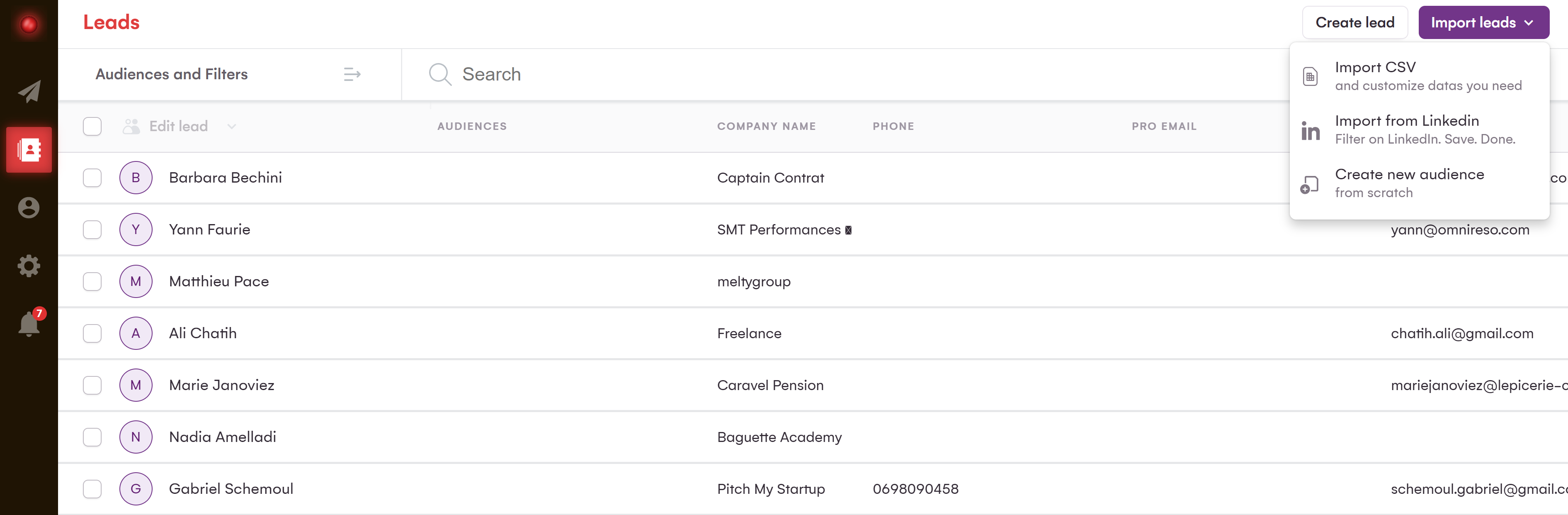
While the practice is not new, it is becoming more widespread and gaining momentum. It has become an essential asset for growth hackers and SMEs looking to combine efficiency and responsiveness.
Is scraping legal?
Although popular, scraping is often considered an illegal activity.
It is currently in a grey area, around which many actors revolve.
If we rely on GDPR, the General Data Protection Regulation, web scraping is legal as long as:
- the scraped data belongs to the public domain
- the collected information is stored securely
- the data is not used for commercial purposes (or sold) without the explicit consent of its owners
What does LinkedIn say about scraping?
Currently, there is only one established case of jurisprudence. And guess what? LinkedIn (provisionally) lost in the American court of justice (the Ninth Circuit) in a case against the company HiQ in 2019.
The latter, a data analysis company, used automatic bots to collect information on LinkedIn for research purposes.
This process did not please the American giant, which did not hesitate to ban it from its platform. HiQ immediately filed a lawsuit, arguing that it had not crossed any legal boundaries.
After deliberation, LinkedIn lost on appeal. The American Court decided that the information present on the social network was public and voluntarily provided by its users.
Since then, the platform has sent the case back to the Supreme Court, which has overturned the court’s decision. The case has returned to the Ninth Circuit.
The issue is that HiQ accessed information from a system it was not supposed to have access to. The final decision has still not been rendered to this day.
To be continued.
Regardless, LinkedIn’s Terms of Service clearly state the following clause:
“You agree not to develop, support, or use any software, device, script, robot, or any other means or process (including browser plug-ins and add-ons, or any other technology) designed to scrape the Services or otherwise copy profiles and other data from the Services.”
LinkedIn Terms of Service
What is scraping on LinkedIn used for?
If you are building your lead generation strategy, chances are you’ve already wondered if there’s an effective and fast way to enrich your data.
Scraping is an inevitable answer to this question. It’s an excellent way to grow your contact list or monitor your competitors’ activity.
Using the appropriate software, you can retrieve a lot of information about your prospects, such as:
- Their last name
- Their first name
- Their job title
- Their employer
- Their external links (website, social media)
- Their professional experience
- Their email address
Thanks to the data scraped from LinkedIn, you can configure your LaGrowthMachine campaigns for multichannel outreach.

As you can see, this method is very effective!
If you decide to use them for commercial purposes, which is your prerogative, you can initiate sales automation to secure professional appointments, present your services, or sell your products.
The advantages of LinkedIn scraping:
Specifically, here are all the benefits of this methodology:
- Undeniable time saving: once you have set up your data extraction criteria, automation does its job. It only takes a few seconds to retrieve a lot of information about your prospects, a prerequisite for a good lead conversion process. Much more efficient than manually copying and pasting everything.
- Ease of implementation: nowadays, tools are very easy to use.
- Data accuracy: no more room for human error, everything is managed by robots. This does not, of course, prevent some inaccuracies that you can then correct manually.
- Data management: once your data is collected, you can correct, delete, or segment it in no time.
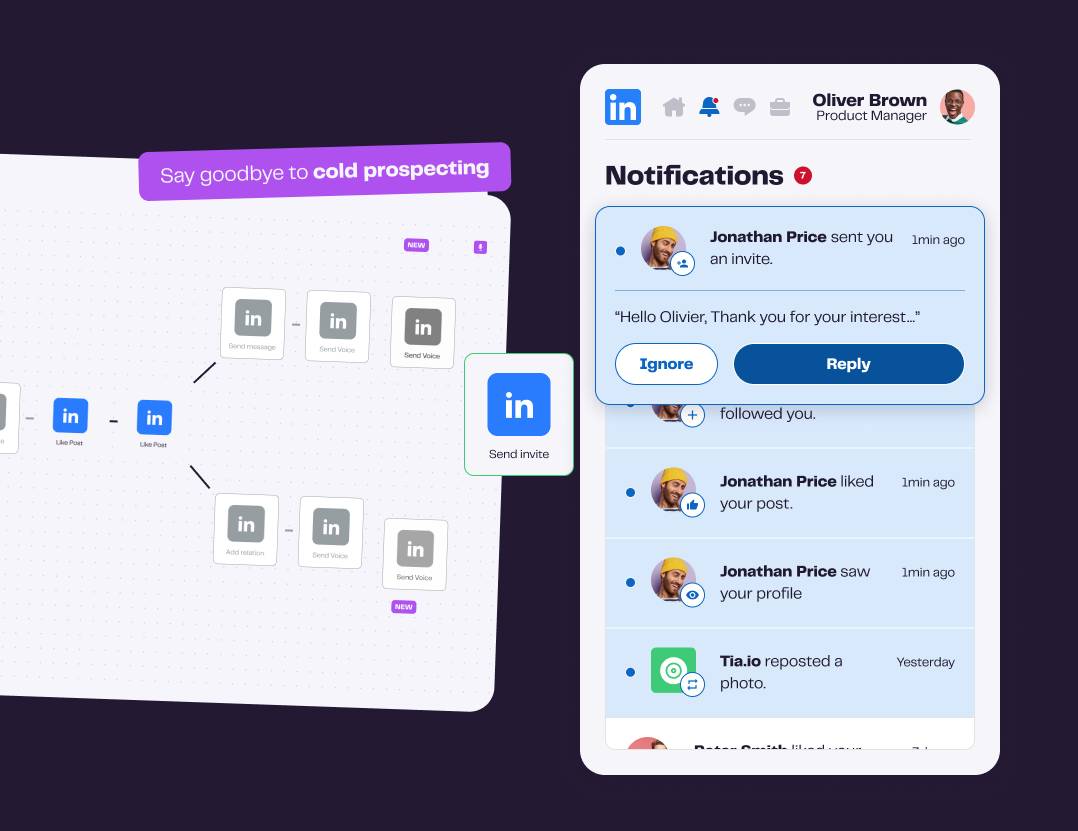
How to scrape LinkedIn effectively?
To extract LinkedIn data, there are two ways. The harder one is to do it manually. And the most common one, with a dedicated tool.
How to scrape LinkedIn manually?
This is a complex task, mainly reserved for those who know how to code and master HTML like a second language.
To do this, you will need to be able to install Selenium, a computer testing framework, and master the Python language.
Although this method is free, we strongly advise you against trying it. You risk investing too much time without achieving the desired results.
There are many tools that will do the job for you, provided you know how to use them.
That’s convenient… LaGrowthMachine is one of them!
How to scrape LinkedIn with a dedicated tool?
Various solutions exist for retrieving LinkedIn data. We will detail them in the next section.
They work more or less on similar systems.
- Scraping LinkedIn profiles: Simply enter the search criteria that interest you for your prospects, then let the machine run. You will then get a data listing exportable in .csv format. Afterward, you just need to process your file to increase your monitoring capacity or enhance your prospecting strategy.
- Scraping your own followers: You can also choose to scrape your own followers. This will help you consolidate all the information obtained from LinkedIn prospecting in one place. Subsequently, you can feed your CRM and multiply your results.
- Scraping LinkedIn groups: This is an excellent way to monitor targeted content. Groups bring together people with the same skills and dealing with the same topics in a specific sector. It’s an ideal source for developing content and contacts during your automated lead generation.
- Scraping LinkedIn events: Ideal for compiling a list of people interested in a conference, workshop, or webinar that fits your industry.
Scraping Sales Navigator, to go further
Sales Navigator is a tool developed by LinkedIn, focused on commercial prospecting.
It is a powerful search tool that allows you to retrieve even more content about platform users.
By using Sales Navigator, you have access to:
- Keyword search
- Geographic area
- Industry sector
- User’s language
- Seniority
- Current tenure
- Company size
Provided you have an account, you can easily scrape emails with LinkedIn as shown below.
This is the fastest and most effective way to build an enriched database.
But the best combo is still using Sales Nav in conjunction with LaGrowthMachine:
- you can import the data scraped from Sales Nav into LaGrowthMachine;
- then, LaGrowthMachine can scrape even more data for a better understanding of each of your leads;
- finally, thanks to the enriched data, you can create automated sequences that will allow you to generate leads, without doing anything!

What are the tools for scraping LinkedIn?
As scraping becomes more common, methods diversify. Today, there are Chrome extensions, free solutions, and paid methods that allow you to achieve your goals.
Obviously, we recommend that you surround yourself with the best tools to avoid falling into illegality or offending LinkedIn’s Terms of Service. Here is our selection:
Derrick

Derrick-app is a Google Sheet application that connects to LinkedIn and imports data directly into Google Sheets. Among the many features offered, you can:
- Import Sales Navigator searches: leads or companies
- Enrich a LinkedIn profile to extract 15+ data points: name, first name, job title, company, education…
- Enrich a company from LinkedIn to extract its industry, number of employees, funding rounds, etc…
- Find professional emails from a list of names, first names, and companies
But one of the features we prefer and use most often is the “Search Lead” function, which allows you to find the LinkedIn profile of all these people in one click, based on a list of names + first names.
A huge advantage of Derrick is its integration into Google Sheets. You can chain enrichments to allow you to:
- search for LinkedIn profiles for a list of names + first names
- then enrich them to get all their profile information
- then search for their professional email
And all this in 3 clicks. We love it!
And with their freemium offer, you get 200 credits per month for free.
Piloterr
Piloterr offers a series of LinkedIn APIs (and others) for software, simplifying the public data scraping process.
As of this writing, they offer the following LinkedIn APIs:
- LinkedIn Profile Info to retrieve details of a LinkedIn profile
- LinkedIn Company Info to retrieve details of a company on LinkedIn
- LinkedIn Product Info
- LinkedIn Job Suggest
- LinkedIn Job Search
- LinkedIn Job Suggest
- LinkedIn Job Info
- LinkedIn Job Count
- LinkedIn Post Info
Captain Data
Captain Data is an excellent data extraction tool. It can retrieve data from over 30 external sources.
It allows you to automatically enrich your contacts while aggregating them with external solutions, such as LaGrowthMachine.
Recommended if you need to measure the scalability of your campaigns.

PhantomBuster
This is probably one of the most used tools by beginners in LinkedIn or Sales Navigator scraping.
It allows you to perform dozens of actions on the platform, while ensuring compliance with the platform’s terms of use (it’s up to you to bypass them, at your own risk).
The tool provides various pre-set “phantoms,” ranging from scraping accounts that liked your posts to extracting event attendees.

Waalaxy
Waalaxy allows you to retrieve all data from a LinkedIn contact. The interface is intuitive and relatively simple to set up.
The platform is constantly developing new features. For example, you can send direct messages to group members or automate your targeting on LinkedIn and Sales Navigator.

Duxsoup
Dux-Soup is a solution that allows you to engage in conversations with LinkedIn prospects. You have the opportunity to send personalized connection requests while taking manual control whenever you feel the need.
The tool effectively puts outreach to work for your lead generation campaign.
It is also available as a Chrome extension, further enhancing its practicality.

Evaboot
Evaboot is a Google Chrome extension specifically dedicated to scraping Sales Navigator.
It allows you to create precise lists that you can clean and manage in just a few clicks.
It’s a solution that lets you retrieve emails in no time, provided you have a Sales Navigator account.


Going further with automation (LGM)
Most of the tools mentioned above allow integration with sales automation tools. But none are as effective as LaGrowthMachine for saving time efficiently.
In our case, the benefit is twofold:
- you can, for example, connect your various marketing software solutions in seconds, without having to change your prospecting routine;
- you can directly enrich your contacts from data scraped from LinkedIn or Sales Navigator before using them in your campaigns.
After enriching your contacts, you will be able to more easily manage your lead generation techniques and see leads come in.

To remember:
Here is your cheat sheet, to reread when you start scraping:
- Scraping allows you to collect a maximum of data on your LinkedIn prospects in a minimum of time
- Respect LinkedIn’s Terms of Service to avoid losing your account
- Prefer the right tools (Captain Data, PhantomBuster, Duxsoup…) over manual scraping
- Optimize your results by connecting Sales Navigator
- Multiply your scraping sources (groups, pages, followers, events)