
TL;DR
Clay specializes in data enrichment at $149/month while HubSpot offers full CRM at $20/user.
– Clay delivers 150+ data provider integrations with AI research and intent tracking
– HubSpot provides free CRM with marketing automation and complete customer platform
– Clay excels at prospecting workflows with enrichment and 14-day no-card trial
– HubSpot includes 2,000+ integrations with service hub and content management built-in
– Clay complements CRMs while HubSpot provides the complete stack
If you’re building a go-to-market strategy, you’ve probably come across both Clay and HubSpot. At first glance, they might seem like competing options, but they serve different purposes. Clay is a data enrichment and prospecting powerhouse, while HubSpot is an all-in-one CRM and marketing platform. Understanding what each tool does best will help you figure out which one (or both) fits your needs.
Clay vs HubSpot: side-by-side comparison table
Here’s a quick reference to compare the two tools at a glance:
| Feature | Clay | HubSpot | La Growth Machine |
|---|---|---|---|
| Starting price | $149/month (Starter, annual billing) | $20/user/month (Starter) | €50/user/month (annual) |
| Free trial | 14 days (no credit card required) | Free tools available (limited features) | 14 days (no credit card required) |
| Key features | Data enrichment, AI research, intent tracking, 150+ integrations | CRM, marketing automation, sales pipeline, service hub, content management | LinkedIn + Email sequences, enrichment, warmup, AI voice |
| Integration options | 150+ data providers, CRM integrations, email sequencing tools | 1,500+ app integrations, native CRM connections | Native: HubSpot, Salesforce, Pipedrive + API |
| Support options | Documentation, community, email support | Email, chat, phone support (varies by tier) | Email, chat, knowledge base, dedicated strategist (4+ seats) |
| Best for | Sales and growth teams focused on prospecting, data enrichment, and outbound campaigns | Teams that need an all-in-one platform for managing marketing, sales, and customer service | Scaling teams needing multichannel automation |
This article breaks down the key differences, pricing, features, and use cases for both tools.
Clay vs. HubSpot: quick overview
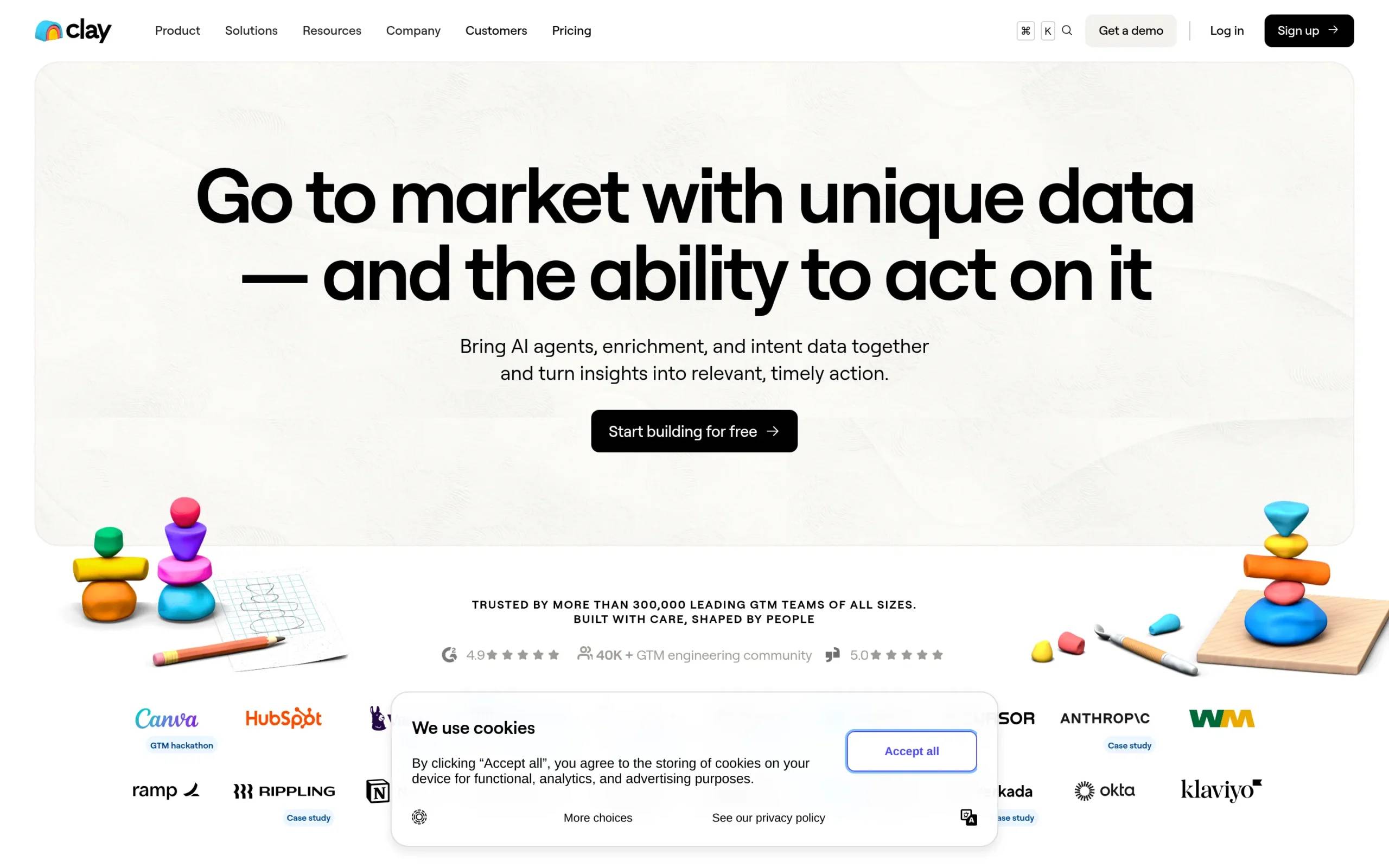
Clay: Clay is a data enrichment and prospecting platform that integrates AI agents, intent data, and over 150 data providers to help teams build targeted lead lists. It automates research, finds contact information, and creates high-intent buyer segments. Clay connects to your CRM and other tools to enrich data and power outbound campaigns. Starting price is $149/month for the Starter plan (billed annually).
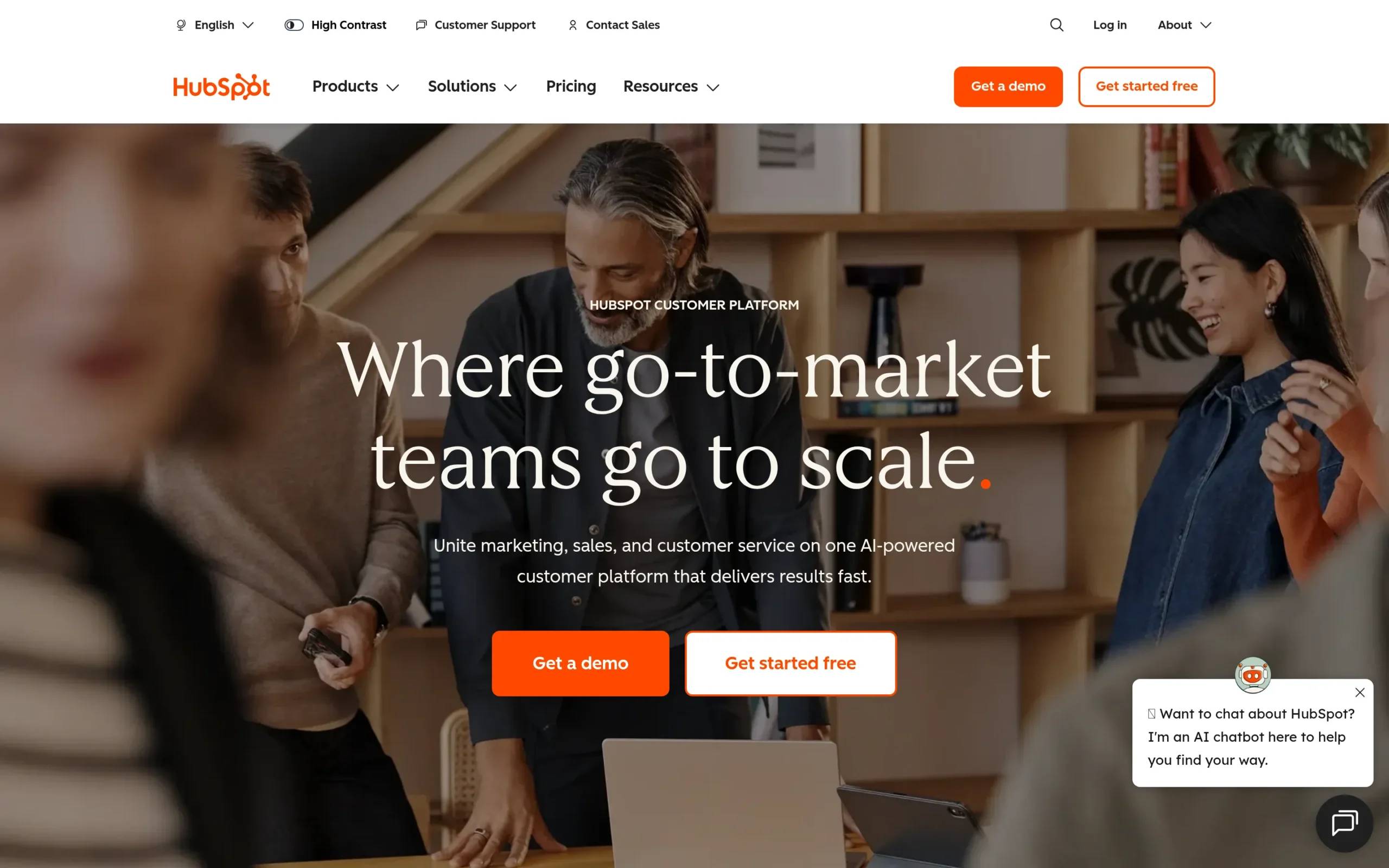
HubSpot: HubSpot is an AI-powered customer platform that combines marketing, sales, and service tools into one ecosystem. It offers a full CRM, marketing automation, sales pipeline management, customer service features, and content management. HubSpot manages the entire customer journey from first touch to retention in a single platform. Pricing starts at $20/user/month for the Starter tier.
Clay vs. HubSpot: head-to-head comparison
These tools approach the sales and marketing process from different angles. Clay focuses on prospecting and data enrichment, while HubSpot manages the full customer relationship lifecycle.
Features & capabilities
Clay: Clay’s core strength is data. It pulls from over 150 enrichment providers to find emails, phone numbers, job titles, company data, and more. The platform uses AI agents (like Claygent) to research companies and contacts, Sculptor to build workflows in natural language, and Signals to track job changes, news mentions, and social activity. Audiences lets you combine enrichment, intent signals, and CRM data to create targeted segments. Clay is built for teams that need accurate, enriched data to fuel their outbound efforts.
HubSpot: HubSpot offers a wide range of tools across marketing, sales, and service. Marketing Hub handles campaign automation, lead nurturing, and performance tracking. Sales Hub automates prospecting, manages pipelines, and provides forecasting tools. Service Hub focuses on customer support with help desk and ticketing features. Content Hub covers content creation and management, while the Smart CRM ties everything together with AI-powered insights and automation. HubSpot is built for teams that want a unified platform to manage contacts, automate workflows, and track performance across the entire customer lifecycle.
Winner: Tie. Clay wins on data depth and enrichment flexibility. HubSpot wins on breadth of features and end-to-end lifecycle management.
Ease of use
Clay: Clay has a steep learning curve. The platform is powerful but requires time to understand how to structure tables, use enrichment providers effectively, and build workflows. For teams familiar with tools like Airtable or spreadsheet-based workflows, the transition is smoother. Clay offers solid documentation and a community to help users get up to speed, but expect to invest some time upfront.
HubSpot: HubSpot is known for its user-friendly interface. The platform is designed to be intuitive, with guided onboarding and a visual workflow builder that makes it easy for non-technical users to set up automation and campaigns. That said, the platform is feature-rich, and navigating all the options can feel overwhelming at first. HubSpot Academy offers extensive training resources to help teams get the most out of the platform.
Winner: HubSpot. While both tools require some ramp-up time, HubSpot’s interface and onboarding experience are more accessible for most users.
Pricing & value
Clay: Clay uses a credit-based pricing model. The Starter plan is $149/month (billed annually) and includes 24,000 credits per year. The Explorer plan is $349/month with 120,000 credits per year. The Pro plan is $800/month with 600,000 credits per year. Enterprise pricing is custom. All plans include unlimited users, AI/Claygent access, and rollover credits. The catch is that credit usage can be hard to predict, especially when running large enrichment jobs or using multiple providers.
HubSpot: HubSpot pricing varies by hub and tier. The Starter tier starts at $20/user/month and includes basic CRM, marketing, and sales features. Professional tiers start around $800-$890/month for Marketing Hub (includes 3 seats) and $90-$100/seat/month for Sales Hub. Enterprise plans start at $3,600/month for Marketing Hub and $150/seat/month for Sales Hub. HubSpot also charges onboarding fees for Professional and Enterprise tiers (typically $1,500-$7,000 depending on the hub). Value depends on how many hubs you need and how many users are on the platform.
Winner: Tie. Clay offers strong value if you need data enrichment at scale. HubSpot offers strong value if you need an all-in-one platform, but costs can add up quickly as you scale.
Integrations
Clay: Clay integrates with over 150 data providers and connects to major CRMs like HubSpot, Salesforce, and Pipedrive. It also integrates with tools like Google Sheets, Slack, and email sequencing platforms. Clay’s strength is its ability to pull data from multiple sources and push enriched records into your CRM or outreach tools.
HubSpot: HubSpot has a massive integration ecosystem with over 1,500 apps in its marketplace. It connects natively to most major marketing, sales, and support tools, including Slack, Zoom, Salesforce, Shopify, and more. HubSpot also offers APIs and webhooks for custom integrations. The platform acts as the central hub for your go-to-market stack.
Winner: HubSpot. While Clay’s integrations are strong for data enrichment workflows, HubSpot’s ecosystem is broader and more versatile.
Data enrichment & prospecting
Clay: This is where Clay shines. The platform is purpose-built for enrichment and prospecting. It combines data from over 150 providers, uses AI to research and validate information, and tracks intent signals like job changes and social mentions. You can build complex workflows to enrich leads, score them based on fit, and push them into your CRM or outreach tool. Clay is built for teams that need deep, accurate data to power targeted campaigns.
HubSpot: HubSpot offers basic enrichment through integrations and add-ons, but it’s not a core feature. The platform focuses on managing and nurturing the leads you already have, not on finding and enriching new ones. Teams that need robust enrichment typically integrate HubSpot with a tool like Clay or ZoomInfo.
Winner: Clay. HubSpot isn’t built for data enrichment the way Clay is.
Clay vs HubSpot: pros and cons
Clay strengths & weaknesses
Pros
- Access to over 150 data providers for comprehensive enrichment
- AI-powered research and intent tracking (job changes, social signals, news mentions)
- Flexible workflows for building custom prospecting processes
- Unlimited users on all plans
- Credit rollover to avoid wasting unused capacity
Cons
- Steep learning curve for new users
- Credit-based pricing can be difficult to predict and budget for
- No built-in outreach capabilities (requires integration with email/LinkedIn tools)
- Can experience lag when working with large datasets
User Rating: G2: 4.8/5 (based on 177 reviews) Capterra: Not widely reviewed
HubSpot strengths & weaknesses
Pros
- All-in-one platform covering marketing, sales, service, and CRM
- User-friendly interface with guided onboarding
- Powerful automation and workflow capabilities
- Massive integration ecosystem (1,500+ apps)
- Strong reporting and analytics across the customer lifecycle
Cons
- Pricing can escalate quickly as you add hubs, seats, and contacts
- Onboarding fees for Professional and Enterprise tiers
- Limited features on lower-tier plans
- Not built for data enrichment (requires third-party tools)
User Rating: G2: 4.5/5 (based on 5,000+ reviews) Capterra: 4.5/5 (based on 4,414 reviews)
Which should you choose?
Here are some scenarios to help you decide:
Choose Clay if:
- Your primary need is data enrichment and prospecting
- You’re running targeted outbound campaigns and need accurate contact data
- You want access to multiple data providers and intent signals
- You already have a CRM and just need better data to feed into it
- Your team has the technical skills to build custom workflows
Choose HubSpot if:
- You need a full CRM to manage contacts, deals, and customer relationships
- You want marketing automation, email campaigns, and lead nurturing in one place
- You’re managing the entire customer lifecycle from lead to retention
- You need a platform that marketing, sales, and service teams can all use
- You want a user-friendly interface with minimal technical setup
Consider both if:
- You need HubSpot’s CRM and automation features, plus Clay’s data enrichment capabilities
- You’re running complex outbound campaigns and want to enrich HubSpot records with Clay data
- You have the budget and team bandwidth to integrate both tools
Need something different? Check out La Growth Machine
Clay and HubSpot are solid choices for their respective use cases. But if you’re looking for a tool that focuses on multichannel sales automation and prospecting, La Growth Machine takes a different approach.
What La Growth Machine does
La Growth Machine is a multichannel prospecting platform that automates outreach across LinkedIn, email, calls, voice messages, and X (Twitter). Instead of just enriching data or managing a CRM, the platform helps you reach prospects on the channels they’re most active on, increasing your chances of getting replies.
Key features include:
- Multichannel campaigns that combine LinkedIn, email, and calls in one sequence
- Lead Enrichment to find and verify email addresses using multiple providers
- Social Warming (auto-liking and following prospects before outreach)
- LinkedIn Voice Messages to stand out and double reply rates
- Lookalike Search and Inbox Suggestions to find similar prospects after positive replies
- CRM integrations with HubSpot, Pipedrive, and Breakcold
How it fits into your stack
Clay is great for building and enriching lead lists. HubSpot is great for managing the full customer lifecycle. La Growth Machine is great for running multichannel outreach campaigns once you have your leads.
If you’re using Clay to build your prospect list, you can export those leads to La Growth Machine to run automated sequences across LinkedIn and email. If you’re using HubSpot as your CRM, you can sync leads from La Growth Machine directly into HubSpot to track conversations and deals.
Or, if your focus is on multichannel prospecting and automation rather than data enrichment or full lifecycle CRM, La Growth Machine might be the right fit on its own.
Pricing: Starting at €50/month per identity Free trial: 14 days (no credit card required)
Worth considering if:
- You need multichannel outreach (LinkedIn + email + calls) in one platform
- You want to automate prospecting without switching between multiple tools
- You’re focused on getting more replies and starting conversations, not just managing data
Clay vs. HubSpot: FAQs
Can Clay integrate with HubSpot? Yes, Clay integrates with HubSpot. You can enrich HubSpot contacts with data from Clay’s 150+ providers, sync enriched records back into HubSpot, and use Clay data to power more targeted campaigns. Many teams use Clay to build and enrich lead lists, then push those records into HubSpot for pipeline management and nurturing.
Is Clay a CRM like HubSpot? No, Clay is not a CRM. It’s a data enrichment and prospecting platform. Clay helps you find and enrich leads, but it doesn’t manage customer relationships, deals, or pipelines the way HubSpot does. If you need CRM functionality, you’ll want to integrate Clay with a CRM like HubSpot, Salesforce, or Pipedrive.
Which tool is better for outbound sales? It depends on what you need. Clay is better if your main challenge is finding accurate contact data and building targeted lead lists. HubSpot is better if you need to manage outbound sequences, track deals, and automate follow-ups within a CRM. For multichannel outreach automation (LinkedIn + email + calls), consider a tool like La Growth Machine.
Conclusion
Clay and HubSpot serve different purposes. Clay is built for data enrichment and prospecting, while HubSpot is built for managing the full customer lifecycle in one platform. Many teams use both: Clay to build and enrich lead lists, and HubSpot to manage relationships and run campaigns.
If you’re looking for something that focuses specifically on multichannel sales automation, La Growth Machine is worth exploring. The platform helps you run automated outreach across LinkedIn, email, and calls to get more replies and start more conversations.
Get 3.5X more leads!
Do you want to improve the efficiency of your sales department? With La Growth Machine you can generate on average 3.5x more leads while saving an incredible amount of time on all your processes.
By signing up today, you’ll get a free 14-day trial to test our tool!