
TL;DR
A GTM tech stack is the complete set of tools that powers your revenue motion from ICP definition to closed deals – covering market intelligence, enrichment, outreach, CRM, and analytics.
Modern stacks are built in 5 interconnected layers: Market Intelligence, Data and Enrichment, Outreach and Engagement, CRM and Pipeline, and Analytics and Revenue Intelligence – each layer feeding the next with clean data.
La Growth Machine is the recommended outreach layer for any GTM stack: native multichannel sequences on LinkedIn, Email and Twitter, built-in waterfall enrichment, and two-way CRM sync with HubSpot, Salesforce, and Pipedrive.
Stack costs range from under €300/month for an early-stage setup (LGM + HubSpot + Apollo) to €2,500+/month for a full enterprise RevOps motion – the key is designing layers intentionally before buying tools.
A go-to-market (GTM) tech stack is the complete set of tools that powers your revenue motion from end to end. It covers every step in the commercial cycle: identifying the right market, finding and enriching prospects, reaching them through the right channels, tracking pipeline inside a CRM, and measuring what actually drives revenue. In 2026, running a B2B revenue team without a deliberate stack design is like running a factory without a production line.
Stack design has become a genuine competitive differentiator. Two companies can target identical ICPs, run identical sequences, and hire equally talented reps. The company with a well-integrated stack will outperform at every stage: faster time-to-first-touch, higher contact rates, cleaner pipeline data, and a revenue attribution model that actually informs decisions. The company with a fragmented stack bleeds budget on overlapping tools, loses data at every handoff, and makes forecasting almost impossible.
The defining shift in recent years is the move from point solutions toward integrated layers. Buying the best-in-class enrichment tool, the best-in-class sequencer, the best-in-class CRM, and hoping they talk to each other is a recipe for broken workflows and dirty data. Modern GTM stacks are designed as interconnected layers where each output feeds the next input, reducing manual work and creating the visibility that revenue leaders need to manage the business.
GTM Stack Overview
| Layer | Function | Example Tools | Why It Matters |
|---|---|---|---|
| Market Intelligence | Define ICP, map total addressable market, monitor intent signals | LinkedIn Sales Navigator, Apollo, Cognism | Ensures your team targets the accounts most likely to convert |
| Data and Enrichment | Find, verify, and enrich contact and company data | Clay, Cognism, Kaspr, Lusha, Dropcontact | Clean data is the foundation of every outreach motion |
| Outreach and Engagement | Reach prospects across LinkedIn, email, and social | La Growth Machine, Salesloft, Outreach | Multichannel sequences with CRM sync drive response rates |
| CRM and Pipeline | Track deals, manage pipeline, and forecast revenue | HubSpot, Salesforce, Pipedrive | Centralizes commercial activity and enables revenue attribution |
| Analytics and Revenue Intelligence | Measure performance, forecast, and optimize | Salesforce Reports, HubSpot Analytics, native BI | Closes the loop between activity and revenue outcome |
The 5 Layers of a Modern GTM Tech Stack
A GTM stack is not a flat list of tools. It is a layered system where each component feeds the next. Understanding the layers is the first step to making intentional purchasing decisions.
Layer 1: Market Intelligence and ICP Definition
Before you can run a pipeline, you need to know who you are targeting. Market intelligence tools help GTM leaders define their ICP with precision, identify which companies are showing buying intent, and segment the addressable market into prioritized tiers.
This layer answers the foundational question: who should we be talking to right now? It informs campaign targeting, sequences messaging, and determines which enrichment data you actually need to pull.
Tools like LinkedIn Sales Navigator, Apollo, and Cognism provide firmographic filters, intent data, and contact discovery that feed the rest of the stack.
Layer 2: Data and Enrichment
Data and enrichment is the layer that most teams underinvest in, and it costs them downstream. If your contact data is stale, incomplete, or unverified, every outreach sequence runs at a fraction of its potential.
This layer takes raw prospect lists and returns verified emails, direct dials, LinkedIn profiles, job titles, technologies used, and firmographic signals. The goal is to arrive at first contact with enough context to be relevant and enough data to route correctly to the CRM.
Modern enrichment goes well beyond static databases. Clay introduced AI-powered waterfall enrichment, querying multiple data sources in sequence until it finds a verified match. This dramatically improves contact coverage rates without multiplying data costs.
Layer 3: Outreach and Engagement
The outreach layer is where pipeline is generated. It is the most visible part of the GTM stack to both reps and prospects, and the place where sequence design, channel mix, and timing decisions directly translate into booked meetings.
In 2026, single-channel outreach is a conversion handicap. Buyers who do not respond to email often engage on LinkedIn. Those who ignore direct messages respond to a comment. Multichannel sequences executed with the right timing outperform any single-channel approach.
This layer must be tightly integrated with both the enrichment layer (feeding contact data) and the CRM layer (recording all activity).
Layer 4: CRM and Pipeline Management
The CRM is the commercial record of truth. It is where deals live, where pipeline stages are tracked, and where revenue forecasting is built. For a VP Sales or Head of Growth, the CRM is the dashboard from which the entire commercial operation is managed.
A CRM that receives incomplete or delayed data from the outreach layer makes pipeline management reactive rather than proactive. Two-way sync between outreach tools and the CRM is non-negotiable in a well-designed stack.
HubSpot, Salesforce, and Pipedrive are the dominant options, each calibrated to a different company stage and complexity level.
Layer 5: Analytics and Revenue Intelligence
The final layer closes the loop. It answers the question every revenue leader needs to answer: what activities and inputs actually produce revenue? Without this layer, GTM decisions are informed by intuition rather than data.
This layer includes CRM-native reporting, custom dashboards, attribution models, and, at more mature stages, dedicated revenue intelligence platforms. The output is the ability to attribute pipeline to specific campaigns, sequences, channels, and reps, and to forecast with confidence.
GTM Tech Stack by Layer: Best Tools in 2026
Market Intelligence
LinkedIn Sales Navigator remains the default starting point for B2B account mapping. Its filtering capabilities, saved search alerts, and buyer intent signals give GTM teams a direct line to the accounts that match their ICP and are showing activity.
Apollo combines a contact database of over 275 million records with intent signals and sequencing capabilities in one platform. For early-stage teams that need market intelligence and outreach in a single tool, it offers strong coverage.
Cognism is the preferred option for teams where compliance and data quality are non-negotiable. Its GDPR-compliant dataset covers European markets with strong mobile number verification, making it the reference choice for outbound teams operating across multiple geographies.
Data and Enrichment
Clay is the most powerful enrichment tool in the modern GTM stack. Its AI-powered waterfall enrichment queries over 50 data sources in sequence, returning verified contact data at a fraction of the cost of maintaining multiple individual data subscriptions. Clay has become the default enrichment infrastructure for growth-stage and enterprise GTM teams.
Cognism doubles as a data source, particularly for verified mobile numbers in European markets. Teams running phone-based outbound sequences use it as a primary enrichment layer.
Kaspr, Lusha, and Dropcontact serve as either primary enrichment sources for smaller teams or as supplementary waterfall layers inside Clay. Each has differentiated coverage by geography and contact type.
Outreach and Engagement
La Growth Machine is the outreach layer of choice for B2B teams that want multichannel coverage without stitching together multiple point solutions. It natively supports LinkedIn, email, and Twitter sequences, includes built-in waterfall enrichment, and syncs two-way with HubSpot, Salesforce, and Pipedrive.
For a VP Sales or Head of Growth, La Growth Machine provides the pipeline visibility that matters: sequence performance by channel, reply rates by persona, and CRM attribution for every booked meeting. Reps run personalized multichannel sequences at scale; leaders see which campaigns generate revenue.
Salesloft and Outreach are the enterprise-grade options for larger revenue teams that need detailed cadence management, conversation intelligence, and deep Salesforce integration. Both are powerful but require dedicated RevOps resources to configure and maintain.
CRM
HubSpot is the dominant CRM for Series A through Series B companies. Its pipeline management, marketing hub integration, and reporting capabilities cover the needs of most scaling B2B teams, and its native integration with La Growth Machine means that outreach activity flows directly into CRM records without manual intervention.
Salesforce is the enterprise standard. At the scale where reporting complexity, custom objects, and deep integration with finance and customer success systems become necessary, Salesforce is the default. It requires a dedicated admin and, in most cases, a RevOps function.
Pipedrive is built for sales-led teams that prioritize deal management and pipeline visibility over marketing automation. It is the leanest CRM option in the stack and integrates cleanly with La Growth Machine.
Automation and Integration
Zapier and Make handle the connective tissue of the GTM stack. They route data between tools that do not have native integrations, trigger workflows based on CRM field changes, and automate list management tasks. At growth stage and above, Make is preferred for its ability to handle complex multi-step workflows.
GTM Tech Stack Examples by Stage
Early-Stage Stack (Seed / Series A)
Tools: La Growth Machine + HubSpot + Apollo
Monthly cost: under €300
At seed stage, the priority is generating pipeline fast with minimal operational overhead. This three-tool stack covers market intelligence and contact discovery (Apollo), multichannel outreach with built-in enrichment (La Growth Machine), and CRM with reporting (HubSpot).
La Growth Machine’s waterfall enrichment replaces a dedicated data tool for most early-stage teams, keeping the stack lean. Sequences run across LinkedIn and email from day one. HubSpot captures all activity and provides the pipeline visibility needed for investor reporting.
This stack lets a two-person sales team punch well above its weight class.
Growth-Stage Stack (Series B+)
Tools: La Growth Machine + Clay + Salesforce + Salesloft + Cognism
Monthly cost: approximately €800
At growth stage, volume and data quality both become critical. Clay handles waterfall enrichment at scale, pulling from Cognism and other sources to maximize contact coverage. Salesforce manages a complex pipeline with multiple deal stages and custom reporting. La Growth Machine runs multichannel sequences for SDRs and feeds all activity back to Salesforce. Salesloft adds conversation intelligence and enterprise cadence management for the AE team.
This stack supports a full SDR-to-AE motion with clear revenue attribution at every stage.
Enterprise Stack
Tools: La Growth Machine + Cognism + Salesforce + Outreach + Clay + Make
Monthly cost: approximately €2,500+
Enterprise GTM stacks add orchestration complexity. Make manages the data routing between Clay, Cognism, Salesforce, and La Growth Machine. Outreach handles enterprise-grade cadence management and conversation intelligence. Cognism provides verified contact data at volume for European markets.
La Growth Machine remains the multichannel outreach layer, running LinkedIn and email sequences for ABM campaigns and feeding every interaction back to Salesforce for attribution. Make handles the custom workflow triggers that keep data clean across the entire stack.
How La Growth Machine Fits Into Any GTM Stack
La Growth Machine is built to be the outreach layer in any GTM stack, regardless of what CRM or data tools you run. It is not a closed ecosystem; it is an integration-first platform designed to plug cleanly into the tools you already use.
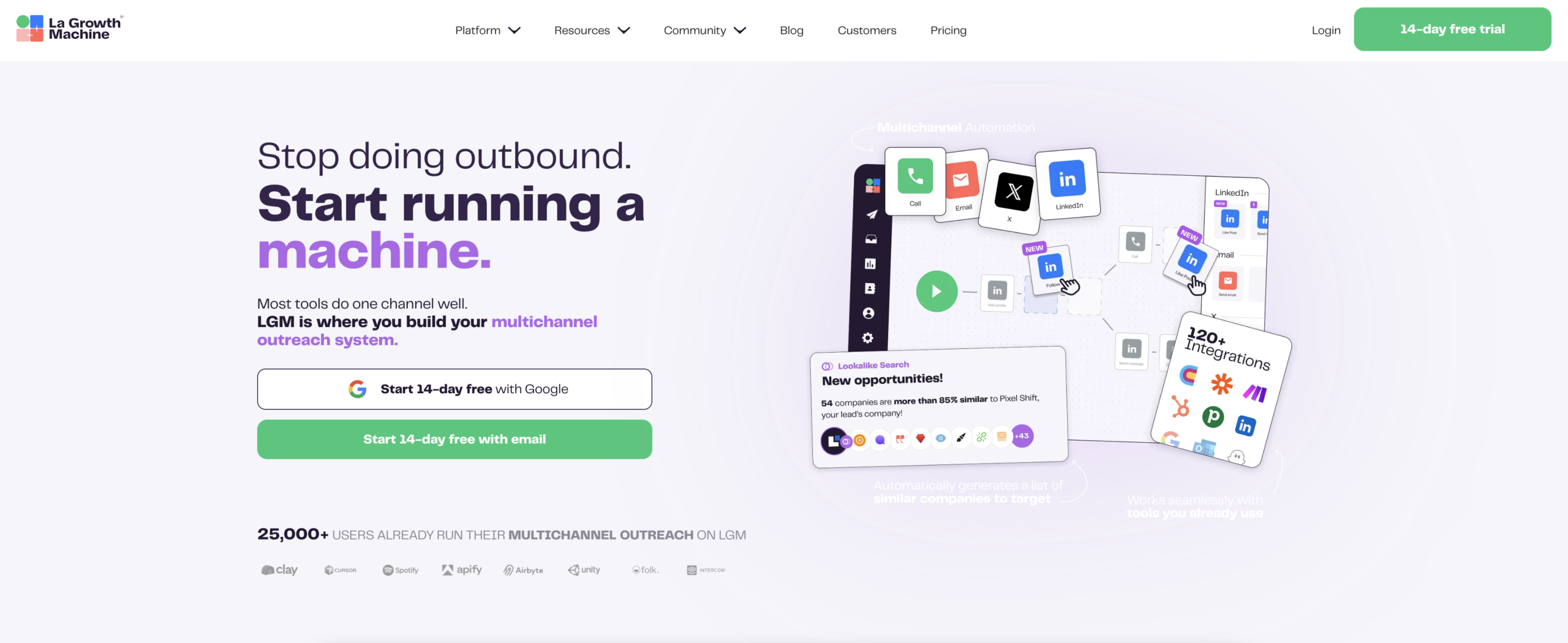
The core value proposition is multichannel outreach without the tool sprawl. Rather than running a LinkedIn automation tool, a separate email sequencer, and a third enrichment service, La Growth Machine handles all three in a single workflow. Sequences combine LinkedIn connection requests, message steps, email touchpoints, and Twitter interactions in any order, with AI-generated personalization at each step.
Waterfall enrichment is built in. Before launching a sequence, La Growth Machine queries multiple data sources to find and verify contact information, which means you can upload a list of LinkedIn profiles or company names and let the platform handle data enrichment. For most early-stage and growth-stage teams, this eliminates the need for a separate enrichment tool entirely.
CRM sync runs two-way with HubSpot, Salesforce, and Pipedrive. Every message sent, reply received, and meeting booked writes back to the CRM record in real time. Revenue leaders get full pipeline visibility: which sequences are generating replies, which campaigns are converting to meetings, and which channels are producing revenue. La Growth Machine pricing starts at €60/month per identity (Basic), with Pro at €120/month and Ultimate at €180/month.
The result is a platform that works for a solo founder running a 30-step LinkedIn sequence and for an enterprise SDR team running 50 simultaneous ABM campaigns. The outreach layer plugs into any CRM and any enrichment infrastructure you have already built.
GTM Stack Mistakes to Avoid
Buying tools before defining the motion. The most common GTM stack mistake is purchasing tools to solve a process problem that has not been defined. Before adding any tool, answer: what is the outbound motion? What are the ICP criteria? What is the sequence logic? Tools should automate a process that already works, not substitute for one.
Duplicating functionality across layers. Most GTM stacks accumulate overlap over time: an enrichment feature in the CRM, enrichment in the sequencer, a dedicated enrichment tool, and a data subscription. Each duplication adds cost without adding coverage. Audit your stack annually and cut tools that replicate functionality you are already paying for.
No CRM sync. If outreach activity does not write back to the CRM, pipeline management is based on incomplete data. Every tool in the stack should have a clear data pathway to the CRM. Any tool that cannot sync activity to your CRM creates a blind spot in revenue attribution.
Skipping enrichment. Teams that skip enrichment and go straight to outreach with raw lists consistently see lower contact rates, higher bounce rates, and sequence performance that makes the entire outreach layer look ineffective. Enrichment is not optional; it is the foundation that makes the outreach layer work.
FAQ
What is a GTM tech stack?
A GTM tech stack is the set of software tools that powers a company’s go-to-market motion from ICP definition through to closed revenue. It typically includes market intelligence, data enrichment, outreach, CRM, and analytics tools working in sequence.
What tools are in a GTM stack?
A complete GTM stack includes tools for market intelligence (LinkedIn Sales Navigator, Apollo, Cognism), data enrichment (Clay, Kaspr, Lusha, Dropcontact), outreach (La Growth Machine, Salesloft, Outreach), CRM (HubSpot, Salesforce, Pipedrive), and workflow automation (Zapier, Make).
How much does a GTM tech stack cost?
An early-stage stack costs under €300/month. A growth-stage stack runs approximately €800/month. An enterprise stack with full RevOps infrastructure typically costs €2,500/month or more. The exact cost depends on the number of seats, contact volume, and which tools cover multiple functions.
What is the difference between a GTM stack and a sales stack?
A sales stack focuses on the tools used by the sales team: CRM, sequencer, and call recording. A GTM stack is broader and includes marketing, demand generation, product, and customer success tooling alongside the sales layer. In practice, most B2B companies use the terms interchangeably when referring to the commercial stack.
What is the most important tool in a GTM stack?
The CRM is the system of record that everything else feeds into, making it the most critical infrastructure decision. The outreach layer (La Growth Machine) is the most important performance lever: it is where pipeline is generated and where sequence design directly translates into booked meetings and revenue.
Can La Growth Machine replace multiple GTM stack tools?
For most teams, yes. La Growth Machine combines multichannel outreach (LinkedIn, email, Twitter), built-in waterfall enrichment, and native CRM sync. This covers the outreach and enrichment layers in one platform, reducing stack complexity and cost.
Conclusion
A well-designed GTM tech stack is not a collection of the best individual tools. It is a system where each layer feeds the next with clean data and clear attribution. Market intelligence informs enrichment targeting. Enrichment enables outreach personalization. Outreach generates pipeline. CRM tracks and converts it. Analytics tells you what is working.
La Growth Machine sits at the center of this system as the outreach layer that connects everything: multichannel sequences that generate pipeline, built-in enrichment that replaces a separate data tool, and CRM sync that writes every interaction back to HubSpot, Salesforce, or Pipedrive.
If you are building or rebuilding your GTM stack, start with the outreach layer. Run your first multichannel sequence in La Growth Machine and see how quickly a well-integrated outreach layer changes your pipeline numbers.
Start your 14-day free trial of La Growth Machine and build the outreach layer your GTM stack needs.