

TL;DR
– Lead Generation is an inbound approach owned by marketing: it attracts interested contacts via content, ads or SEO, but takes 6 to 12 months to generate stable volume.
– Prospecting is an outbound approach owned by SDRs: it directly contacts target accounts to generate pipeline immediately, but requires personalization to avoid spam filters.
– La Growth Machine unifies both in a single workflow: multichannel sequences for cold lists, native CRM sync for inbound leads, and LinkedIn Intents to target contacts already signaling interest.
– The winning combination: use lead generation to build awareness with target accounts, then trigger prospecting as soon as an interest signal appears. The shared KPI to align on: meetings booked.
Most B2B teams use these two terms interchangeably. That is a mistake that costs pipeline. Lead generation and prospecting do not share the same objective, do not target the same buyer profile, and are not measured with the same KPIs.
Understanding the distinction — and more importantly, knowing how to combine them — is what separates sales teams that generate pipeline predictably from those that rely on luck.
This guide explains both approaches, who owns them, when to use each, and how La Growth Machine lets you unify them in a single workflow.
TL;DR: Lead Generation vs Prospecting at a Glance
| Criteria | Lead Generation | Prospecting |
|---|---|---|
| Definition | Attract interested contacts via content, ads, events | Directly identify and contact qualified prospects |
| Approach | Inbound (pull) | Outbound (push) |
| Owner | Marketing | Sales / SDR |
| Timeline | 6-12 months for stable results | Immediate pipeline |
| Key metrics | CPL, MQL, landing page conversion rate | Meetings booked, reply rate, pipeline generated |
| Automation | Highly automated (SEO, ads, email nurturing) | Semi-automated (sequences, enrichment, multichannel) |
| Scalability | High long-term | High with the right tools |
What the Two Terms Actually Mean
Lead Generation: The Net
Lead generation is the process of attracting contacts who may be interested in your product or service. The approach is inbound: you create content (blog posts, webinars, whitepapers, ads), distribute it at scale, and wait for people to signal interest by leaving their contact details.
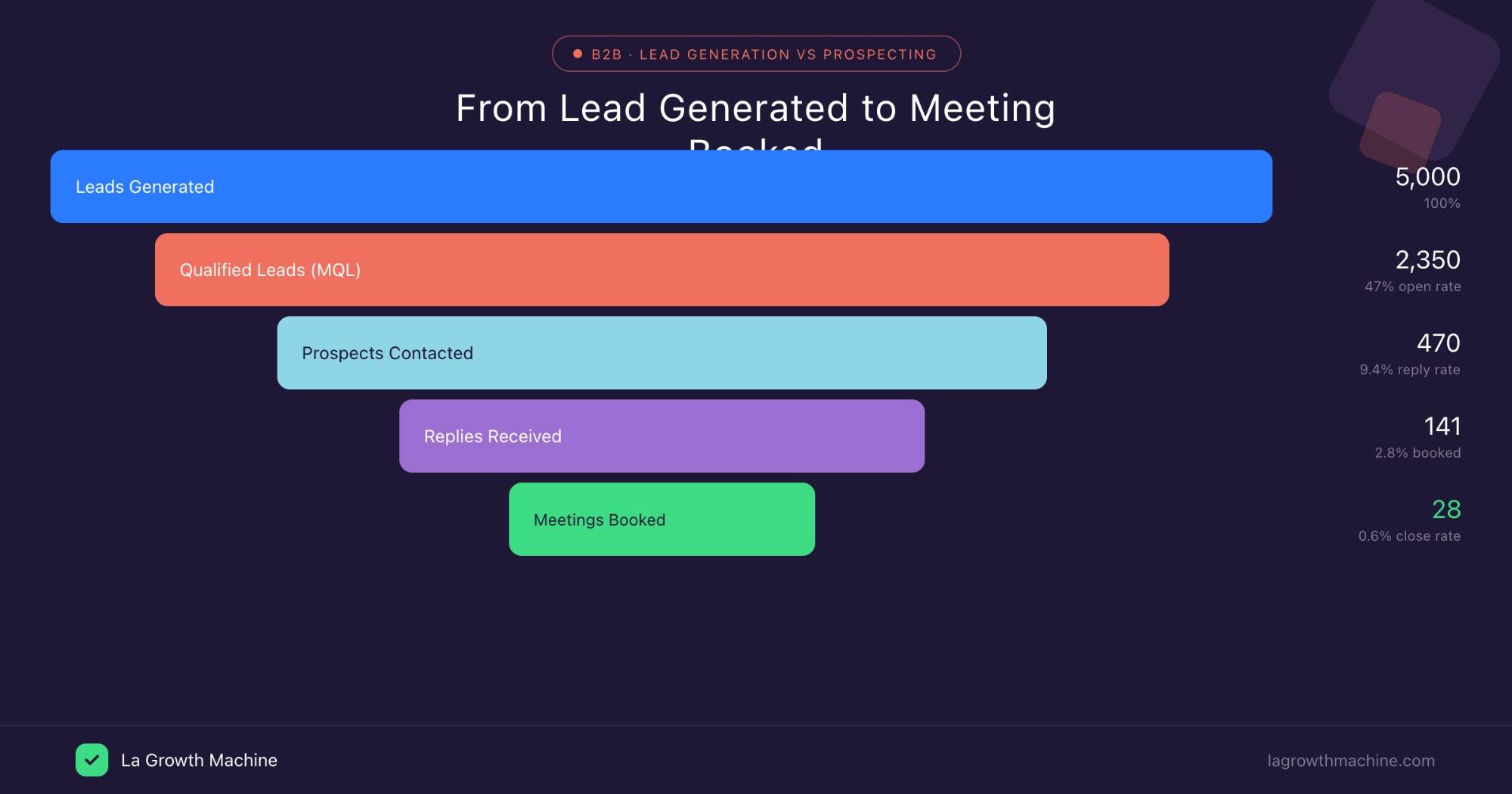
A lead generated through inbound has already shown a signal of interest, however minimal. They downloaded a guide, filled out a form, or clicked on an ad. That signal is what distinguishes them from a cold contact.
Lead generation belongs to marketing. It is measured in cost per lead (CPL), MQL volume, and landing page conversion rates. Its main limitation: it takes time. SEO campaigns take 6 to 12 months to generate volume. Content marketing strategies pay off over the long term.
Prospecting: The Rifle
Prospecting is the opposite. Your sales team — or your SDRs — identifies accounts and contacts that match your ICP (Ideal Customer Profile) and reaches out to them directly. You do not wait for them to come to you. You go find them.
Prospecting is outbound: cold email, LinkedIn message, phone call, multichannel sequence. It is more active, more direct, and generates pipeline immediately. A well-built prospecting sequence can book meetings the same week it launches.
Prospecting belongs to Sales and SDRs. It is measured in meetings booked, pipeline generated, and reply rate by channel.
The Real Difference: Who Owns It?
The confusion often comes from internal organization. In many companies, marketing and sales do not talk enough. Marketing generates leads, qualifies them loosely, and hands them to SDRs. SDRs receive contact lists with no context, do not know what the prospect downloaded or why, and restart qualification from scratch.
The result: inbound leads are treated like cold contacts. Marketing efforts are wasted. The MQL-to-meeting conversion rate stays low.
The ownership distinction is essential:
Marketing owns lead generation: reach the largest number of relevant personas, build interest, generate broadly qualified contacts.
Sales owns prospecting: identify, qualify and contact high-potential accounts, convert interest signals into conversations, turn conversations into meetings.
When both functions align on this split, pipeline becomes predictable. When they overlap without coordination, contacts are over-reached, poorly qualified, or ignored.
The Metrics That Separate Both Approaches
Measuring lead generation and prospecting with the same KPIs is another source of confusion.
Lead generation: volume and cost metrics
- Cost per lead (CPL): how much each generated contact costs on average
- MQL volume: how many leads reach the marketing qualification threshold
- Landing page conversion rate: what percentage of visitors leave their contact details
- Organic traffic: how many people discover your content
Prospecting: pipeline and conversion metrics
- Meetings booked: the number of sales meetings generated
- Pipeline generated: total value of opportunities created by prospecting
- Reply rate by channel: which channel generates the most engagement (LinkedIn vs email vs call)
- Average time to first meeting: how long between first contact and a scheduled call
The metric that matters at the end is the meeting booked, not the lead generated. An MQL that never converts to a meeting adds nothing to the pipeline. That is why aligning both teams on the same final metric — meetings — is the key to a coherent acquisition strategy.
When to Use One, the Other, or Both
There is no universal answer. The right combination depends on your growth stage, sales cycle, and target market size.
Prioritize lead generation if:
- Your market is broad and your ICP loosely defined
- Your sales cycle is long (6+ months) and requires nurturing
- You sell a product with strong SEO or content potential (price point under €500/month)
- You have the marketing resources to produce content consistently
Prioritize prospecting if:
- Your ICP is precise and the addressable market limited (e.g. 500 target accounts)
- You need pipeline this quarter
- Your sales cycle is short or your product sells on demo
- Your SDR team is in place and can execute sequences
Both together if:
- You are in growth mode with resources in both teams
- You want inbound leads picked up by prospecting to maximize their conversion
- You want to reach target accounts across multiple touchpoints (advertising + email + LinkedIn)
The most effective combination is to use lead generation to build awareness with your target accounts, then trigger prospecting as soon as a signal of interest is detected. That is exactly what modern multichannel outreach tools enable.
How La Growth Machine Unifies Both Approaches
La Growth Machine is a multichannel outreach platform built for prospecting — but it also covers the inbound-to-outbound lead generation use case.
Here is how the integration works in practice:
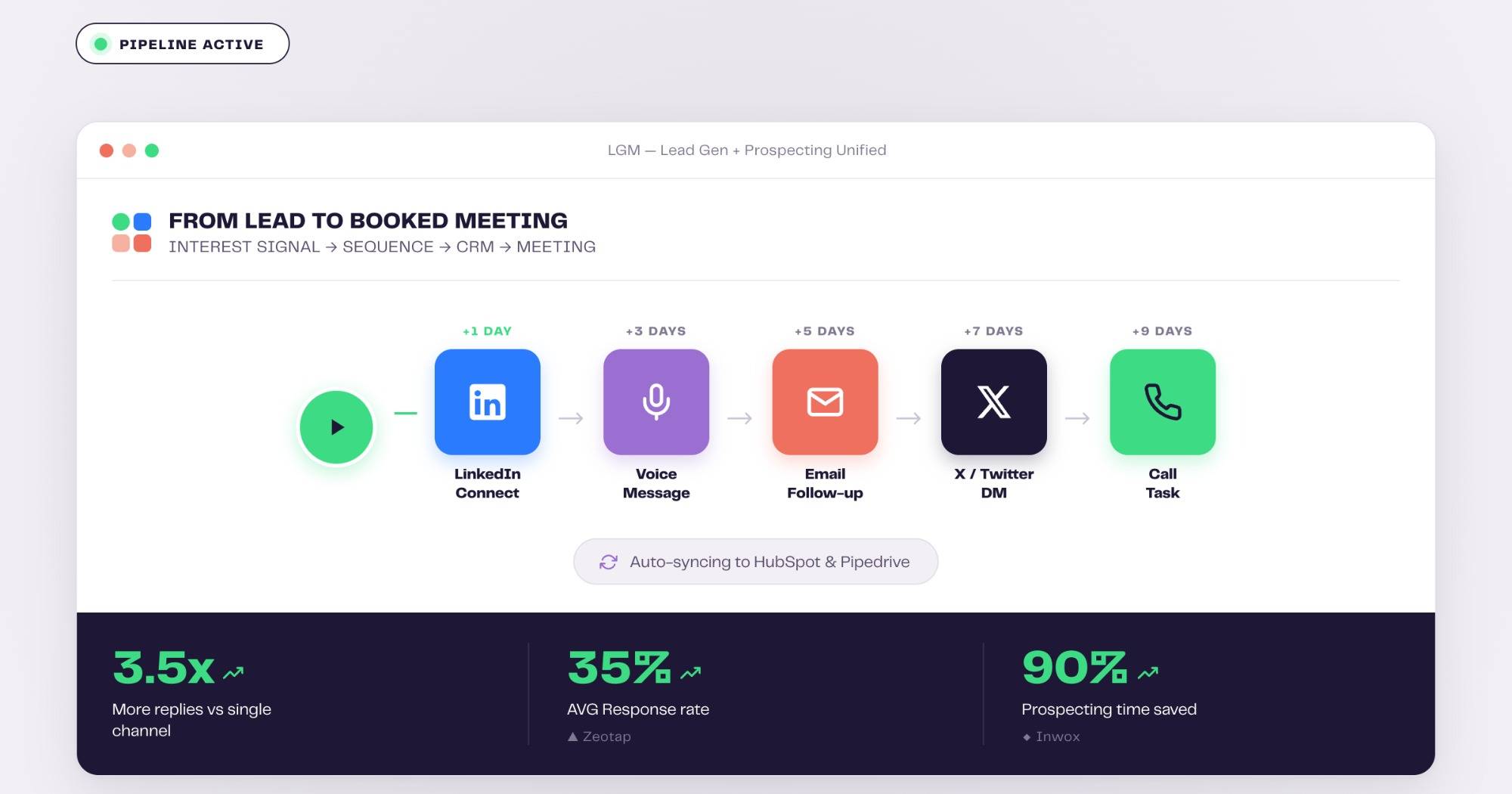
Pure prospecting: You import a list of target accounts, LGM automatically enriches contacts (emails, LinkedIn profiles) through waterfall enrichment, and launches a multichannel sequence: LinkedIn profile visit, connection request, follow-up message, email if no reply, Twitter DM. All from a single conditional workflow builder.
Inbound-to-outbound: A lead downloads content from your site. They become an MQL in your CRM. LGM syncs natively with HubSpot, Salesforce and Pipedrive: as soon as a lead reaches a defined stage in the CRM, a prospecting sequence triggers automatically. The warm lead receives a personalized LinkedIn message within 24 hours. No manual intervention from your SDR.
LinkedIn Intents: LGM detects interest signals on LinkedIn — visits to your company page, engagement with your content, job changes. These signals automatically trigger a targeted sequence. That is the convergence of lead generation (the interest signal) and prospecting (the direct outreach).
LGM plans start at €60/month per identity (Basic), €120/month (Pro) and €180/month (Ultimate). The Pro plan unlocks full conditional workflows and LinkedIn Intents. You can test the platform for free for 14 days at lagrowthmachine.com.
Best Practices for Combining Both in 2026
1. Define a marketing-sales SLA on leads
Every MQL passed to sales needs a defined follow-up timeline (e.g. contact within 4 hours). Without an SLA, inbound leads pile up without being worked.
2. Segment sequences by source
An inbound lead and a cold contact do not get the same message. Create distinct sequences based on contact origin: lead from content download, contact from LinkedIn list, or referred contact — each gets a different opening.
3. Measure the same final KPI
Marketing and Sales must align on the meeting booked as their shared metric. MQLs that never convert to meetings should trigger a review of qualification criteria.
4. Use interest signals to prioritize
Do not prospect all contacts with the same intensity. Contacts who visited your pricing page or downloaded a comparison guide deserve a more direct approach than those who only opened an email.
5. Do not over-contact inbound leads
A lead who found you through SEO does not need a 12-touch sequence. They have already done some qualification work. Simplify the journey and accelerate toward the demo.
FAQ
What is the real difference between a lead and a prospect?
A lead is a contact who has shown a minimal interest signal (filled out a form, clicked an ad). A prospect is a qualified contact who matches your ICP and for whom a sales conversation has been initiated or scheduled. All prospects pass through the lead stage, but not all leads become prospects.
Is lead generation exclusively a marketing function?
No. Sales and SDRs also do lead generation when they identify new target accounts from LinkedIn, databases or enrichment tools. But inbound lead generation — content, SEO, advertising — remains traditionally run by marketing.
Does outbound prospecting still work in 2026?
Yes, but the context has changed. Inboxes are saturated, LinkedIn acceptance rates have dropped for non-personalized messages. What works: multichannel sequences (LinkedIn + email + voice), deep personalization, and behavioral triggers (job change, funding round, page visit).
What budget should I allocate to each approach?
There is no universal ratio. A common rule of thumb among B2B scale-ups: 60% on outbound prospecting (immediate results) and 40% on inbound lead generation (long-term capital). This ratio shifts as content builds organic volume over time.
Can you automate prospecting without losing quality?
Yes, as long as you do not automate personalization. Generic mass-sent messages destroy sender reputation. Automation should focus on repetitive tasks: contact enrichment, sequence delays, follow-ups. Message personalization stays human or AI-assisted with review.
How do I measure the ROI of each approach?
Lead generation: CPL and cost per MQL. Prospecting: cost per meeting booked and pipeline generated per SDR. The arbitrage metric is cost per qualified opportunity — which approach generates a qualified opportunity at the lowest cost in your specific context.
Conclusion
Lead generation and prospecting are not opponents. They are complementary. One builds long-term demand, the other converts that demand into immediate pipeline.
The mistake to avoid: treating them as separate activities run by teams that do not talk to each other. High-performing teams align marketing and sales on shared qualification criteria, clear SLAs, and one final metric — the meeting booked.
La Growth Machine lets your SDRs manage both flows from a single platform: import cold lists and launch multichannel sequences, and sync inbound leads from your CRM to automatically trigger outreach at the right moment.
Start your free 14-day trial at lagrowthmachine.com — no credit card required.