

TL;DR
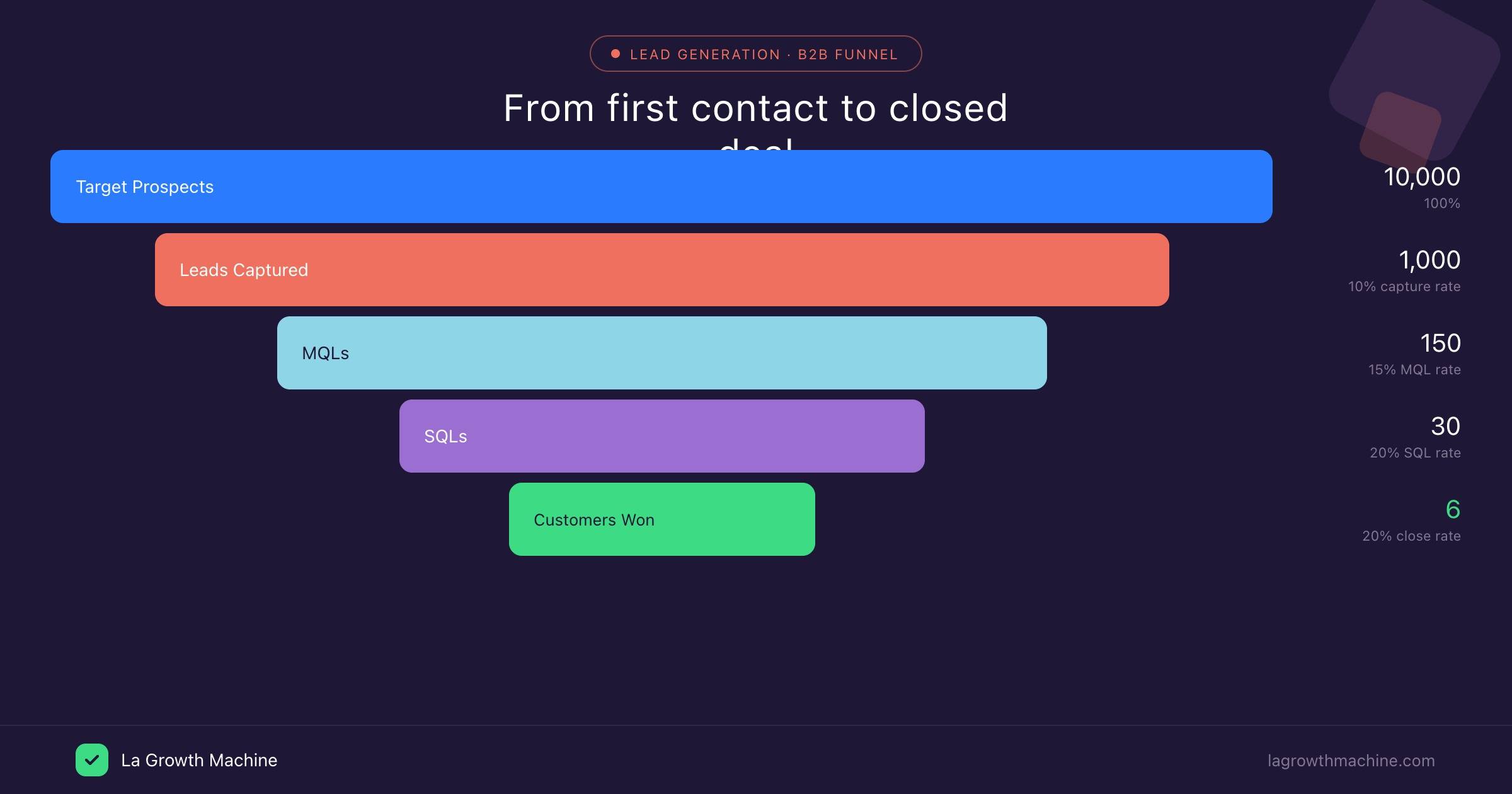
– Lead generation in 2026 is about pipeline quality, not lead volume — 80% of leads never convert without a clear ICP and a qualification system between MQL and SQL.
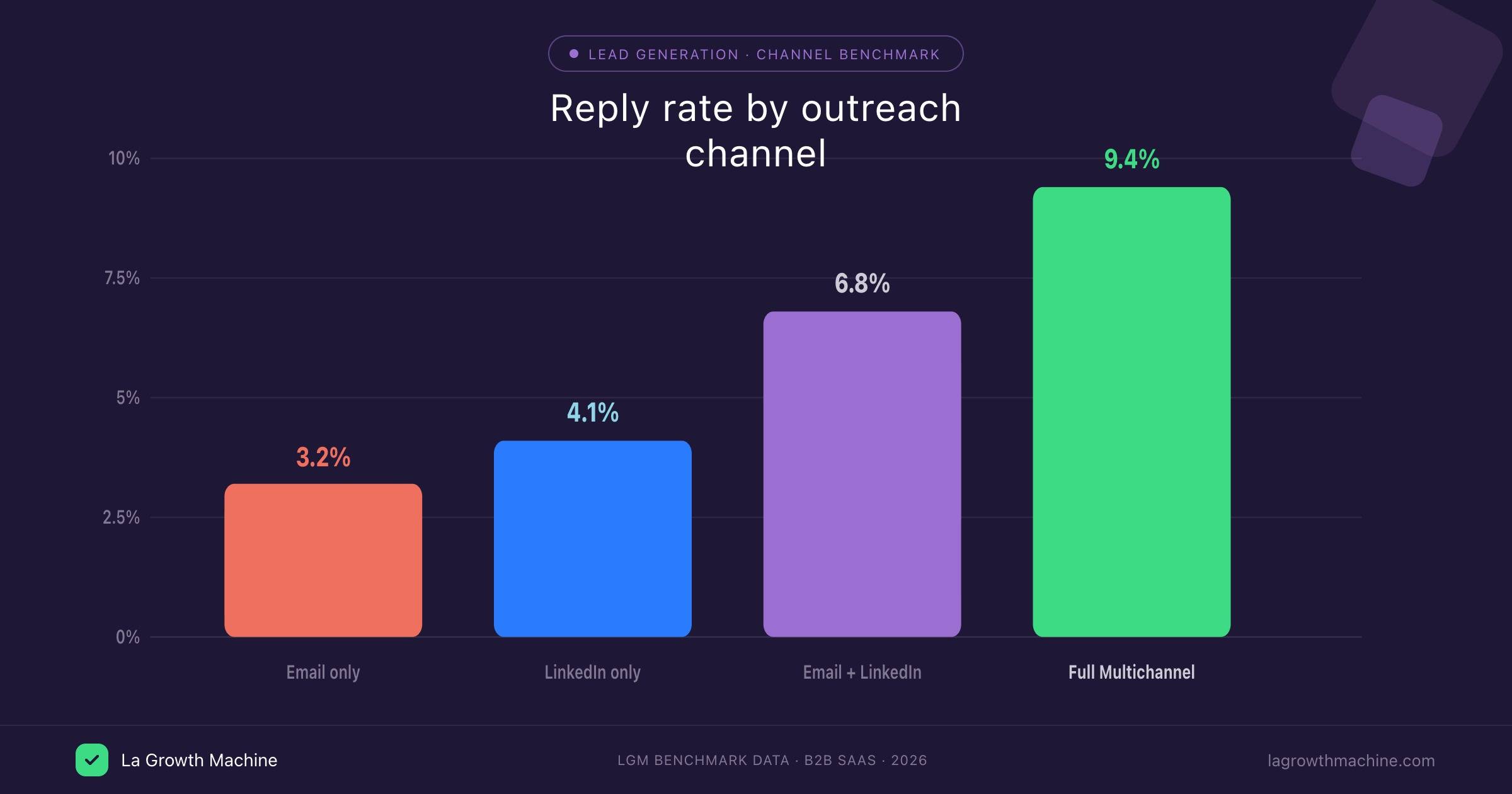
– Multichannel outreach (LinkedIn + email combined) generates significantly more meetings booked than any single-channel approach, with full multichannel reaching 9.4% reply rate vs 3.2% for email alone.
– La Growth Machine automates multichannel sequences across LinkedIn and email at scale, letting your team focus exclusively on live conversations — from €60/month per identity.
– Start with outbound (cold email + LinkedIn) for short-term pipeline, invest in content and SEO for long-term compounding growth — and always measure cost per SQL, not lead volume.
Most teams measure lead generation success by the number of leads they generate. That is the first mistake.
In 2026, the teams closing the most pipeline are not generating more leads. They are generating better ones, faster, and converting them more consistently. That requires a clear understanding of what lead generation actually involves, which techniques work at scale, and how to build a system that feeds your pipeline without burning out your sales team.
This guide covers all of it: the fundamentals, the best lead generation techniques available today, the strategies that scale, and the metrics that tell you whether it is working.
What is Lead Generation?
Lead generation is the process of identifying and attracting potential customers who have shown interest in your product or service, then moving them toward a sales conversation.
It sits at the foundation of every B2B revenue model. No leads, no pipeline. No pipeline, no revenue. But the definition misses the nuance that matters: not all leads are equal. A contact who downloaded a whitepaper and a contact actively evaluating vendors are both technically leads — but they require completely different approaches.
This is why modern lead generation is less about volume and more about qualification. According to research from Gartner, nearly 80% of new leads never turn into sales. The problem is rarely the number of leads — it is what happens to them after they enter the funnel.
The 3 Types of Leads You Need to Distinguish
Understanding which type of lead you are working with changes everything downstream.
Marketing Qualified Leads (MQLs) have shown interest through content consumption, form fills, or event attendance. They are not ready to buy — but they are worth nurturing toward a sales conversation.
Sales Qualified Leads (SQLs) have been vetted and match your Ideal Customer Profile. They have budget, authority, need, and a realistic timeline. These go directly into active pipeline.
Product Qualified Leads (PQLs) have experienced value through a free trial or freemium feature. They have shown intent through product behavior, not just content consumption — which makes them some of the highest-converting leads you can generate.
In practice, most teams over-invest in MQL volume and under-invest in the qualification layer between MQL and SQL. That gap is where pipeline generation breaks down.
Inbound vs Outbound Lead Generation: The Real Tradeoffs
The inbound vs outbound debate is a false choice. High-performing teams use both. The question is where to invest first based on your stage and resources.
| Inbound | Outbound | |
|---|---|---|
| Time to first lead | 3-12 months | Days to weeks |
| Cost at scale | Lower (compounds over time) | Higher (volume-dependent) |
| Targeting control | Limited | High |
| Prospect temperature | Warmer | Colder |
| Best for | Building authority and long-term pipeline | Hitting short-term pipeline targets |
Inbound lead generation attracts prospects organically through content, SEO, social media, and word of mouth. It compounds, lowers cost per lead over time, and generates warmer prospects. The tradeoff: it takes 6 to 12 months to build real momentum.
Outbound lead generation means going directly to your ideal prospects via cold email, LinkedIn outreach, or paid ads. It is faster to activate and easier to target precisely. The tradeoff: higher cost per lead and lower response rates if messaging or targeting is off.
The most effective B2B teams run both in parallel: inbound handles brand-aware demand, outbound fills the gaps and accelerates pipeline generation on a predictable cadence.
The 7 Best Lead Generation Techniques in 2026
| Technique | Best for | Speed | Cost | Scalability |
|---|---|---|---|---|
| Multichannel outreach | B2B pipeline, meetings booked | Fast | Medium | High |
| Content marketing + SEO | Long-term inbound pipeline | Slow | Low (long-term) | Very high |
| LinkedIn prospecting | B2B, senior buyers | Medium | Low-Medium | Medium |
| Cold email sequences | High-volume outbound | Fast | Low | High |
| ABM | Enterprise, large deals | Medium | High | Medium |
| Paid lead generation | Demand capture, testing | Fast | High | High |
| Referrals + partners | Warm, high-converting leads | Slow to build | Low | Medium |
1. Multichannel Outreach (LinkedIn + Email)
Multichannel outreach is the highest-performing lead generation technique for B2B teams in 2026. Reaching the same prospect across LinkedIn and email significantly increases the number of meetings booked compared to either channel alone.
The approach: identify your ICP, build a targeted list, and run coordinated sequences across LinkedIn (connection request, follow-up message, InMail) and email (cold email, structured follow-ups). Automation handles the sequencing so your team focuses on conversations, not manual admin.
La Growth Machine is built for this workflow — multichannel sequences running automatically until a reply comes in, at which point your rep takes over. Plans start at €60/month per identity.
2. Content Marketing and SEO
Content marketing generates inbound leads by answering the questions your prospects are already searching for. It is the highest-ROI long-term lead generation channel for most B2B companies.
The key is targeting keywords with commercial intent, not just traffic volume. A guide on lead generation techniques attracts prospects actively researching how to generate pipeline — exactly the right audience for a sales tool.
An effective content-led approach combines a content hub targeting primary and secondary keywords, gated resources (playbooks, templates) to convert readers into leads, and internal linking to move readers toward higher-intent pages.
3. LinkedIn Prospecting
LinkedIn is the highest-quality B2B prospecting channel available. With over 900 million professionals on the platform and data that self-updates, it removes the data quality problem that plagues most outbound databases.
Effective LinkedIn lead generation combines profile optimization, targeted connection requests with personalized notes, content publishing to build visibility with your ICP, and LinkedIn Sales Navigator for precise audience filtering by role, company size, industry, and growth signals.
4. Cold Email Sequences
Cold email remains one of the most scalable B2B lead generation techniques when done correctly. What works in 2026: hyper-targeted lists built against a precise ICP, personalized first lines based on real prospect context, short emails focused on a single pain point, and structured follow-up sequences of three to five touches minimum.
What kills deliverability and pipeline: purchased lists, generic copy, sequences with no pauses, and sending from domains with no warmup history. Most cold email failures come from execution problems, not channel limitations.
5. Account-Based Marketing (ABM)
ABM flips the traditional lead generation funnel. Instead of generating volume and qualifying down, you identify high-value target accounts first and build coordinated campaigns specifically for them.
It is resource-intensive but produces higher conversion rates and larger deal sizes. Best suited for teams with a clear ICP, deal sizes above $10k, and at least one dedicated marketing resource to support outbound with content and paid retargeting.
A basic ABM motion: define 50 to 200 target accounts, identify the buying committee at each, run personalized outreach alongside paid retargeting simultaneously, and track account-level engagement rather than individual contact activity.
6. Paid Lead Generation (LinkedIn Ads, Google Ads)
Paid channels generate leads immediately and give precise targeting control. The catch: cost per lead is high and results stop the moment you stop spending.
LinkedIn Lead Gen Forms — where prospects submit contact info without leaving the platform — consistently outperform website traffic campaigns for pipeline generation when targeting a precise B2B audience. Google Ads work best for capturing high-intent search demand that your organic content has not yet earned.
Use paid primarily to validate messaging and capture existing demand. Organic channels should carry the long-term volume.
7. Referrals and Partner Programs
Referred leads close at higher rates and churn less. They come pre-qualified by someone who already trusts your product, which means your sales team starts every conversation with credibility already established.
A basic referral program: ask happy customers directly, make the process frictionless, and offer a meaningful incentive. Partner programs — resellers, integration partners, co-marketing with complementary tools — scale referrals without requiring 1-to-1 asks.
Lead Generation Strategies That Scale
Individual techniques generate leads. Strategies determine whether those leads become consistent pipeline.
Define Your ICP First
Who exactly is your ideal customer? Industry, company size, role, tech stack, growth stage, budget signals. The tighter your ICP, the higher your conversion rates across every channel. Generating leads outside your ICP wastes sales capacity and skews your metrics in ways that lead to bad investment decisions.
Lead Scoring: Stop Wasting Sales Time
Not every lead deserves immediate sales attention. Lead scoring assigns points based on demographic fit (how well the contact matches your ICP) and behavioral signals (pages visited, content downloaded, emails opened). When a lead reaches a threshold score, it routes to sales automatically.
This keeps your team focused on prospects with real intent and prevents high-potential leads from being buried under low-quality volume.
Automate the Repeatable, Keep Humans on the Conversational
Research, list building, sequence enrollment, and follow-ups can all be automated. The moment a prospect replies, a human takes over. This is the model that scales outbound without degrading the quality of the conversation.
La Growth Machine runs this automated layer — multichannel sequences execute automatically until a reply comes in. Your team only spends time on live conversations and pipeline management.
Key Metrics to Track
| Metric | What it measures | B2B benchmark |
|---|---|---|
| Cost per Lead (CPL) | Channel efficiency | $150-400 (varies by industry and channel) |
| MQL-to-SQL conversion rate | Qualification quality | 10-20% |
| SQL-to-Close rate | Sales effectiveness | 15-30% |
| Pipeline generated per channel | Business impact per source | Target: 3-4x your quarterly revenue goal |
| Customer Acquisition Cost (CAC) | Total acquisition efficiency | Should be less than 1/3 of LTV |
Track these per channel, not just in aggregate. Knowing your overall CPL is $200 tells you little. Knowing that LinkedIn outreach generates SQLs at $180 and paid ads at $620 tells you exactly where to shift budget.
8 Lead Generation Mistakes to Avoid
- Prioritizing volume over quality. More leads is not better leads. Set MQL standards before launching campaigns and hold them.
- Skipping ICP definition. Without a precise ICP, your sales team wastes cycles on contacts who will never convert.
- Single-channel dependency. One channel going down kills pipeline overnight. Build at least two independent lead sources.
- No follow-up sequence. Over 80% of conversions happen after the third contact. One email with no follow-up is not a strategy.
- Ignoring email deliverability. Sending from unwarmed domains or to purchased lists lands you in spam before you even start.
- Treating all leads the same. An MQL who downloaded a top-of-funnel guide needs different content than an SQL evaluating vendors.
- No lead scoring. Without scoring, everything routes to sales and nothing gets prioritized properly.
- Measuring lead volume instead of pipeline. Lead count is a vanity metric. Pipeline contribution per channel is what drives resource allocation decisions.
FAQ
What is lead generation in B2B?
Lead generation in B2B is the process of identifying potential business customers and attracting them into your pipeline through inbound or outbound methods, then qualifying them for a sales conversation.
What is the best lead generation technique in 2026?
Multichannel outreach combining LinkedIn and email consistently outperforms single-channel approaches for B2B teams. When paired with a precise ICP and lead scoring, it generates the highest-quality pipeline at a predictable cost.
How do you generate leads without a big budget?
Start with outbound — cold email and LinkedIn prospecting require more time than money. Simultaneously invest in content marketing, which compounds over time. Referrals cost almost nothing and convert at the highest rate of any channel.
What is the difference between a lead and a prospect?
A lead is any contact who has shown some level of interest. A prospect is a lead who has been qualified as a potential buyer — they fit your ICP and have indicated intent to evaluate or purchase.
How long does lead generation take to show results?
Outbound channels can generate leads within days. Inbound channels like SEO and content marketing typically take 3 to 12 months to produce consistent volume. Most teams run both simultaneously to balance short-term pipeline needs with long-term compounding growth.
What tools do you need for B2B lead generation?
At minimum: a CRM, a data source for prospect lists, and an outreach platform for multichannel sequences. La Growth Machine covers prospecting and multichannel outreach in a single platform, starting at €60/month per identity.
What is lead scoring and why does it matter?
Lead scoring is a system that assigns points to leads based on how well they match your ICP and how they behave with your content. It tells your sales team which leads to prioritize, which to nurture, and which to disqualify — preventing pipeline waste.
How do you measure lead generation success?
Track MQL-to-SQL conversion rate, cost per SQL, pipeline generated per channel, and revenue contribution. Volume metrics like number of leads are useful context but should never be primary KPIs.
Conclusion
Lead generation in 2026 is not about generating more activity. It is about building a system that produces consistent, qualified pipeline.
That starts with a precise ICP, combines the right mix of inbound and outbound techniques, and uses automation to scale without losing the personalization that drives replies.
The teams that win at lead generation do not try every channel. They pick two or three that fit their audience, execute them with discipline, and measure what connects to revenue — not what flatters their dashboards.