


Sales Automation in 2026:
The Complete B2B Guide
Most teams automate the wrong things first — and scale noise instead of pipeline. This guide covers the stack, the sequence structure, and the attribution that actually generate revenue you can prove.

- Sales automation is the practice of using software to remove repetitive, low-judgment tasks from the sales process — lead research, outreach sequencing, follow-ups, CRM updates — so reps focus on the only thing that closes deals: conversations.
- Most teams fail because they automate before their process is validated, or run single-channel campaigns with no CRM attribution. They scale noise, not pipeline.
- A working stack has three distinct layers: data enrichment (Clay, Apollo, Cognism), outreach execution (La Growth Machine), and CRM attribution (HubSpot, Pipedrive, Salesforce). Each does one job.
- Multichannel structured outreach — LinkedIn + email in a coordinated sequence — books 3.5x more meetings than single-channel blasts and gives managers full pipeline visibility.
- La Growth Machine is a multichannel outreach platform that runs LinkedIn, email, and Twitter sequences with native CRM sync, AI-powered personalization, and no LinkedIn ban risk.
What is sales automation?
Sales automation is the practice of using software to handle repetitive, low-judgment tasks across the sales process: lead research, outreach sequencing, follow-ups, CRM updates, and meeting scheduling. The goal isn't to replace salespeople — it's to remove the manual work that prevents them from doing the one thing that generates pipeline: having real conversations.
That's the core problem. Most teams buy tools before they understand their own process. They automate sequences that weren't converting manually, on channels they haven't validated, into a CRM that doesn't log any of it. The tool isn't the issue. The order of operations is.
In 2026, the definition has expanded: sales automation now includes AI-assisted personalization at the message level, intent-based triggering (acting when a prospect changes jobs, raises a round, or visits your pricing page), and real-time bidirectional CRM sync that makes pipeline visible to everyone from SDR to CFO. But the core principle is unchanged: automate the predictable, protect the judgment-dependent.
Sales automation ≠ marketing automation. Marketing automation handles top-of-funnel nurture — email drips triggered by content downloads, lead scoring from website behavior. Sales automation starts when a prospect enters the pipeline: targeted outreach sequences, multichannel follow-ups, reply management, and revenue attribution. The two are complementary — La Growth Machine sits in the sales layer, picking up where marketing automation ends.
The sales automation stack in 2026
The execution layer is where most teams under-invest. Enrichment tools are increasingly interchangeable — you'll switch Apollo for Clay, and Clay for something else as the market evolves. Your outreach platform and your CRM are the constants. They're where your process lives. Build the stack around those two first, then plug in enrichment tools as needed.
How the three layers connect
Why most sales automation fails
Automating before the process is validated. If your outreach isn't converting manually, automation will only send more of the wrong messages faster. The sequence structure, the ICP, the value proposition — all of this needs to work at small scale before you automate it. Validate manually first. Automate second.
Signal you're here: reply rates under 3%, high unsubscribe rates, reps saying the leads "aren't interested."
Single-channel outreach. Email-only campaigns average 1–3% reply rates. LinkedIn-only gets 5–8%. Run both in a coordinated sequence — LinkedIn connection on day 1, message on acceptance, email on day 4 if no reply — and you reach 12–18%. Most teams pick one channel and wonder why results plateau.
Signal you're here: email-only campaigns, no LinkedIn sequences, or completely separate tools for each channel with no shared logic or conditional branching.
No connection to revenue. Tracking open rates and reply rates is not the same as tracking pipeline. If you can't attribute booked meetings and generated deals to specific outreach campaigns, you can't prove ROI to leadership — and you can't improve what's actually working. Most teams optimize for vanity metrics because they never set up attribution.
Signal you're here: weekly reports full of "engagement" with no pipeline or revenue line item anywhere.
The teams that win in 2026 aren't the ones who automated the most. They're the ones who protected the moments that needed a human — qualification calls, objection handling, enterprise negotiations — and automated everything else with full visibility into the revenue impact of each campaign.
What structured outreach actually delivers
But the most important number for any sales team isn't on this chart. It's the percentage of your pipeline that you can directly attribute to outreach. Most teams don't know this number today. Building the right automation stack is how you start tracking it.
The sales automation stack in 2026
Map your process before you touch any tool.
Write down every task your team does manually in a week. Sort by frequency and judgment required. High-frequency, low-judgment tasks automate first: lead research, follow-up sequences, CRM logging, meeting scheduling. Anything requiring relationship context, nuanced reading of a conversation, or subjective judgment stays human.
Common trap: automating lead qualification. Scoring leads based on engagement signals is automatable — deciding whether a lead is actually a product fit is not.
Define your ICP with precision
Automation amplifies targeting — good or bad. A vague ICP means sending the right message to the wrong people at scale. Before building any sequence, lock in: company size, industry vertical, role and seniority, tech stack signals, and at least one concrete buying trigger (headcount growth, recent funding, new VP hire, expansion into a new market).
Validate your ICP against your last 20 closed deals. If the profile doesn't match 80%+ of them, tighten it before automating anything.
Build multichannel sequences, not single-channel blasts
LinkedIn connection request on day 1 → personalized message on acceptance → email follow-up on day 4 if no reply → second LinkedIn touch on day 8. Add conditional logic: if they reply on LinkedIn, skip the email. If they open the email three times without responding, trigger a nudge. This coordination — not volume — is what gets reply rates above 10%.
In La Growth Machine, conditional branches are built visually in the sequence editor. You set the trigger, LGM handles the routing.
Connect your outreach platform to your CRM
Every touchpoint, reply, LinkedIn connection, and stage change should sync to your CRM automatically. No manual logging. No end-of-week updates. Your pipeline should reflect what's happening in real time — so managers can report on it, reps can prioritize correctly, and leadership can see outreach-attributed revenue without a spreadsheet.
La Growth Machine syncs natively with HubSpot, Pipedrive, and Salesforce — bidirectional, real time.
Set up lead scoring and routing
Not all replies are equal. A prospect who clicked your link twice and replied "interesting, tell me more" is not the same as one who asked to unsubscribe. Set up engagement-based scoring so reps always know which conversations to prioritize — and let cooler leads flow automatically into a re-engagement sequence next quarter.
Measure pipeline attributed to outreach, not reply rates
Set up attribution before your first campaign goes live. Track three numbers: meetings booked per sequence, pipeline generated per campaign, deals closed from outreach. These are the numbers that justify the budget, surface what's working, and tell you exactly where to iterate. Open rates are a proxy. These three are the business.
Sales automation examples that actually move pipeline
Conditional branch: reply received at any step → sequence pauses, rep takes over.
AI in sales automation: what actually works in 2026
- Writing personalized first-line openers at scale (company news, LinkedIn posts, job changes)
- Researching prospects and surfacing relevant signals before outreach
- Scoring leads based on engagement behavior across email and LinkedIn
- Generating and A/B testing subject line variants
- Summarizing long reply threads and suggesting next-step actions for reps
- Qualifying whether a prospect is actually a product fit
- Handling live objections in discovery or demo calls
- Building trust in high-stakes or long-cycle enterprise deals
- Deciding when to permanently exit a prospect from all sequences
- Judging whether a reply is genuinely warm or politely dismissive
See how to build a multichannel AI sales agent →
The practical rule: use AI to help reps do more of the right things, faster. Never use it to automate the judgment calls that determine whether a deal closes. The moment a prospect feels like a number in a batch sequence, you've already lost the conversation.
La Growth Machine is a multichannel outreach platform that runs LinkedIn, email, and Twitter sequences with native CRM sync, AI-powered personalization, and no LinkedIn ban risk. Build your sequence once in the visual editor, set your conditional branches, and let it run across every channel — while every reply, booking, and stage change is attributed back to the exact campaign that generated it.
It's not a replacement for Clay or Apollo — it's the execution layer between your enrichment stack and your CRM. Where the outreach happens, where conversations start, and where pipeline gets built.
Go deeper on sales automation
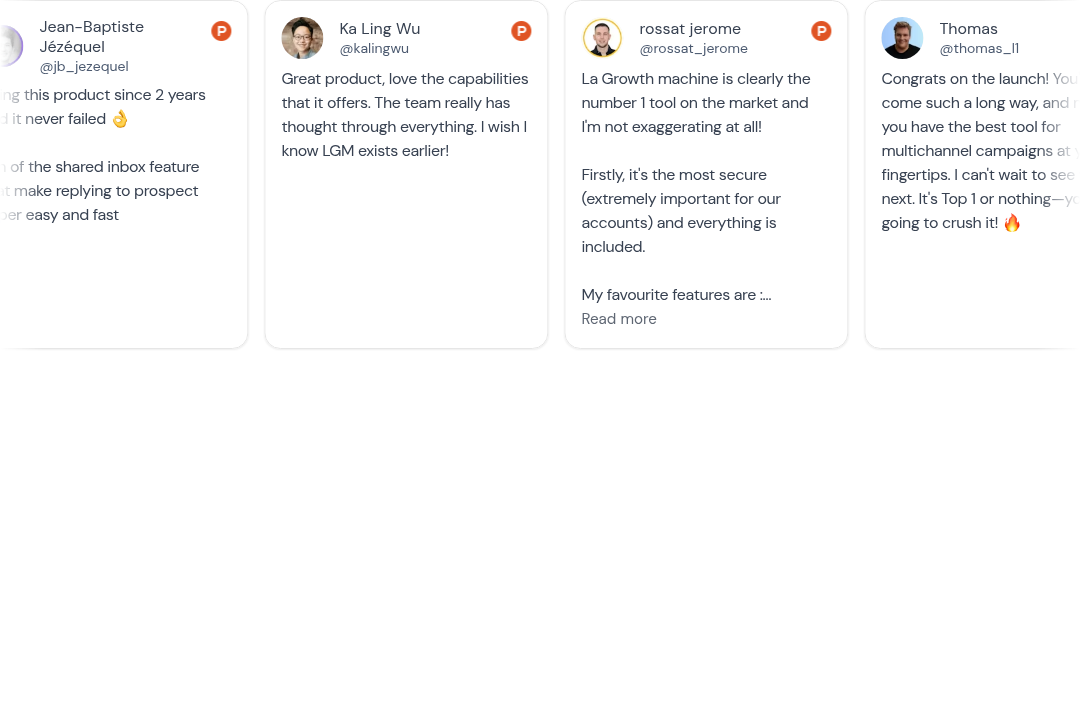
What revenue teams say after switching to La Growth Machine







Keep building
Join 45,000+ revenue teams using La Growth Machine to connect outreach to pipeline, not just activity metrics.
Frequently Asked Questions
about LinkedIn Safety
