

Are you trying to get the best out of your prospecting actions for B2B? There are several LinkedIn prospecting techniques that can boost your lead generation to the next level.
One underutilized tactic is cold messaging – sending a message to someone you don’t know, in the hopes of starting a conversation.
What is cold messaging on LinkedIn? What are the advantages for businesses? How to do it properly?
In this post, we’ll explain what cold messaging is, what its benefits are, and share some tips for doing it well. Stay tuned!
What is a LinkedIn cold message?
A cold message on LinkedIn is a message that you send to someone you don’t know, to start a conversation with one or many prospects.
Basically, it’s a way to reach out to new people that could be interested in your products or services, without being too sales-y.
To do this, you need to have a good understanding of who your target market is and what their needs are. Once you know this, you can start using a tool to prospect on LinkedIn and send them a personalized sales message.
Cold messaging is one of the most underestimated sales techniques to do LinkedIn lead generation. But when you do it the right way, it’s incredibly efficient.
Great cold messaging always comes with the previous step, which is great segmentation. For this matter, you can use Sales Navigator Boolean searches.
Why should businesses use cold messaging on LinkedIn?
As we’ve just seen above, LinkedIn cold messages are simply a way to do traditional business by reaching out to someone the same way you would have done it by phone or email.
Except for the fact that it’s happening through LinkedIn.
There are several advantages to using this technique:
- You can reach out to high-quality prospects that you wouldn’t be able to connect with otherwise. To know more about contacting someone, you can check our post “How to reach out to someone on LinkedIn?”
- You can reach out to an unlimited number of leads on your domain
- It’s a low-cost way to get new customers
- You can start building relationships with potential customers before you even have a product or service to sell
- You can nurture these relationships over time so that when you do have something to sell, they’ll be more likely to buy from you
- It’s also a great way to build brand awareness
This is a non-exhaustive list, but you got the idea: LinkedIn cold messaging is a direct way to get new B2B leads without spending a huge amount of money.
But it’s pretty time-consuming, though.
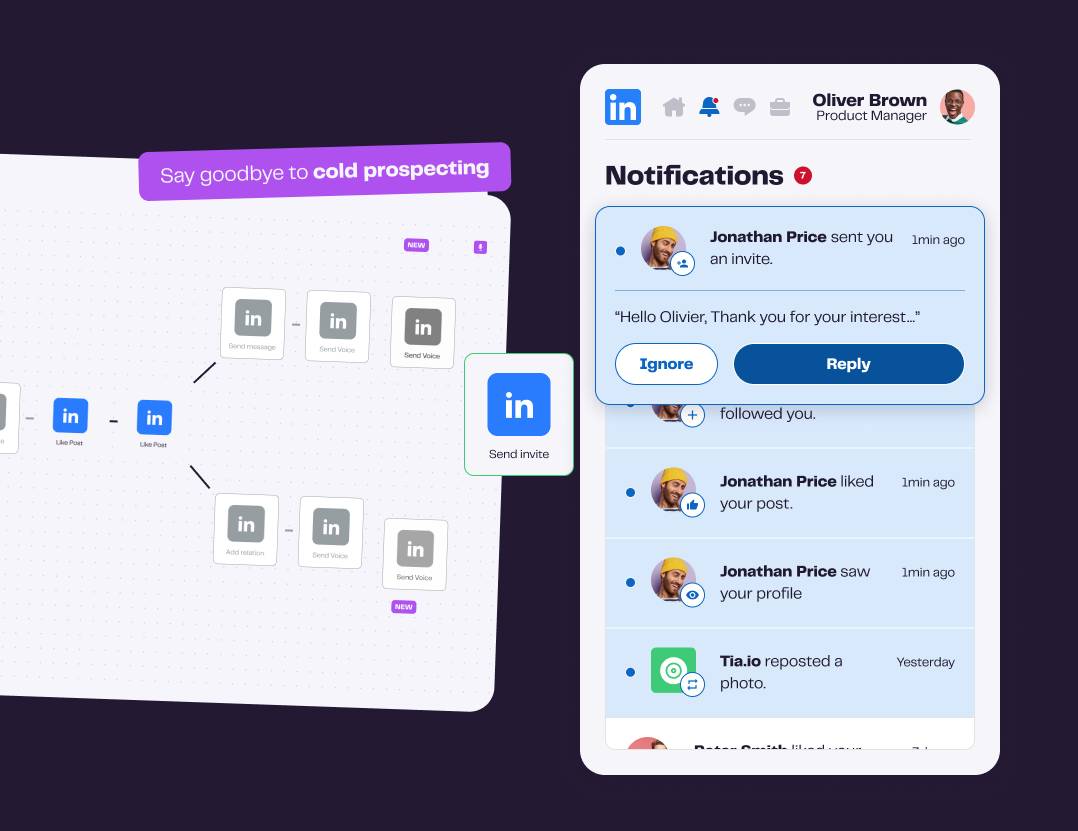
That’s why we created La Growth Machine. With our LinkedIn Automation tool, you can easily import lists of leads from any source, and build your LinkedIn prospecting sequence in advance to do the same things, in a few minutes instead of days or weeks.
Types of LinkedIn cold messages
Before diving into templates and strategies, let’s clarify the three main types of LinkedIn cold messages you can send:
Connection request messages
These are the 300-character notes you can attach when sending a connection request to someone you’re not connected with. These are your foot in the door—make them count.
Best for: Initial outreach when you haven’t interacted with someone before
Character limit: 300 characters (not words!)
Success factor: Personalization and mentioning a specific reason you’re reaching out
Follow-up messages after connecting
Once someone accepts your connection request, you can send them a standard LinkedIn message with no character limit. This is where you can expand on your initial message and move the conversation forward.
Best for: Building on the connection you’ve established, providing value, asking for meetings
Character limit: None (but keep it under 200 words for best results)
Success factor: Don’t immediately pitch—provide value first, then ask
InMail messages
InMails let you message people you’re not connected with, but they require a LinkedIn Premium subscription. They come with subject lines and have much higher visibility than connection requests.
Best for: Reaching decision-makers who don’t accept connection requests, following up when your connection request is ignored
Character limit: 1,900 characters including spaces
Success factor: Compelling subject line + immediate value in the opening line
Understanding LinkedIn messaging limits and best practices
Here’s what nobody tells you about LinkedIn outreach: there are hard limits built into the platform, and if you exceed them, your account gets restricted or worse—banned.
InMail credits by subscription tier
Premium Career: 5 InMail credits per month
Premium Business: 15 InMail credits per month
Sales Navigator Core: 50 InMail credits per month
Sales Navigator Advanced: 50 InMail credits per month (but with better targeting)
Recruiter Lite: 30 InMail credits per month
Credits roll over: Unused InMail credits carry over to the next month, up to a maximum of 5x your monthly allocation. So Sales Navigator users can bank up to 250 credits.
Free InMails: You get 1 free InMail credit back when your recipient responds to your InMail. This is why response rates matter—they directly impact how many people you can reach.
Weekly/monthly sending recommendations
Here’s the sustainable outreach volume that keeps you safe while maximizing reach:
Daily limits:
- Connection requests: 15-20 per day
- Messages to existing connections: 50-100 per day
- InMails: 5-10 per day (if you have the credits)
Weekly targets:
- 100-125 connection requests
- 200-300 messages to connections
- 20-30 InMails (Sales Navigator users)
Pro tip: LinkedIn tracks your activity patterns. If you suddenly go from 10 connections/week to 100, that’s suspicious. Ramp up gradually over 2-3 weeks.
Open profile vs. standard InMail
There are actually two types of InMails:
Standard InMail: Requires Premium, counts against your credits, goes to anyone on LinkedIn
Open Profile InMail: 100% free, unlimited, but only works for people who’ve enabled “Open Profile” settings (typically recruiters, salespeople, and consultants looking for inbound opportunities)
To find Open Profile members, look for the “OpenLink Network” badge on their profile. These people have specifically indicated they want to receive messages from anyone, making them ideal targets for cold outreach.
How to prepare before sending your first cold message
Before you start firing off connection requests, you need to set the stage. Think of cold messaging like showing up to a networking event—you wouldn’t walk in looking disheveled and immediately start pitching, right?
Step 1: Optimize your LinkedIn profile for cold outreach
Your LinkedIn profile is your credibility. When someone receives your message, the first thing they’ll do is click your name to see who you are. If your profile looks incomplete, generic, or salesy, you’ve lost them.
Profile photo and banner optimization:
- Professional headshot with good lighting (not a cropped vacation photo)
- Smiling, approachable expression—you want to look like someone people would want to talk to
- Banner image should reflect your industry or value proposition (not the generic LinkedIn default)
Headline that builds credibility:
- Bad: “Sales Manager at Company XYZ”
- Good: “Helping SaaS companies increase pipeline by 40% | Outbound Sales Strategist”
- Your headline should communicate who you help and how you help them, not just your job title
Summary that addresses your prospects’ needs:
- Don’t make it about you—make it about them
- Lead with the problem you solve: “Most sales teams waste 60% of their time on leads that never convert…”
- Include proof points: results, client names, case studies
- End with a call-to-action: “If you’re looking to [outcome], let’s connect”
Proof elements:
- Get 5-10 recommendations from clients or colleagues
- Add relevant certifications or awards
- Include rich media: presentation slides, videos, portfolio work
Your profile should answer this question in 10 seconds: “Can this person help me solve my problem?”
Learn more about optimizing your LinkedIn profile.
Step 2: Define your target audience
Cold messaging without proper targeting is like throwing darts blindfolded. You might hit something eventually, but you’ll waste a lot of time and annoy a lot of people.
Building your buyer persona:
Start with the basics: job titles, industries, company size, location. But don’t stop there. The best targeting goes deeper:
- What are their KPIs and how are they measured?
- What keeps them up at night? (Revenue targets, team performance, competitive threats)
- Where do they consume information? (LinkedIn groups, industry publications, conferences)
- Who influences their decisions? (Bosses, peers, industry analysts)
Identifying decision-makers:
Job title alone doesn’t tell you if someone can actually buy from you. Use LinkedIn’s search filters to look for signals:
- Seniority level (Director, VP, C-suite)
- Decision-making indicators in their profile (“responsible for…”, “oversees budget for…”)
- Recent job changes (new hires in relevant roles often have budget to make changes)
Using Sales Navigator filters effectively:
Sales Navigator is built for this. Key filters to master:
- Function + Seniority: Find VPs of Sales, Directors of Marketing, etc.
- Company headcount + growth: Target companies in growth mode (hiring aggressively)
- Posted on LinkedIn in past 30 days: Active users are more likely to see and respond
- Changed jobs in past 90 days: New role = new budget and fresh perspective
- Interested in: Shows what topics they follow (use this to personalize messages)
Save your searches and set up alerts. Sales Navigator will notify you when new people match your criteria.
Check out our guide on building a list from LinkedIn Sales Navigator.
Step 3: Set SMART sales objectives
Cold outreach without goals is just activity without outcomes. You need to know what success looks like.
Defining success metrics:
- Primary metric: Meetings booked (not just responses—actual conversations that could lead to opportunities)
- Secondary metrics: Acceptance rate (connections accepted / requests sent), response rate (responses / messages sent), reply-to-meeting rate (meetings / responses)
Planning your outreach volume:
Work backwards from your goal:
If you need 10 new qualified meetings per month:
- Assuming 40% acceptance rate = 25 connection requests needed
- Assuming 30% response rate to first message = ~8 responses
- Assuming 60% of responses lead to meetings = ~5 meetings
- Account for follow-ups and InMails bringing in another 5 meetings
This means you need to send at least 25 connection requests per week to hit 10 meetings per month. Adjust based on your actual conversion rates.
Setting up tracking systems:
Use a CRM or simple spreadsheet to track:
- Who you’ve contacted and when
- Their response (or lack thereof)
- Next steps and follow-up dates
- Which message templates perform best
How to write LinkedIn cold messages that get responses
Now we get to the core: crafting messages that people actually want to read and respond to.
The 4 pillars of effective cold messages
Every high-converting LinkedIn message is built on these four foundations:
Personalization beyond first names:
Using {FirstName} is table stakes. Real personalization references:
- Something specific they posted or shared
- A mutual connection or shared group
- Their company’s recent news (funding, product launch, expansion)
- A pain point specific to their role or industry
Relevance to their current situation:
Your message needs to connect to something happening in their world right now:
- “Noticed your company just expanded into EMEA…”
- “Saw your post about struggling with [specific challenge]…”
- “Given the recent changes in [industry], I imagine you’re focused on [problem]…”
Relevance answers the prospect’s question: “Why should I care about this message today?”
Brevity that respects their time:
Get to the point fast. Structure your messages like this:
- Line 1: Why you’re reaching out (personalized hook)
- Line 2-3: What’s in it for them (value proposition)
- Line 4: Clear call-to-action (what you want them to do)
Connection request messages need to be especially tight—you only get 300 characters.
Clear intent and call-to-action:
Don’t make people guess what you want. End with a specific, low-friction ask:
- “Would you be open to a 15-minute call next week?”
- “Can I send you a case study of how we helped [similar company]?”
- “Worth a quick conversation?”
Vague endings (“Let me know if you’re interested”) don’t convert. Specific, easy asks do.
Essential copywriting principles
Leading with their needs, not your pitch:
Bad: “We’re a leading provider of [your product category] with 10 years of experience…”
Good: “Most [their role] struggle with [specific problem]. We’ve helped companies like [similar company] solve this by [specific outcome].”
See the difference? The first message is about you. The second is about them.
Learn more about effective email copywriting (the principles apply to LinkedIn too).
The “pain point” strategy:
People don’t buy products—they buy solutions to problems. Lead with the pain:
“I noticed [Company] is expanding into new markets. Most companies we work with struggle with [specific challenge] during that growth phase—especially around [detailed pain point]. We’ve developed an approach that helps [solve that specific problem].”
This works because you’re demonstrating you understand their situation better than a generic sales pitch would.
Creating genuine curiosity:
The best cold messages make people want to know more:
“We recently helped [Similar Company] increase [metric] by [impressive number]% using an approach that most [their industry] companies overlook.”
Now they’re thinking: “What’s the approach? Why does it work? How did [Similar Company] do it?” You’ve created a curiosity gap that can only be filled by responding.
Balancing professionalism with authenticity:
You’re reaching out cold—acknowledge it. Don’t pretend you’re old friends:
“Hey [Name], I know this is out of the blue, but I saw [specific thing] and thought it was worth reaching out…”
This transparency builds trust. You’re not trying to trick anyone.
Common mistakes that kill response rates
Let’s talk about what not to do—because avoiding these mistakes is often more impactful than perfecting your approach.
Generic, copy-paste messages:
If your message could be sent to 1,000 people without changing a word, it’s too generic. People can smell mass outreach instantly, and they delete it just as fast.
Bad: “Hi [Name], I help companies like yours grow their sales. Would love to connect!”
This could go to literally anyone. It shows zero research and no real reason to connect.
Being too pushy or salesy upfront:
Don’t lead with your pitch. Build rapport first:
Bad: “Hi [Name], I see you’re looking for sales automation solutions. Let me show you why we’re the best option…”
You don’t know if they’re looking for sales automation. You don’t know what their priorities are. You’re guessing and pushing your agenda.
Good: “Hi [Name], saw your post about scaling outbound. Curious—how are you currently handling follow-ups at [Company]?”
Ask first. Understand their situation. Then (and only then) position your solution.
Ignoring the recipient’s profile and interests:
If someone posts content about AI in marketing and you message them about email deliverability without acknowledging their AI interests, you’re missing an easy connection point.
Browse their recent activity before messaging. Reference something they care about. Show you’ve done 30 seconds of research.
Poor timing and follow-up cadence:
Sending a connection request and following up 24 hours later = desperate and annoying.
Sending a message and never following up = leaving money on the table.
The right cadence:
- Connection request (Day 1)
- Wait for acceptance (typically 3-5 days)
- First message (Day of acceptance or day after)
- Follow-up if no response (5-7 days later)
- Second follow-up (7-10 days after that)
- Final message or move on (7 days after second follow-up)
Two touchpoints per week maximum. More than that feels spammy.
25+ LinkedIn cold message templates that work
Now let’s get to the templates. Use these as starting points, not scripts. Every template should be customized with specific details about your prospect.
A note on response rates: The percentages you’ll see below are based on real campaigns from La Growth Machine users and our own internal testing. Your results will vary based on your targeting, industry, and how well you customize the templates.
Templates for connection requests
Remember: You only get 300 characters for connection requests. Make every word count.
Template 1: Mutual connection reference
Hi [FirstName], I noticed we’re both connected to [MutualConnection]. [He/She] and I worked together at [Company/Project], and I see you’re doing interesting work in [Industry/Role]. Would love to connect!
Why it works: Social proof from a mutual connection significantly increases acceptance rates. People trust recommendations from their network.
Expected acceptance rate: 55-65%
Template 2: Shared LinkedIn group member
Hey [FirstName], saw we’re both in the [GroupName] group. I’ve been following the discussions about [Topic] and noticed your insights on [Specific Point]. Let’s connect!
Why it works: Shared communities create instant common ground. You’re not a complete stranger—you’re part of the same professional community.
Expected acceptance rate: 50-60%
Template 3: Engaging with their content
[FirstName], really enjoyed your post about [Topic]. Your point about [Specific Statement] resonated with me. I’d love to connect and hear more about your thoughts on this.
Why it works: Genuine engagement with their content shows you’re paying attention and value their expertise. It’s flattering and creates a reason to connect.
Expected acceptance rate: 45-55%
Template 4: Industry peer connection
Hi [FirstName], noticed you’re a [Role] at [Company]. I’m in a similar role at [YourCompany], and I think we’d benefit from exchanging notes on [Challenge/Topic]. Let’s connect?
Why it works: Peer-to-peer connections feel collaborative rather than sales-y. No one feels like they’re being sold to.
Expected acceptance rate: 50-60%
Template 5: Event/webinar attendance
Hey [FirstName], I see you’re attending [Event/Webinar]. I am too! Would love to connect beforehand and compare notes on what sessions we’re most excited about.
Why it works: Shared upcoming experiences create a natural reason to connect and an easy conversation starter.
Expected acceptance rate: 60-70% (very high because of strong relevance)
Templates for first messages after connecting
Once they accept your connection request, you have unlimited characters. But don’t write an essay—keep it under 150 words.
Template 6: Value-first follow-up
Thanks for connecting, [FirstName]! I saw you’re focused on [Goal/Challenge] at [Company]. I recently came across [Relevant Article/Resource/Tool] that addresses exactly this—thought you might find it useful: [Link].
No pitch, just thought it could help. Let me know what you think!
Why it works: You’re providing value before asking for anything. This builds goodwill and positions you as a helpful resource, not a salesperson.
Expected response rate: 25-35%
Template 7: Question-based engagement
Hey [FirstName], thanks for connecting! Quick question—how are you currently handling [Specific Challenge] at [Company]? I’ve seen a few different approaches work well, curious what your take is.
Why it works: Questions invite dialogue. You’re asking for their expertise, which is flattering and encourages a response.
Expected response rate: 30-40%
Template 8: Shared challenge discussion
[FirstName], appreciate you connecting! Saw your recent post about [Challenge]. We were dealing with something similar at [Your Company] last quarter. Curious if you’ve explored [Potential Solution/Approach]?
Why it works: You’re relating your experience to theirs, creating peer-level conversation rather than a sales dynamic.
Expected response rate: 20-30%
Template 9: Content sharing approach
Hi [FirstName], saw you’re working on [Project/Initiative] at [Company]. We just published a breakdown of how [Similar Company] approached this—achieved [Impressive Result]. Thought the playbook might be useful: [Link].
Let me know if you want to discuss their approach!
Why it works: Hyper-relevant content is valuable. If it’s genuinely useful, they’ll appreciate it and be more open to future conversation.
Expected response rate: 25-30%
Templates for B2B sales and partnerships
Template 10: Problem-solution pitch
[FirstName], noticed [Company] recently [Specific Action: hired 50 people, launched in new market, etc.]. Most companies we work with face [Specific Challenge] when they hit this growth stage.
We helped [Similar Company] solve this by [Brief Description of Solution]. Result: [Specific Outcome] in [Timeframe].
Worth a 15-minute conversation to see if there’s a fit?
Why it works: You’re leading with relevance (their recent action), identifying a likely pain point, and providing proof. The ask is low-friction (just 15 minutes).
Expected response rate: 20-30%
Template 11: Case study reference
Hi [FirstName], we recently helped [Similar Company in Their Industry] achieve [Impressive Result] with [Your Solution Category]. Given [Their Company]’s focus on [Similar Goal], thought you might be interested in how they did it.
Can I send over the case study? 3-minute read, pretty tactical.
Why it works: Case studies from similar companies are highly relevant social proof. You’re offering value (the case study) before asking for a meeting.
Expected response rate: 25-35%
Template 12: Company news congratulations
[FirstName], saw the news about [Funding Round/Product Launch/Expansion/Award]. Congrats! As you’re scaling [Specific Area], I imagine [Related Challenge] is top of mind.
We’ve worked with companies at similar stages ([Company1], [Company2]) to help with exactly this. Worth exploring how they approached it?
Why it works: Congratulations messages feel personal. You’re acknowledging their success while naturally transitioning to a relevant business challenge.
Expected response rate: 25-35%
Template 13: Partnership proposal
Hey [FirstName], I’ve been following [Their Company]’s work in [Specific Area]. We work with [Similar Audience] at [Your Company], and I think there could be interesting partnership opportunities around [Specific Collaboration Idea].
Open to exploring this? Could be mutually beneficial.
Why it works: Partnership messages feel collaborative, not sales-y. You’re proposing mutual value creation, which is more appealing than a vendor relationship.
Expected response rate: 15-25% (lower because partnerships require more consideration, but higher quality conversations)
Template 14: Webinar/event invitation
[FirstName], we’re hosting a webinar next week on [Topic] with [Notable Speaker]. Given your work in [Related Area], thought it might be relevant.
Covering [Specific Takeaway 1], [Specific Takeaway 2], and [Specific Takeaway 3]. Want me to send the link?
Why it works: Event invitations are low-commitment asks. If the topic is relevant, it’s an easy “yes” and a soft introduction to your company.
Expected response rate: 20-30% (higher if the topic is highly relevant)
InMail templates and subject lines
InMails require subject lines and have higher visibility than standard messages. They’re your nuclear option for hard-to-reach prospects.
InMail Subject Line Best Practices
- Keep it under 50 characters (mobile inbox preview)
- Use numbers when possible (“3 ways to…” or “27% increase in…”)
- Create curiosity without being clickbait-y (intriguing but honest)
- Personalize the subject line when possible ([Company Name], [Industry], [Their Role])
- Avoid spam triggers (all caps, excessive punctuation, “FREE!!!”)
Template 15: Direct value offer InMail
Subject: Quick idea for [Company]’s [Goal]
Hi [FirstName],
I know this is out of the blue, but I’ve been following [Company]’s growth in [Area] and had a thought that might be valuable.
Most [Industry] companies struggle with [Pain Point] as they scale. We’ve developed an approach that helps [Solve That Problem]—[Similar Company] saw [Specific Result] in [Timeframe] using it.
Worth a quick conversation? I can walk you through their exact playbook in 15 minutes.
Best,
[Your Name]
Why it works: You’re leading with value and proof, not a generic pitch. The subject line is specific to their company, increasing open rates.
Expected response rate: 20-30%
Template 16: Insight-based InMail
Subject: Thought on [Company]’s [Strategy/Challenge]
[FirstName],
Saw that [Company] is [Specific Action They’re Taking]. Smart move, especially given [Industry Trend].
One thing I’ve noticed working with [Similar Company Profile] is that [Specific Challenge] often becomes an issue around this stage. We helped [Company Name] get ahead of this by [Solution], resulting in [Outcome].
Any interest in discussing how they approached it?
[Your Name]
Why it works: You’re demonstrating industry knowledge and offering relevant insights, not just pitching your product.
Expected response rate: 25-35%
Template 17: Mutual connection introduction
Subject: [Mutual Connection] suggested I reach out
Hi [FirstName],
[Mutual Connection Name] mentioned we should connect—I was talking to [him/her] about [Topic] and your name came up.
[He/She] thought you might be interested in [Specific Value Proposition] given [Their Company]’s focus on [Relevant Area].
Would you be open to a brief call next week to explore if there’s a fit?
Thanks,
[Your Name]
Why it works: Referrals have the highest conversion rates in sales. Even a loose mutual connection provides social proof and credibility.
Expected response rate: 35-45% (highest because of referral)
Template 18: Follow-up when connection request ignored
Subject: Following up on connection request
Hey [FirstName],
I sent you a connection request last week but noticed it might’ve gotten lost in the shuffle (I know LinkedIn inboxes can be overwhelming).
The reason I reached out: [Specific, Relevant Value Proposition]. We’ve helped companies like [Similar Company] achieve [Result], and I thought it might be relevant for [Their Company].
If the timing isn’t right, no worries at all. But if you’re interested, I’d love to share [Specific Resource/Case Study/Insight].
Best,
[Your Name]
Why it works: You’re acknowledging the previous outreach (transparency), providing a clear reason to engage, and giving them an easy out.
Expected response rate: 15-25% (lower because they already ignored you once, but InMail visibility helps)
InMail Character Count Optimization
You have 1,900 characters for InMails, but shorter is usually better:
- Subject line: 6-10 words maximum
- Body: 100-150 words (around 600-900 characters)
- Paragraphs: Keep them to 1-2 sentences each
- White space: Use it liberally—walls of text get skipped
Follow-up message templates
Most sales happen in the follow-up, yet 70% of salespeople never send one. These templates fix that.
Template 19: Gentle reminder follow-up
Hey [FirstName], wanted to follow up on my last message about [Topic]. I know things get busy—no worries if the timing isn’t right.
That said, if [Pain Point/Challenge] is something you’re thinking about for [Quarter/Timeframe], I’d love to share how [Similar Company] approached it. 15 minutes, your call.
Let me know!
Why it works: You’re acknowledging they’re busy (empathy), restating the value proposition (reminder), and making the ask easy.
Expected response rate: 15-25%
Template 20: Value-added follow-up
[FirstName], following up on my last note. In the meantime, came across this [Article/Tool/Resource] about [Relevant Topic]—thought you’d find it interesting: [Link].
Also wanted to mention: we just published a case study on how [Company] solved [Challenge] and achieved [Result]. Worth a look if you’re dealing with anything similar.
Want me to send it over?
Why it works: You’re providing additional value in the follow-up, not just asking again. This keeps you top of mind and reinforces your expertise.
Expected response rate: 20-30%
Template 21: Case study share follow-up
Hi [FirstName], know you’re busy so I’ll keep this short. Wanted to share a quick case study of how [Similar Company] tackled [Challenge]—might be relevant given [Their Company]’s focus on [Related Goal].
The breakdown: [Brief, bullets-format summary of approach and results]
If this resonates, happy to walk you through their full playbook on a quick call. Let me know.
Why it works: Case studies are concrete proof. If it’s relevant, it’s hard to ignore.
Expected response rate: 20-30%
Template 22: “Breakup” final follow-up
[FirstName], I’ve reached out a couple times about [Topic] but haven’t heard back—totally understand if it’s not a priority right now or if you’re already handling [Challenge] another way.
I’ll stop pestering you after this, but wanted to leave the door open: if anything changes or [Specific Trigger Event] happens down the road, feel free to reach out. Would be happy to help then.
Best of luck with [Their Company]!
Why it works: Breakup emails often get responses because they’re refreshingly honest and give prospects an easy way to re-engage later without feeling guilty.
Expected response rate: 10-20% (surprisingly effective despite being the last attempt)
Specialized templates
Template 23: Recruiter to candidate
Subject (InMail): Exciting opportunity at [Company]
Hi [FirstName],
Your background in [Specific Skill/Experience] caught my attention. We’re looking for a [Role] at [Company] to [Key Responsibility], and I think you’d be a great fit.
What makes this role unique: [Specific Selling Point About Role/Company/Team].
Are you open to exploring new opportunities? If so, I’d love to schedule a quick call to discuss.
Best,
[Your Name]
Why it works: Direct, respectful, and highlights what makes the opportunity special. Candidates appreciate transparency.
Expected response rate: 35-45% (candidates are generally open to opportunities)
Template 24: Job seeker to hiring manager
Subject (InMail): Application for [Role] at [Company]
Hi [FirstName],
I recently applied for the [Role] position at [Company] and wanted to reach out directly. I’ve been following [Company]’s work in [Specific Area] and am really impressed by [Specific Project/Achievement].
My background in [Relevant Experience] aligns well with [Key Requirement from Job Posting], and I think I could make an immediate impact on [Specific Goal/Challenge].
Would you be open to a brief conversation about the role?
Thank you,
[Your Name]
Why it works: Shows initiative and genuine interest in the company. Directly connecting to the role’s requirements demonstrates you’ve done your homework.
Expected response rate: 25-35%
Template 25: Job seeker to employee for referral
Hi [FirstName], I noticed you work at [Company]. I’m applying for the [Role] position and would love to get your perspective on the team and company culture.
Specifically curious about: [Specific Question About Role/Team/Company].
If you have 10 minutes for a quick call, I’d really appreciate it. And if you think I’d be a fit and are comfortable providing a referral, even better!
Thanks,
[Your Name]
Why it works: You’re asking for advice first (low-pressure), then mentioning the referral as a secondary possibility. Feels collaborative rather than transactional.
Expected response rate: 30-40%
How to personalize cold messages at scale
Here’s the tension: personalization gets responses, but manual personalization doesn’t scale. The solution? Systematize your personalization.
Manual personalization techniques
Even when using templates, you need to insert unique details about each prospect. Here’s where to find them:
Company-specific research points:
- Recent funding rounds (Crunchbase, company press releases)
- New product launches (company blog, tech news sites)
- Executive changes (LinkedIn company page updates)
- Job postings (company careers page—tells you what they’re prioritizing)
Recent activity references:
- Posts they’ve liked or commented on (visible in their LinkedIn activity)
- Content they’ve published (articles, posts, videos)
- Groups they’re active in (check their profile)
- Events they’re attending (LinkedIn events section)
Pain point identification:
- Review their job description—what are they responsible for?
- Check industry publications—what challenges are common in their sector right now?
- Look at their company’s competitors—what are they doing differently that might create pressure?
- Search their company name + “challenges” or “problems” to find public discussions
Learn how to enrich your lead data for better personalization.
How to handle responses to your LinkedIn cold messages
Getting a response is great—but what you do next determines whether it turns into a real opportunity. Here’s how to handle different types of responses:
Positive responses
These are the best-case scenarios: “Yes, let’s talk” or “This sounds interesting.”
Moving the conversation forward: Don’t waste time with unnecessary back-and-forth. Respond within 2 hours if possible. Thank them for their interest, provide one additional piece of relevant information or proof, then move to scheduling.
Booking the meeting: Send a calendar link immediately. “Great! Here’s my calendar—grab any 15-minute slot that works for you: [link]. Looking forward to discussing {{SpecificTopic}}.”
Providing next-step resources: If they need more info before committing to a call, send exactly one resource (case study, demo video, product brief). Don’t overwhelm them. Then: “After you’ve had a chance to review, let’s schedule time to discuss how this could work for {{Company}}.”
Neutral responses
These are the “tell me more” or “send me some information” responses that could go either way.
Addressing concerns: If they express hesitation, address it directly and briefly. “I understand—most people I talk to initially wonder about {{CommonConcern}}. Here’s how we handle that…” Then pivot to the ask.
Providing additional context: Share a specific, relevant example: “We helped {{SimilarCompany}} solve exactly this. Their situation was similar to yours—{{Similarity}}—and they achieved {{Result}} in {{Timeframe}}.”
Keeping the conversation alive: End every message with a question or clear next step. Never send information and disappear. “Does this address your question about {{Topic}}? If so, when could we schedule 15 minutes to discuss next steps?”
Negative responses
“Not interested,” “Wrong person,” or “Bad timing.”
Gracefully accepting rejection: Thank them for their time and honesty. People remember how you handle rejection. “I appreciate you letting me know, {{FirstName}}. Best of luck with {{TheirGoal}}!”
Leaving the door open: Add a soft close that invites future contact: “If anything changes or {{SituationChange}} happens, feel free to reach out. Happy to help then.”
Learning from feedback: If they tell you why they’re not interested, that’s gold. Thank them and adjust your approach for future prospects: “Thanks for the feedback—that’s helpful context. I’ll make sure to lead with {{Adjustment}} in the future.”
Skeptical responses
“How is this different from…” or “We’ve tried similar things before.”
Building trust with data: Share specific metrics and proof points. “Fair question. Our clients typically see {{Metric}} improve by {{Percentage}} within {{Timeframe}}. Happy to share the data from {{SimilarCompany}} if that would help.”
Sharing success stories: Tell a brief story about a client who was skeptical too: “{{ClientName}} had the same concern. Here’s what changed their mind…” Stories build trust faster than claims.
Addressing objections directly: Don’t dance around their concern. Tackle it head-on, then ask for the meeting: “You’re right that there are a lot of {{CategoryType}} solutions out there. Here’s specifically how we’re different: {{Differentiator}}. Worth 15 minutes to see if that difference matters for {{Company}}?”
Tracking and optimizing your LinkedIn cold message campaigns
You can’t improve what you don’t measure. Here are the metrics that matter and how to use them:
Key metrics to monitor
Acceptance rate: Connection requests accepted ÷ connection requests sent. Healthy benchmark: 40-60%. If you’re below 30%, your targeting or connection message needs work.
Response rate: Responses ÷ messages sent. Healthy benchmark: 20-35%. Below 15% means your messaging isn’t resonating. Above 40% means you’ve nailed your targeting and copy.
Meeting booking rate: Meetings booked ÷ positive responses. Healthy benchmark: 40-60%. If this is low, you’re getting interest but failing to convert it to action.
Conversion to opportunity: Meetings that turn into actual sales opportunities. This varies wildly by industry and deal size, but track it to understand your overall funnel efficiency.
A/B testing your messages
Never assume you know what works—test everything.
What to test: Test one variable at a time: message length (short vs. detailed), CTA (asking for a call vs. sharing a resource), personalization approach (company-specific vs. role-specific), opening line, and follow-up timing (3 days vs. 7 days).
Sample size requirements: You need at least 50-100 messages per variant to draw meaningful conclusions. Small sample sizes lead to false positives. Be patient.
Interpreting results: Look for statistically significant differences (at least 15-20% improvement) before declaring a winner. Track secondary metrics too—a message might get more responses but fewer meetings booked.
La Growth Machine’s built-in A/B testing features make it easy to test different approaches within your sequences.
When to pivot your approach
If you’ve sent 100+ messages with under 10% response rate, something’s broken. Potential culprits:
- Wrong target audience (you’re reaching out to people who don’t have the problem you solve)
- Weak personalization (your messages feel generic)
- Unclear value proposition (they don’t understand why they should care)
- Timing (maybe it’s December and everyone’s checked out)
Don’t be afraid to completely scrap your approach and try something new. The best cold messaging campaigns are built through iteration.
Using automation tools for LinkedIn cold messaging
Let’s address the elephant in the room: should you automate LinkedIn outreach, and if so, how do you do it safely?
Benefits of automation vs. manual outreach
Manual outreach gives you maximum control and personalization but limits your scale. You might send 20-30 thoughtful messages per day—great for enterprise deals or high-touch sales.
Automated prospecting lets you reach 100+ prospects per day while maintaining personalization through variables and conditional logic. The key is using automation to handle repetitive tasks (sending messages, follow-ups, scheduling) while you focus on strategy and personalization.
The best approach? Combine both. Use automation for the mechanics, but inject human touches where they matter most.
Maintaining the human touch at scale
Automation doesn’t mean robotic. Here’s how to stay human:
Use dynamic variables beyond first names: Insert company names, job titles, recent posts, mutual connections, and custom research notes into your templates.
Write like a human: Your templates should sound conversational, not corporate. Read them out loud. If you wouldn’t say it in person, don’t put it in a message.
Respond personally: When someone replies, turn off the automation and respond as yourself. This is where the real relationship building happens.
Add manual touchpoints: For high-value prospects, pause the sequence and send a personalized video message or voice note. Mix automation with authentic human moments.
Compliance and safety considerations
LinkedIn’s terms of service technically prohibit automation, but the platform tolerates it within reason. Here’s how to stay safe:
- Stay within sending limits (100 connection requests/week, under 300 messages/day)
- Use cloud-based tools instead of browser extensions that are easier to detect
- Randomize timing between actions (don’t send 50 messages at 9:00 AM sharp)
- Monitor your account for warnings or restrictions
- Don’t scrape aggressively or mass export data
- Provide value in your messages—spam gets reported, value gets responses
The goal isn’t to game LinkedIn’s system. It’s to use technology to have more meaningful conversations with the right people.
Conclusion
Mastering cold LinkedIn messages isn’t about finding the perfect template or growth hack—it’s about genuinely understanding your prospects, providing real value, and being consistent in your outreach.
The best cold LinkedIn messages share these characteristics: they’re personalized beyond surface level, they lead with relevance to the prospect’s current situation, they’re concise and respect time, and they include a clear call-to-action. When you combine these principles with smart automation and multichannel outreach, you create a prospecting system that consistently fills your pipeline.
Start with the templates in this guide, but remember—templates are starting points, not scripts. Customize every message with specific details about your prospect. Test different approaches. Track your metrics religiously. And most importantly, be patient. Cold outreach is a numbers game, but it’s also a skill that improves dramatically with practice.
Get 3.5X more leads!
Do you want to improve the efficiency of your sales department? With La Growth Machine you can generate on average 3.5x more leads while saving an incredible amount of time on all your processes.
By signing up today, you’ll get a free 14-day trial to test our tool!