
TL;DR
– La Growth Machine is the top pick for outreach execution: multichannel sequences across LinkedIn, email, and Twitter with native CRM attribution sync (Basic €60/month, Pro €120/month, Ultimate €180/month).
– HubSpot and Salesforce anchor the CRM layer — HubSpot for growing teams that want an all-in-one RevOps base, Salesforce for enterprise teams with complex customization needs.
– Salesloft and Outreach add AI-powered sales engagement and deal forecasting on top of your CRM, surfacing pipeline risk signals before deals fall out of the quarter.
– Apollo.io and Clay handle the data layer: Apollo for prospecting and intent data, Clay for multi-source enrichment that keeps CRM records clean across 50+ providers.
– Zapier and Make connect the stack — Zapier for no-code automation across 6,000+ apps, Make for complex multi-step workflows with branching logic and error handling.
Revenue operations (RevOps) is the function that aligns Sales, Marketing, and Customer Success around shared data, shared processes, and a single view of the customer journey. Instead of three siloed teams running separate playbooks, RevOps creates one operating system for revenue — common definitions, clean handoffs, and attribution that actually holds up in a board review. When done right, every rep knows where pipeline comes from, every marketer sees which campaigns convert to closed-won, and every CS manager can spot expansion signals before they go cold.
The right tooling is the foundation of any RevOps motion. You can have perfect alignment on paper, but if your outreach data sits in one tool, your CRM data in another, and your reporting in a third spreadsheet that someone updates on Fridays, the alignment collapses under its own weight. Tools do not replace process — but the wrong tools make good process impossible. The right stack turns your RevOps strategy into something your team can actually execute every day.
A modern RevOps stack operates across three layers. The data layer captures, enriches, and syncs prospect and customer data so every downstream system works from the same record. The outreach and engagement layer drives pipeline through prospecting, sequencing, and conversation intelligence. The CRM and reporting layer stores everything, tracks deals, and surfaces the forecasting and attribution insights that help leadership make decisions. The tools in this article map to those three layers — and together they form a complete RevOps stack for B2B teams.
TL;DR: Best Revenue Operations Tools Compared
| Tool | RevOps Layer | Best For | Integrations | Price |
|---|---|---|---|---|
| La Growth Machine | Outreach execution | Multichannel prospecting with CRM attribution | HubSpot, Pipedrive, Salesforce | From €60/month per identity |
| HubSpot | CRM + reporting | All-in-one RevOps base for growing teams | 1,000+ integrations | Free tier; paid from $45/month |
| Salesforce | CRM + reporting | Enterprise RevOps with deep customization | AppExchange, 3,000+ integrations | From $25/user/month |
| Salesloft | Engagement + reporting | Sales engagement + pipeline forecasting | Salesforce, HubSpot, Gong | Custom pricing |
| Outreach | Engagement + reporting | AI-powered deal insights and forecasting | Salesforce, HubSpot, Gong | Custom pricing |
| Apollo.io | Data + outreach | Prospecting database with intent data | Salesforce, HubSpot, Zapier | Free tier; paid from $49/month |
| Clay | Data enrichment | AI enrichment from 50+ data sources | All major CRMs and outreach tools | From $149/month |
| Zapier | Automation | Connecting every tool in your stack | 6,000+ apps | Free tier; paid from $19.99/month |
| Make | Automation | Complex multi-step RevOps workflows | 1,500+ apps | Free tier; paid from $9/month |
What a Modern RevOps Stack Looks Like
The three-layer model is a practical way to think about where each tool sits and what job it does.
Layer 1: Data. This is the foundation. Clean, enriched, deduplicated data is what makes every other layer work. Without it, CRM records are incomplete, sequences fire on stale leads, and attribution breaks. Tools like Clay and Apollo sit here — they pull from dozens of data sources, enrich records automatically, and feed clean data into your CRM and outreach tools.
Layer 2: Outreach and engagement. This is where pipeline gets built. Multichannel sequences, call recording, conversation intelligence, and meeting scheduling all live here. La Growth Machine, Salesloft, Outreach, and Apollo all operate in this layer — turning enriched data into booked meetings and qualified pipeline.
Layer 3: CRM and reporting. This is the record of truth. Every touched lead, every deal stage, every closed-won and closed-lost goes here. HubSpot and Salesforce are the dominant platforms. Zapier and Make connect the three layers together so data flows automatically instead of being moved manually.
The best RevOps teams do not treat these layers as separate decisions — they build them to work together. An outreach tool that does not sync attribution back to your CRM is a black box. A CRM without enriched data is a graveyard. Automation that connects the layers is what turns a collection of tools into an operating system.
1. La Growth Machine
La Growth Machine is the top pick for the outreach execution layer of a RevOps stack. It handles multichannel prospecting across LinkedIn, email, and Twitter from a single workflow editor — so your team runs coordinated sequences instead of one-channel blasts. Leads move through steps automatically, with AI-generated messaging that adapts to each persona and stage.
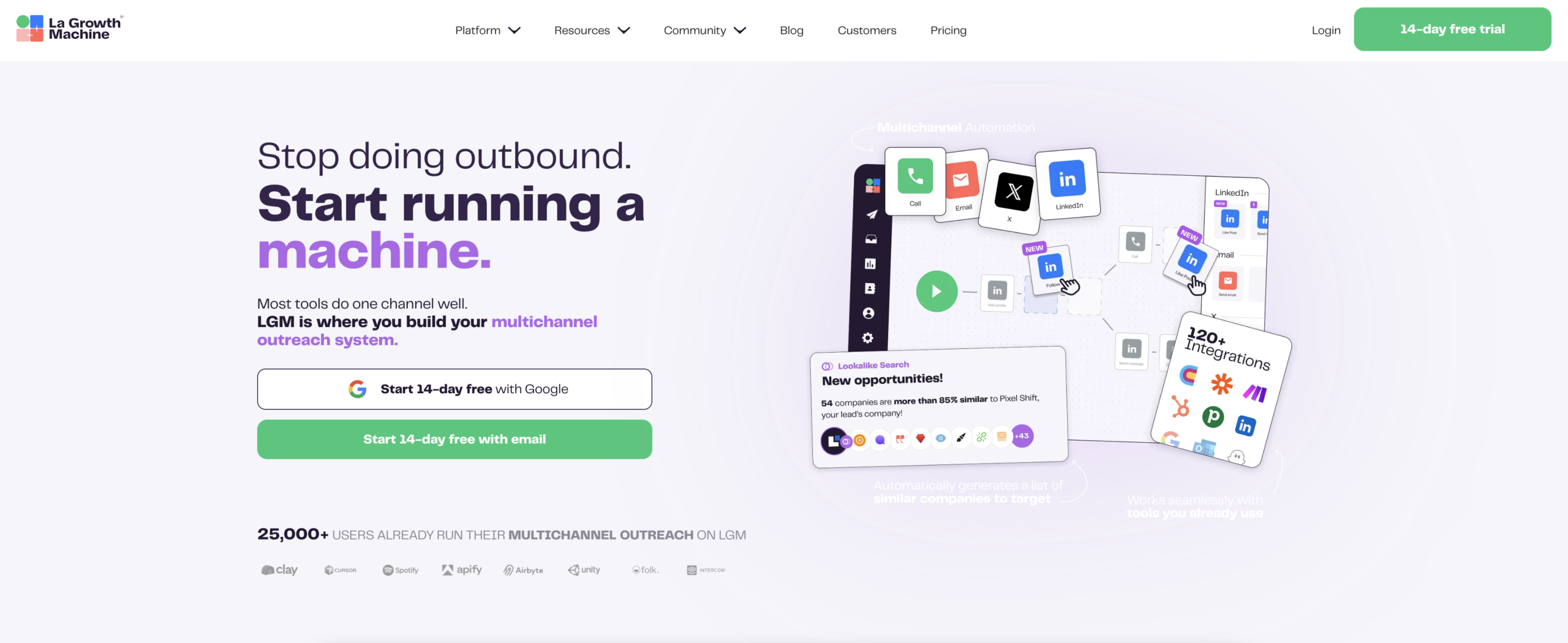
What makes La Growth Machine genuinely useful for RevOps is the enrichment and attribution layer built into the platform. The waterfall enrichment engine pulls contact data from multiple providers in sequence — you define the priority, LGM fills the gaps. Every lead touched by a sequence gets enriched automatically before the first message goes out. When a lead converts — a meeting booked, a reply received, a form submitted — that activity syncs back to your CRM (HubSpot, Pipedrive, or Salesforce) with full attribution. Your CRM record shows which sequence, which step, and which channel drove the response. That is the attribution data your RevOps reporting needs to answer the question every VP of Sales asks: where does our pipeline actually come from?
For teams building pipeline at scale, the identity-based pricing model means you can run multiple outreach identities under one account — useful when SDRs, AEs, and founders all need to prospect from their own profiles without managing separate subscriptions.
Pricing: Basic €60/month, Pro €120/month, Ultimate €180/month per identity.
Best for: B2B teams that want multichannel outreach execution with native CRM sync and full pipeline attribution built in.
2. HubSpot
HubSpot is the most accessible RevOps platform on the market. It combines CRM, marketing hub, sales hub, and customer service hub in a single interface — so Sales, Marketing, and CS can all operate from the same data without complex integrations. Deal pipeline, contact records, email sequences, meeting scheduling, revenue reporting, and forecasting are all native to the platform.
For RevOps leaders, HubSpot’s reporting suite is the main draw. You can build custom dashboards that show pipeline by source, revenue by campaign, deal velocity by stage, and forecast vs. target — all without exporting to a spreadsheet. The native attribution models (first-touch, last-touch, multi-touch) give you a defensible answer when leadership asks which marketing programs are driving revenue. The platform also supports deal scoring, sequence enrollment triggers based on CRM properties, and automated task creation — which means the handoff from marketing to sales to CS can be orchestrated in HubSpot without external automation tools.
HubSpot works best for teams that want one platform to do most of the heavy lifting. It is less customizable than Salesforce at the enterprise level, but for teams up to a few hundred people it is often the fastest path to a functioning RevOps stack.
Best for: Growing B2B teams that want an all-in-one RevOps base without heavy technical setup.
3. Salesforce
Salesforce is the enterprise standard for a reason. Its CRM is deeply customizable, with object modeling, workflow rules, approval processes, and automation that can accommodate the most complex sales motions. Revenue Cloud adds CPQ, billing, and revenue recognition on top of the core CRM — giving enterprise RevOps teams a single platform that spans the full customer lifecycle from opportunity to invoice.
Einstein AI forecasting is the feature that gets the most attention from RevOps leaders. Instead of requiring reps to manually update forecast categories, Einstein analyzes deal activity, email sentiment, and stage progression to generate a predictive forecast. For teams managing hundreds of deals across multiple regions, that predictive layer is a meaningful signal — it surfaces which deals are at risk before they fall out of the quarter. Salesforce’s AppExchange ecosystem means you can connect almost any tool in your stack directly to your CRM records, and the platform’s reporting and dashboard capabilities are among the most powerful available.
The tradeoff is complexity and cost. Salesforce implementations require dedicated admins or consultants, and licensing costs scale quickly. For teams under 50 people, it is often more infrastructure than they need.
Best for: Enterprise B2B teams with complex sales processes, multiple product lines, or global operations.
4. Salesloft
Salesloft sits at the intersection of sales engagement and RevOps reporting. It handles email sequences, LinkedIn steps, call logging, and meeting scheduling — but its real differentiation for RevOps teams is the pipeline management and forecasting layer built into the platform. Salesloft’s Revenue Intelligence gives managers a view of every deal’s health, based on activity data from rep outreach: email open rates, call outcomes, meeting completions, and engagement trends.
Conversation intelligence (call recording and AI analysis) is another feature that matters for RevOps. Every sales call is recorded, transcribed, and analyzed for talk-to-listen ratio, competitor mentions, objection patterns, and next steps. That data feeds back into deal records and pipeline reporting — so when you review forecast accuracy at the end of a quarter, you have call-level evidence to explain why deals moved or stalled. Salesloft integrates natively with Salesforce and HubSpot, so the engagement data it generates syncs back to your CRM without manual effort.
Best for: Sales-led B2B teams that want engagement execution and pipeline reporting in one platform.
5. Outreach
Outreach is built for enterprise RevOps execution. Its AI deal insights feature analyzes deal activity across email, calls, and meetings to surface risk signals in real time — deals that have gone dark, opportunities with low engagement, forecast items that are unlikely to close based on current activity. Kaia, Outreach’s AI meeting assistant, joins calls automatically, takes notes, and surfaces relevant talk tracks and competitive battlecards in real time.
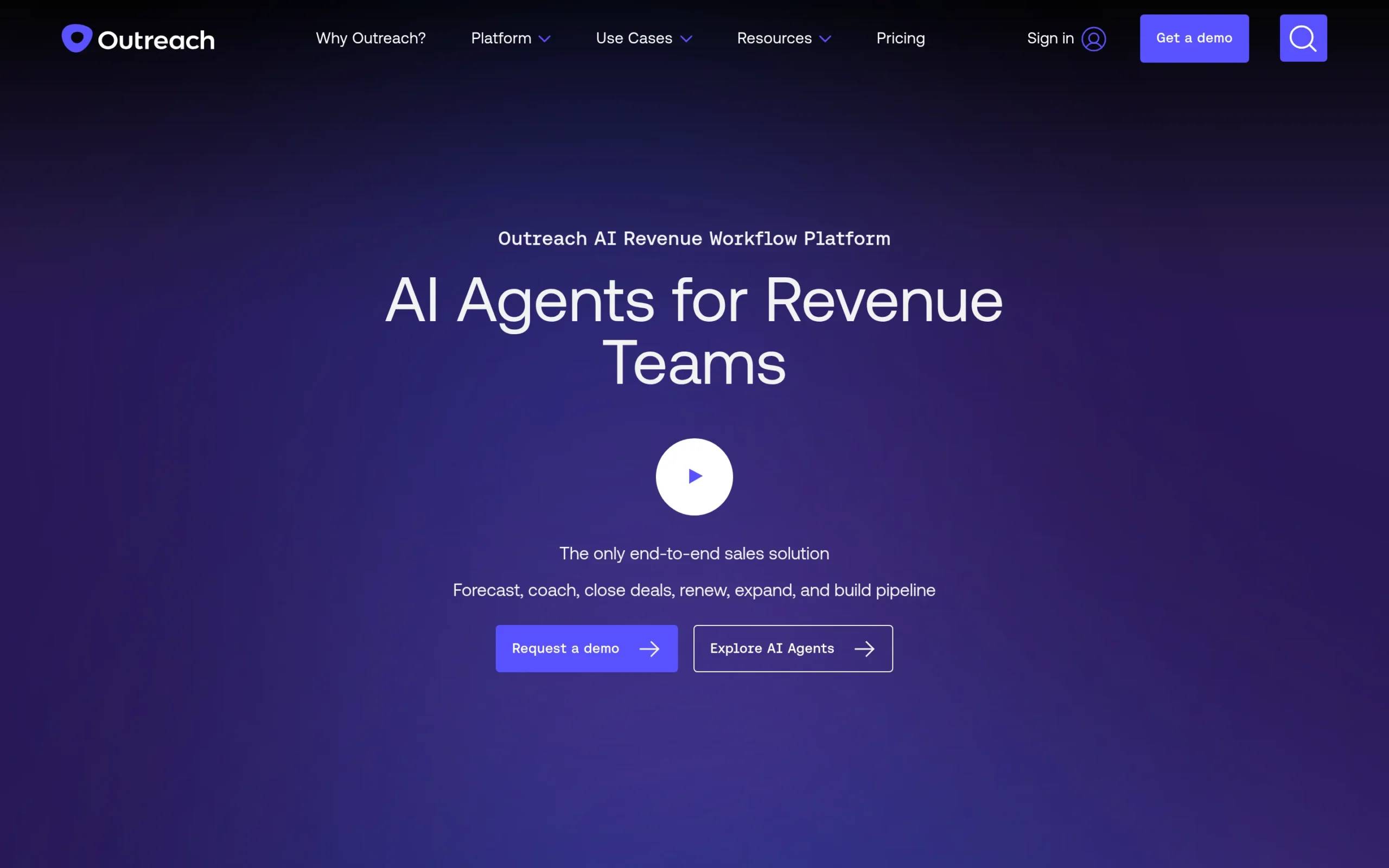
For RevOps teams at scale, Outreach’s revenue forecasting module is designed to give managers confidence in their numbers. Instead of relying on rep-submitted forecasts — which are notoriously optimistic — Outreach generates AI-weighted forecasts based on actual deal activity. When a rep says a deal is going to close this quarter but has not had a conversation with the buyer in three weeks, Outreach flags the discrepancy. That kind of signal is what lets RevOps leaders have honest pipeline reviews instead of exercises in wishful thinking.
Best for: Enterprise B2B teams with large sales orgs that need AI-powered deal risk management and forecasting.
6. Apollo.io
Apollo.io operates at the intersection of the data layer and the outreach layer. Its database of 275+ million contacts and 60+ million companies is the starting point — teams use it to build prospect lists with filters for job title, company size, technology stack, funding stage, and intent signals. Those lists feed directly into Apollo’s native email sequencing, or export to any outreach tool in your stack.
The intent data layer is where Apollo earns its place in a RevOps stack. Intent signals tell you which companies are actively researching topics related to your product — so your outbound efforts focus on accounts that are already in-market instead of spraying cold outreach at the entire addressable market. When intent data from Apollo syncs into your CRM alongside the contact data, your RevOps reporting can start to answer the question: are we reaching accounts when they are actually ready to buy? That is the kind of attribution insight that moves from reporting to action.
Best for: B2B teams that need a prospecting database with intent data for outbound-led RevOps.
7. Clay
Clay is the data enrichment tool that RevOps teams use when a single data provider is not enough. It connects to 50+ data sources — LinkedIn, Apollo, Clearbit, Hunter, Crunchbase, and more — and runs them in a waterfall: try source one, if it fails try source two, and so on until the field is filled. The result is contact and company records that are significantly more complete than what any single provider can deliver.
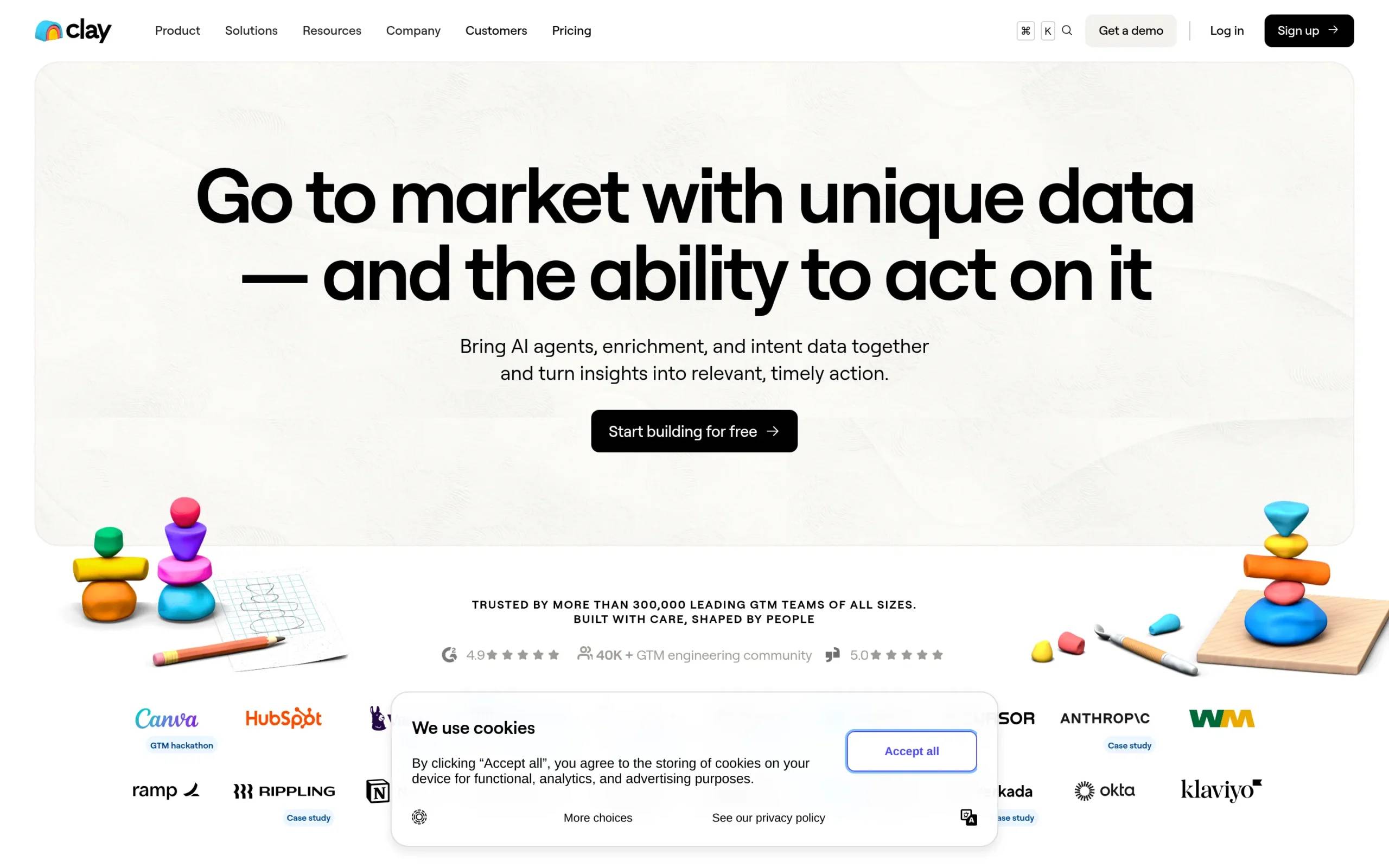
For RevOps, Clay sits at a critical point in the data pipeline. Before a contact enters your CRM or your outreach sequence, Clay enriches it — filling in job title, company size, tech stack, LinkedIn URL, and whatever other fields your scoring model needs. That enrichment data feeds into lead routing, sequence personalization, and CRM reporting. Teams also use Clay to clean and re-enrich their existing CRM data — running the enrichment engine over existing records to fill gaps that accumulated over time. Clean data in means clean reports out.
Best for: RevOps teams that need multi-source enrichment to maintain data quality across their CRM and outreach tools.
8. Zapier
Zapier connects the tools in your RevOps stack without requiring engineering resources. Its 6,000+ app integrations cover virtually every tool a B2B team uses — CRMs, outreach platforms, enrichment tools, scheduling software, analytics platforms, and internal tools. Workflows (called Zaps) trigger automatically when something happens in one app and take action in another: a new form submission creates a contact in HubSpot, a demo booking adds a row to a tracking sheet and sends a Slack notification to the AE, a deal moving to Closed Won triggers a customer onboarding sequence in your CS platform.
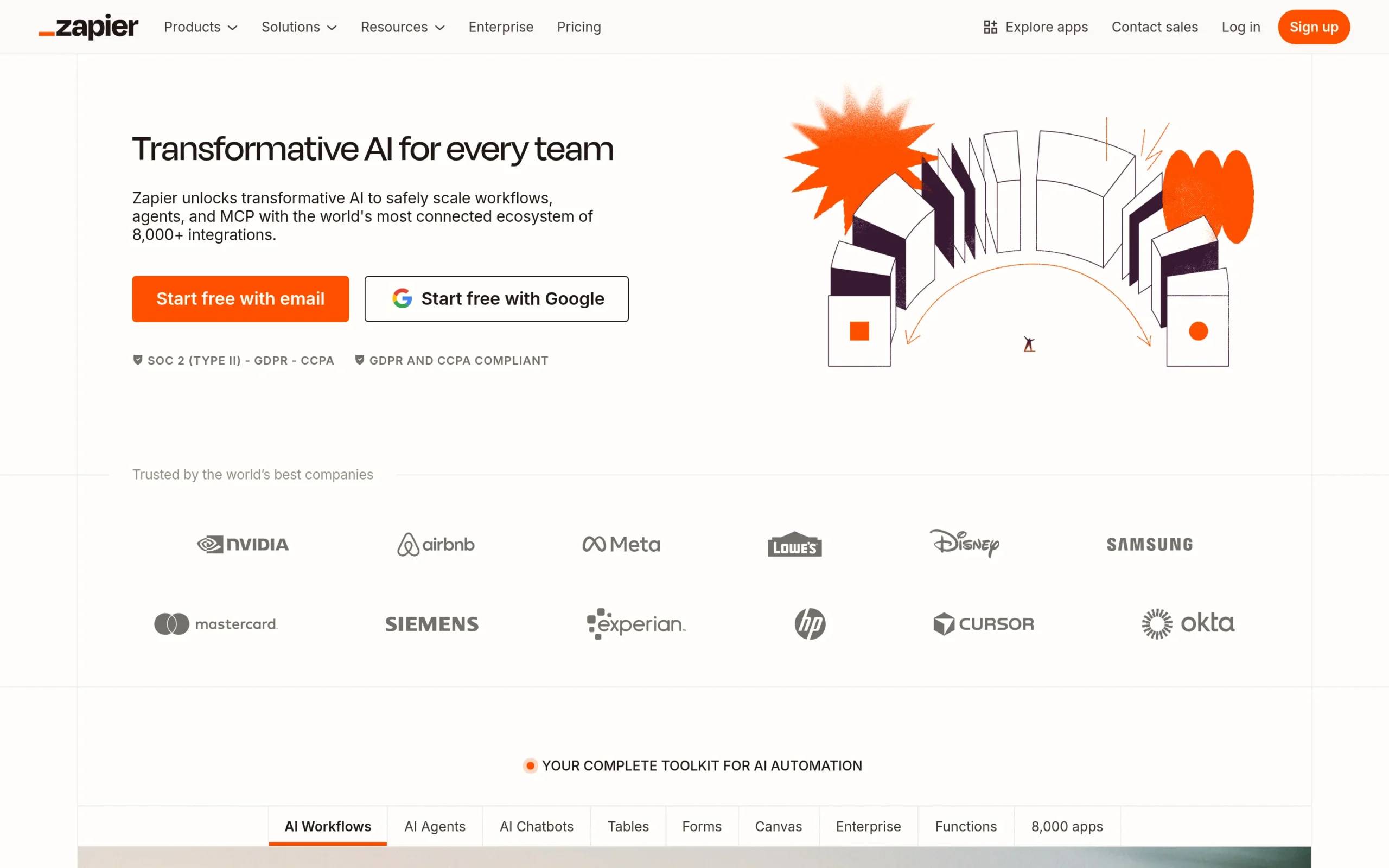
For RevOps specifically, Zapier handles the data handoffs that keep your stack functioning as a system rather than a collection of disconnected tools. Lead scoring logic that fires off sequence enrollment, stage-change triggers that update attribution records, renewal date reminders that create tasks in your CRM — these are the automations that make a RevOps stack actually work at scale without requiring someone to manually move data between tools every day.
Best for: RevOps teams that need no-code automation to connect tools and automate data handoffs across the stack.
9. Make
Make (formerly Integromat) is the more powerful alternative to Zapier for teams that need complex multi-step workflows. Its visual workflow builder handles branching logic, error handling, data transformation, and iteration over arrays — use cases that hit the ceiling in Zapier but are native in Make. For RevOps teams with non-standard data flows or complex routing logic, Make is often the right choice.
Common RevOps use cases in Make include multi-condition lead routing (route by territory, then by company size, then by rep availability), CRM data transformation (normalize field values before writing to Salesforce), and complex reporting pipelines that pull from multiple sources and write to a central data warehouse. Make also handles error scenarios more gracefully than most automation tools — when a step fails, you can configure retry logic, fallback routes, and error notifications instead of losing the data silently.
Best for: RevOps teams with complex automation needs that go beyond what Zapier can handle.
How to Build Your RevOps Stack by Team Size
Not every team needs all nine tools. The right stack depends on where you are in your growth stage.
Startup (under 20 people)
At the startup stage, you need pipeline fast and overhead low. A three-tool stack covers the core:
- La Growth Machine — multichannel outreach with built-in enrichment and CRM sync
- HubSpot (free tier) — CRM, deal pipeline, and basic reporting
- Zapier — automation to connect the two
This stack costs under €100/month, generates pipeline from day one, and gives you the attribution data you need to know what is working. When you start closing deals and building a repeatable motion, you add tools — but this is enough to get started.
Scale-up (20 to 100 people)
At this stage you have specialization — SDRs, AEs, marketers, and CS all with separate workflows. A five-tool stack handles the complexity:
- La Growth Machine — outreach execution for SDRs and founders
- HubSpot (paid) — CRM + marketing + sales hub, deal forecasting
- Apollo.io — prospecting database and intent data for outbound
- Clay — enrichment to keep CRM data clean as volume grows
- Zapier or Make — automation to keep the stack connected
This stack gives you a full outbound motion, clean data, and reporting that supports a weekly pipeline review with your leadership team.
Enterprise (100+ people)
At enterprise scale, customization and compliance requirements push you toward a different set of choices:
- Salesforce — enterprise CRM with Revenue Cloud for full lifecycle management
- Outreach or Salesloft — engagement execution at scale with AI forecasting
- La Growth Machine — outbound and prospecting for new business teams
- Apollo.io + Clay — data sourcing and enrichment at volume
- Make — complex automation for non-standard workflows
- Zapier — departmental self-service automation for simpler use cases
At this stage you likely also have a dedicated RevOps team or hire — someone whose full-time job is managing the stack, maintaining data quality, and building the reporting infrastructure that keeps leadership informed.
Frequently Asked Questions
What is revenue operations (RevOps)?
Revenue operations is the business function that aligns Sales, Marketing, and Customer Success around shared data, shared processes, and shared metrics. The goal is to remove the handoff friction between functions so that pipeline data, attribution data, and customer data all live in one system of record. RevOps teams own the tech stack, the data governance, the forecasting process, and the reporting that leadership uses to make decisions.
What tools do RevOps teams use?
RevOps teams typically use a CRM (HubSpot or Salesforce) as the system of record, an outreach or sales engagement tool (La Growth Machine, Salesloft, Outreach) for pipeline generation, a data enrichment tool (Clay, Apollo.io) for data quality, and an automation platform (Zapier, Make) to connect everything together. The exact stack depends on team size, sales motion, and technical resources available.
What is the difference between RevOps and SalesOps?
SalesOps focuses specifically on the Sales team — territory planning, quota setting, CRM administration, and sales process optimization. RevOps is broader: it covers Sales, Marketing, and Customer Success together, with a focus on the full revenue lifecycle from first touch to renewal. RevOps teams own the shared data infrastructure and attribution models that SalesOps alone cannot provide.
How do I build a RevOps stack from scratch?
Start with your CRM — HubSpot is the fastest path for most B2B teams. Add an outreach tool that syncs attribution back to the CRM (La Growth Machine is built for this). Add an enrichment source to keep your data clean. Then add automation to connect the tools. Do not add complexity until the core three-layer stack is working reliably. A simple stack that runs well beats a complex one that requires constant maintenance.
What CRM is best for RevOps?
HubSpot is the best CRM for most B2B teams building a RevOps function. It is fast to implement, has native marketing, sales, and CS hubs in one platform, and its reporting suite covers the attribution and forecasting use cases that RevOps teams need. Salesforce is the better choice for enterprise teams with complex customization requirements, multiple product lines, or global operations that need the depth of Revenue Cloud.
Build Your RevOps Stack Starting with Pipeline
A RevOps stack is only as good as the pipeline it generates. You can have perfect forecasting and attribution — but if the top of funnel is not producing enough qualified opportunities, the rest of the system has nothing to measure. That is why the outreach execution layer matters as much as the CRM and reporting layer.
La Growth Machine handles the outreach layer end to end: multichannel sequences across LinkedIn, email, and Twitter, waterfall enrichment that fills contact data automatically, and native CRM sync that writes attribution back to HubSpot, Pipedrive, or Salesforce with every interaction. Your pipeline does not just grow — it grows with data you can trace.
Start a 14-day free trial of La Growth Machine and connect your first multichannel sequence to your CRM in under an hour.