
TL;DR
Apollo combines data and engagement while Lemlist specializes in personalized multichannel cold outreach.
– Apollo offers 210M+ contacts with sequences starting at $49/month including free plan
– Lemlist focuses on video personalization and deliverability starting at $69/month with trials
– Apollo serves teams needing prospecting data plus automation in single platform
– Lemlist excels at creative personalization across email LinkedIn and calls for engagement
– Integration needs and whether you need data provider versus outreach tool determines choice
Choosing between Apollo and Lemlist can feel like picking between two different approaches to sales outreach. Apollo positions itself as an all-in-one sales intelligence and engagement platform with a massive contact database, while Lemlist focuses on cold email personalization and multichannel outreach with a strong emphasis on deliverability.
Apollo vs. Lemlist: side-by-side comparison table
Here’s a quick reference table to compare the key aspects of both platforms:
| Feature | Apollo | Lemlist | La Growth Machine |
|---|---|---|---|
| Starting price | $49/user/month (annual) | $69/user/month | €50/user/month (annual) |
| Free trial | Yes (Free plan available) | Yes (14 days) | 14 days (no credit card required) |
| Key features | 275M+ contact database, email sequences, calling, meeting scheduling, AI conversation intelligence | Multichannel sequences, AI personalization, dynamic images, lemwarm deliverability, unified inbox | LinkedIn + Email sequences, enrichment, warmup, AI voice |
| Integration options | 50+ integrations including Salesforce, HubSpot, Zoho, Pipedrive, Slack | HubSpot, Salesforce, Clay, Zapier, Make, limited native integrations | Native: HubSpot, Salesforce, Pipedrive + API |
| Support options | Email support, webinars, knowledge base, dedicated support for Enterprise | Email and chat support, knowledge base, quick response times | Email, chat, knowledge base, dedicated strategist (4+ seats) |
| Best for | Teams needing prospecting data and outreach in one platform, sales teams focused on volume | Teams prioritizing personalization and deliverability, creative cold outreach campaigns | Scaling teams needing multichannel automation |
Both tools have their loyal fans, and both can drive results. But which one actually fits your team’s needs? In this article, we’ll break down exactly how Apollo and Lemlist stack up across features, pricing, ease of use, integrations, and more. We’ll also look at when you might want to consider a different option altogether.
By the end, you’ll have a clear framework for making the right choice for your sales process.
Apollo vs. Lemlist: quick overview
Let’s start with a high-level look at what each platform brings to the table.
Apollo:
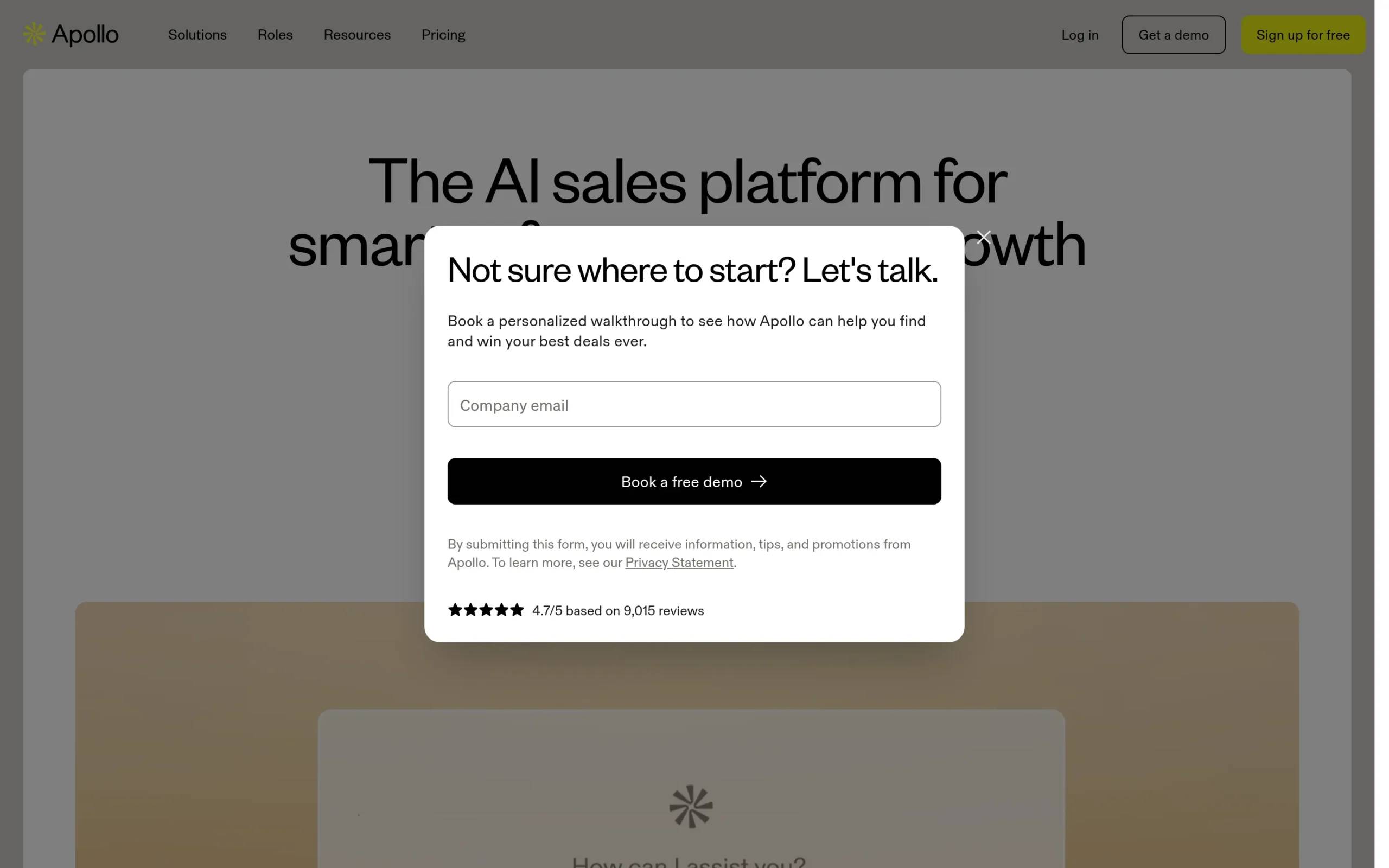
Apollo.io is a sales intelligence and engagement platform designed to help teams build pipeline faster. It combines a massive B2B database of over 275 million contacts and 73 million companies with sales engagement tools like email sequences, calling, and meeting scheduling. Apollo’s main selling point is having prospecting data and outreach automation in one place, so you don’t need to jump between tools. Starting price: $49 per user/month (billed annually).
Lemlist:
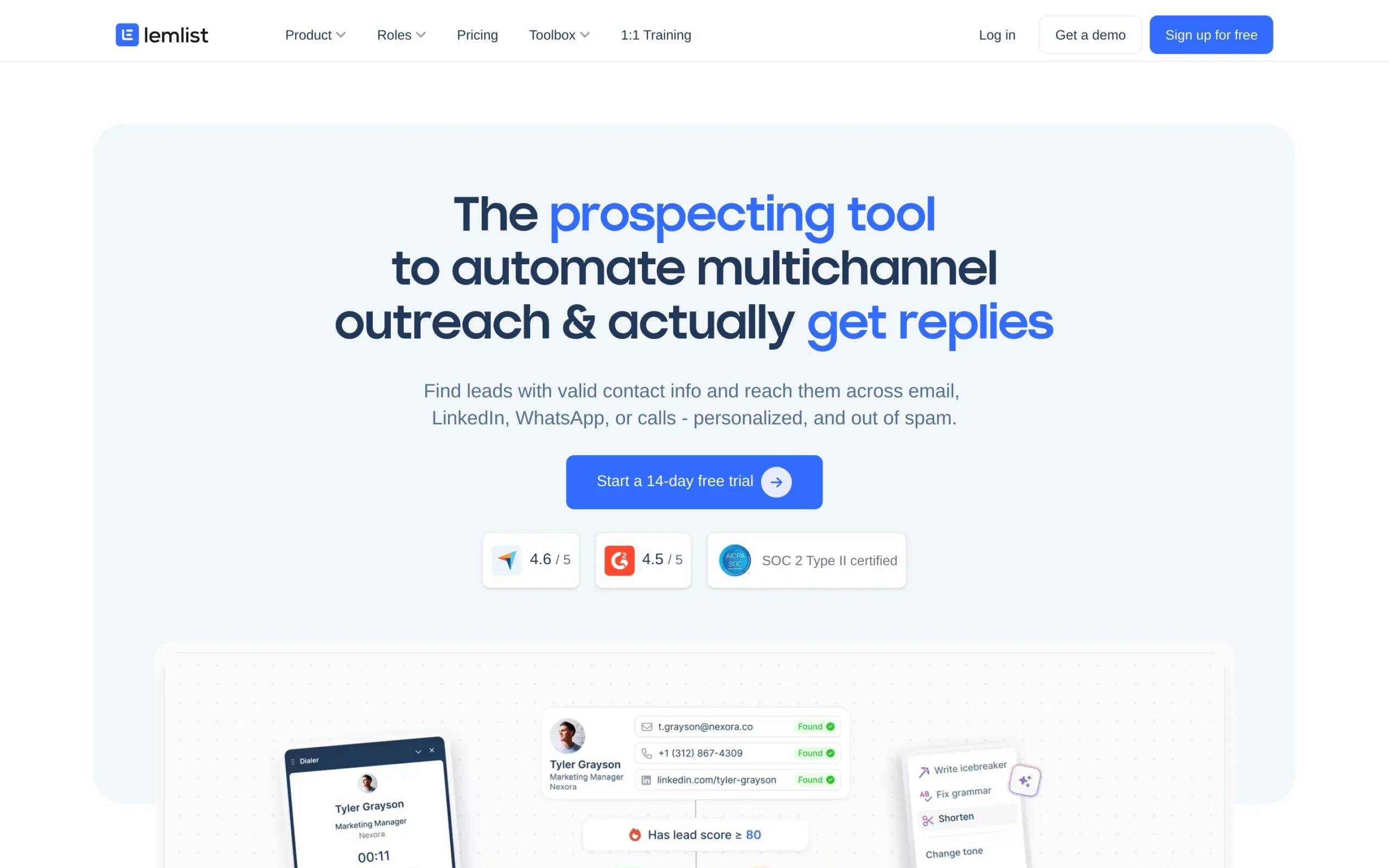
Lemlist is a sales engagement platform built specifically for cold outreach across email, LinkedIn, and other channels. It’s known for its advanced personalization features like dynamic images and landing pages, plus a strong focus on email deliverability through its lemwarm tool. Lemlist is designed for teams who want to stand out in crowded inboxes with creative, personalized campaigns. Starting price: $69 per user/month.
Apollo vs. Lemlist: head-to-head comparison
Now let’s dig into the details and compare these platforms where it really matters.
Features and capabilities
Apollo:
Apollo offers a comprehensive suite that goes well beyond basic cold email. You get access to over 275 million contacts with verified emails and phone numbers, advanced search filters to build targeted lists, email sequencing with A/B testing, built-in calling with local presence dialing, and meeting scheduling. Apollo also includes conversation intelligence features like AI-powered call summaries and meeting insights. The platform handles both outbound prospecting and inbound lead conversion, with features like anonymous visitor identification and real-time form enrichment. Workflow automation helps teams scale what’s working without adding manual tasks.
Lemlist:
Lemlist focuses heavily on multichannel outreach personalization. You can create sequences across email, LinkedIn, phone, and WhatsApp all from one platform. The standout features include AI-powered personalization that adapts text, images, and even landing pages dynamically for each lead, advanced email deliverability tools through lemwarm (their email warmup solution), access to a 600M+ lead database with email finding and verification, and a unified inbox that tracks all interactions across channels in one thread. Lemlist also supports A/B testing and has extensive template libraries to help you get started quickly.
Winner: Tie. Apollo wins if you need an all-in-one platform with built-in prospecting data and conversation intelligence. Lemlist wins if your priority is creative personalization and deliverability optimization for cold outreach campaigns.
Ease of use
Apollo:
Apollo has a relatively intuitive interface, especially for the prospecting and list-building side. The search functionality is straightforward, and most users can start building contact lists within minutes. However, the platform’s breadth can be overwhelming at first. There are a lot of features, and the learning curve gets steeper when you start setting up sequences, integrations, and workflows. Some users report that the UI can feel cluttered during high-usage periods, and certain actions require more clicks than expected. That said, Apollo offers regular webinars and training resources to help with onboarding.
Lemlist:
Lemlist has a more streamlined, modern interface focused specifically on campaign creation and management. Setting up a basic email sequence is quick and user-friendly. The challenge comes with the more advanced personalization features like dynamic images and landing pages, which require some experimentation to master. Some users mention that the interface isn’t the most intuitive when you’re trying to navigate between campaigns, lists, and settings. However, Lemlist’s customer support is highly rated and responds quickly when users need help.
Winner: Lemlist. While both platforms have learning curves, Lemlist’s focused approach to outreach makes it easier for new users to get campaigns running quickly without feeling overwhelmed by too many features.
Pricing and value
Apollo:
Apollo offers four pricing tiers. The Free plan includes basic features with 1,200 credits per year. The Basic plan is $49 per user/month (billed annually) or $59 per month (billed monthly) and includes 30,000 credits per year. The Professional plan is $99 per user/month (billed annually) or $119 per month (billed monthly) with more advanced features and higher credit limits. The Enterprise plan offers custom pricing for large organizations with specific needs. One important note is that Apollo uses a credit system, and certain actions like revealing emails or exporting contacts consume credits. Some users find the credit system confusing and report that credits run out faster than expected, especially on lower-tier plans.
Lemlist:
Lemlist has three main pricing tiers. Email Pro is $69 per user/month and includes automated email outreach, unlimited email accounts, AI personalization, lemwarm for deliverability, and basic integrations. Multichannel Expert is $99 per user/month and adds LinkedIn and WhatsApp integration, multichannel sequences, and the lead database with email finder. Enterprise offers custom pricing for large organizations and includes advanced API access, dedicated account management, and priority support. Lemlist also charges separately for lead credits if you want to use their database to find emails and phone numbers, which can add to the overall cost.
Winner: Apollo. Apollo offers a lower entry point at $49/month and includes a massive prospecting database in the price. However, the credit system can make it harder to predict actual costs. Lemlist is more expensive upfront but offers straightforward pricing for what you get, especially if you don’t need a huge prospecting database.
Integrations
Apollo:
Apollo integrates with over 50 tools including major CRMs like Salesforce, HubSpot, Zoho, and Pipedrive. You can also connect with Slack, Gmail, Outlook, LinkedIn, and various sales and marketing automation platforms. Apollo offers API access for custom integrations, and native connections sync data automatically so your CRM stays up to date. However, some users note that certain integrations feel clunky and require manual configuration to work smoothly.
Lemlist:
Lemlist offers native integrations with HubSpot and Salesforce for CRM syncing, plus connections to enrichment tools like Clay, Dropcontact, and Leadfuze. You can also integrate with Zapier and Make for broader workflow automation. However, the integration ecosystem is noticeably smaller than Apollo’s. If you need deep connections with a wide range of tools, Lemlist may require more workarounds or third-party automation platforms.
Winner: Apollo. Apollo has a significantly broader integration ecosystem, making it easier to connect with your existing tech stack without needing middleware like Zapier.
Deliverability and email infrastructure
Apollo:
Apollo includes basic email deliverability features like sending limits and built-in guardrails to protect sender reputation. You can connect multiple email accounts and rotate sending across them. However, Apollo doesn’t offer a dedicated email warmup tool, and some users report deliverability issues when sending high volumes, especially if domain configuration isn’t perfect.
Lemlist:
Lemlist treats deliverability as a core feature. The platform includes lemwarm, an automated email warmup tool designed to keep your emails out of spam folders by gradually building sender reputation and engaging with your domain. Lemlist also provides deliverability tips and monitoring throughout your campaigns. The platform supports inbox rotation across multiple email accounts and offers best practices to maintain high deliverability rates.
Winner: Lemlist. If email deliverability is a top concern, especially for cold outreach at scale, Lemlist’s focus on this area gives it a clear advantage.
Apollo vs. Lemlist: pros and cons
Apollo strengths and weaknesses
Pros:
- Massive B2B database with over 275 million contacts built right into the platform
- All-in-one solution combining prospecting data, email outreach, calling, and meeting scheduling
- Advanced search filters to build highly targeted prospect lists
- Strong workflow automation to scale successful strategies
- Conversation intelligence features like AI call summaries and meeting prep
Cons:
- Credit system can be confusing and credits may run out faster than expected
- Data accuracy is inconsistent according to some user reviews
- Interface can feel cluttered and overwhelming for new users
- Limited phone number availability compared to email contacts
- Occasional slowdowns during high-usage periods
User Rating:
- G2: 4.7/5 (based on 9,252 reviews)
- Capterra: 4.5/5 (based on 381 reviews)
Lemlist strengths and weaknesses
Pros:
- Excellent personalization features including dynamic images, videos, and landing pages
- Strong email deliverability tools with lemwarm built-in
- Multichannel outreach across email, LinkedIn, WhatsApp, and phone
- Unified inbox to manage all conversations in one thread
- Highly rated customer support that responds quickly
Cons:
- Higher starting price compared to most competitors
- Bugs and technical issues reported by some users
- Interface can be unintuitive when navigating between sections
- Limited native CRM integrations beyond HubSpot and Salesforce
- Learning curve for advanced personalization features
User Rating:
- G2: 4.5/5 (based on 959 reviews)
- Capterra: 4.6/5 (based on 386 reviews)
Which should you choose?
Here’s a framework to help you decide which tool makes more sense for your situation:
Consider Apollo if:
- You need a large prospecting database and don’t want to pay for a separate data provider
- Your team needs calling and meeting scheduling built into the same platform as email outreach
- You want conversation intelligence features like call recording and AI summaries
- You prefer an all-in-one solution that handles both inbound and outbound sales motions
- Your team size and budget can handle the credit-based pricing model
Consider Lemlist if:
- Email deliverability is a top priority and you want dedicated warmup tools
- Your outreach strategy relies heavily on personalization to stand out
- You need multichannel sequences across email, LinkedIn, and WhatsApp
- You already have prospecting data from another source or tool
- You want a platform specifically built for cold outreach campaigns
You might need both if:
- Your team is large enough to have separate roles for prospecting (Apollo) and outreach execution (Lemlist)
- You want to use Apollo’s database to build lists, then export them to Lemlist for highly personalized campaigns
- Budget isn’t a constraint and you’re optimizing for the best-in-class tool in each category
Looking for another option? Consider La Growth Machine
If you’ve read this far and neither Apollo nor Lemlist quite checks all your boxes, there’s a third option worth considering: our platform, La Growth Machine.
What La Growth Machine does:
La Growth Machine is a multichannel sales automation platform built specifically for teams who want to combine the power of LinkedIn, email, Twitter/X, and phone outreach in smart, sequenced campaigns. Unlike Apollo, we don’t try to be a CRM or an all-in-one sales platform. Unlike Lemlist, we go beyond email to make LinkedIn automation our core strength, with features like automated LinkedIn voice messages (with AI voice cloning) and social warming that no other tool offers.
We handle multichannel prospecting end-to-end: import leads from LinkedIn (including people who engaged with your posts), enrich their contact data automatically, reach them across LinkedIn and email in coordinated sequences, and manage all replies in one unified inbox. Our approach is designed to help you get more conversations, not just more emails sent.
How we compare:
Where Apollo focuses on database size and Lemlist focuses on email, La Growth Machine focuses on multichannel orchestration. We don’t make you choose between LinkedIn and email. You can Like posts and Follow prospects before messaging them (social warming), send connection requests with personalized notes, follow up via LinkedIn InMail or email, add voice messages to stand out, and include call reminders in your sequence, all from a single workflow.
Our LinkedIn voice message feature actually clones your voice using AI, so you can send personalized “Hi {{firstname}}” intros at scale while keeping the authenticity that gets 2x more replies. No other platform can do this.
We also solve the data problem differently than Apollo. Instead of maintaining our own database, we integrate with the best enrichment providers (9 different email finders with validation and scoring), so you get better data quality. And we include features both Apollo and Lemlist lack, like lookalike search (show us your best customer, we’ll find similar companies), LinkedIn intent data (target people who engaged with your content), and real chat mode to make automated messages look natural.
Pricing:
La Growth Machine starts at €50/month per identity for the Basic plan. Our Pro plan at €100/month includes lookalike search, LinkedIn intent data, inbox rotation, and advanced integrations. The Ultimate plan at €150/month adds custom sequences, webhooks, and advanced CRM sync. All plans include a 14-day free trial with no credit card required.
Best for:
- Sales and growth teams who want LinkedIn and email working together, not separately
- Teams who need more than basic email automation but less than a full CRM
- Companies focused on quality conversations over spray-and-pray volume
- Anyone who wants LinkedIn voice messages and social warming as part of their outreach strategy
- Teams looking for a tool that’s powerful but not overcomplicated
Apollo vs. Lemlist: FAQs
Can Apollo and Lemlist integrate with each other?
Not directly. Apollo and Lemlist don’t have native integrations with each other. However, you can use both in your workflow by exporting contact lists from Apollo and importing them into Lemlist for outreach campaigns. Some teams also use Zapier to create custom workflows between the two platforms, though this requires a paid Zapier account and some technical setup.
Which platform has better data accuracy?
Both platforms have mixed reviews on data accuracy. Apollo’s database is larger but users frequently report inconsistent data quality, with some contacts being outdated or incorrect. Lemlist’s database is smaller but uses multiple enrichment providers to verify emails. If data accuracy is critical, you might want to use a dedicated enrichment tool like Apollo for prospecting, then verify contacts through a separate service before importing to your outreach platform.
Do either platforms work for B2C outreach?
Both Apollo and Lemlist are primarily designed for B2B sales and marketing. Apollo’s database focuses exclusively on business contacts, making it unsuitable for B2C. Lemlist can technically be used for B2C email campaigns, but its features and pricing are built with B2B cold outreach in mind. If you’re doing B2C, you’d likely be better served by traditional email marketing platforms.
Conclusion
Apollo and Lemlist take different approaches to solving the same problem: helping sales teams connect with prospects efficiently. Apollo bets on convenience by putting prospecting data and engagement tools in one platform, while Lemlist bets on quality by making personalization and deliverability the top priorities.
Neither is objectively better. The right choice depends on whether you need built-in prospecting data, whether you value personalization over volume, and how your team prefers to work.
If you’re looking for something that bridges the gap, focusing on multichannel orchestration rather than trying to be everything to everyone, La Growth Machine offers a different path forward. We’re built specifically for teams who know that LinkedIn plus email beats email alone, and who want automation that still feels human.
Get 3.5X more leads!
Do you want to improve the efficiency of your sales department? With La Growth Machine you can generate on average 3.5x more leads while saving an incredible amount of time on all your processes.
By signing up today, you’ll get a free 14-day trial to test our tool!