

In B2B, we very often hear about social selling. A notion that is a bit vague at first, social selling has become one of the major challenges of acquisition today.
What is social selling? What are the benefits of social selling? How to do social selling?
In this article, I will cover the topic by giving you my own framework and my experience feedback on the subject. If you want to know everything about social selling and succeed too, stay with me until the end!
What is social selling?
Social selling is a concept that comes from marketing and follows the emergence and growth of social networks over the past two decades.
As its name suggests, social selling consists of selling on social networks. Social selling can be broken down into several sub-actions, which are:
- publishing posts – on LinkedIn for example;
- outreach;
- finding emails via LinkedIn
- organizing webinars;
- setting up a solid LinkedIn profile;
- etc…
By default, every social network connects people with other people, and all these people have needs (= will be receptive to a message, an offer, a value proposition).

In B2B, we will primarily focus on LinkedIn, which is the leading professional network in the world, with a database of over 1 billion people.
Do you already see the potential?
Good. Let’s delve a little deeper into the advantages.
What is social selling for?
As explained just above, the objective of social selling is simple: to sell on social networks. Yes, but what else?
A good social selling strategy will allow you to:
- diversify your acquisition strategy: social selling encompasses many actions that will ensure you acquire clients through inbound, outbound… but also globally, in parallel with other channels you use for your acquisition (SEO, SEA, email prospecting, etc.).
- reduce your acquisition costs: many of the actions you will implement in your social selling strategy are related to inbound, which means leads come naturally, motivated by a need, and therefore convert better, for a much lower investment.
- increase the quality of your leads: for leads generated through inbound who come on their own, with their motivations, and after being exposed to your message/offer, the conversion rate is generally higher than with outbound.
In short, a major advantage linked to the multiplication of actions and especially to the integration of inbound into your strategy.

Now, let’s see how to implement all this.
How to do good social selling?
Here we are at the heart of the matter.
In this section, I will explain step by step my framework to help you improve your social selling performance.
As explained, I work on B2B acquisition, so the framework below is specific to LinkedIn.
It is based on 3 key steps:
- Work on your reputation;
- Expand your network (focus on your personas);
- Capitalize on engagement.
Spoiler: you will likely need a LinkedIn subscription that allows you to do this faster, which will allow you to retrieve your leads’ phone numbers on LinkedIn, for example.
1. Work on your E-reputation
First question: with whom?
If you want to resonate on LinkedIn, there are two main components to work on: reach and engagement.

And they are interconnected! This means that the more you engage, the greater your reach will be.
So, to work on your reputation and your personal branding on LinkedIn, we want to favor the people with whom our strategy engages the most.
So the first step is to define your personas.
Once your personas are defined, you will need to map out the content you will produce. At this stage, you have 3 choices:
- TOFU: “Top of the funnel” content, whose objective is to cast a wide net, on non-specialized topics, where we will mainly talk about the what and the why.
- MOFU: “Middle of the funnel” content, whose objective is to talk about the how, and to refine on more technical issues, use-cases, tips that bring value to your readers.
- BOFU: “Bottom of the funnel” content, whose objective is to promote your brand, which perfectly addresses a pain point already expressed through TOFU and MOFU.

As for the distribution, you can consider that a good 60% / 25% / 15% split will work.
Regarding this last step, you can organize events. For example, group a few sub-topics and make them a live session, or invite a recognized expert on the subject. Because associating with a recognized expert on the subject will also boost your credibility, and therefore your engagement… you get the idea.
The hardest part is not so much finding the content, but rather the format that will hook your audience.
In this context, events highlight their importance, but they are not your only tools: images, videos, carousels, emojis, … all contribute to making people want to read, just as much as the intrinsic value of your LinkedIn post.
2. Expand your network to your personas
You have precisely targeted your personas and generated a ton of content to publish on LinkedIn, enough to set up a real social selling strategy.
That’s already great!
Now, you need to increase your readership.
To do this, we want to grow your LinkedIn network, but only with people who will be genuinely engaged and receptive to the topics you will cover, because remember: engagement = reach.
For this, there are two options:
- either you create lists of people using LinkedIn Basic or Sales Navigator – I prefer the latter, paid option, for the relevance of its targeting – and you contact them manually.
- you create your lists in the same way, but you use an automation tool like La Growth Machine to contact them and add them to your network automatically.
3. Engage with those who seem most receptive to your message
Now that everything is in place, your posts will start to circulate, and people (perhaps your future clients?) will react, comment, etc… which is already a victory, because these actions demonstrate engagement and contribute to improving your reach for your future posts.
Now that we have the offer (our content) and the demand (the personas), we can start selling:
- if a person likes or comments on a post, it means they are interested in the topic
- if a person attends a live session, it means they are interested in the topic
- etc…
At this point, you must absolutely contact these people, because the intention is strong.
For this, we again recommend LGM, which will allow you to automatically add these types of leads to an audience, which is itself associated with a sequence of pre-prepared LinkedIn messages.
If you are doing outreach, pay attention to your LinkedIn opening lines, which will be of paramount importance.
Even better: LGM now allows you to automatically import leads based on intent.
The method in image below:
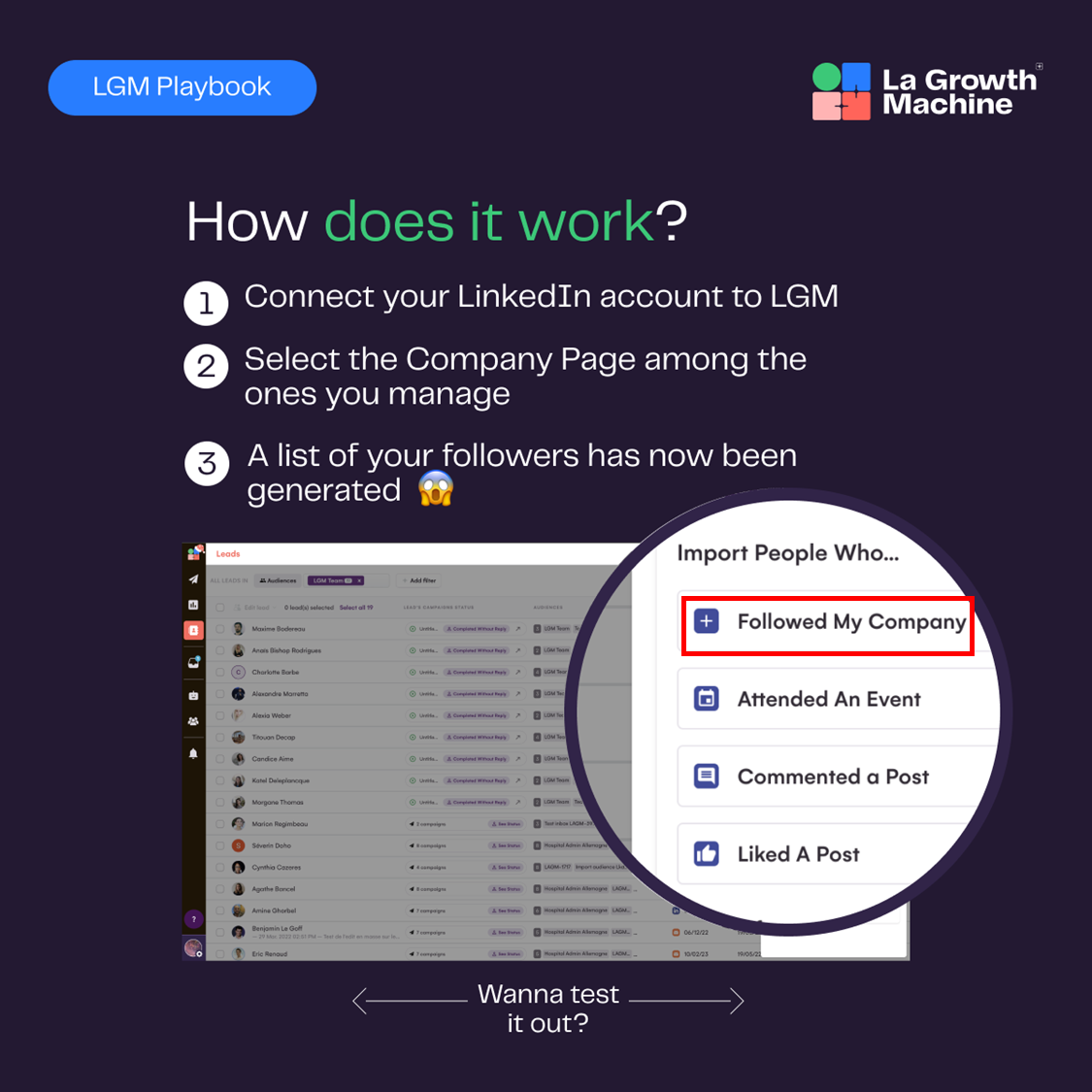
You have nothing left to do, except launch your campaign, wait for a response, and close :)