
TL;DR
HubSpot provides full-scale CRM platform with marketing automation while Lemlist specializes in cold outreach.
– HubSpot starts at $9/month per seat with free forever CRM
– Lemlist costs $69/month per user for Email Pro with multichannel sequences
– HubSpot includes 2,000+ integrations and complete customer platform with service tools
– Lemlist delivers AI personalization and lemwarm deliverability with 450M+ lead database
– HubSpot suits full marketing teams while Lemlist targets cold email specialists
If you’re weighing HubSpot against Lemlist, you’re trying to solve two different problems. One is a full-scale customer platform that manages marketing, sales, and service under one roof. The other is a sales engagement tool built for cold outreach across email, LinkedIn, and other channels.
HubSpot vs. Lemlist – Side-by-side comparison table
Here’s a quick reference to compare the two tools at a glance:
| Feature | HubSpot | Lemlist | La Growth Machine |
|---|---|---|---|
| Starting price | Free tools available; paid plans start at $9/month per seat | $69/month per user (Email Pro) | €50/user/month (annual) |
| Free trial | Yes, free CRM forever | 14 days | 14 days (no credit card required) |
| Key features | CRM, marketing automation, sales automation, customer service, content management | Multichannel outreach (email, LinkedIn, WhatsApp, calls), AI personalization, lead database, deliverability tools | LinkedIn + Email sequences, enrichment, warmup, AI voice |
| Integration options | 2,000+ integrations | HubSpot, Salesforce, Pipedrive, Zapier, Phantombuster | Native: HubSpot, Salesforce, Pipedrive + API |
| Support options | Knowledge base, community, phone/email support (varies by plan) | Email support, knowledge base, community | Email, chat, knowledge base, dedicated strategist (4+ seats) |
| Best for | Teams needing all-in-one CRM, marketing, sales, and service platform | Sales teams focused on cold outreach and multichannel prospecting | Scaling teams needing multichannel automation |
This comparison breaks down what each tool does, where they excel, and how they stack up on features, pricing, ease of use, and integrations. We’ll also cover other options if neither of these fits your needs.
HubSpot vs. Lemlist – Quick overview
HubSpot
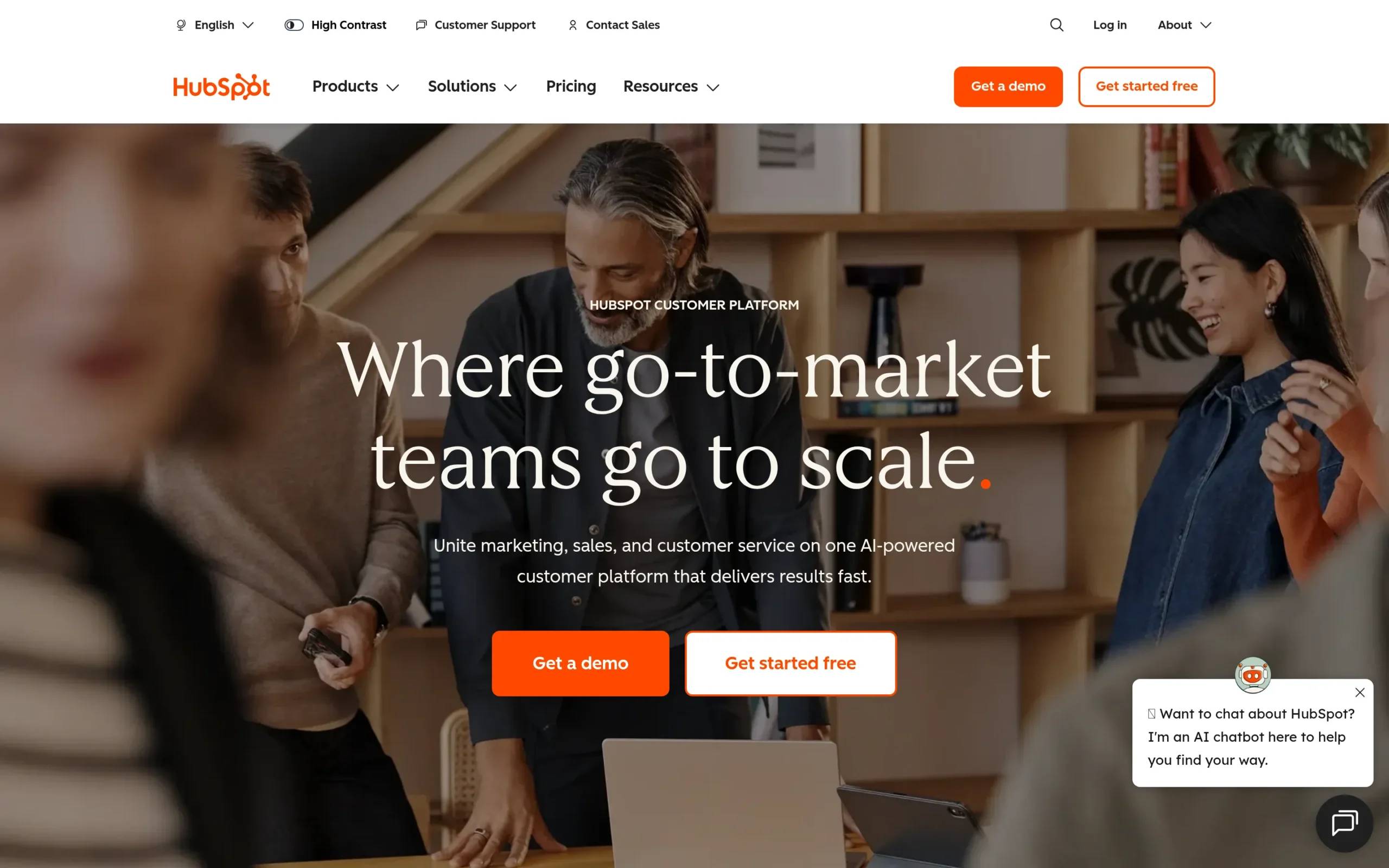
HubSpot is an AI-powered customer platform that combines CRM, marketing automation, sales tools, customer service, and content management into one system. It’s built for businesses that want to centralize their entire go-to-market operation. Over 278,000 customers in more than 135 countries use HubSpot to streamline workflows, scale growth, and improve customer engagement. The platform offers free tools alongside tiered plans (Starter, Professional, Enterprise) across its Marketing Hub, Sales Hub, Service Hub, CMS Hub, and Operations Hub.
Starting price: Free tools available; paid plans start at $9/month per seat
Lemlist
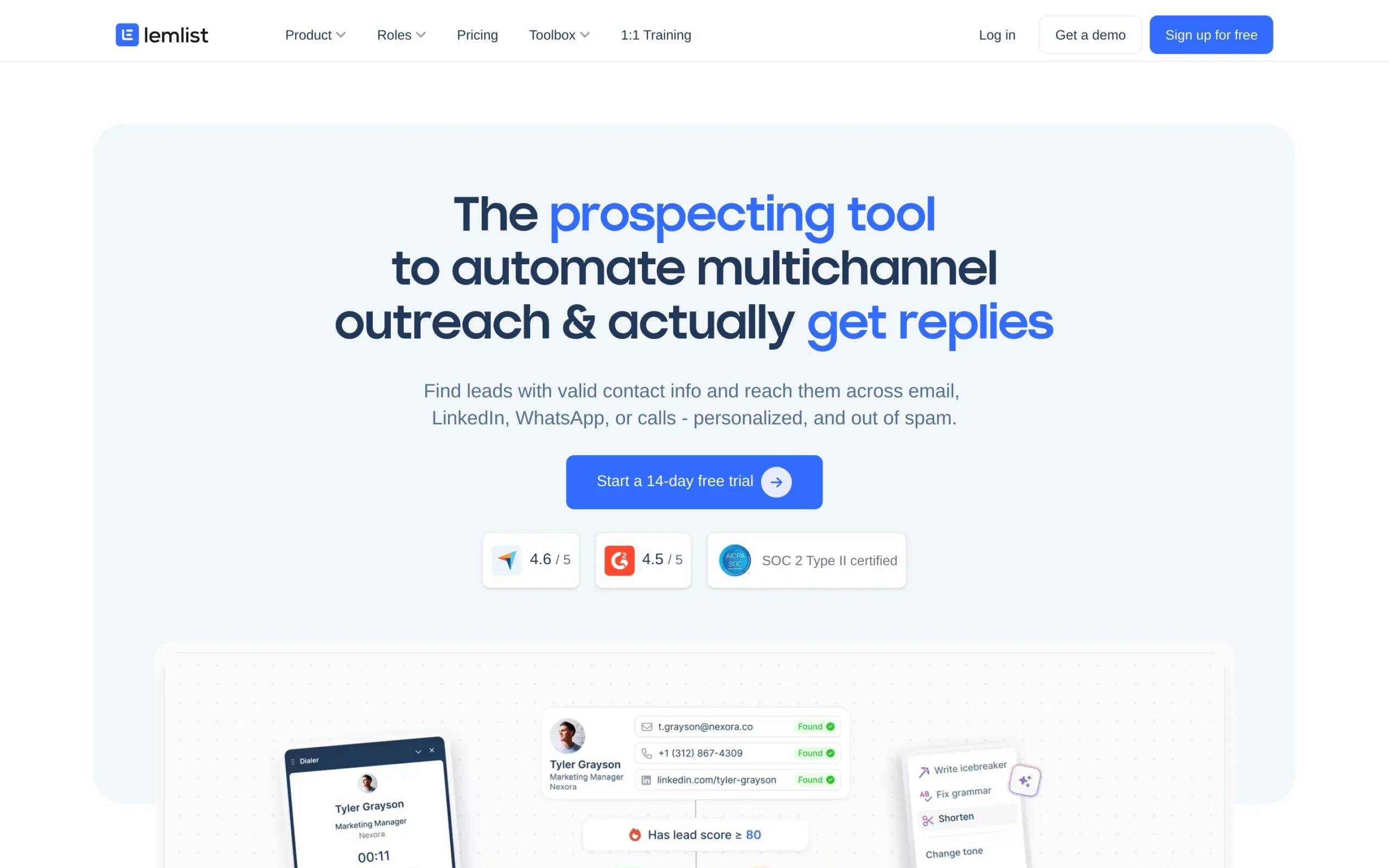
Lemlist is a sales engagement platform for automating multichannel outreach across email, LinkedIn, WhatsApp, and calls while keeping messages personalized. It’s designed for sales teams who want to find leads, personalize at scale, and follow up efficiently from a single platform. Lemlist includes deliverability tools like lemwarm to help emails land in inboxes instead of spam folders. It’s popular among B2B sales teams, SDRs, and agencies running high-volume outreach campaigns.
Starting price: $69/month per user (Email Pro plan)
HubSpot vs. Lemlist – Head-to-head comparison
Let’s break down how these two tools compare across the features that matter most when choosing a sales and outreach platform.
Features & capabilities
HubSpot: HubSpot handles the full customer lifecycle. Its Marketing Hub runs campaigns, personalizes content, and tracks performance with automation. The Sales Hub automates prospecting, manages pipelines, and speeds up deal velocity. The Service Hub scales customer support with help desk and feedback tools. The Smart CRM ties everything together, acting as a single source of truth for customer data and providing AI-powered insights to drive revenue. HubSpot also includes a Content Hub for managing and distributing content across the customer journey.
Lemlist: Lemlist focuses on outbound sales engagement. It automates multichannel sequences combining email, LinkedIn, WhatsApp, and calls from one platform. AI-powered personalization lets you customize messages, images, and landing pages dynamically for each lead. The platform includes a 600M+ lead database with email verification, inbox rotation to protect deliverability, lemwarm to keep emails out of spam, and a unified inbox to track all interactions in one thread. Lemlist is built for teams that need to scale cold outreach without losing the personal touch.
Winner: Tie. HubSpot wins if you need an all-in-one platform managing marketing, sales, and service. Lemlist wins if your focus is high-volume, multichannel cold outreach with strong deliverability.
Ease of use
HubSpot: HubSpot is user-friendly, especially for teams already familiar with CRM platforms. The interface is clean and intuitive once you get oriented, but there’s a learning curve due to the sheer volume of features and functionality. Setting up workflows, automations, and custom properties requires upfront work. Smaller teams or less technical users may find it overwhelming at first. HubSpot offers extensive documentation, a strong knowledge base, and training through HubSpot Academy.
Lemlist: Lemlist is quick to set up and straightforward to use. You can launch campaigns, connect email accounts, and start sending sequences without needing much technical know-how. The interface is less complex than HubSpot because it focuses on one job: outreach. Some users mention a learning curve around technical setup like DMARC and deliverability settings, but once configured, the day-to-day use is smooth. The platform offers templates and campaign recipes to speed up the process.
Winner: Lemlist. It’s simpler and faster to get up and running, especially for teams focused on outreach.
Pricing & value
HubSpot: HubSpot offers free CRM tools, which is a solid starting point for small teams. Paid plans begin at $9/month per seat for the first year (Starter tier), but costs can scale quickly. Professional plans for Sales Hub and Service Hub start around $1,500/month, and Marketing Hub Professional starts around the same. Enterprise plans can run $3,500 to $7,000/month depending on the hub. Additional costs can come from contact limits, technical support, and advanced features. HubSpot’s value grows with team size and complexity, but it’s a significant investment once you move beyond the free tier.
Lemlist: Lemlist offers three pricing tiers. The Email Pro plan starts at $69/month per user and includes email outreach, automation, AI personalization, and deliverability features. The Multichannel Expert plan is $99/month per user, adding LinkedIn, WhatsApp, and call sequences. Enterprise pricing is custom for larger organizations. Lemlist includes a 14-day free trial. For teams running dedicated outreach campaigns, Lemlist offers solid value without the overhead of a full CRM.
Winner: Tie. HubSpot offers more breadth and a free tier, making it valuable for teams needing an all-in-one solution. Lemlist is more affordable and focused, making it better value for dedicated outreach teams.
Integrations
HubSpot: HubSpot has an extensive integration ecosystem with over 2,000 apps available in the HubSpot Marketplace. It connects natively with major platforms like Salesforce, Google Workspace, Microsoft 365, Slack, Zoom, and hundreds of other marketing, sales, and service tools. The breadth of integrations makes HubSpot flexible and adaptable to complex tech stacks.
Lemlist: Lemlist integrates with popular CRMs including HubSpot, Salesforce, Pipedrive, and Breakcool. It also connects with tools like Zapier, Phantombuster, Calendly, and Dropcontact. While the integration library is smaller than HubSpot’s, it covers the essentials needed for outreach workflows. Some users note that native CRM integrations could be deeper and more seamless.
Winner: HubSpot. The sheer number of integrations and native connections gives it the edge for teams with diverse tool needs.
Automation & workflows
HubSpot: HubSpot’s workflow engine is powerful and flexible. You can automate lead nurturing, deal stage progression, task assignments, email follow-ups, and data syncing across teams. Workflows can be triggered by dozens of criteria and can include branching logic, delays, and conditional actions. The automation capabilities extend across marketing, sales, and service, making it possible to build complex, cross-functional processes.
Lemlist: Lemlist automates outreach sequences across email, LinkedIn, calls, and WhatsApp. You can set up multi-step campaigns with personalized messages, automatic follow-ups based on engagement, and out-of-office detection that pauses and resumes sequences. Automation is designed for outbound sales motions. It’s simpler than HubSpot’s workflow engine but effective for its intended use case.
Winner: HubSpot. It offers deeper, more complex automation across the entire customer lifecycle. Lemlist excels at outreach-specific automation but doesn’t match HubSpot’s breadth.
HubSpot vs. Lemlist – Pros and cons
HubSpot strengths & weaknesses
Pros
- All-in-one platform combining CRM, marketing, sales, and service
- Powerful automation and workflow capabilities
- Extensive integration ecosystem with 2,000+ apps
- Scalable for growing businesses and enterprises
- Free CRM tier available
Cons
- High costs, especially as you scale beyond free tools
- Steep learning curve due to feature complexity
- Rigid annual contracts on many plans
- Limited features in lower-tier plans
- Additional costs for advanced support and features
User Rating:
- G2: 4.4/5 (based on 12,000+ reviews)
- Capterra: 4.5/5 (based on 4,414 reviews)
Lemlist strengths & weaknesses
Pros
- Strong multichannel outreach (email, LinkedIn, WhatsApp, calls)
- AI-powered personalization at scale
- Built-in deliverability tools (lemwarm, inbox rotation)
- Access to 600M+ lead database with email verification
- Simpler, faster setup than full CRMs
- Unified inbox for managing all outreach conversations
Cons
- Pricing can add up quickly per user
- Learning curve for technical setup (DMARC, deliverability)
- Occasional bugs and interface issues reported by users
- Limited CRM integrations compared to competitors
- Campaign management and reporting could be more robust
User Rating:
- G2: 4.5/5 (based on 898 reviews)
- Capterra: 4.6/5 (based on 386 reviews)
Which should you choose?
Here are some clear decision-making criteria to help you figure out which tool fits your needs:
Consider HubSpot if:
- You need a full-scale CRM that handles marketing, sales, and customer service
- Your team wants to centralize all customer data and workflows in one platform
- You’re scaling and need automation across the entire customer lifecycle
- You want extensive integration options with your existing tech stack
- You have budget flexibility and plan to invest in a long-term platform
Consider Lemlist if:
- Your primary focus is cold outreach and prospecting
- You need multichannel sequences across email, LinkedIn, and other channels
- Email deliverability and personalization at scale are critical
- You want a simpler, faster setup without CRM overhead
- You’re a sales team, SDR org, or agency running high-volume campaigns
Other options to consider
Since HubSpot and Lemlist serve different core functions, there’s another tool worth exploring depending on what you need.
HubSpot is a full customer platform. Lemlist is a sales engagement tool. What if you need multichannel sales automation?
HubSpot excels at managing your entire customer journey, marketing campaigns, and service operations. Lemlist is built for cold email and LinkedIn outreach with strong deliverability. But if you’re looking for a tool that automates multichannel prospecting, enriches lead data, and integrates tightly with your CRM, La Growth Machine takes a different approach.
What La Growth Machine does:
Our platform is designed to help sales and growth teams automate multichannel outreach across LinkedIn, email, calls, voice messages, and X (Twitter) while keeping it personal and effective. We handle time-consuming tasks like lead enrichment (verifying emails with 9 providers), building targeted lists with Lookalike Search and LinkedIn Intents, and automating sequences that feel human.
Unlike Lemlist, which focuses primarily on email and LinkedIn messaging, La Growth Machine gives you more channels to work with, including LinkedIn voice messages (which double reply rates) and Social Warming (automatically liking posts and following prospects before outreach). Unlike HubSpot, which requires significant setup and ongoing management across multiple hubs, La Growth Machine focuses on prospecting and outreach, so you can get up and running faster.
How it fits into your stack:
If you’re already using HubSpot as your CRM, La Growth Machine integrates directly and syncs all contacts and interactions automatically. You can use HubSpot to manage your customer lifecycle and La Growth Machine to power your outbound prospecting engine.
If you’re comparing Lemlist to La Growth Machine, the key difference is breadth. We offer more channels (voice messages, Social Warming, calls), deeper lead enrichment, and Lookalike Search to automatically find prospects similar to your best customers. We also include Inbox Rotation, A/B testing, and a unified inbox with built-in lead qualification.
Pricing:
- Starting at €50/month per identity (Basic Plan)
- Pro Plan at €100/month (includes Lookalike Search, LinkedIn Intents, Social Warming, Inbox Rotation)
- 14-day free trial (no credit card required)
Worth considering if:
- You want multichannel prospecting beyond email and standard LinkedIn messaging
- Lead enrichment and finding lookalike prospects are priorities
- You’re looking for a tool that bridges the gap between cold outreach and CRM
- You need strong deliverability without the complexity
HubSpot vs. Lemlist – FAQs
Can HubSpot and Lemlist be used together?
Yes. Lemlist integrates with HubSpot, so you can sync contacts, track campaign activity, and push engagement data back into your CRM. Many teams use HubSpot as their central customer platform and Lemlist to handle dedicated cold outreach campaigns. This setup lets you keep all customer data centralized in HubSpot while using Lemlist’s specialized outreach and deliverability features.
Which tool is better for cold email campaigns?
Lemlist is purpose-built for cold email and multichannel outreach, with features like lemwarm for deliverability, AI personalization, inbox rotation, and automated follow-ups. HubSpot can send email sequences through its Sales Hub, but it’s not optimized for high-volume cold outreach. If cold email is your primary goal, Lemlist is the stronger choice.
Is HubSpot worth the investment for small teams?
HubSpot’s free CRM is a solid starting point for small teams that need basic contact management, deal tracking, and email integration. However, costs can escalate quickly once you need advanced features like automation, reporting, or multichannel campaigns. Small teams focused on outbound sales may find more immediate value in a specialized tool like Lemlist or La Growth Machine, while teams building a full go-to-market engine may benefit from investing in HubSpot’s broader platform.
Conclusion
Both HubSpot and Lemlist are strong tools, but they’re built for different jobs. HubSpot is the all-in-one platform for managing your entire customer journey, from first touch to renewal. Lemlist is the focused sales engagement tool for teams running multichannel cold outreach at scale.
If you need a full CRM that centralizes marketing, sales, and service, HubSpot makes sense despite the higher cost and complexity. If your focus is cold prospecting and you want strong deliverability with multichannel sequences, Lemlist is the more direct fit.
And if you’re looking for a tool that sits somewhere in between, focused on automating multichannel prospecting with lead enrichment, Lookalike Search, and CRM integration, La Growth Machine is worth exploring. We’re built to help sales teams get more replies, start more conversations, and close more deals without getting bogged down in manual prospecting work.
Get 3.5X more leads!
Do you want to improve the efficiency of your sales department? With La Growth Machine you can generate on average 3.5x more leads while saving an incredible amount of time on all your processes.
By signing up today, you’ll get a free 14-day trial to test our tool!