

TL;DR
LeadIQ streamlines prospecting with one-click contact capture and CRM push starting $75/month.
– Chrome extension captures contact details instantly from LinkedIn, Sales Navigator, websites
– One-click push sends enriched data directly to Salesforce, Outreach, Salesloft
– Prospecting intelligence surfaces job changes and buying signals for timely outreach
– Limited outreach automation focuses on data capture rather than campaign execution
– Ideal for sales reps needing fast contact enrichment while actively prospecting
Looking for a sales intelligence tool to simplify your prospecting? LeadIQ has become popular with B2B sales teams who need accurate contact data quickly. But is it right for your outreach strategy?
LeadIQ Features, Pros & Cons, Pricing vs. La Growth Machine: Quick comparison
Here’s how LeadIQ Features, Pros & Cons, Pricing compares to La Growth Machine:
| Aspect | LeadIQ Features, Pros & Cons, Pricing | La Growth Machine |
|---|---|---|
| Key Strengths | All-in-one platform with comprehensive features | Scaling teams needing enrichment + deliverability + multichannel in one platform |
| Considerations | Learning curve and pricing at scale | Requires time investment for multichannel setup |
| Best For | Teams needing comprehensive sales and marketing tools | Scaling teams needing enrichment + deliverability + multichannel in one platform |
LeadIQ Features, Pros & Cons, Pricing pricing comparison
Pricing comparison between LeadIQ Features, Pros & Cons, Pricing and La Growth Machine:
| Tool | Starting Price | Free Trial |
|---|---|---|
| LeadIQ Features, Pros & Cons, Pricing | Free | Available |
| La Growth Machine | €50/month (annual) | 14 days |
This LeadIQ review breaks down its key features, pricing structure, and what users actually think. We’ll look at where it excels and where it falls short, especially for multichannel prospecting. By the end, you’ll know whether LeadIQ belongs in your sales stack.
What is LeadIQ?
LeadIQ is a B2B sales intelligence and prospecting platform that helps revenue teams build pipeline faster. It’s a data provider that captures verified emails and phone numbers, mainly through LinkedIn integration. The tool simplifies the prospecting workflow by letting sales reps pull contact information directly from LinkedIn profiles and sync it straight into their CRM or sales engagement platform.
The platform targets mid-market companies and sales development teams who rely heavily on outbound prospecting. It’s popular among SDRs and BDRs who spend their days hunting for leads on LinkedIn Sales Navigator. LeadIQ saves time by automating the tedious work of copying contact details and manually entering them into multiple systems.
Beyond data capture, LeadIQ now includes champion tracking (monitoring when your contacts change jobs), AI-powered account prospecting, and an AI writing assistant called Scribe that generates email copy. It integrates with major CRMs like Salesforce and HubSpot, plus sales engagement platforms like Outreach and Salesloft.
LeadIQ key features
LeadIQ packs several features aimed at making prospecting faster and more efficient. Here’s what you get:
Prospector (Chrome extension)
This is LeadIQ’s core offering. The Chrome extension sits on top of LinkedIn and other web pages, letting you capture contact data in seconds. When you’re browsing a prospect’s LinkedIn profile, you click the LeadIQ button to instantly pull their email address, phone number, and job details.
The extension works with LinkedIn Sales Navigator, making it easy to export entire search results or individual profiles. Once captured, you can push contacts directly to your CRM or add them to a list for bulk export. This workflow eliminates the copy-paste grind that burns out most SDRs.
However, the data quality isn’t always consistent. Users frequently report that phone numbers are missing or that they receive personal cell numbers instead of work lines, which can lead to awkward situations when you accidentally call someone’s family member.
Waterfall email enrichment
LeadIQ uses a waterfall enrichment system that queries multiple data providers (reportedly 9 different sources) to find and verify email addresses. The platform scores each email based on confidence level, so you know whether it’s likely to bounce or deliver successfully.
This multi-provider approach improves your chances of finding accurate emails compared to tools that rely on a single database. LeadIQ also offers double validation to reduce bounce rates. While email enrichment is generally solid, some users mention that accuracy drops when targeting niche industries or smaller companies where public data is scarce.
Champion tracking
This feature automatically monitors when your contacts change jobs. When someone you’ve worked with moves to a new company, LeadIQ sends you an alert so you can reconnect at the perfect moment. It’s especially useful for account executives who want to follow warm leads across organizations.
Champion tracking helps reduce churn risk and creates upsell opportunities, since you’re engaging with people who already know your product. That said, the feature relies on LinkedIn data being up to date, so there can be a lag between when someone changes roles and when you get notified.
AI-powered account prospecting
LeadIQ’s AI account prospecting tool identifies companies that match your ideal customer profile and surfaces key decision-makers within those organizations. You can set criteria like industry, company size, and tech stack, and LeadIQ will recommend accounts and contacts to prioritize.
This works well for teams running account-based strategies who want to focus on high-value prospects. But the recommendations are only as good as the filters you set, and some users find the account matching less precise than specialized ABM tools like 6sense or Demandbase.
Scribe AI copywriting assistant
Scribe generates email copy based on the prospect’s profile and company information. You can create entire sequences with follow-ups in one click, and the AI adapts messaging to avoid repetitive phrasing across emails.
It’s a time-saver if you’re sending dozens of emails per day, but the output often needs editing. The tone can feel generic, and the German localization (for non-English markets) reportedly sounds unnatural. Think of Scribe as a first-draft generator, not a finished product.
Integrations
LeadIQ integrates with major CRMs (Salesforce, HubSpot, Pipedrive) and sales engagement platforms (Outreach, Salesloft, Groove by Clari). It also connects with workflow automation tools like Zapier, Workato, and Clay.
One common complaint is that the Salesforce integration can be buggy. Users report issues with contacts not syncing correctly or getting assigned to the wrong accounts. The HubSpot integration works through Workato, which adds an extra layer of complexity. For teams that rely on seamless data flow between tools, these hiccups can be frustrating.
LeadIQ pricing
LeadIQ offers four pricing tiers, but transparency isn’t their strong suit. Here’s what’s publicly available:
Free plan: 50 verified emails per month, 5 phone numbers, 40 AI-generated emails via Scribe, and tracking for 10 accounts. This is basically a trial to test the platform, not a long-term solution.
Essential plan: $36 per user per month. You get 1,000 verified emails, 50 phone numbers, 100 AI emails, and 50 tracked accounts. This plan is aimed at solo SDRs or small teams just getting started.
Pro plan: $79 per user per month. Bumps you up to 2,000 verified emails, 100 phone numbers, 500 AI emails, 100 tracked accounts, and 100 tracked contacts. You also unlock lookalike search and intent data.
Enterprise plan: Pricing is not publicly available. This tier offers unlimited prospecting, 200 phone numbers per month, 2,000 AI emails, 300 tracked accounts, and 100 tracked contacts, plus advanced integrations and API access.
LeadIQ’s pricing is competitive for mid-market teams, especially compared to heavyweight platforms like ZoomInfo. But the credit system can catch you off guard. Once you burn through your monthly email or phone number credits, you’ll need to upgrade or wait until the next billing cycle. There’s no option to purchase additional credits à la carte on lower-tier plans.
LeadIQ pros and cons
Let’s look at what users love and what drives them crazy.
G2: 4.2/5 (based on 1,147 reviews)
Capterra: 4.4/5 (based on 24 reviews)
Pros
- Strong LinkedIn integration: The Chrome extension makes capturing leads from LinkedIn Sales Navigator incredibly fast. It’s one of the smoothest workflows for exporting contacts without switching between tabs.
- Multiple data sources for email enrichment: By querying 9 providers, LeadIQ increases the chances of finding accurate emails compared to single-source tools. The confidence scoring helps you prioritize which contacts are safe to email.
- Champion tracking is genuinely useful: Monitoring job changes gives you a natural reason to reconnect with warm leads. This feature alone can generate pipeline without cold outreach.
- Decent pricing for small to mid-sized teams: At $36-$79 per user per month, LeadIQ is more affordable than enterprise-level platforms like ZoomInfo or Apollo’s higher-tier plans.
- Fast customer support: Multiple users mention that the support team is responsive and helpful when things go wrong.
Cons
- Inconsistent data quality: Phone numbers are often missing, outdated, or personal cell numbers instead of work lines. Email accuracy drops significantly for niche industries and smaller companies.
- Buggy Salesforce integration: Users frequently report that contacts don’t sync properly or get assigned to the wrong accounts. This creates manual cleanup work that defeats the purpose of automation.
- Limited filtering options: When capturing contacts on LinkedIn, the filter options are fairly basic. If you need advanced segmentation or fine-tuned targeting, you’ll feel constrained.
- AI-generated copy needs heavy editing: Scribe’s output is generic and often sounds like obvious AI. The German localization is particularly weak, making it unusable for non-English campaigns without significant rewrites.
- No company data for many prospects: Users report that company-level information (firmographics, tech stack) is often missing, requiring manual research to fill in the gaps.
Considering alternatives?
LeadIQ is a solid tool for capturing contact data from LinkedIn and syncing it to your CRM. But here’s the thing: it’s built for single-channel prospecting. You’re still limited to email and phone, two channels that are increasingly saturated and harder to break through.
If you’re serious about outbound, multichannel is no longer optional. Research shows that multichannel sequences generate up to 3.5x more replies than email-only campaigns. That’s because you’re meeting prospects where they actually engage: LinkedIn, email, calls, and even voice messages, instead of relying on one channel to do all the heavy lifting.
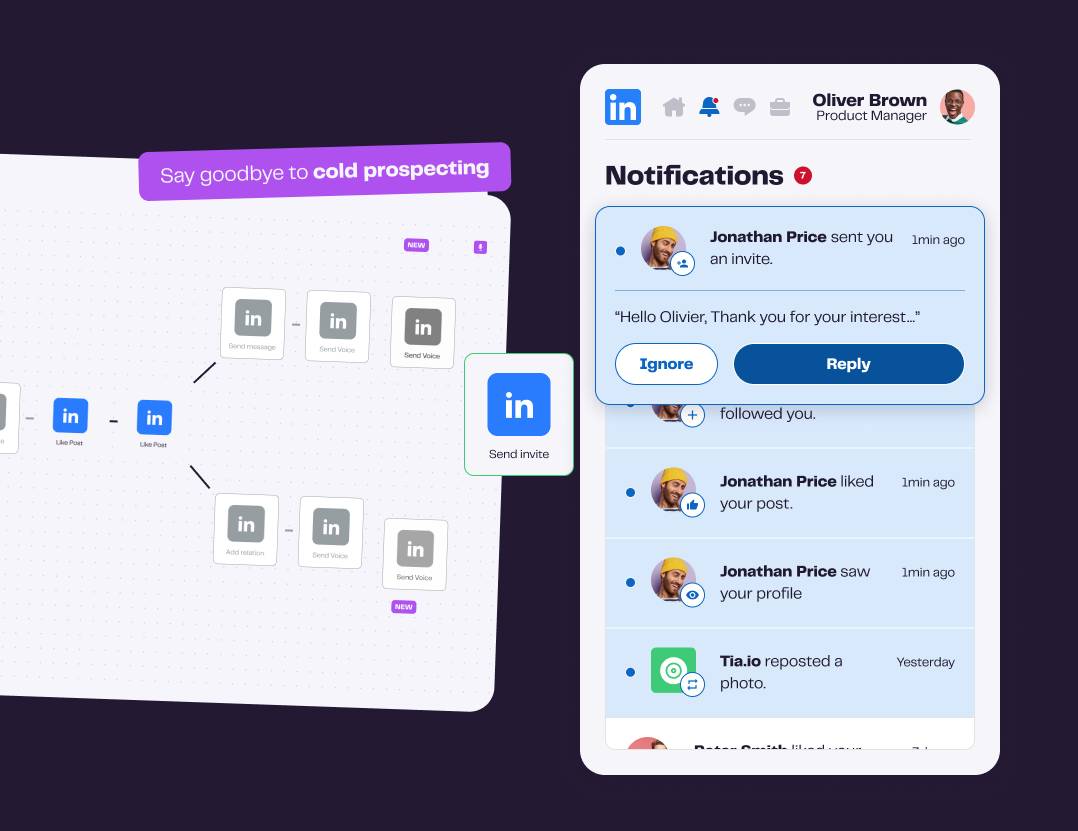
This is where La Growth Machine comes in. While LeadIQ helps you find and organize contact data, La Growth Machine automates your entire multichannel outreach workflow. You can build sequences that combine LinkedIn connection requests, profile visits, messages, email follow-ups, call reminders, and even LinkedIn voice messages, all from one platform.
Here’s what sets La Growth Machine apart:
True multichannel automation: Run campaigns across LinkedIn, email, X (Twitter), calls, and voice messages. LeadIQ only handles data capture; LGM executes the entire outreach sequence automatically.
LinkedIn voice messages: This feature alone doubles reply rates. You can even clone your voice to send personalized audio messages at scale, something LeadIQ doesn’t offer at all.
Built-in email enrichment: LGM uses waterfall enrichment (just like LeadIQ) but includes it for free and unlimited in all plans. No credit caps, no surprises.
Multichannel inbox: Manage all your LinkedIn and email conversations in one unified thread. No more switching between platforms to track replies. LeadIQ doesn’t have an inbox at all, you’re still juggling tools.
Native CRM sync: LGM syncs all leads and every prospecting action (messages, connection requests, profile visits) to HubSpot, Pipedrive, and Salesforce. This creates a complete activity timeline in your CRM, not just contact records.
Intent-based prospecting: Import people who liked or commented on LinkedIn posts, signed up for events, or follow your company page. Target prospects at the exact moment they’re showing interest.
Pricing that scales: Starting at €50/month for the Basic plan and €100/month for Pro (which includes lookalike search, intent data, and advanced features), LGM offers more functionality at a comparable price point. And there’s a 14-day free trial with no credit card required.
LeadIQ is fine if you just need a data enrichment tool. But if you want to actually book meetings and fill your pipeline, you need a platform that automates your entire outreach strategy, not just the data collection part. La Growth Machine gives you the multichannel firepower that outbound demands.
Conclusion
LeadIQ is a useful prospecting tool for teams that live in LinkedIn and need a fast way to capture contact data. The Chrome extension, email enrichment, and champion tracking are genuinely valuable features that save time and improve targeting. For mid-market sales teams with straightforward data needs, it’s a solid choice at a reasonable price.
That said, the platform has clear limitations. Data quality is inconsistent, especially for phone numbers. The Salesforce integration is buggy. The AI copywriting assistant needs heavy editing. And most importantly, LeadIQ only solves half the problem: it gets you the contact information, but it doesn’t help you run effective multichannel campaigns.
LeadIQ works best for teams that already have a strong outreach system in place and just need better data sourcing. If that’s you, it’s worth testing the free plan to see if the data quality meets your standards.
But if you’re looking for a platform that combines data enrichment with automated multichannel outreach, La Growth Machine is the smarter move. You’ll get the same data capabilities plus the ability to actually engage prospects across LinkedIn, email, calls, and voice messages, all from one platform.
Get 3.5X more leads!
Do you want to improve the efficiency of your sales department? With La Growth Machine you can generate on average 3.5x more leads while saving an incredible amount of time on all your processes.
By signing up today, you’ll get a free 14-day trial to test our tool!