

TL;DR
– Lemlist is email-first with LinkedIn added on its Multichannel plan; its Email plan is flat at $69/month on monthly billing with unlimited users and 50,000 emails, and lemwarm is included
– La Growth Machine runs LinkedIn, email, X and calls in one sequence, billed per identity from €60/month on monthly billing, with two-way CRM sync that can pause a sequence on CRM state
– Real cost for 5 reps sharing 3 LinkedIn accounts: $545/month on Lemlist Multichannel (5 seats at $109) against €360/month on La Growth Machine Pro (3 identities at €120), both verified August 2026
– Pick Lemlist for email at volume across many seats; pick La Growth Machine when LinkedIn opens the conversation or your headcount grows faster than your sending accounts
Last updated: August 2026 · 11 min read · By Erwann Lefevre
Choosing between Lemlist and La Growth Machine is not a features beauty contest. It is an infrastructure decision, and the two tools price that infrastructure on completely different units. Lemlist bills $109 per user per month on its Multichannel plan. La Growth Machine bills €60 per identity per month on Basic. A five-person team with three LinkedIn accounts pays for five seats on one side and three identities on the other, and that gap only widens as you hire.
The unit matters more than the sticker price, because it decides what happens to your bill when your team changes shape rather than when your volume does.
Lemlist vs La Growth Machine: which one should you pick?
For B2B teams running LinkedIn and email as one sequence, La Growth Machine is the stronger fit at €60 per identity per month; Lemlist wins on email volume, where its $69 plan covers unlimited users and 50,000 emails.
| If you are | Pick | Why |
|---|---|---|
| An email-first team with many seats and high send volume | Lemlist | The Email plan is flat rate with unlimited users and 50,000 emails a month |
| A GTM team running LinkedIn and email in one sequence | La Growth Machine | Both channels sit in the same sequence and the same inbox, billed per identity |
| A team scaling headcount faster than sending accounts | La Growth Machine | Cost tracks identities, not seats |
| A team that lives in email and wants creative email formats | Lemlist | Dynamic images, embedded pages and video snippets are its home ground |
| A GTM engineer who needs an API on the entry plan | Lemlist | La Growth Machine gates its API behind the Pro plan |
| A revenue team that wants CRM state to gate the sequence | La Growth Machine | Deals and lifecycle changes in the CRM can pause a running sequence |
How we compared Lemlist and La Growth Machine
This comparison uses two levels of proof, and it is worth being blunt about which is which. We run our own outbound on La Growth Machine every day. Lemlist was not run in a live campaign for this piece: it was assessed on published documentation, checked in August 2026.
Proof levels, stated plainly: 1 tool tested in live campaigns (La Growth Machine), 1 tool compared on public sources only (Lemlist). We did not field-test Lemlist, so you will find no verdict here on how it behaves at volume, only what its pricing page, help centre and product documentation state.
Disclosure: La Growth Machine is our own product, so treat our verdict on it as an interested one. We have tried to keep the comparison honest by naming where Lemlist wins, and it wins in two places that matter. Its Email plan carries unlimited users for a flat fee, which is cheaper than our per-identity model for large email-only teams. And its API ships on every paid plan, where ours starts at Pro.
Everything below is sourced one of three ways: a published pricing page, published product documentation, or our own daily use of La Growth Machine. Where a claim would have needed a Lemlist field test we did not run, we left it out.
Lemlist vs La Growth Machine at a glance
The table below compares the two on the criteria that change the decision, rather than on feature counts. Pricing units, entry price, sending capacity, enrichment model and the plan at which programmatic access appears are the five lines that most often decide which tool a team ends up keeping after the first year.
| Criterion | Lemlist | La Growth Machine |
|---|---|---|
| Channels | Email, LinkedIn, SMS, WhatsApp add-on, calls | Email, LinkedIn, X, calls |
| Pricing unit | Flat on Email, per user on Multichannel | Per identity |
| Entry price (monthly billing) | $69/month, Email plan (verified August 2026) | €60/month per identity, Basic (verified August 2026) |
| Multichannel price (monthly billing) | $109/user/month, Multichannel plan (verified August 2026) | €120/month per identity, Pro (verified August 2026) |
| Senders or inboxes | 5 senders per user on Multichannel | 1 sending email on Basic, 5 inboxes in rotation on Pro, 10 on Ultimate |
| Built-in prospect data | 650M+ contact records included (verified August 2026) | None, sourcing happens upstream |
| Enrichment model | Email and phone finder, plus paid verification credits at $0.10 per record found | Monthly credit allowance: 1,250 credits on Basic, 2,000 on Pro, 5,000 on Ultimate |
| Deliverability | lemwarm included on every paid plan, Deliverability Hub | Inbox rotation across multiple inboxes per identity |
| CRM sync | HubSpot and other CRMs, contacts deduplicated by email, email activity logged to the timeline | Native two-way sync with HubSpot, Pipedrive, Salesforce, Folk and Recruit CRM, no middleware |
| API and MCP available from | Entry plan (Email), plus lemlist MCP and lemAgent | API and webhooks from Pro, MCP server on any plan |
| Best for | Email-first teams sending at volume | GTM teams running LinkedIn and email as one sequence |
Lemlist: overview, features, pricing and best fit
Lemlist started as a cold email tool and its centre of gravity is still there. Its strength is email craft: dynamic images, embedded landing pages, video snippets and liquid templating. LinkedIn, SMS and calls were layered on later and live on the Multichannel plan, which is the one most teams end up on if LinkedIn matters to them.
Overview. Lemlist is an email-first outreach platform that has grown into a multichannel one. Its Email plan is flat rate with unlimited users, which is unusual in this category and genuinely useful for larger teams. Its Multichannel plan adds LinkedIn, SMS and a call dialer, and switches the billing to per user. Our full Lemlist review goes deeper on the sequence editor itself.
Key features. Email sequencing with creative personalisation formats. A pool of 650M+ contact records with email and phone finder. lemwarm, its warm-up product, included on every paid plan. A Deliverability Hub. LinkedIn, SMS and WhatsApp steps on Multichannel. A built-in call dialer with VoIP integrations. CRM integrations and an API on every paid plan. lemAgent and lemlist MCP for driving the tool from an AI assistant.
Pros & cons. On the plus side: unlimited users on the Email plan, the strongest creative email formats in the category, warm-up bundled rather than sold separately, and programmatic access from the entry tier. On the minus side: LinkedIn sits behind the per-user Multichannel plan, so a team with more reps than sending accounts pays for the mismatch, and the LinkedIn layer is shallower than what dedicated LinkedIn platforms offer.
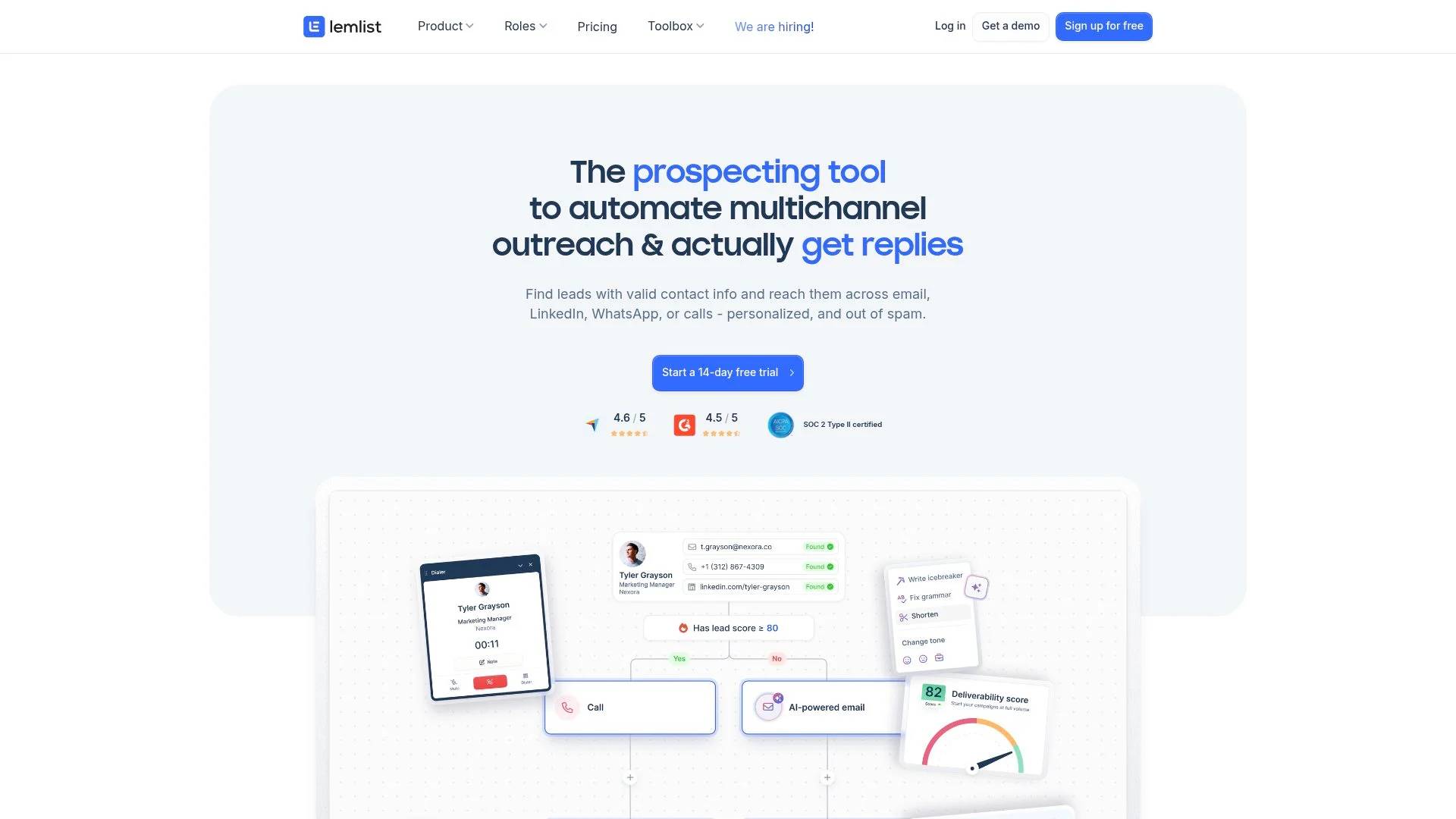
Pricing. Email at $69 per month on monthly billing ($55 on annual billing), flat rate with unlimited users and 50,000 emails a month. Multichannel at $109 per user per month on monthly billing ($87 on annual billing), with five senders per user. Enterprise is custom priced. Verification credits are an add-on at $0.10 per email or phone number found. All figures verified August 2026 on the official pricing page, which displays annual rates by default.
Best for. Email-dominant teams with a lot of seats and a lot of volume, and marketers who want their emails to look designed rather than typed.
La Growth Machine: overview, features, pricing and best fit
La Growth Machine was built for multichannel from the start, which shows up less in the feature list than in the billing unit. It charges per identity, where an identity is one connected LinkedIn account plus its paired email inboxes. That maps cost to sending infrastructure rather than to headcount, which is the whole argument for it.
Overview. La Growth Machine is an outreach platform where LinkedIn, email, X and calls run inside a single sequence, with replies landing in one shared inbox. LinkedIn actions run on cloud infrastructure with dedicated IPs per identity rather than through a browser extension. The sequence builder is where the difference is most visible.
Key features. One sequence per person across LinkedIn, email, X and calls. Cloud LinkedIn infrastructure with dedicated IPs per identity and no browser extension. Social Warming, Real Chat Mode and LinkedIn voice messages. Inbox rotation and A/B testing. A shared multichannel inbox with reply and out-of-office detection. Waterfall enrichment, lookalike search and intent data. Native two-way CRM sync without middleware. A REST API, webhooks and an MCP server exposing 40+ actions.
Pros & cons. On the plus side: per-identity billing that does not punish hiring, LinkedIn and email genuinely in the same sequence, CRM sync that runs both ways without a connector in between, and an MCP server that is open source and free. On the minus side: there is no built-in prospect data, so list building happens upstream in another tool, and the API and webhooks start at the Pro plan rather than on Basic, which is a real constraint if you are building on it early.

Pricing. Basic from €60/month per identity (Basic, monthly billing, verified August 2026), covering LinkedIn and email with one sending email and up to three identities. Pro at €120 per identity per month on monthly billing, adding calls, five inboxes in rotation, the API and webhooks. Ultimate at €180 per identity per month on monthly billing, adding X and ten inboxes in rotation. Annual billing brings those to €50, €100 and €150. A 14-day free trial runs without a credit card. All figures verified August 2026.
Best for. GTM and revenue teams whose first meaningful reply comes from LinkedIn as often as from email, and who want that activity to land in the CRM without a middleware step.
Round 1: How each tool models multichannel
Both tools now cover more than one channel, so the useful question is not whether they do multichannel but how the sequence is shaped underneath. In one, LinkedIn is a step you add to an email sequence. In the other, the sequence is channel-agnostic and the tool picks the next touch from conditions you set.
Lemlist’s model is email-first with channels attached. On the Multichannel plan you can trigger LinkedIn invites, messages and profile visits inside a sequence, alongside SMS and a call dialer. The LinkedIn layer is lighter than what dedicated LinkedIn tools provide, which is a reasonable trade if LinkedIn is a reminder touch rather than the channel that opens the conversation.
La Growth Machine’s model is one contact story per person across channels, built on a native multichannel sequence builder. A sequence can open on LinkedIn, follow up by email, drop a voice message, and route every reply into the same shared inbox under the right identity. LinkedIn actions run in the cloud on dedicated IPs per identity, so nothing depends on a browser session staying open on a rep’s laptop.
Round 1 verdict: Lemlist treats multichannel as a set of channels you can add. La Growth Machine treats it as the shape of the sequence itself. If LinkedIn is where your first real reply happens, the second model is the one that will not force a migration in a year.
Round 2: What each pricing model actually costs
Sticker price is the wrong frame here, because the two tools do not charge for the same thing. Lemlist charges flat on Email and per user on Multichannel. La Growth Machine charges per identity. The comparison only becomes meaningful once you fix a team shape and run both models against it, which is what the table below does.
Take a five-person sales team running LinkedIn and email, sharing three LinkedIn accounts between them. On Lemlist, LinkedIn requires the Multichannel plan, so that is five seats at $109 per user per month on monthly billing, or $545. On La Growth Machine, three identities on Pro at €120 per identity per month on monthly billing comes to €360. Both figures verified August 2026.
| Cost component | Lemlist (5 users, Multichannel) | La Growth Machine (3 identities, Pro) |
|---|---|---|
| Core subscription, monthly billing | $545 | €360 |
| LinkedIn steps | Included on Multichannel | Included |
| Warm-up and deliverability | lemwarm included on every paid plan | Inbox rotation, 5 inboxes per identity |
| Enrichment | Email and phone finder included, verification billed at $0.10 per record found | 2,000 credits/month per identity on Pro, which covers 400 fully enriched leads at no extra cost |
| CRM sync | Included, native | Included, native two-way |
| API and webhooks | Included from the entry plan | Included from Pro |
Now change the team shape and the answer flips. A ten-person team doing email only, with no LinkedIn in the sequence, pays $69 a month on Lemlist’s Email plan because users are unlimited on that tier. The same motion on La Growth Machine would still be billed per identity. On a pure email play at scale, Lemlist is cheaper than us, and it is not close.
Round 2 verdict: the deciding variable is whether your headcount grows faster than your sending accounts. If it does, per-identity billing wins. If your motion is email-only and seat-heavy, Lemlist’s flat Email plan wins, and no amount of multichannel argument changes that arithmetic.
Round 3: What lands in your CRM
A sequence is only as useful as the trace it leaves in the CRM, because that trace is what your reporting is built on. The two tools differ less on whether they sync and more on what they sync, and on whether the CRM can talk back to the sequence. That second half is where the gap is widest.
Lemlist’s HubSpot integration creates contact and company records from campaigns and logs outbound activity to the contact timeline. Contacts are deduplicated by email address, companies by domain or company name. The activity types logged are the email ones: sent, opened, clicked, replied, bounced and unsubscribed. You can choose which of those sync, which keeps the timeline readable.
La Growth Machine syncs two ways with HubSpot, Pipedrive, Salesforce, Folk and Recruit CRM, with no middleware in between. Activity from every channel in the sequence flows into the CRM, not only email steps. The direction that matters more is the return trip: CRM state can gate a running sequence. A campaign can pause when the CRM already holds a deal for that contact, when a lifecycle stage changes, or when the contact enters a dynamic list, and exclusion lists work the same way.
That return trip is the part most comparisons skip: the difference between a CRM that records what outreach did and one that decides whether outreach should continue. On reporting, the platform surfaces performance by campaign, message, channel and sender, and tracks deal stages, including calls booked, alongside loss reasons. It reports stages, not amounts.
Round 3 verdict: if your reporting is email-centric, Lemlist’s timeline is enough. If LinkedIn activity needs to be visible in the CRM, or if you want the CRM to stop a sequence rather than just record it, La Growth Machine’s two-way HubSpot sync is the one built for that.
Round 4: What you can drive from an API and an AI assistant
This is the round that did not exist two years ago and now decides more purchases than creative email formats do. Both tools are programmable and both ship an MCP server, so an assistant can read campaign data and act on it. What separates them is not whether the surface exists but which plan it appears on.
Lemlist exposes CRM integrations and an API on every paid plan, including the entry Email tier. It also ships lemAgent and lemlist MCP, both listed on its pricing page as part of the core feature set. For a small team that wants to script something on day one without a plan upgrade, that is a genuine advantage and worth saying plainly.
La Growth Machine exposes a REST API and webhooks from the Pro plan, not on Basic. That is a real gate and it catches people out, so it belongs in any honest comparison. The API covers creating and stopping leads, building an audience from a LinkedIn search URL, marking a lead converted, and pulling campaign stats. Webhooks ship on the same plans and push events out to your stack, which is the difference between an event-driven integration and a cron job that polls for changes.
The MCP server sits outside that gate and does a different job, which is worth separating because the two are easy to confuse. The API is for unattended code: your systems call it, webhooks call your systems back. The MCP server is for an assistant working in a conversation: it reads live workspace data and runs actions, with write actions asking for explicit confirmation by default and a read-only mode available. It is open source and free, needs an active account rather than a specific plan, works with any MCP client including Claude, ChatGPT, Cursor and n8n, and exposes 40+ actions covering audiences, campaign stats, conversations and replies. If you are building a pipeline, you want the API and the Pro plan. If you want to run outreach from an assistant, the MCP is enough on its own. There are also 11 published GTM skills in an MIT-licensed repository.
Round 4 verdict: Lemlist gets programmatic access into your hands earlier, on a cheaper plan. La Growth Machine’s surface is broader once you are on Pro, and its MCP server is the piece that lets a GTM engineer pilot campaigns from an assistant rather than from a dashboard.
Which tool fits your team
The honest answer depends on three things: where your first reply comes from, whether your team grows in seats or in sending accounts, and how early you need to build on an API. The four profiles below cover most of the teams that end up comparing these two tools, and each one has a clear answer rather than a hedge.
…for email-first teams sending high volume
If more than three quarters of your sequences are email and LinkedIn is a reminder touch, Lemlist is the better economic fit. Its Email plan is flat rate with unlimited users and 50,000 emails a month, and lemwarm is bundled. If you want to widen the shortlist before deciding, our roundup of Lemlist alternatives covers the email-first field in more depth.
…for GTM teams running LinkedIn and email together
If a connection request opens the conversation and email carries it forward, you want both channels in one sequence and one inbox rather than two tools and two threads. That is La Growth Machine’s design, and per-identity billing usually lands cheaper for this shape because a team of five commonly runs two or three LinkedIn accounts, not five.
…for teams scaling headcount faster than inboxes
This is the clearest case of the four. Per-user pricing grows linearly with hiring even when sending volume does not, so a team going from five reps to fifteen over eighteen months pays three times more on Lemlist’s Multichannel plan while its sending infrastructure barely changes. Per-identity billing tracks the infrastructure instead.
…for GTM engineers building on the API
If you plan to script against the platform in week one, check the plan gate before the feature list. Lemlist ships its API on the entry plan. La Growth Machine starts it at Pro, so budget for €120 per identity per month on monthly billing rather than €60. Both ship an MCP server, so assistant-driven work is possible on either.
Who La Growth Machine is built for
La Growth Machine fits a specific shape of team rather than everyone comparing these two tools, and being clear about that is more useful than a pitch. It is built for B2B companies in software, tech, finance and agencies, typically between 11 and 500 people, with a sales or GTM team that is scaling.
The fit is strongest when LinkedIn is a first-class channel rather than a follow-up, when replies need to reach a shared inbox instead of individual accounts, and when outreach activity has to land in the CRM cleanly enough for someone to report on it. If you are a GTM engineer wiring outreach into the rest of the revenue stack, the API, the webhooks and the MCP server are the parts to look at first.
The fit is weakest in two cases. If you need prospect data inside the tool, there is none, and list building stays upstream in something like Clay or Sales Navigator. And if your outbound is email only, the per-identity model has no advantage over a flat email plan.
How to choose between Lemlist and La Growth Machine
Four checks will settle this faster than any feature comparison, and each of them produces a number rather than an opinion. Run them against your own pipeline before you look at a demo, because the answers are what actually determine which pricing model works in your favour over the next eighteen months.
- Count where your replies come from. Split last quarter’s replies between email and LinkedIn. If LinkedIn is under 20%, the email-first tool is probably enough. If it is over 40%, the sequence model matters more than the sticker price.
- Count seats against sending accounts. Write down your headcount and your number of LinkedIn accounts and inboxes. If the first number is growing faster than the second, per-user pricing will get expensive in a way per-identity pricing will not.
- Check what your CRM is missing today. Look at how many LinkedIn-sourced conversations currently have no trace in your CRM. That number tells you how much the sync difference is worth to you in reporting terms.
- Check when you need the API. If you plan to build in the first month, note that La Growth Machine gates its API at Pro while Lemlist ships one on the entry plan. That single line can change which tool is cheaper for your first year.
Frequently asked questions
What is the main difference between Lemlist and La Growth Machine?
Lemlist is an email-first platform that added LinkedIn, SMS and calls over time, billing flat on its Email plan and per user on Multichannel. La Growth Machine runs LinkedIn, email, X and calls inside one sequence and bills per identity, meaning one LinkedIn account plus its paired inboxes. The billing unit is the difference that compounds.
Is Lemlist cheaper than La Growth Machine?
It depends entirely on your team shape. For email-only teams with many seats, Lemlist’s Email plan at $69 per month on monthly billing with unlimited users is cheaper, and clearly so. For teams running LinkedIn and email with fewer sending accounts than reps, three identities on Pro at €120 each on monthly billing usually costs less than five Multichannel seats at $109. Both verified August 2026. Our guide to the best email outreach software covers the wider field if neither fits.
Does La Growth Machine warm up your inboxes the way lemwarm does?
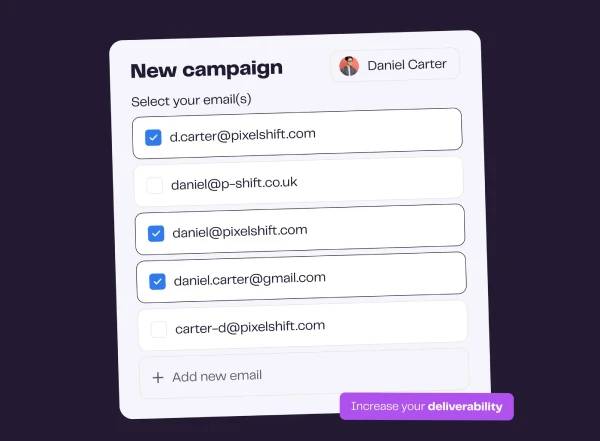
No, and this is a real difference rather than a wording one. Lemlist includes lemwarm on every paid plan. La Growth Machine has no equivalent warm-up product: it approaches deliverability by rotating sends across several inboxes per identity, five on Pro and ten on Ultimate, which spreads reputation load rather than building it on a single domain. If a dedicated warm-up product is a requirement, Lemlist covers it and we do not.
Can La Growth Machine replace both an email tool and a LinkedIn tool?
Yes, that is the design. One subscription covers email sequences, LinkedIn outreach on cloud infrastructure with dedicated IPs, X messages and calls, inside one sequence builder with a shared inbox. It does not replace a data source: there is none built into the product, and sourcing stays upstream.
How does CRM sync compare between the two?
Lemlist creates contact and company records in HubSpot and logs email activity, sent, opened, clicked, replied, bounced and unsubscribed, to the contact timeline, deduplicating contacts by email address. La Growth Machine syncs two ways with several CRMs without middleware, carries activity from every channel rather than email alone, and lets CRM state pause a running sequence when a deal exists, a lifecycle stage changes or a contact enters a dynamic list.
Can you drive either tool from an AI assistant?
Both ship an MCP server, so both can be driven from an assistant. Lemlist offers lemAgent and lemlist MCP as part of its core feature set. La Growth Machine’s MCP server is open source and free, works with any MCP client, and exposes 40+ actions covering audiences, campaign stats, conversations and replies, with write actions requiring explicit confirmation by default.
Conclusion: our verdict
Lemlist and La Growth Machine are not competing for the same team, and the pricing unit is the tell. If your outbound is email at volume across a lot of seats, Lemlist’s flat Email plan is cheaper than anything we can offer, and its warm-up product is included where we have none.
If LinkedIn opens your conversations, if your headcount grows faster than your sending accounts, or if you want the CRM to gate the sequence rather than just record it, La Growth Machine is the architecture that matches. You can see the identity model and current rates on our pricing page, and the free trial runs 14 days without a credit card.
The question is not which tool has more features. It is whether you are buying an email platform with channels attached, or a sequence that happens to include email.