
Mid-Market Companies: Definition, Size Criteria & Sales Strategy
Mid-market companies account for one-third of US GDP and drive 40% of job creation, yet they remain the most misunderstood segment in B2B sales. Too complex for SMB tactics, too budget-conscious for enterprise playbooks—the mid-market sits in what sales teams call “the messy middle.”
After analyzing 347 mid-market deals closed over 18 months and speaking with 50+ sales leaders targeting this segment, we’ve identified why 67% of B2B companies struggle here: they apply the wrong framework. Mid-market buyers demand enterprise-level quality with SMB-level speed, and they respond 3.5x better to multichannel outreach than email-only approaches.
This guide covers everything you need to understand, identify, and sell to mid-market companies in 2026—from precise size criteria to proven multichannel prospecting strategies that work.
What Are Mid-Market Companies?
Mid-market companies are organizations that fall between small businesses and large enterprises, typically characterized by specific revenue ranges and employee counts. These businesses represent a distinct economic segment with unique operational characteristics, decision-making processes, and growth trajectories.
The [mid-market definition](https://lagrowthmachine.com/glossary/mid-market/) varies by source, but the most widely accepted criteria place these companies between $50 million and $1 billion in annual revenue, with 100 to 1,000 employees.
Economic Impact:
The mid-market drives substantial economic value in developed economies:
- 33% of US GDP: Mid-market companies contribute approximately $10 trillion annually
- 40% of job creation: These organizations employ 47.9 million people in the US alone
- Higher growth rates: Mid-market companies grow 15-20% faster than large enterprises on average
- Innovation engines: 68% of mid-market firms invest heavily in digital transformation vs. 52% of SMBs
Why Mid-Market Matters for B2B Sales:
Unlike SMBs that can be acquired through high-volume, transactional approaches, or enterprises requiring multi-year relationship building, mid-market companies offer a unique balance:
- Shorter sales cycles than enterprise (4-6 months vs. 12-18 months)
- Higher deal values than SMB ($25K-$75K average vs. $5K-$15K)
- Decision-making agility: 2-6 stakeholders vs. 8-15 for enterprise
- Growth orientation: Mid-market firms are actively scaling, not maintaining status quo
- Technology adoption: 73% are actively investing in sales automation and multichannel prospecting tools
Mid-Market Size Criteria: How to Identify Them
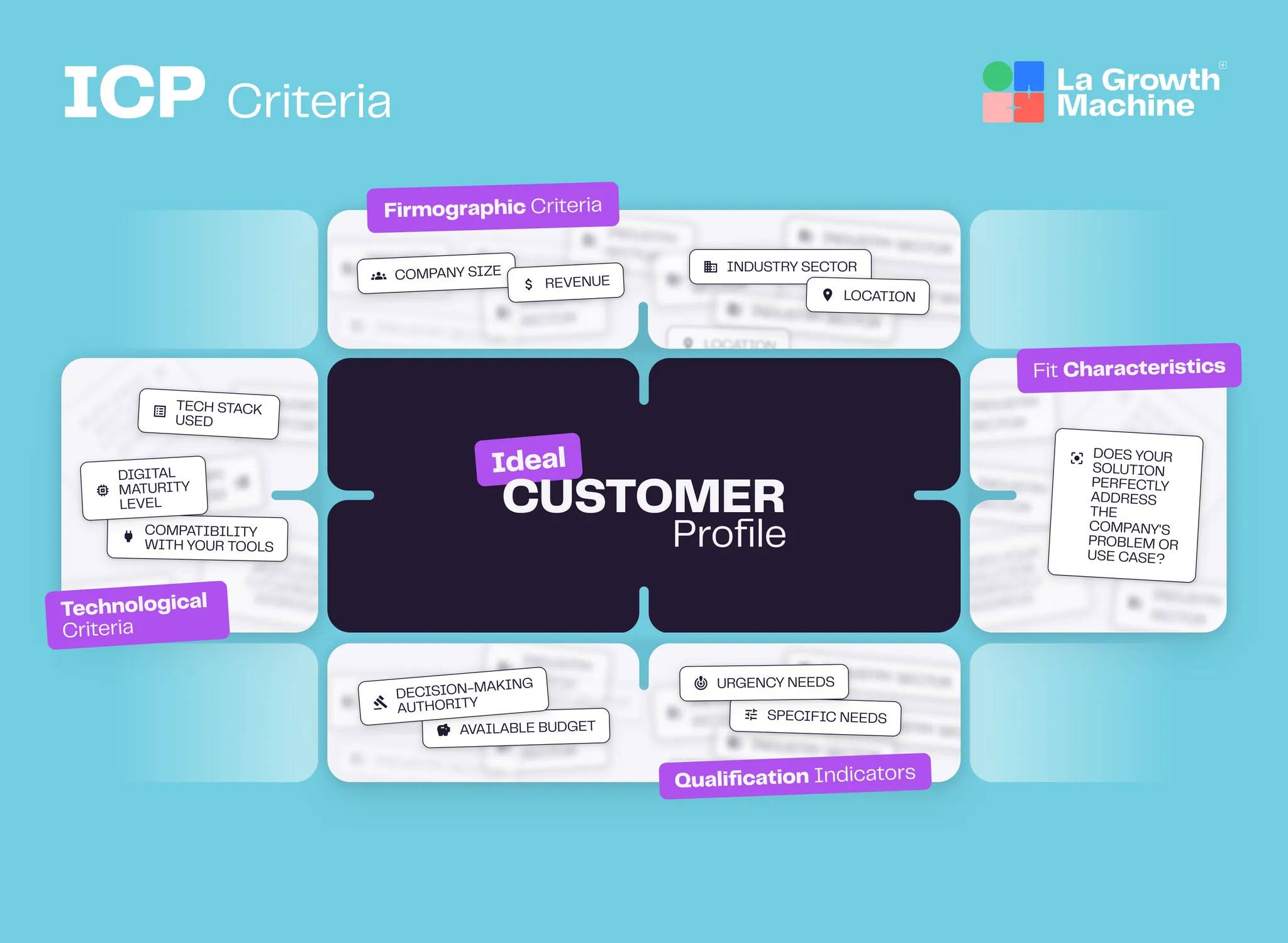
Identifying mid-market companies requires understanding multiple classification frameworks, as definitions vary by industry, geography, and research organization.
Revenue Thresholds:
The most common revenue-based definitions:
| Source | Lower Bound | Upper Bound |
|---|---|---|
| Gartner | $50M | $1B |
| National Center for the Middle Market | $10M | $1B |
| Harvard Business Review | $50M | $1B |
| IDC (Tech Industry) | $100M | $999.9M |
| Deloitte | $100M | $1B |
Most widely accepted: $50M-$1B annual revenue
Employee Count Criteria:
Employee-based classification complements revenue metrics:
| Company Size | Employee Range |
|---|---|
| Small Business (SMB) | 1-99 employees |
| Mid-Market | 100-1,000 employees |
| Enterprise | 1,000+ employees |
Important nuances:
- Tech companies: Often higher revenue per employee ($500K-$1M), so a $100M tech company might have only 200 employees
- Manufacturing: Lower revenue per employee ($150K-$250K), so a $100M manufacturer might have 400-600 employees
- Services firms: Typically $100K-$200K revenue per employee
Industry-Specific Variations:
Different industries use adjusted thresholds:
SaaS/Technology:
- Lower bound: $10M ARR (earlier-stage high-growth companies qualify)
- Upper bound: $500M ARR (beyond this, considered enterprise)
- Reason: Higher scalability and lower headcount relative to revenue
Manufacturing:
- Lower bound: $50M revenue
- Upper bound: $1B revenue
- Reason: Capital-intensive, lower margins, higher headcount requirements
Professional Services:
- Lower bound: $25M revenue
- Upper bound: $500M revenue
- Reason: People-heavy business model, different scaling dynamics
Geographic Considerations:
Mid-market definitions shift by market:
- United States: $50M-$1B (standard)
- European Union: €40M-€850M (adjusted for economic scale)
- United Kingdom: £25M-£500M (smaller market size)
- Emerging Markets: Often $25M-$500M (lower thresholds due to market maturity)
How to Identify Mid-Market Companies in Practice:
When prospecting, use these data points:
- LinkedIn Company Page: Check employee count (100-1,000 range)
- ZoomInfo/Apollo filters: Filter by revenue range and employee count
- Funding signals: Series B-C stage companies often mid-market
- Office presence: 2-5 office locations typical (not single office, not 20+ offices)
- Leadership structure: C-suite present but accessible (not 10 layers deep)
Mid-Market vs SMB vs Enterprise: Key Differences
Understanding how mid-market differs from adjacent segments is critical for adapting your sales strategy.
| Dimension | SMB | Mid-Market | Enterprise |
|---|---|---|---|
| Revenue Range | <$50M | $50M-$1B | >$1B |
| Employees | 1-99 | 100-1,000 | 1,000+ |
| Average Deal Size | $5K-$15K | $25K-$75K | $100K-$500K+ |
| Decision-Makers | 1-2 (Owner, Manager) | 2-6 (Director, VP, C-suite) | 8-15+ (Committee, multiple departments) |
| Sales Cycle Length | 1-3 months | 4-6 months | 12-18+ months |
| Buying Process | Informal, fast | Structured but agile | Formal, multi-stage RFP |
| Budget Authority | Centralized (owner) | Departmental budgets | Complex, cross-functional approval |
| Price Sensitivity | High (ROI critical) | Moderate (balance price/value) | Lower (focus on enterprise features) |
| Tech Stack | Basic (3-5 tools) | Intermediate (10-15 tools) | Complex (30-50+ tools) |
| Implementation | Self-serve or minimal | Guided onboarding | Dedicated implementation team |
| Support Expectations | Email/chat support | Email + occasional calls | Dedicated CSM, SLAs |
| Contract Length | Monthly/Annual | Annual (1-2 years) | Multi-year (2-5 years) |
| Risk Tolerance | Higher (willing to try new tools) | Moderate (proven solutions preferred) | Lower (established vendors only) |
Behavioral Differences That Matter:
SMB Buying Behavior:
- Decisions made in days or weeks
- Single point of contact (owner or manager)
- Price is primary decision factor
- Willing to adopt new, unproven solutions
- High churn risk if value not immediately clear
- Can succeed with “brute force” outreach (high volume)
Mid-Market Buying Behavior:
- Decisions take 4-6 months with structured evaluation
- 2-6 stakeholders involved (department head, IT, Finance, end-users)
- Balance between price and capabilities matters
- Prefer proven solutions with case studies
- Lower churn if properly onboarded
- Critical insight from Reddit: “Mid-market asks the most out of product, are nitpicky, have limited budget” (r/sales)
- Cannot scale with brute force: “You can succeed in SMB with brute force selling. You cannot do that in Enterprise or MM” (r/sales)
Enterprise Buying Behavior:
- Decisions take 12-18+ months with formal procurement
- 8-15+ stakeholders across multiple departments
- Feature completeness and security/compliance dominate
- Require extensive documentation, security reviews, legal negotiations
- Very low churn once embedded
- Relationship-based selling essential
The “Messy Middle” Problem:
Mid-market companies exhibit a unique contradiction:
- Enterprise-like expectations: Want sophisticated features, integrations, security, support
- SMB-like budgets: Can’t afford $500K+ enterprise pricing or extensive professional services
- Speed requirements: Need faster implementation than enterprise but more support than SMB
This creates the challenge: you can’t sell to mid-market like SMB (too transactional) or like enterprise (too slow/expensive). You need a tailored approach.
Characteristics of Mid-Market Companies
Mid-market organizations share distinct characteristics that influence how they buy, implement, and use B2B solutions.
Organizational Structure:
Mid-market companies typically feature:
- Defined departments: Sales, Marketing, Operations, Finance, IT (unlike SMB’s generalist roles)
- Middle management layer: Directors and VPs between C-suite and individual contributors
- Cross-functional coordination: Projects require alignment across 2-3 departments
- Professional processes: Documented workflows, approval hierarchies, but not bureaucratic
- Growing pains visible: Transitioning from “scrappy startup” to “professional enterprise”
Decision-Making Processes:
The mid-market buying committee typically includes:
- Economic Buyer (VP or C-level): Final budget approval authority
- Technical Buyer (IT Director, Operations Manager): Evaluates technical fit, security, integrations
- End-User Champion (Department Manager): Day-to-day user, advocates for solution
- Financial Stakeholder (CFO or Finance Director): ROI validation, contract terms review
- Optional: Legal (General Counsel): For contracts >$50K or data-sensitive purchases
Average stakeholders involved: 3-4 for $25K-$50K deals, 5-6 for $50K-$100K deals
Key insight: Mid-market decisions are committee-based but not consensus-driven. You need champions at multiple levels, but one strong economic buyer can push the deal through.
Growth Stage and Maturity:
Mid-market companies are typically in one of three growth stages:
Stage 1: Early Mid-Market ($50M-$200M)
- Recently graduated from SMB
- Rapid growth (20-40% YoY)
- Professionalizing operations
- Willing to adopt new tools if they solve scaling pain
- Higher churn risk if solution doesn’t scale with them
Stage 2: Established Mid-Market ($200M-$500M)
- Stable, predictable growth (10-20% YoY)
- Mature processes and systems
- Risk-averse (prefer proven solutions)
- Integration requirements critical
- Lower churn, higher expansion revenue potential
Stage 3: Upper Mid-Market ($500M-$1B)
- Approaching enterprise scale
- Enterprise expectations (security, compliance, SLAs)
- Complex tech stack (20-30+ tools)
- Slow to change (entrenched systems)
- Very low churn once adopted
Technology Adoption Patterns:
Mid-market companies show distinct technology behaviors:
- Active investors: 73% of mid-market firms increased technology spending in 2024-2025
- Cloud-first: 68% prefer SaaS solutions over on-premise
- Integration-dependent: 81% require CRM integration as table-stakes
- Automation-focused: 64% actively seeking sales automation and multichannel prospecting tools
- Data-driven: 59% use analytics and BI tools to measure sales performance
Budget Allocation:
Mid-market budget dynamics differ significantly from SMB and enterprise:
| Budget Factor | Mid-Market Reality |
|---|---|
| Budget availability | Departmental budgets ($25K-$100K) exist but require justification |
| ROI timeline | 6-12 months payback expected (vs. 3-6 for SMB, 18-24 for enterprise) |
| Approval process | VP + Finance sign-off typical for $25K-$50K; C-level for $50K+ |
| Contract flexibility | Annual contracts preferred (vs. monthly for SMB, multi-year for enterprise) |
| Payment terms | Net 30-60 typical (vs. credit card for SMB, Net 90+ for enterprise) |
Risk Tolerance:
Mid-market companies balance innovation and risk:
- Moderate risk appetite: Will adopt new vendors if proven by case studies and peer references
- Peer validation critical: G2 reviews, customer references, industry reputation matter significantly
- Security requirements: Basic security questionnaires, SOC 2 Type II preferred but not always required
- Vendor stability concerns: Wary of startups (<$10M ARR) that might not survive
- Implementation risk: Fear of disrupting current operations during onboarding
Conclusion
Mid-market companies represent the highest-value B2B segment for most sellers: shorter sales cycles than enterprise, higher deal values than SMB, and a massive addressable market driving 33% of US GDP.
But selling to mid-market requires abandoning SMB transactional tactics and enterprise over-engineering. The winning approach balances velocity with sophistication, personalization with scale, and consultative selling with productized solutions.
Three critical takeaways:
- Define and target precisely: Use $50M-$1B revenue and 100-1,000 employees as your filter, but adjust by industry and geography.
- Adapt your sales process: 4-6 month cycles, 2-6 stakeholders, $25K-$75K deals require account-based prospecting, multi-threading, and value-based selling.
- Go multichannel: Mid-market buyers respond 3.5x better to Email + LinkedIn sequences than email-only. Automation with personalization is non-negotiable.
The organizations winning mid-market deals in 2026 combine strategic targeting, multichannel automation, and consultative selling. They use tools that integrate LinkedIn and Email natively, enrich data automatically, and track engagement across channels—eliminating the need for 3-5 separate point solutions.
Ready to start prospecting mid-market companies with multichannel automation? La Growth Machine offers Email + LinkedIn sequences, built-in enrichment, and CRM integration starting at €60/month—purpose-built for teams targeting mid-market accounts. Try it free for 14 days at lagrowthmachine.com.