
TL;DR
– An API connects software to software: a developer reads the docs and writes code against its endpoints. It is stateless and every API differs.
– MCP (Model Context Protocol) connects an AI model to software: the assistant discovers the server’s tools at runtime, with one standard protocol for every server.
– They are not rivals: an MCP server usually sits on top of an API and wraps it, collapsing M×N custom integrations into M+N.
– La Growth Machine exposes both an API (for developers) and an official MCP server (run outreach from your AI assistant): the API for code, MCP for AI at runtime.
An API lets one piece of software talk to another. The Model Context Protocol (MCP) lets an AI model talk to that software, usually by wrapping the API underneath. So they aren’t rivals: an MCP server most often sits on top of an API and makes it usable by an AI assistant. The short version: APIs connect software to software, MCP connects AI to software.
This guide explains what each one is, the real differences (consumer, discovery, standardization, state, and integration math), why MCP doesn’t replace APIs, and when to reach for each.
MCP vs API, in one line
An API is an interface for developers writing code. MCP is an interface for AI models acting at runtime. An API exposes endpoints a programmer integrates by hand; an MCP server exposes tools, resources, and prompts that an AI assistant discovers and uses on its own. MCP was introduced by Anthropic in November 2024 as an open standard, and it usually calls APIs under the hood.
What is an API
An API (Application Programming Interface) is a contract that lets two software systems exchange data and actions. A developer reads the documentation, writes code against the endpoints, handles authentication, and parses the responses. REST APIs are the most common kind on the web.
APIs are powerful and everywhere, but they share three traits that matter for AI:
- Built for software-to-software communication, not for an AI deciding what to call.
- Stateless by design: each call is independent, with no memory of previous requests.
- Non-standardized: every API differs. One uses OAuth, another an API key. One returns JSON, another XML. A developer integrates each one separately.
What is an MCP server
An MCP server exposes tools, data, and prompts to an AI application through the Model Context Protocol. Instead of a developer hand-coding each integration, the AI assistant connects to the server and asks what it can do. The server answers with a machine-readable list of capabilities the model can call.
MCP was built from the ground up for large language models. It standardizes how an AI fetches context and takes actions, so once an assistant can speak to one MCP server, it can speak to any of them. Learn more about the La Growth Machine MCP server for a concrete example.
MCP vs API: the key differences
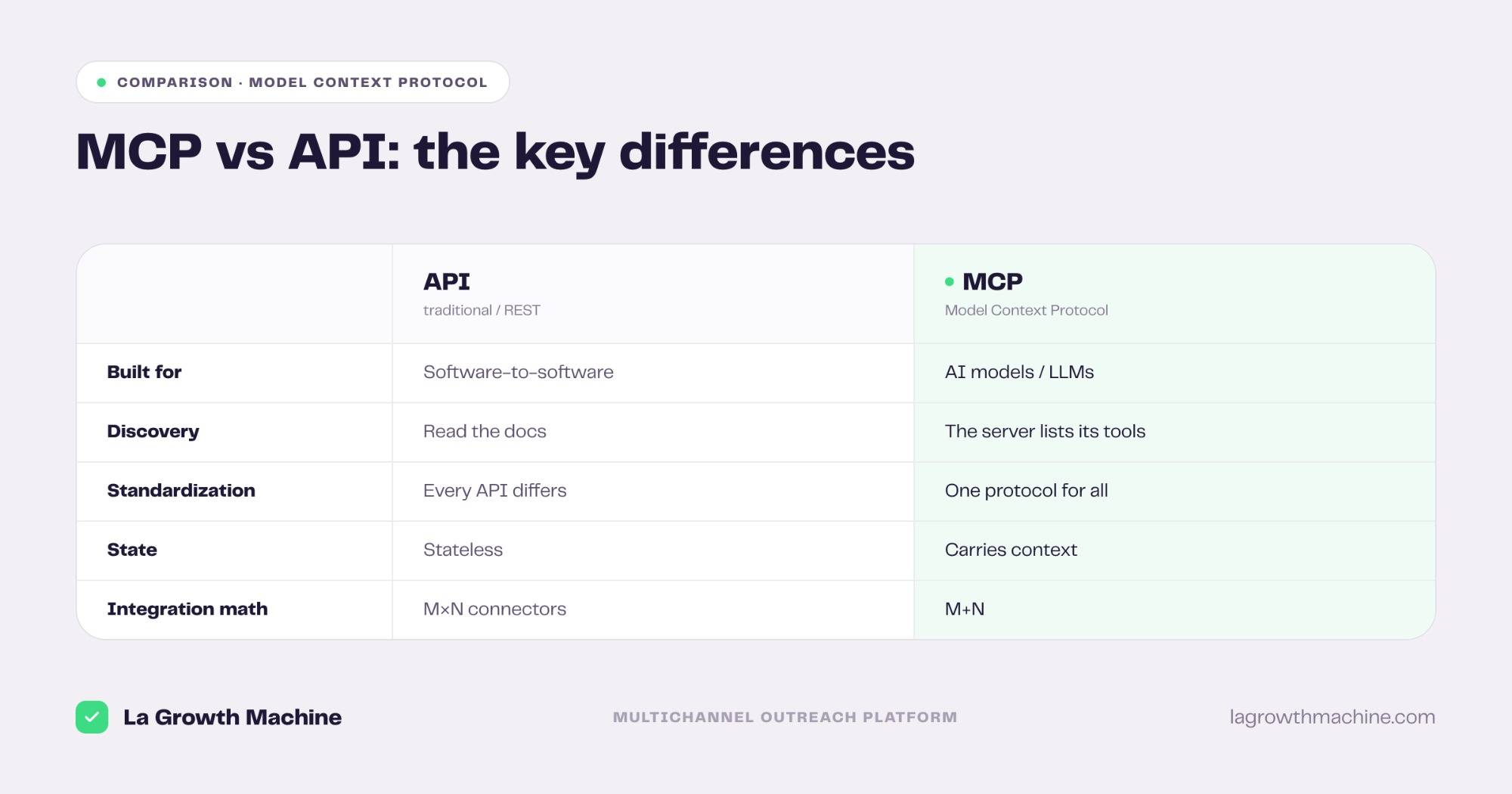
The two operate at different layers and serve different consumers. Here is the side-by-side.
| Dimension | API (traditional / REST) | MCP |
|---|---|---|
| Built for | Software-to-software | AI models / LLMs |
| Consumer | Developers writing code | AI assistants at runtime |
| Discovery | Read the documentation | Self-describing: the server lists its tools |
| Standardization | Every API differs (auth, format) | One protocol for every server |
| State | Stateless | Designed to carry context |
| Integration math | M×N custom connectors | M+N |
| Layer | Low-level service communication | Sits above APIs, often wrapping them |
The two differences that matter most:
Dynamic discovery. With an API, the API doesn’t tell you what it can do, you read the docs. MCP flips this. An AI can query an MCP server with “what tools do you offer?” and get back a typed list of functions, inputs, and outputs. The model figures out how to use it at runtime.
Standardization and the M×N problem. With M AI models and N tools, the traditional approach needs M×N custom connectors. MCP collapses that to M+N: each model and each server implements the protocol once, and they all interoperate.
They’re not rivals: MCP wraps APIs
MCP and APIs solve different problems, so most real setups use both. A REST API handles the low-level communication between services. An MCP server sits one layer above it and translates those capabilities into something an AI agent can discover and call. In practice, an MCP server is often a thin wrapper around an existing API.
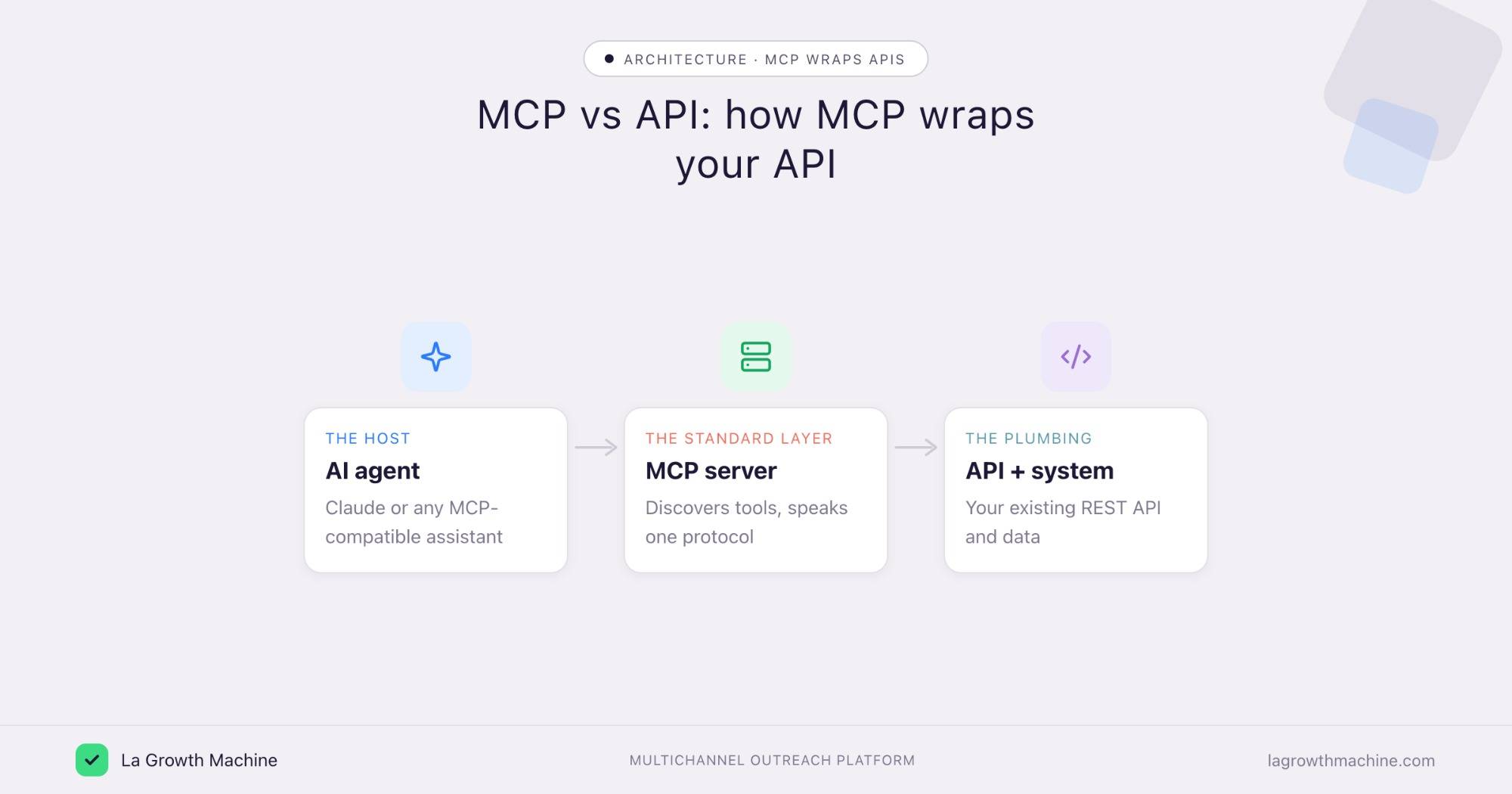
Think of the API as the plumbing and MCP as the standardized faucet the AI knows how to turn. You keep your API; MCP makes it usable by any MCP-compatible assistant without a bespoke integration for each one.
When to use which
Use an API when software needs to talk to software: a backend calling a payment provider, a scheduled job syncing records, a mobile app fetching data. The consumer is code you control, and you want the tightest, lowest-level integration.
Use an MCP server when an AI assistant or agent needs to read from or act on a system in natural language, at runtime, without you hand-coding the integration. If you want Claude or any MCP-compatible host to use a tool the moment it’s connected, you want MCP.
In most stacks the answer is both: keep your APIs, and add an MCP server on top of the ones you want your AI to reach.
A concrete use case with La Growth Machine
La Growth Machine is an outreach platform that connects multichannel campaign execution to proven revenue impact. It exposes both an API and an official MCP server, and the difference between them is exactly the MCP-vs-API distinction in practice.
With the API, a developer writes code to push audiences, trigger campaigns, or pull stats. With the MCP server, you connect La Growth Machine to your AI assistant and run the same work in plain language: “build an audience of CMOs in SaaS and launch a LinkedIn plus email sequence,” or “show me reply and meeting-booked rates for the Q2 campaign.” The MCP server wraps the underlying capabilities so a Growth Engineer or RevOps lead reads pipeline generated and meetings booked straight from the conversation, no integration code required.
Beyond the MCP server, La Growth Machine also ships Claude Skills: packaged workflows that tell Claude how to run specific GTM tasks end to end, on top of the connection the MCP server provides.
MCP vs. API: frequently asked questions
Does MCP replace APIs? No. MCP usually sits on top of APIs and wraps them for AI agents. The API still handles the underlying communication; MCP makes it usable by an AI without a custom integration.
Is MCP just an API? Not quite. An API is built for software-to-software calls that a developer codes against. MCP is a standardized layer an AI discovers and uses at runtime, often calling an API underneath.
What is the M×N problem MCP solves? With M AI models and N tools, custom integrations require M×N connectors. MCP reduces that to M+N: each side implements the protocol once and they all interoperate.
When should I use an API instead of MCP? When the consumer is software you control and you want a direct, low-level integration: backend services, scheduled jobs, mobile apps. Use MCP when an AI assistant needs to use the system at runtime.
Can MCP and APIs work together? Yes, and they usually do. The common pattern is an MCP server wrapping an existing REST API so any MCP-compatible AI can use it.