

TL;DR
– La Growth Machine combines waterfall enrichment with multichannel outreach in one workflow — finds verified emails and phones from LinkedIn profiles across multiple providers, then launches sequences automatically. The only tool where data and outreach are the same step.
– Cognism offers phone-verified mobile numbers and strong GDPR compliance for EU teams, with intent data — premium pricing, best for enterprise selling into EMEA.
– Apollo.io covers 275M+ contacts with built-in email sequencing at an accessible price point, but accuracy varies outside the US and GDPR compliance is partial.
– Clay orchestrates 50+ data sources with AI-powered enrichment agents — most flexible for custom pipelines, but requires a primary data source and significant setup.
– Use La Growth Machine when you want to go from LinkedIn profile to booked meeting without stitching tools together. Use Cognism for verified EU phone numbers at enterprise scale. Use Apollo for broad US-first prospecting on a budget. Use Clay when you need custom enrichment workflows no standard database can provide.
Finding accurate contact data is the difference between a pipeline that fills itself and one that stalls. In 2026, the average B2B contact decays at 30% per year — phone numbers change, people switch companies, email addresses go dark. Your outreach is only as good as the data powering it.
Sales teams today face two distinct problems: sourcing the right contacts and reaching them before the data expires. Most tools solve one side of the equation. A few solve both. This guide covers the 8 best B2B data providers in 2026 — what they do well, where they fall short, and how to choose the right one for your team.
Whether you run a lean SDR team or a full RevOps stack, you need a data provider that fits your workflow, covers your target market, and keeps you on the right side of GDPR. Here is what you need to know.
TL;DR — Quick Comparison
| Tool | Data Type | Coverage | GDPR | Price |
|---|---|---|---|---|
| La Growth Machine | Emails + phones (waterfall) | Global | Yes | From €60/month |
| Cognism | Phone-verified mobiles + intent | EU + US | Yes | Custom |
| Apollo.io | 275M+ contacts, firmographics | Global | Partial | Free + paid plans |
| Clay | Multi-source enrichment (50+) | Global | Partial | From $149/month |
| Lusha | Direct dials + emails | US + EU | Yes | Free + paid plans |
| Kaspr | LinkedIn-native phones + emails | EU focus | Yes | Free + paid plans |
| Dropcontact | Email finder + verification | EU focus | Yes | From €24/month |
| Clearbit | Company enrichment + technographics | Global | Partial | Custom |
1. La Growth Machine — Data + Outreach in One
La Growth Machine is not just a data provider — it is the only platform that combines waterfall enrichment with multichannel outreach in a single workflow. Instead of exporting leads from a data tool, importing them into a sequencer, and hoping the data holds, LGM does everything in sequence: it finds verified emails and phone numbers from LinkedIn profiles by querying multiple providers in order, then launches your outreach automatically.
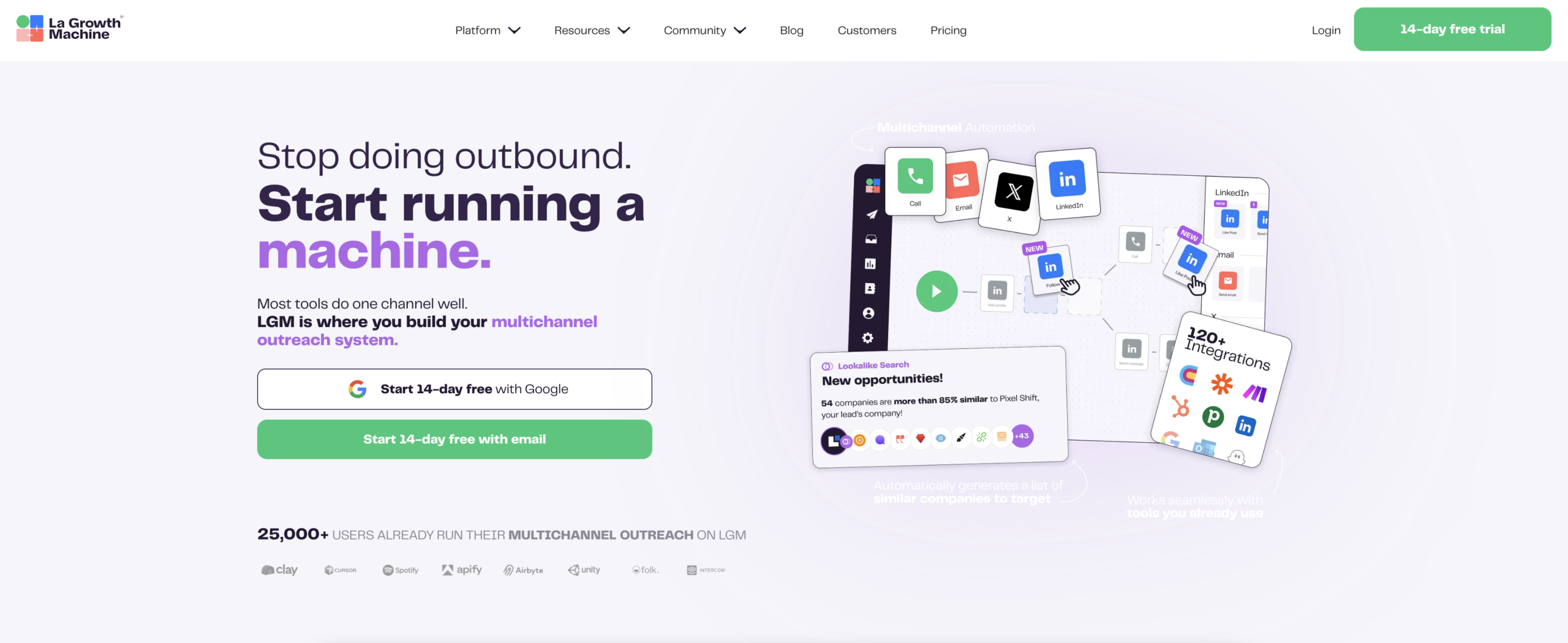
The waterfall enrichment logic is the key differentiator. When LGM looks for a contact’s email, it does not rely on a single database. It queries provider A, then provider B, then provider C — stopping only when it finds a verified result. This dramatically improves match rates compared to any single-source tool. Sales teams report finding valid emails for 40-60% more contacts than with standalone enrichment tools.
The workflow impact is significant. Your SDRs import a LinkedIn Sales Navigator search or a CSV, and LGM handles enrichment, then automatically triggers the outreach sequence — LinkedIn connection, email, LinkedIn message — without any manual handoffs. You book meetings, not spreadsheets.
Pricing: Basic €60/month per identity, Pro €120/month per identity, Ultimate €180/month per identity. Includes enrichment credits and outreach sequences.
Best for: Sales teams that want to stop stitching together a data tool, an enrichment tool, and a sequencer. One platform, one workflow, one bill.
2. Cognism — Best for GDPR-Compliant EU Data
Cognism is the gold standard for teams targeting European markets with compliance requirements front and center. Its phone-verified mobile numbers — called Diamond Data — are manually verified by a human team, not just algorithmically validated. That matters when your SDRs are calling directly and need numbers that actually connect.
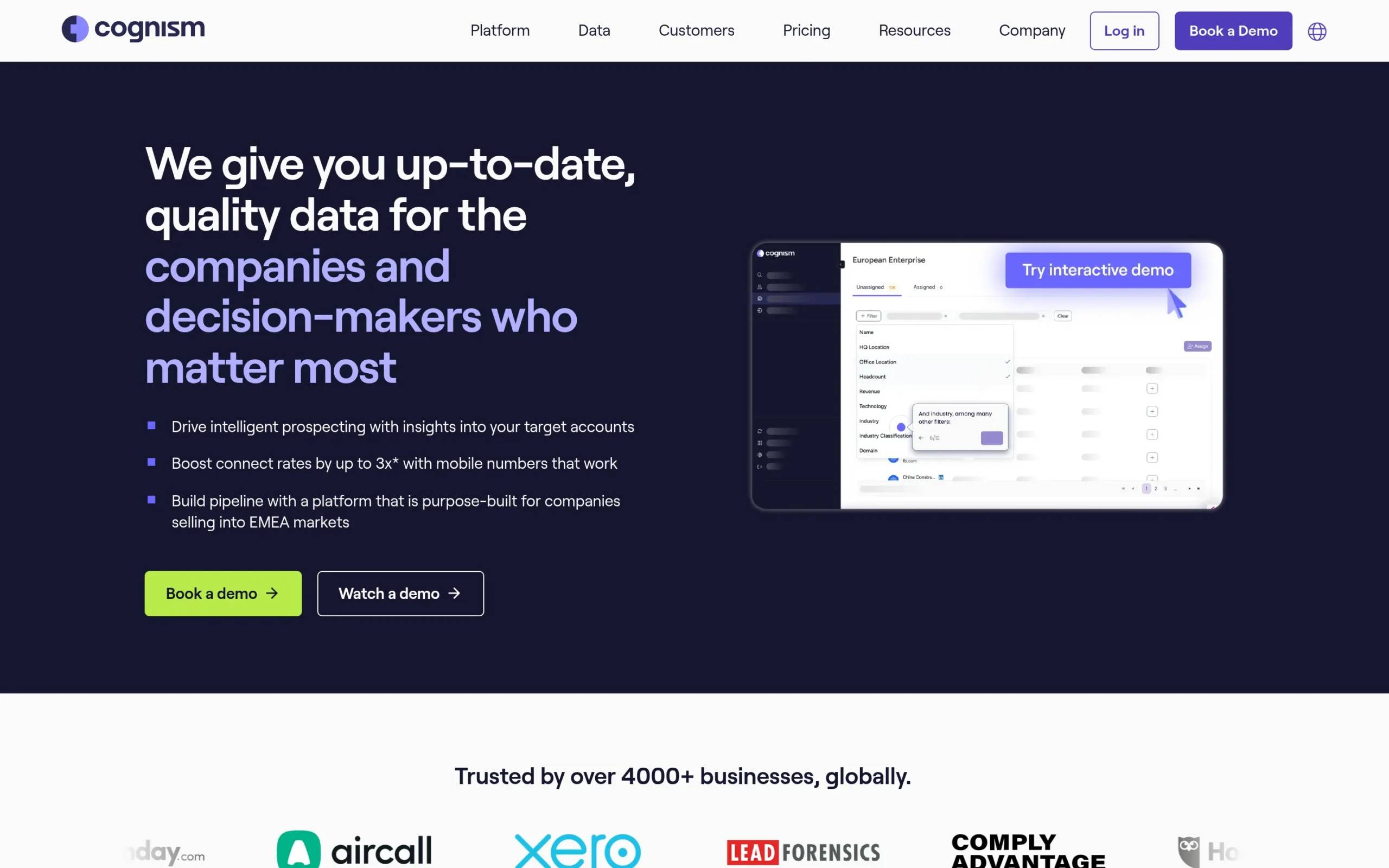
Beyond phone data, Cognism layers in intent signals from Bombora, firmographic filters, and technographic data. The platform integrates natively with Salesforce, HubSpot, and Outreach, and its Chrome extension lets reps pull contact data directly from LinkedIn profiles.
Cognism’s GDPR compliance is genuine — it maintains a suppression list called GDPR Consent Profiles and actively removes contacts who have opted out across the EU. For teams in regulated industries or those selling into enterprise EMEA accounts, this is not a minor detail.
Best for: Enterprise sales teams in the EU that need verified mobile numbers and cannot afford compliance risk.
Limitation: Pricing is enterprise-grade and custom. Not the right fit for early-stage startups or high-volume low-ACV motions.
3. Apollo.io — Largest Contact Database with Built-In Sequencing
Apollo.io has built the largest self-serve B2B contact database, with 275 million contacts and 60 million companies. It combines firmographic filters, technographic data, and AI-powered lead scoring to help teams identify and prioritize the right accounts.
What makes Apollo distinctive at this scale is the built-in email sequencing. Most data tools require you to export leads into a separate sequencer. Apollo lets you go from search to outreach without leaving the platform. Its free tier is one of the most generous in the market, making it popular with early-stage teams and individual SDRs.
The trade-off is data accuracy. With 275 million contacts, freshness becomes a real challenge. Apollo’s email data quality is variable, particularly for smaller companies and non-US markets. Teams selling into EU markets often combine Apollo with a GDPR-focused provider like Cognism or Kaspr.
Best for: Teams that need broad coverage, volume-based prospecting, and built-in email sequences at an accessible price point.
Limitation: Data accuracy varies by region and company size. Not fully GDPR-compliant for EU outreach at scale.
4. Clay — Best for Custom Enrichment Workflows
Clay is in a different category from traditional data providers. Rather than maintaining a proprietary database, Clay acts as an enrichment orchestration layer — connecting 50+ data sources and letting you build custom enrichment waterfalls with no code.
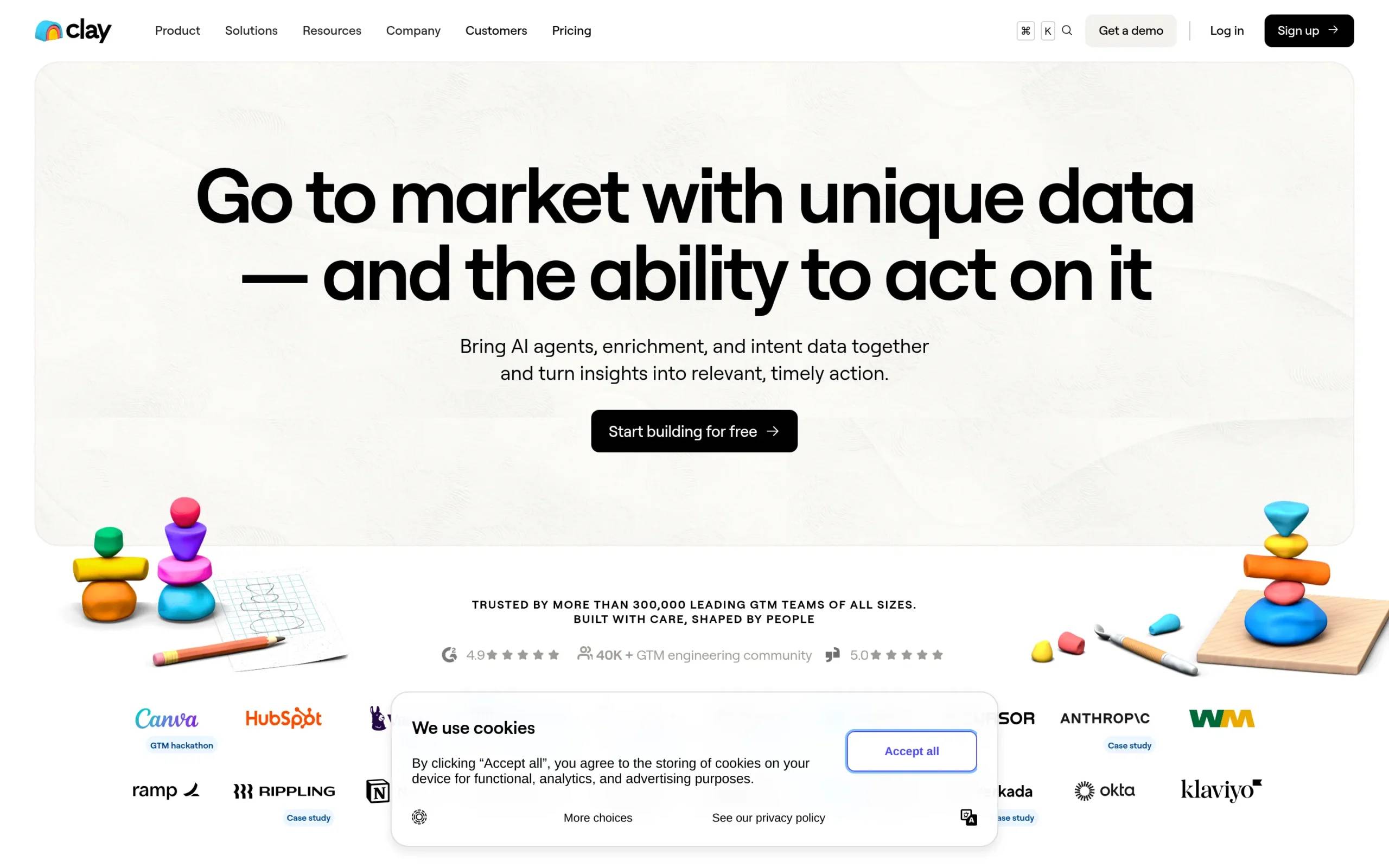
The platform’s AI agent, Claygent, can research companies and contacts autonomously — scraping websites, pulling LinkedIn data, summarizing recent news, and writing personalized email snippets, all in a spreadsheet-style interface. For ops-minded sales teams that want to enrich leads with signals that no standard database carries, Clay is the most flexible tool available.
The learning curve is real. Clay rewards teams that invest time building their workflows. Out-of-the-box, it does not replace a database-style provider — it amplifies one. Most power users combine Clay with a primary source like Apollo or LinkedIn Sales Navigator, then run enrichment passes through Clay to add depth.
Best for: RevOps and growth teams building custom data pipelines, hyper-personalized outreach at scale, or unique enrichment workflows.
Limitation: Not a standalone data source. Requires a primary database and significant setup investment.
5. Lusha — Contact Data with a Chrome Extension
Lusha focuses on what SDRs need most: direct dials and verified work emails, accessible without leaving the browser. Its Chrome extension pulls contact data from LinkedIn profiles with a single click, and the platform is GDPR-compliant with a privacy-by-design approach.
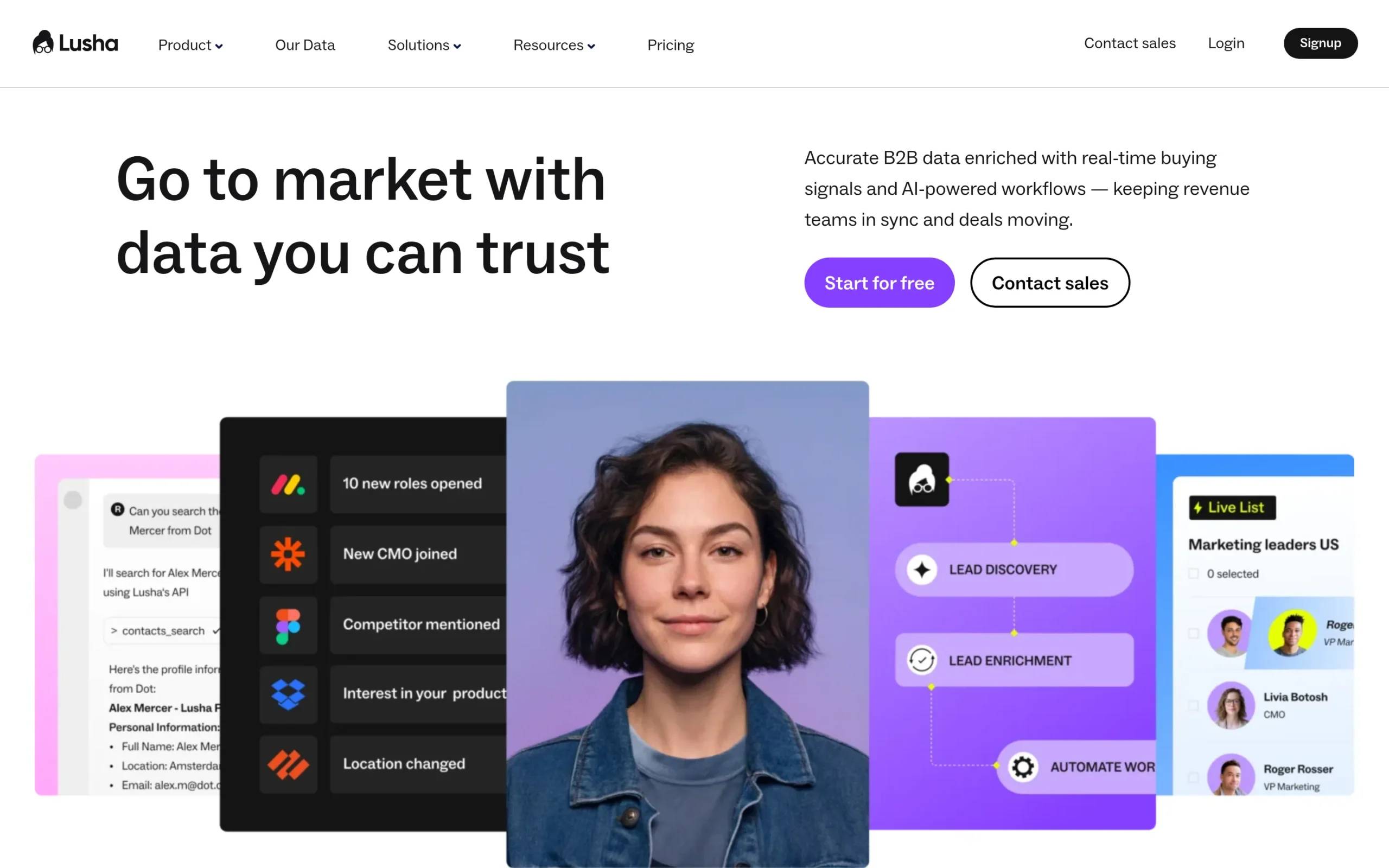
Lusha’s database covers primarily US and EU contacts, with strong accuracy for mid-market and enterprise accounts. The platform integrates with Salesforce, HubSpot, Outreach, and Salesloft, pushing contacts directly into CRM without manual data entry.
The free tier gives five credits per month, enough for testing but not for scale. Paid plans are consumption-based, which works well for low-volume, high-ACV sales motions where each contact matters. For teams doing high-volume prospecting, costs can escalate quickly.
Best for: Individual SDRs and small teams doing targeted outreach on LinkedIn who need quick access to direct dials.
Limitation: Credit-based model becomes expensive at volume. Database depth is narrower than Apollo or Cognism.
6. Kaspr — LinkedIn-Native Data for EU Teams
Kaspr is built specifically for LinkedIn-based prospecting, with a Chrome extension that extracts phone numbers and emails directly from LinkedIn profiles, Sales Navigator, and LinkedIn Recruiter. Its strength is EU coverage and GDPR compliance — Kaspr is particularly well suited for French, German, and UK markets.
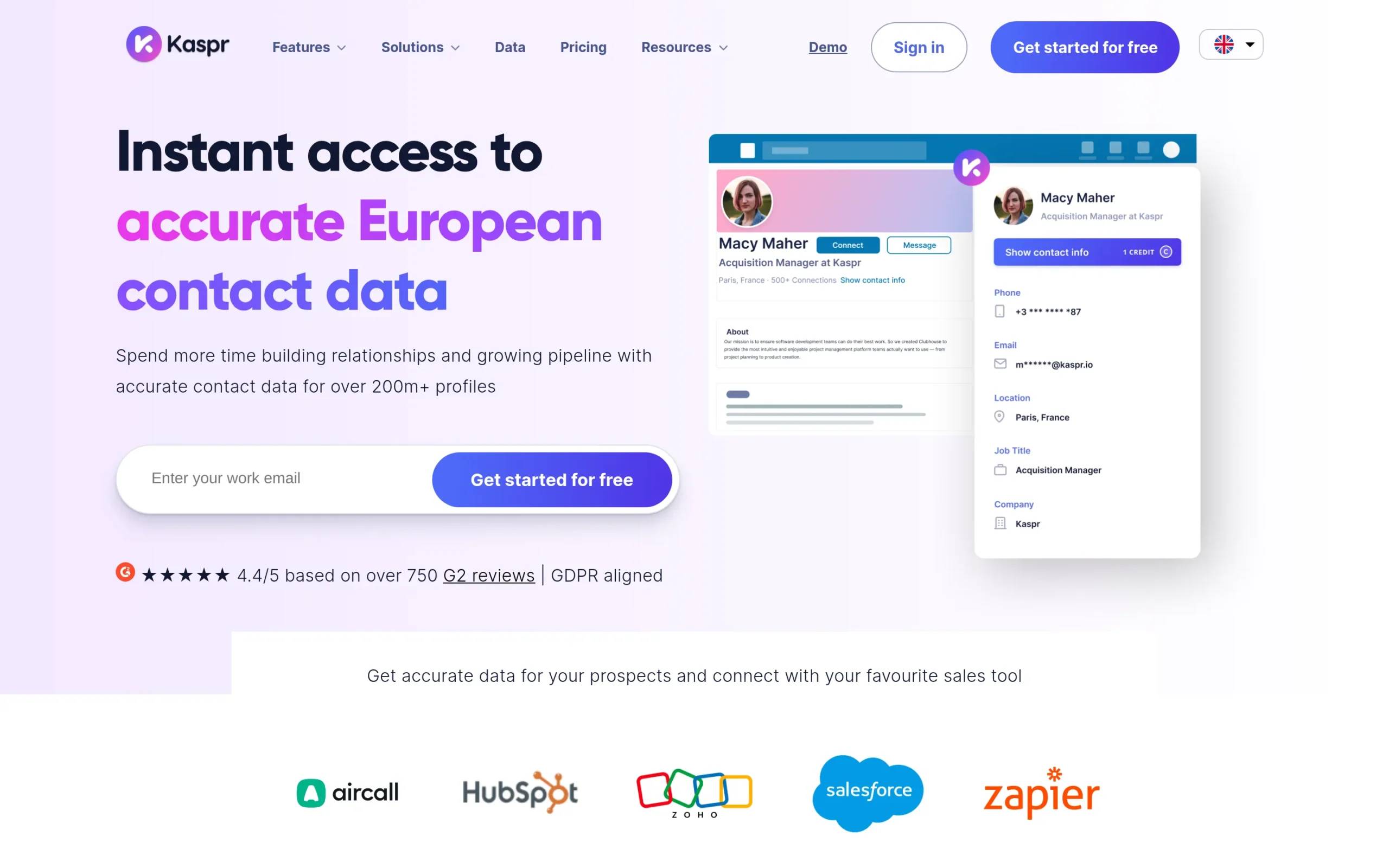
Unlike tools that rely on a static database, Kaspr updates contact data in real time from LinkedIn activity. When someone changes jobs, their new contact details appear in Kaspr faster than in most alternatives. This freshness advantage matters for EU-focused teams where database staleness is a common pain point.
Kaspr integrates with HubSpot, Salesforce, Pipedrive, and Lemlist, and it allows bulk export from LinkedIn list views — useful for operationalizing Sales Navigator searches without manual contact-by-contact lookups.
Best for: EU-based sales teams doing LinkedIn-first prospecting who need GDPR-compliant phone numbers and emails.
Limitation: Coverage outside EU is limited. Not designed for US-first go-to-market motions.
7. Dropcontact — GDPR-Native Email Finder
Dropcontact takes a fundamentally different approach to B2B email finding. It does not maintain a stored database of contacts. Instead, it generates and verifies email addresses in real time using an algorithmic approach — combining company domain, naming conventions, and live verification. The result is a tool that is GDPR-compliant by architecture, not by policy.
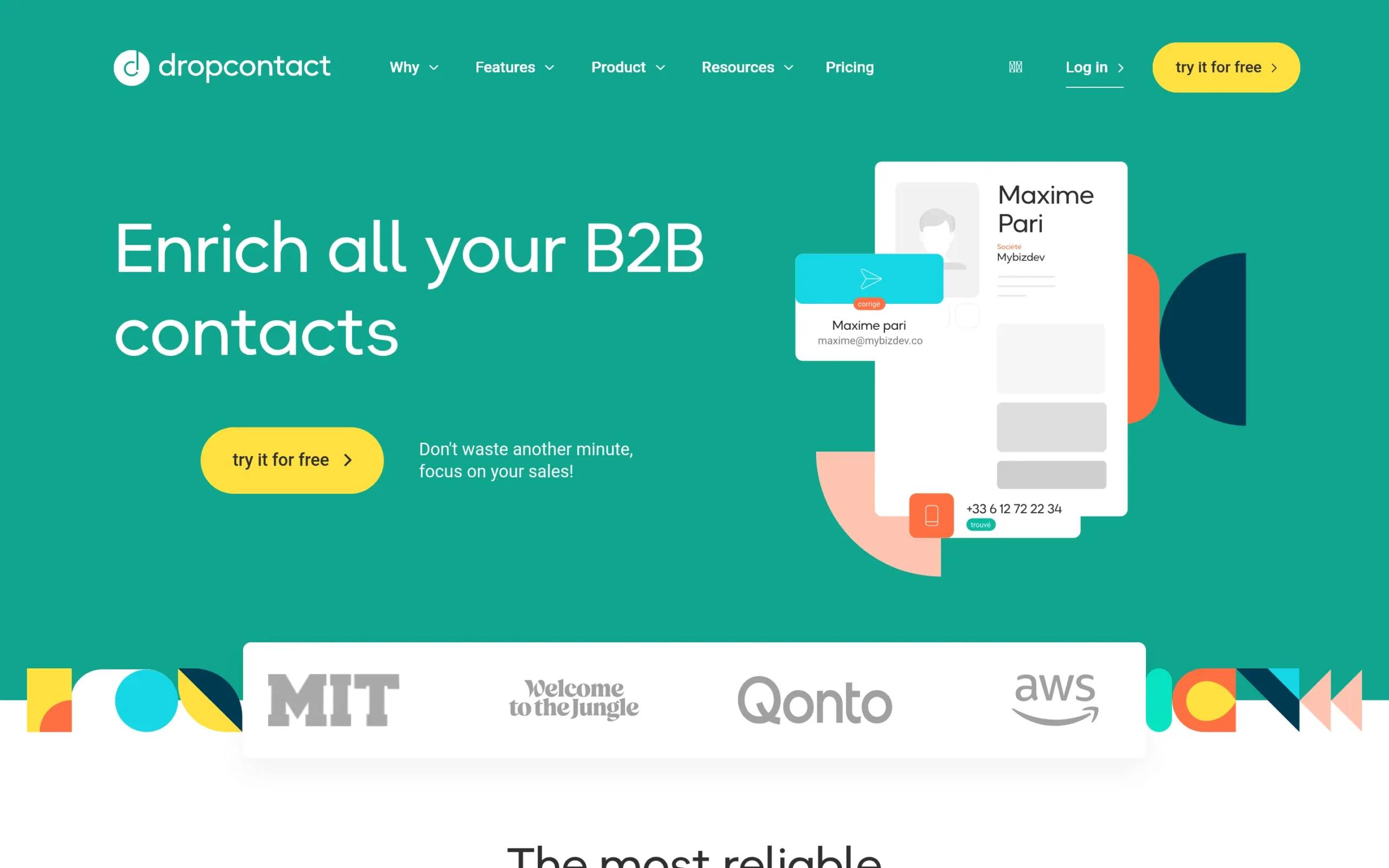
This makes Dropcontact especially strong for EU and French market teams, where data storage regulations are most strictly enforced. Because no personal data is stored, there is no database to audit or comply against. Teams plug it into their CRM via native HubSpot or Salesforce integrations, and Dropcontact enriches contacts automatically as they enter the system.
The trade-off is coverage. Without a proprietary database, Dropcontact has lower match rates for unusual naming conventions or smaller company domains. It works best as a complement to a primary sourcing tool rather than a standalone prospecting engine.
Best for: Teams in France and the EU that need email enrichment with zero data storage risk, plugged directly into their CRM.
Limitation: Lower match rates than database-backed tools. No phone number data.
8. Clearbit — Company Enrichment and Website Intelligence
Clearbit sits at the intersection of sales intelligence and marketing data. Its core strength is company-level enrichment — firmographics, technographics, and website visitor identification — rather than contact-level phone and email data.
Clearbit’s Reveal product identifies anonymous website visitors by IP and enriches them with company data, feeding hot accounts directly into HubSpot or Salesforce. Its enrichment API powers CRM enrichment at scale — when a lead fills out a form with just an email address, Clearbit fills in job title, company size, industry, and technology stack automatically.
The HubSpot-native integration is particularly tight. Teams running an inbound motion on HubSpot use Clearbit to score leads and route them without manual research. For outbound prospecting or contact-level data (direct dials, personal emails), Clearbit is not the right tool — its strength is account intelligence, not contact sourcing.
Best for: Marketing and RevOps teams running inbound motions, account-based marketing programs, or CRM enrichment at scale.
Limitation: Not a contact sourcing tool. Limited personal contact data (no direct dials). Custom pricing puts it out of reach for smaller teams.
How to Evaluate a B2B Data Provider
Choosing a data provider is not about the largest database — it is about fit. Here are the criteria that actually matter.
Accuracy Rate
A provider with 50 million contacts at 95% accuracy outperforms one with 300 million at 70%. Ask vendors for their bounce rate benchmarks and whether they offer data guarantees or credit-back policies for bounced emails. Independent tests consistently show accuracy varies significantly by geography and company size tier.
Coverage by Geography
Most providers are US-first, with EU coverage as an afterthought. If your ICP includes French, German, or UK companies, test coverage specifically — do not rely on headline database size. Tools like Cognism and Kaspr are built for EU; Apollo and Clearbit skew heavily US.
GDPR Compliance
Compliance is not binary. Ask specifically: Does the provider store personal data? How do they handle opt-outs and suppression lists? Do they have a Data Processing Agreement? For EU outreach, this matters legally and operationally. Dropcontact and Kaspr are built GDPR-first; Apollo and Clearbit are more variable.
Integration with Outreach Tools
A data provider that requires manual CSV exports and imports is a time tax on your team. Prioritize tools that integrate directly with your CRM and sequencer. If your workflow starts on LinkedIn, a Chrome extension matters. If you are enriching inbound leads, an API or native CRM integration matters more.
Waterfall Enrichment vs. Single Provider
Single-provider tools cap your match rate at the coverage of that one database. Waterfall enrichment — querying multiple sources in sequence until a verified result is found — consistently delivers 20-40% higher match rates. La Growth Machine’s built-in waterfall is the most seamless implementation: enrichment and outreach happen in the same workflow, with no data handoff.
FAQ
What is a B2B data provider? A B2B data provider is a company that supplies sales and marketing teams with contact and company information — email addresses, phone numbers, job titles, firmographics, and technographics — used to identify, reach, and qualify potential customers.
How accurate is B2B contact data? Accuracy varies significantly by provider and geography. Top-tier providers achieve 85-95% email deliverability on verified contacts. Phone number accuracy is generally lower, which is why phone-verified databases like Cognism’s Diamond Data command a premium. Data decays at roughly 30% per year as people change jobs and companies.
Which B2B data provider is best for EU markets? Cognism, Kaspr, and Dropcontact have the strongest EU coverage and most robust GDPR compliance. For teams that also need outreach automation, La Growth Machine’s waterfall enrichment covers EU contacts well and builds GDPR compliance into the workflow.
What is waterfall enrichment? Waterfall enrichment means querying multiple data sources in sequence — provider A, then provider B, then provider C — and stopping when a verified result is found. This approach achieves significantly higher match rates than relying on a single provider. La Growth Machine uses waterfall enrichment natively, without requiring separate tool subscriptions.
How much do B2B data providers cost? Pricing varies widely. Free tiers exist at Apollo and Lusha (limited credits). Mid-market options like Kaspr and Dropcontact start at €20-50/month. La Growth Machine starts at €60/month per identity and includes both enrichment and outreach. Enterprise tools like Cognism and Clearbit use custom pricing that typically starts at $500-1,000/month.
Can I use B2B data for cold email legally? Yes, with conditions. In the EU under GDPR, cold outreach to business contacts is permitted under the “legitimate interest” legal basis, provided the contact is relevant to your offer and you include an opt-out mechanism. This applies to business email addresses — not personal Gmail or Hotmail addresses. Always verify with legal counsel for your specific use case.
Conclusion
The best B2B data provider is the one that fits your workflow, your geography, and your compliance requirements. For EU-focused teams, Cognism and Kaspr deliver the strongest verified coverage. For US-heavy volume prospecting, Apollo covers the most ground. For custom enrichment pipelines, Clay has no equal.
But if your goal is to close the gap between finding a contact and booking a meeting, La Growth Machine is the only platform that does both in one place. Waterfall enrichment finds verified emails and phones from LinkedIn profiles across multiple providers. Multichannel outreach sequences launch automatically. Your team focuses on conversations, not data hygiene.
Start a 14-day free trial of La Growth Machine and see how many more meetings your team books when data and outreach work together.