

TL;DR
– 12 data enrichment tools compared on data types, region coverage, GDPR posture and price, with entry prices verified on each vendor page in July 2026
– Waterfall beats single-source: 1,000 leads at a 50% single-provider match rate return 500 contacts, a 3-provider waterfall returns 750 to 850
– La Growth Machine runs waterfall enrichment inside the outreach workflow from €60/month, so enriched contacts feed LinkedIn and email sequences with no export step
– Pick by data type and region: US databases (Apollo, ZoomInfo) for coverage, EU tools (Cognism, Dropcontact, Kaspr) for GDPR, Clay or Derrick for a data layer
A single enrichment provider matches somewhere between 30% and 70% of your list, depending on region, seniority, and industry. Run 1,000 leads through one tool at a 50% match rate and half your pipeline comes back empty: no verified email, no direct dial, no way to reach the person. Every one of those blanks is a sequence that never sends.
Teams patch the gap by stacking tools. An email finder here, a phone provider there, a firmographic database on top, and suddenly enrichment is four subscriptions and a manual export-import cycle between each one. The data goes stale in the gap. B2B contacts change jobs constantly, so a record enriched in one tool and sent from another is often wrong by the time it ships.
This guide covers the 12 best data enrichment tools for B2B in 2026, what each one actually does, what it costs, and which situation each one fits. Prices are verified on each vendor’s own page in July 2026.
Which data enrichment tool is the best?
There is no single winner, because enrichment tools split by data type, region, and whether they plug into your outreach or sit beside it. Find your situation:
| If you are | Best pick | From | Why |
|---|---|---|---|
| Running outreach and want enrichment in the same workflow | La Growth Machine | €60/mo | Waterfall enrichment feeds LinkedIn and email sequences natively, no export step |
| Working in a spreadsheet or want AI-driven enrichment | Derrick | Free, then €9/mo | Google Sheets add-on, 100+ data points, runs on Claude or OpenAI |
| Building complex GTM data workflows | Clay | $167/mo | 150+ sources in one waterfall, plus an AI research agent |
| Prospecting at scale on a US database | Apollo | $49/seat/mo | 275M+ contacts with enrichment built into the prospecting tool |
| Phone-first outbound in the EU | Cognism | Custom | Manually phone-verified numbers and a strong GDPR posture |
| Email-only, GDPR-native | Dropcontact | €79/mo | Real-time algorithmic email finder, no stored database |
| Finding emails by domain, cheaply | Hunter | Free, then €49/mo | The simplest domain search and email verifier on the list |
⚠️ Two names need a caveat. Clearbit is no longer a standalone product, it was acquired by HubSpot and now ships as Clearbit by HubSpot, so it only makes sense inside that ecosystem. ZoomInfo is powerful but enterprise-priced with no public entry point. Both are covered in full below.
The rest of this article is the evidence behind those answers.
How we tested and compared these 12 tools
Two different levels of evidence sit in this article, and it is worth being explicit about which is which.
Tools we run in production. La Growth Machine is our own platform, and its waterfall enrichment runs on real campaigns every day. Clay, Apollo, Hunter, and Dropcontact we have used inside real GTM stacks. Those observations are first-hand.
Tools compared on public data. For the rest, category, data types, region coverage, and entry pricing are verified on each vendor’s own pricing and product pages in July 2026. Where we have not run a tool ourselves, we describe what it does and what it costs, and we do not invent a field verdict.
⚠️ Disclosure: La Growth Machine is our product. It ranks first for one specific job, enrichment that lives inside the outreach workflow rather than in a separate tab. If you need a standalone enrichment layer to feed a different sequencer, several tools below do that better, and we say so.
Every tool was evaluated on the same five criteria:
| Criterion | The question we asked | What separates the tools |
|---|---|---|
| Coverage and match rate | What share of a real list comes back with a usable email or phone? | Database size and region. US databases win in North America, EU providers win in Europe, and no single source covers everyone |
| Data types | Email only, or phone and firmographics too? | Email finders are narrow and cheap. Full platforms add direct dials, job titles, tech stack, and intent |
| GDPR posture | Where does the data come from, and is there an opt-out process? | Public-data and consent-based models carry less risk than scraped databases for EU outbound |
| Waterfall or single source | One database, or several providers in sequence? | Waterfall across multiple providers consistently beats any single source on match rate |
| Fit with your stack | Does the data land where you actually send from? | Enrichment that sits in a separate tool goes stale in the export gap. Native or CRM-synced enrichment does not |
Quick comparison: all 12 data enrichment tools
| Tool | Best for | From | Data types | Region strength | Free tier |
|---|---|---|---|---|---|
| La Growth Machine | Enrichment inside outreach | €60/mo | Email, phone, firmographic | Global | 14-day trial |
| Derrick | Spreadsheet and AI enrichment | Free, €9/mo | 100+ points, email, phone, tech | EU and global | Free 100 credits |
| Clay | GTM data workflows | $167/mo | 150+ sources, waterfall | Global | Free 500 actions |
| Apollo | Scaled US prospecting | $49/seat/mo | Email, phone, firmographic | North America | Free forever |
| Cognism | Phone-first EU outbound | Custom | Phone-verified, intent | EU, UK, DACH | No |
| ZoomInfo | Enterprise US data | Custom | Full firmographic, intent | North America | No |
| Clearbit by HubSpot | HubSpot-native enrichment | Bundled | Firmographic, intent, IP reveal | Global | No standalone |
| Lusha | LinkedIn prospecting | $49.90/mo | Email, phone | North America | Free 40 credits |
| Dropcontact | GDPR email finding | €79/mo | Email, verification | EU, France | No |
| Hunter | Email by domain | €49/mo | Email finder, verifier | Global | Free 50 credits |
| Kaspr | LinkedIn phone/email in EU | €45/mo | Phone, email | EU | Free 15 credits |
| Datagma | Cheap email and phone | $49/mo | Email, phone, company | Global | Free 90 emails |
Prices are entry-tier list prices verified on each vendor’s pricing page in July 2026, converted to monthly where billed annually. Credit-based tools vary with volume.
The 12 best data enrichment tools (in depth)
1. La Growth Machine: best for enrichment inside outreach
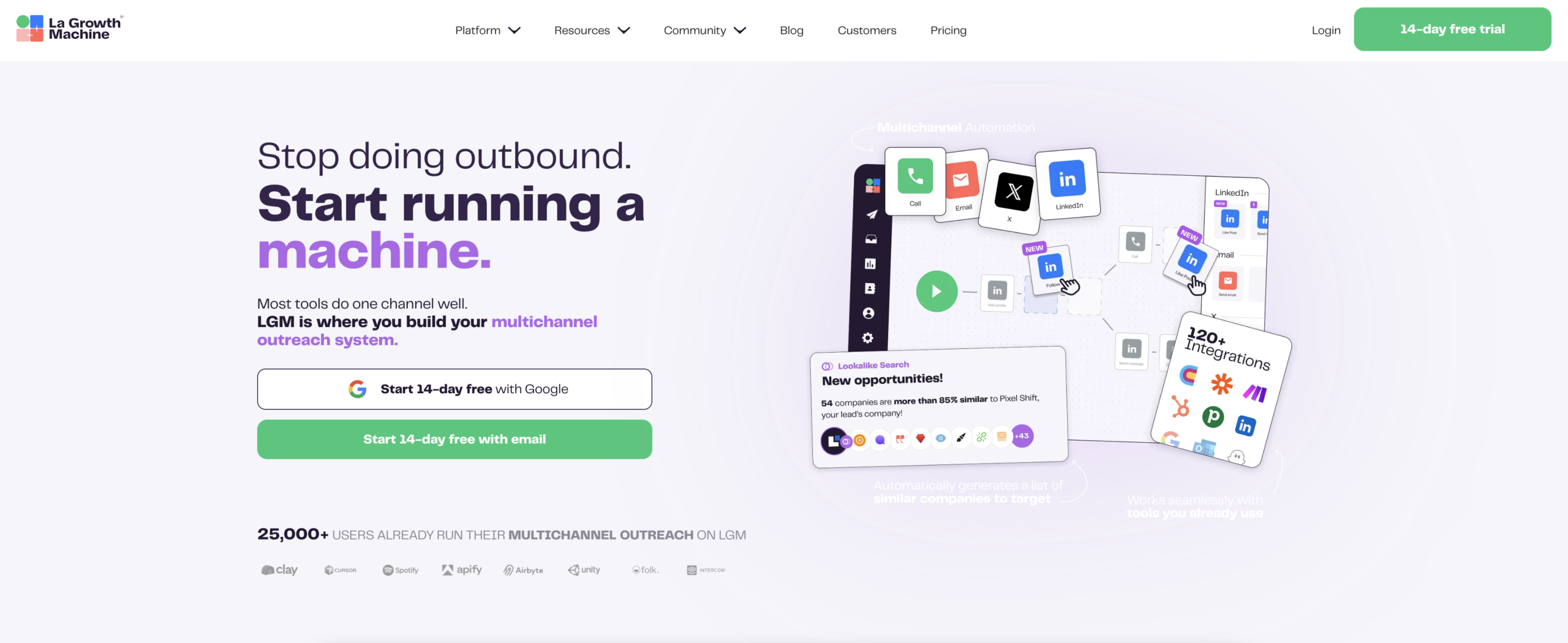
Overview. La Growth Machine is the only tool on this list where enrichment is not a separate step. You drop a LinkedIn URL, and the platform runs waterfall enrichment across multiple data providers in sequence, then feeds the enriched contact straight into a LinkedIn and email sequence. There is no export, no import, no second subscription to reconcile.
Key features.
- Built-in data enrichment returns professional and personal emails, direct phone numbers, and job-title verification.
- Waterfall logic routes each contact through providers in priority order. If provider one returns no verified email, it tries provider two, then three, so coverage holds up without you managing the cascade.
- The LGM database supplies additional B2B data directly in the platform.
- Enriched contacts flow into multichannel sequences immediately, so a LinkedIn URL becomes a first message in minutes, not after an export cycle.
Pros and cons.
- ✅ Enrichment and outreach in one workflow, so data never goes stale in an export gap
- ✅ Waterfall coverage without assembling or paying for a separate enrichment stack
- ✅ From €60/month with enrichment included, not metered as an add-on
- ⚠️ It is an outreach platform, so it is not the right pick if you only want a standalone enrichment API to feed a different sequencer
- ⚠️ Not built for one-off spreadsheet enrichment, that is closer to Derrick’s job
Pricing. Basic €60/month, Pro €120/month, Ultimate €180/month per identity, enrichment included at every tier.
Best for. B2B companies of roughly 11 to 500 employees, typically software, tech, finance, and agencies, where a sales team is scaling outbound or a GTM team is building the motion, and enrichment needs to feed sequences rather than sit in a data tool.
Derrick: best for spreadsheet and AI enrichment
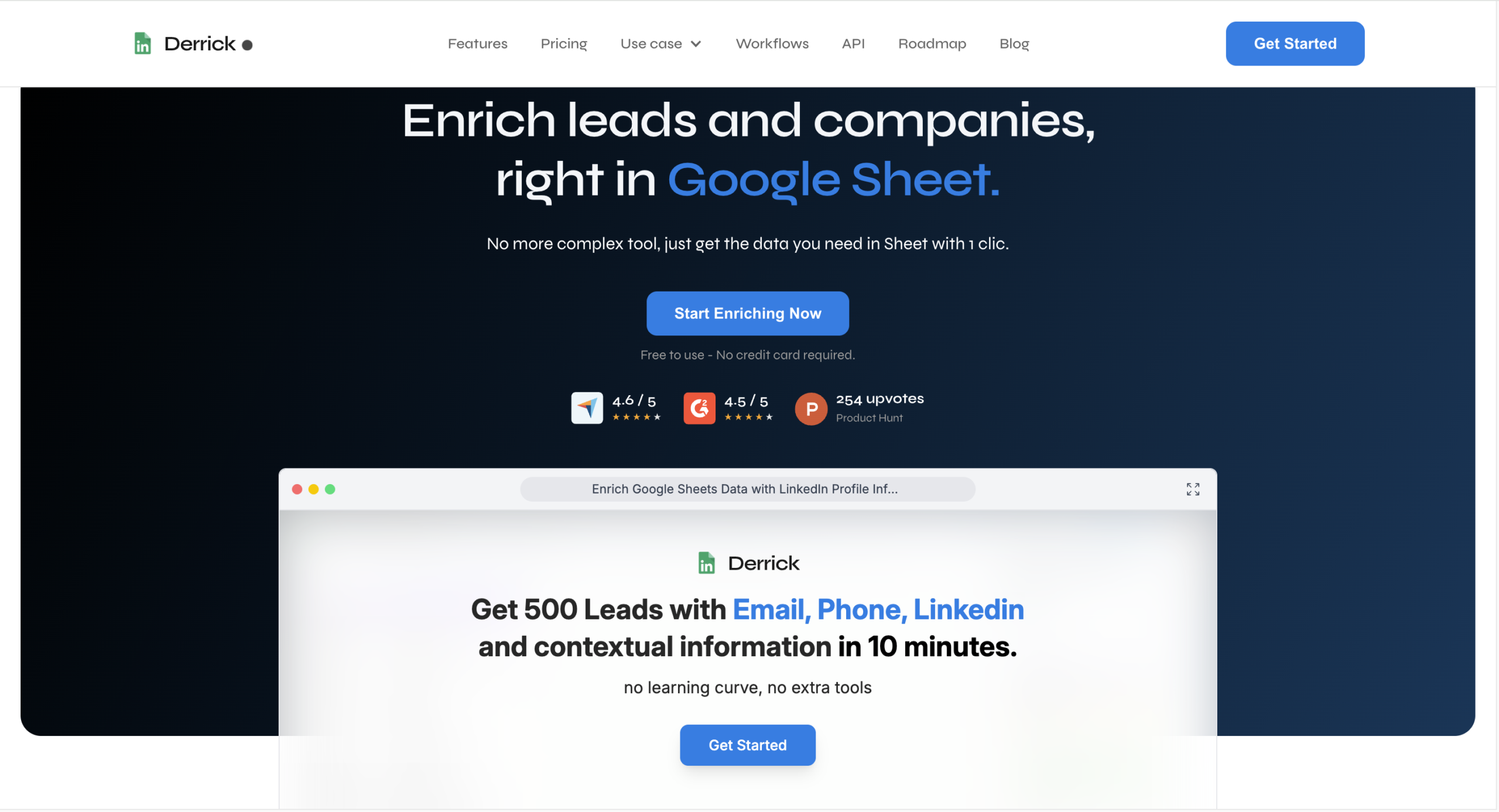
Derrick is a B2B enrichment tool that lives inside Google Sheets. From a name, a domain, or a LinkedIn URL, it returns over 100 data points: verified professional emails, direct phone numbers, LinkedIn profile data, company firmographics, tech stack, and French SIRET/SIREN registry data. Its distinguishing move is that it runs on Claude or OpenAI natively, so you can ask it to research and structure fields that no fixed database holds, directly in a spreadsheet cell.
For data model, Derrick uses public data only and stores nothing, refreshing from 15+ premium sources, which is a clean GDPR posture. It exposes an API and an MCP server on paid tiers, so it plugs into custom workflows and AI agents, and it connects to HubSpot, Salesforce, Pipedrive, and 3,000+ apps through Zapier, Make, and n8n.
Pricing. Free tier with 100 credits per month, no card required. Paid from €9/month for 4,000 credits, with credits rolling over.
Best for. Teams that live in a spreadsheet, want AI-driven enrichment on demand, or need a GDPR-clean source they can wire into their own automations.
2. Clay: best for complex GTM data workflows
Overview. Clay is the most powerful standalone enrichment layer available. It connects to 150+ data providers and runs them as a waterfall to maximize match rate, and its Claygent AI agent can autonomously browse company sites and public pages to fill fields no database covers.
Key features. Multi-provider waterfalls across 150+ sources, Claygent for AI research, signal and job-change tracking, and native templates that pass enriched data into La Growth Machine for execution.
Pros and cons.
- ✅ The deepest multi-source waterfall on the market
- ✅ AI research fills gaps that fixed databases leave open
- ⚠️ Steep learning curve, it is a builder’s tool
- ⚠️ Credit costs escalate quickly at high enrichment volume
Pricing. Free tier with 500 actions per month. Launch plan from $167/month, credit-based beyond that.
Best for. GTM engineers building deep, multi-source enrichment workflows who already run a separate outreach tool.
3. Apollo: best for scaled US prospecting
Overview. Apollo is a large B2B database with enrichment built into the prospecting tool. Its database covers 275M+ contacts with firmographics, tech stack, and job-change signals, and the enrichment layer pulls from that database directly.
Key features. Contact and account enrichment, email and phone finder, firmographic and intent data, and a Chrome extension, all inside the same platform you prospect from.
Pros and cons.
- ✅ Deep North American coverage and fast when you prospect inside Apollo
- ✅ Free-forever tier to start
- ⚠️ GDPR posture is weaker, its data practices have drawn scrutiny in the EU
- ⚠️ Phone-number quality is uneven next to dedicated phone providers
Pricing. Free plan. Basic from $49/seat/month, Professional from $79/seat/month.
Best for. Teams already prospecting in Apollo that want enrichment without adding a separate tool, focused on North American data.
4. Cognism: best for phone-first EU outbound
Overview. Cognism focuses on GDPR-compliant enrichment with phone-verified numbers. Its Diamond Data product manually verifies mobile numbers to produce direct dials that actually connect, and it layers intent data through Bombora and G2.
Key features. Phone-verified direct dials, intent data integration, an opt-out database and consent infrastructure, and strong coverage in the UK and DACH.
Pros and cons.
- ✅ The strongest phone-verified numbers for EU calling
- ✅ A genuine GDPR posture that reduces legal risk on EU outbound
- ⚠️ Enterprise pricing with no public entry point, hard to evaluate for small teams
- ⚠️ Overkill if phone is not a core channel
Pricing. Custom, quote-based. No published entry price.
Best for. EU-focused sales teams where phone prospecting is a core channel and GDPR compliance is non-negotiable.
5. ZoomInfo: best for enterprise US data
Overview. ZoomInfo is the largest B2B data platform for the North American market, with deep firmographic coverage, intent signals, and org-chart data. It is an enterprise product, priced and sold accordingly.
Key features. A very large US contact and company database, intent data, technographics, and enrichment and CRM-hygiene tooling for large data volumes.
Pros and cons.
- ✅ The deepest North American database on the list
- ✅ Intent and org-chart data built for large sales orgs
- ⚠️ Custom enterprise pricing, typically a significant annual commitment
- ⚠️ US-centric, and its data practices draw GDPR scrutiny for EU use
Pricing. Custom, quote-based. No public pricing.
Best for. Enterprise sales teams with the budget for a full data platform and a primarily North American market.
6. Clearbit by HubSpot: best for HubSpot-native enrichment
Overview. Clearbit was one of the best-known enrichment APIs, and it was acquired by HubSpot. It now ships as Clearbit by HubSpot, so it is no longer a standalone product you buy on its own. It enriches records using public web data, proprietary data, and LLMs to standardize firmographic fields.
Key features. Lead, contact, and account enrichment, real-time scoring and routing, IP-based visitor reveal for anonymous website traffic, and form-shortening, all inside HubSpot.
Pros and cons.
- ✅ Clean enrichment and intent data if HubSpot is your CRM
- ✅ IP reveal turns anonymous traffic into enrichable records
- ⚠️ No standalone product anymore, it only makes sense inside HubSpot
- ⚠️ Teams not on HubSpot should look elsewhere
Pricing. Bundled into HubSpot’s data offering, no independent standalone plan.
Best for. Teams already running HubSpot that want enrichment and intent native to the CRM.
7. Lusha: best for LinkedIn prospecting
Overview. Lusha enriches contacts through a Chrome extension and API, pulling direct dials and professional emails from LinkedIn profiles in real time. It is popular with SDR teams that prospect on LinkedIn and want contact data without leaving the profile.
Key features. A LinkedIn Chrome extension, bulk API enrichment, and CRM sync with HubSpot, Salesforce, and Pipedrive.
Pros and cons.
- ✅ Fast for individual enrichment straight off a LinkedIn profile
- ✅ Free tier and low entry price for SDRs
- ⚠️ GDPR posture raises questions for strict EU use, given LinkedIn-sourced data
- ⚠️ Credit consumption per reveal adds up at scale
Pricing. Free tier with 40 credits per month. Paid from $49.90/month.
Best for. SDRs who prospect heavily on LinkedIn and need quick individual contact enrichment.
8. Dropcontact: best for GDPR-native email finding
Overview. Dropcontact takes a different approach: no stored database. It uses real-time algorithms to find and verify professional emails from domain patterns, public sources, and SMTP validation, which puts it in a GDPR-native model since it builds and stores nothing.
Key features. Algorithmic email finding, real-time verification, CNIL-audited EU-based processing, contact deduplication, and native CRM connections to HubSpot, Pipedrive, and Salesforce.
Pros and cons.
- ✅ The cleanest GDPR model on the list, audited against CNIL standards
- ✅ Deduplication reduces CRM-hygiene work
- ⚠️ Real-time verification returns fewer results than database providers
- ⚠️ Limited phone enrichment, it is email-first
Pricing. Starter from €79/month, pay-per-credit available.
Best for. Teams that prioritize GDPR compliance and email enrichment, especially in the French market.
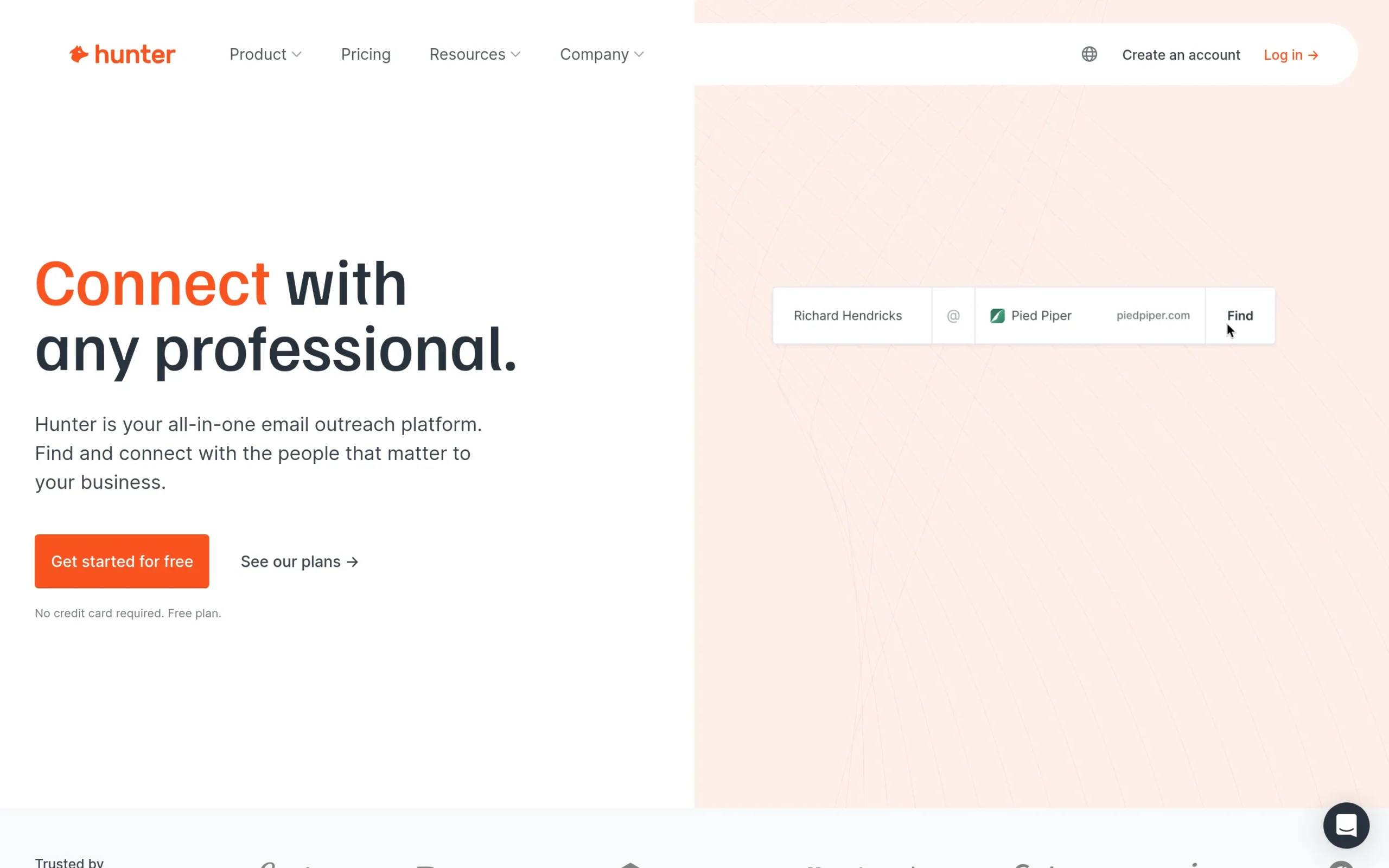
9. Hunter: best for finding emails by domain
Overview. Hunter is the simplest tool on this list. It finds professional email addresses by company domain, verifies deliverability, and offers bulk enrichment for contact lists. It does one thing, email, and does it reliably.
Key features. Domain search, email verifier, bulk enrichment, and a clean API that drops into existing workflows.
Pros and cons.
- ✅ Reliable and affordable for domain-based email finding
- ✅ Clean API and a usable free tier
- ⚠️ Email only, no phone numbers or firmographic data
- ⚠️ Not a full enrichment platform
Pricing. Free tier with 50 credits per month. Starter from €49/month (€34/month billed annually).
Best for. Teams that start with a target company list and need the right contact emails quickly, without full enrichment.
10. Kaspr: best for LinkedIn phone and email in the EU
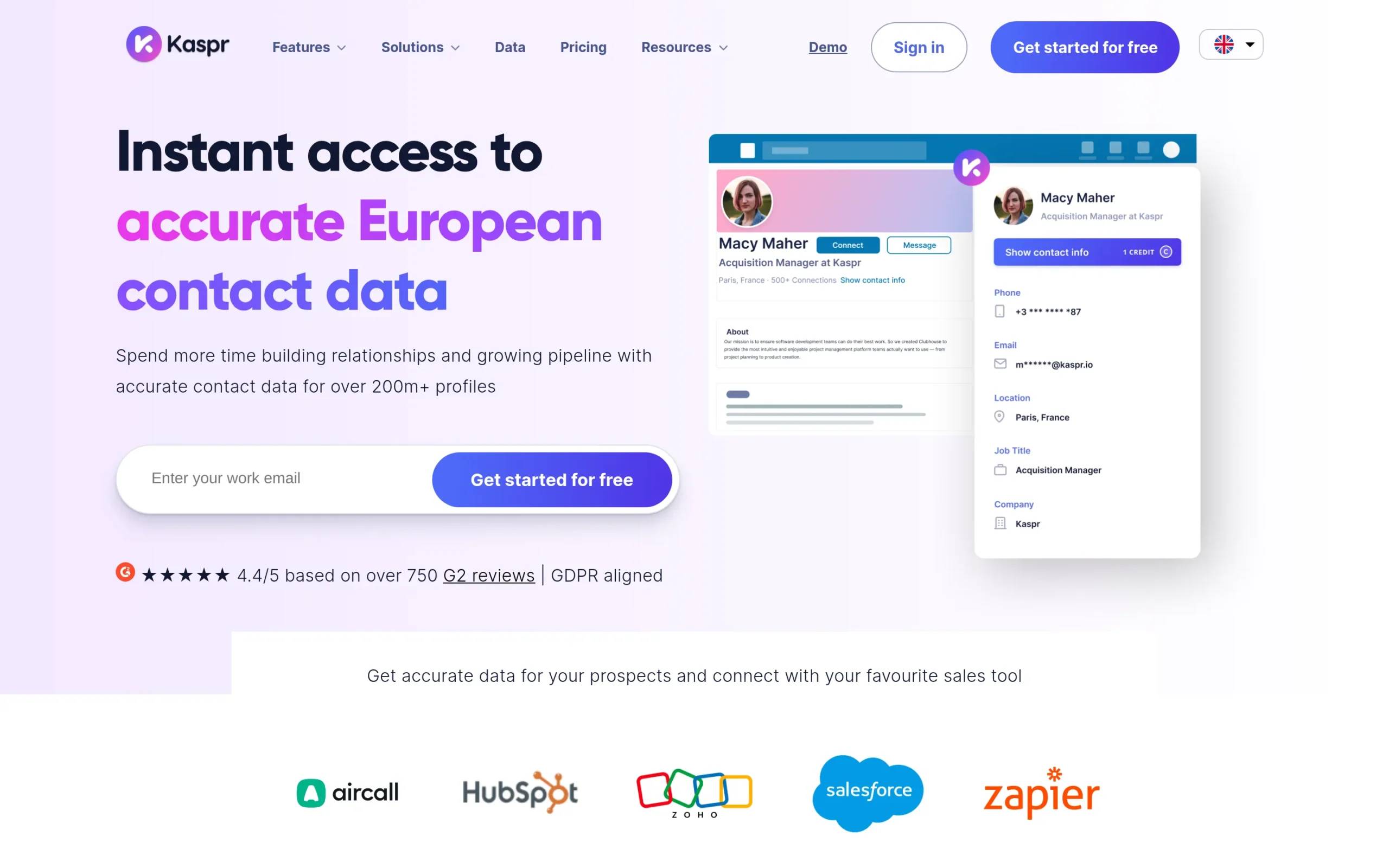
Overview. Kaspr is LinkedIn-native enrichment built for European teams. It extracts phone numbers and emails from LinkedIn profiles and Sales Navigator lists, with GDPR compliance as a core design principle and integration with opt-out lists.
Key features. A LinkedIn Chrome extension, CSV bulk enrichment, API access, and unlimited B2B email credits on paid plans.
Pros and cons.
- ✅ Strong phone coverage in France, Germany, and the UK
- ✅ GDPR and CCPA aligned, one of the safer EU options
- ⚠️ Coverage drops significantly outside Europe
- ⚠️ A regional tool rather than a global one
Pricing. Free tier with 15 email credits per month. Paid from €45/month.
Best for. European B2B teams that need GDPR-compliant phone and email enrichment from LinkedIn.
11. Datagma: best for cheap email and phone enrichment
Overview. Datagma is a low-cost enrichment tool covering email, phone, and company data from a name or LinkedIn URL, with a credit model and a usable free tier. It competes on price at the entry level.
Key features. Email and mobile-phone enrichment, company data, catch-all email detection at no credit cost, credit rollover, and API access.
Pros and cons.
- ✅ One of the cheapest paid entry points for phone plus email
- ✅ Free catch-all detection and credit rollover
- ⚠️ Smaller and less known than the database majors, so coverage varies
- ⚠️ Thinner firmographic and intent data than a full platform
Pricing. Free tier with 90 verified emails and 3 mobile phones per month. Paid from $49/month.
Best for. Budget-conscious teams that want email and phone enrichment without a database-platform price.
Best data enrichment tool by use case
The right tool depends on your data type, region, and where the enriched contact needs to land.
Best data enrichment tool for B2B outbound
La Growth Machine if the enriched data feeds LinkedIn and email sequences, because the enrichment and the sending live in one workflow and nothing goes stale between them. Clay or Derrick if you run a separate sequencer and want a deep data layer upstream of it, Clay for the widest source library, Derrick for AI-driven enrichment in a spreadsheet. The trap in outbound is enriching in one tool and sending from another, since a contact enriched on Monday and sequenced on Thursday is often already wrong.
Best data enrichment tool for CRM enrichment and accuracy
Dropcontact for a GDPR-clean, deduplicating email layer that syncs into HubSpot, Pipedrive, or Salesforce, and Clearbit by HubSpot if HubSpot is your CRM and you want enrichment and intent native to it. CRM accuracy is a decay problem: records rot as people change jobs, so the tool that matters is the one that re-enriches on a schedule rather than once at import.
Best data enrichment tool for GTM stacks
Clay for teams that build data workflows across many sources, and Derrick for the same job inside a spreadsheet with an AI layer and an MCP server for agents. Both are data-layer tools: they enrich, you route the output into whatever executes. Pair either with an outreach platform rather than expecting them to send.
Best data enrichment tool for EU and GDPR compliance
Cognism for phone-verified EU numbers, Dropcontact for a CNIL-audited email model that stores nothing, and Kaspr for GDPR-aligned LinkedIn enrichment. Derrick’s public-data-only model also sits cleanly here. US-centric databases like Apollo and ZoomInfo are stronger on coverage but carry more GDPR risk for EU outbound, so the choice is a real trade-off between match rate and compliance.
Best waterfall enrichment
La Growth Machine if the waterfall should feed your outreach directly, and Clay for the widest standalone source library. Waterfall beats any single provider because no one database covers everyone: 1,000 leads at a 50% single-source match rate return 500 contacts, and the same list through three providers in sequence returns 750 to 850.
Need enrichment inside your outreach? Meet La Growth Machine
Most tools on this list solve one slice: an email finder, a phone provider, a firmographic database, a spreadsheet layer. The stack math from the top of this article is the consequence. Four subscriptions, four logins, and an export-import cycle between enrichment and the tool you actually send from, with the data decaying in every gap.
Who this is for. B2B companies of roughly 11 to 500 employees, mostly software, tech, finance, and agencies, with a sales team scaling outbound or a GTM team building the motion.
La Growth Machine runs waterfall enrichment inside the outreach workflow. You drop a LinkedIn URL, LGM finds the verified email and phone across multiple providers in sequence, and the contact flows straight into a LinkedIn and email sequence. Enrichment feeds outreach, outreach generates conversations, and nothing sits in a separate tool waiting to go stale. Enrichment is included from €60/month per identity, with a 14-day trial and no card required. See pricing.
How to choose a data enrichment tool
1. Match the region to your market. US databases like Apollo and ZoomInfo win in North America and show gaps in Europe. EU providers like Cognism, Kaspr, and Dropcontact win the reverse. Match rate varies enough by region that this decision comes first.
2. Decide how much GDPR risk you can carry. If you prospect in the EU, a public-data or consent-based model matters. Cognism, Dropcontact, Kaspr, and Derrick are built for it. Scraped-database tools carry more risk on EU outbound.
3. Choose waterfall over single source for coverage. No single database covers everyone. A tool that cascades across providers, or a platform with native waterfall, returns meaningfully more usable contacts per list.
4. Count the whole stack, not the entry price. A $49 email finder plus a phone provider plus an enrichment API is not a $49 setup. Add every line, and price it per enriched contact against your real monthly lead volume.
5. Put enrichment where you send from. Data that lives in a separate tool goes stale in the export gap. Native enrichment or scheduled CRM re-enrichment keeps records fresh where they are used.
Frequently asked questions
What is data enrichment?
Data enrichment is the process of adding missing information to a contact record. For B2B sales it usually means turning a LinkedIn URL or company domain into a complete profile: verified email, direct phone number, job title, and firmographic data like company size and tech stack. The point is to reach the right person with enough context that outreach lands.
What is the best B2B data enrichment tool in 2026?
For teams that want enrichment and outreach in one workflow, La Growth Machine is the strongest pick, because its waterfall enrichment feeds LinkedIn and email sequences with no export step. For a standalone enrichment layer with the deepest source coverage, Clay leads. For EU phone-first outbound, Cognism. The best tool depends on your data type, region, and whether enrichment feeds a sequencer or sits beside it.
What is the best data enrichment API for sales teams?
Clay exposes the widest multi-source waterfall through its API, Derrick offers an API and an MCP server on paid tiers for spreadsheet and agent workflows, and Hunter has a clean, simple API for domain-based email finding. Choose by depth: Clay for many sources, Hunter for email-only simplicity, Derrick for AI-driven enrichment you can wire into automations.
Is data enrichment GDPR compliant?
It can be, when the provider follows proper data governance. For B2B prospecting, legitimate interest is the most common legal basis. Tools like Cognism, Dropcontact, and Kaspr are built with EU compliance as a core principle, maintaining opt-out databases and documenting their processing basis. Derrick uses public data only and stores nothing. US-centric databases like Apollo and ZoomInfo carry more risk for EU-focused teams.
What is waterfall enrichment?
Waterfall enrichment runs each contact through multiple data providers in sequence. If the first returns a verified result, the process stops. If not, it moves to the next provider, and so on. This maximizes coverage without paying for redundant results. No single database covers everyone, so a waterfall consistently outperforms any one source. La Growth Machine uses waterfall enrichment natively in its outreach workflow, and Clay applies the same logic across 150+ sources.
How accurate are data enrichment tools?
Accuracy varies by tool and target profile. Email accuracy typically runs 70% to 90% for tools that do real-time SMTP verification. Phone accuracy varies more: manually verified numbers like Cognism’s Diamond Data are the most reliable, while database-sourced direct dials from other providers land around 50% to 70%. Match rates also vary, which is exactly why waterfall enrichment across multiple sources beats single-provider approaches.
How much does a data enrichment tool cost?
Entry pricing runs from free tiers to enterprise contracts. The cheapest working options are credit-based: Derrick from €9/month, Datagma and Hunter around $49/month, Kaspr from €45/month. Mid-market platforms sit higher: La Growth Machine from €60/month with enrichment included, Clay from $167/month. Cognism and ZoomInfo are custom enterprise pricing. The number that matters is cost per enriched contact against your real monthly volume, not the sticker price.
Conclusion: our top picks
Best overall for B2B teams: La Growth Machine, for B2B software, tech, finance, and agencies between 11 and 500 employees, where enrichment should feed sequences instead of sitting in a separate data tool. Waterfall enrichment included from €60/month. See pricing.
Best spreadsheet and AI enrichment: Derrick, our partner, from free to €9/month, for AI-driven enrichment inside Google Sheets with an MCP server for agents.
Best standalone data layer: Clay for the deepest waterfall.
Best for the EU: Cognism for phone, Dropcontact for GDPR-native email, Kaspr for LinkedIn.
Best for scale on US data: Apollo if you prospect inside it, ZoomInfo at enterprise budgets.
Whatever you pick, put enrichment as close to your outreach as you can, count the whole stack before comparing entry prices, and choose a waterfall over any single source if match rate is what you are optimizing for.