
TL;DR
– Pipedrive is best for pure sales teams that want pipeline clarity and fast onboarding, without a built-in outreach layer.
– HubSpot is an all-in-one marketing and sales suite that scales in complexity and price, ideal when marketing and sales share the same platform.
– La Growth Machine is the outreach layer that sits on top of either CRM, with native bidirectional sync to both Pipedrive and HubSpot on the Ultimate plan.
– Choose your CRM based on your sales/marketing alignment needs, then add LGM on top for LinkedIn and email outreach — no Zapier required.
| Pipedrive | HubSpot | La Growth Machine | |
|---|---|---|---|
| Type | Pure sales CRM | All-in-one suite | Outreach platform |
| Pipeline management | Best-in-class | Solid, more complex | Not a CRM |
| Marketing automation | Limited | Powerful | Not applicable |
| LinkedIn outreach | Requires 3rd party | Requires 3rd party | Native |
| Email sequences | Via integrations | Available (paid plans) | Native |
| CRM sync | Self (it is the CRM) | Self (it is the CRM) | Native Pipedrive + HubSpot (Ultimate) |
| Entry price | ~$14/user/month | Free (limited) | €60/month |
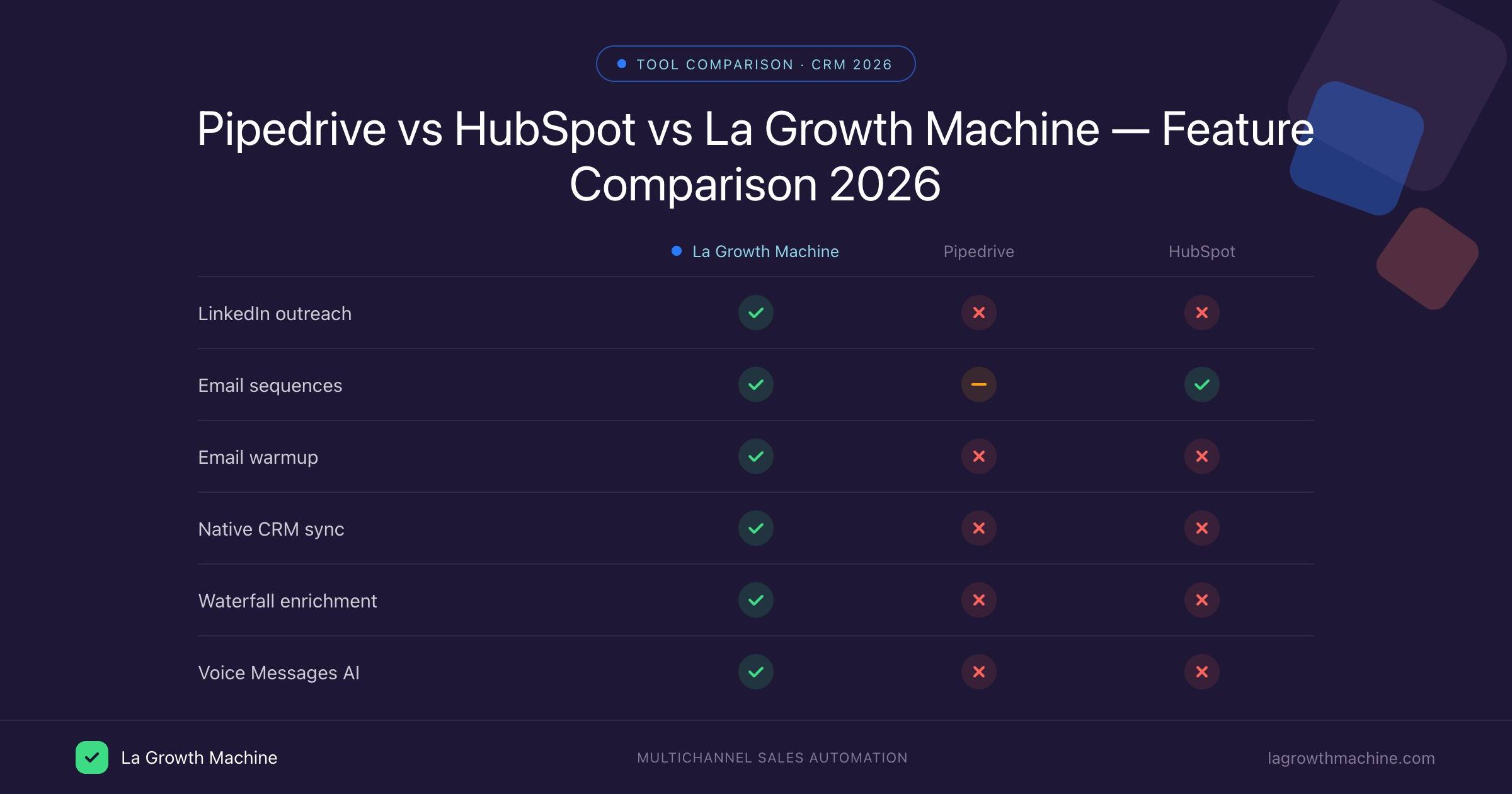
Most B2B sales teams eventually reach the same debate: Pipedrive or HubSpot? We’ve run both alongside real sales teams. The honest answer is that each wins in a different scenario. Pipedrive wins when you want speed, simplicity, and pipeline clarity. HubSpot wins when sales and marketing need to share the same platform. But here’s what both camps consistently discover: neither tool has LinkedIn outreach built in. And in 2026, LinkedIn is where B2B deals start. This comparison breaks down which CRM fits which team, plus explains why the outreach layer you stack on top matters as much as the CRM itself.
Round 1: Core Philosophy
Pipedrive: Built for Salespeople
Pipedrive launched with a single promise: give salespeople a CRM they’d actually use. The result is a pipeline-first interface built around a Kanban board that mirrors how deals actually move. You see every deal at a glance, drag cards between stages, and get activity reminders that keep reps on track.
Onboarding takes hours, not days. There’s no marketing suite to configure, no service hub to set up, no CMS to connect. Pipedrive is a sales tool, and it does that job extremely well.
Pricing sits between $14/user/month (Essential) and $59/user/month (Professional). The Professional plan unlocks workflow automation, revenue forecasting, and advanced reporting — features that growing sales teams actually need.
The limitation is equally clear: Pipedrive does not do outbound outreach. It manages what happens after a prospect enters the pipeline. Getting them there requires a separate tool.
HubSpot: The All-in-One Suite
HubSpot positioned itself as the platform where marketing and sales can finally work from the same data. The product suite covers marketing automation, email campaigns, landing pages, a CMS, a service desk, and a CRM — all connected in one ecosystem.
The free tier is genuinely useful for small teams just starting to organize their contacts. But scaling up comes with a steep jump: the Sales Hub Professional plan starts at approximately $450/month for 5 users. That’s before adding any marketing or service hubs.
HubSpot’s strength is alignment. When a marketer nurtures a lead through email campaigns and that lead moves to a sales rep, the handoff is clean. The rep sees every touchpoint the prospect had with the brand. The reporting is unified.
The limitation mirrors Pipedrive’s: LinkedIn outreach is not built in. HubSpot offers integrations via its marketplace, but those require connecting separate tools — and usually Zapier to make them talk.
La Growth Machine: The Outreach Layer
La Growth Machine is not a CRM. This distinction matters. LGM sits on top of whichever CRM you choose and handles the outbound prospecting that neither Pipedrive nor HubSpot does natively.
LGM runs multichannel sequences across LinkedIn, email, and (on the Ultimate plan) X/Twitter. It enriches contacts automatically through waterfall enrichment, warms email accounts to protect deliverability, and includes Voice Messages AI for LinkedIn outreach.
On the Ultimate plan (€180/month), LGM syncs natively with both Pipedrive and HubSpot. No Zapier. No middleware. Contacts created or updated in LGM push directly into your CRM, and deal stage changes in the CRM can trigger or pause LGM sequences. The integration is bidirectional.
Plans start at €60/month per identity (Basic: LinkedIn + Email + Social Warming + Voice Messages AI + Waterfall Enrichment). The Pro plan at €120/month adds LinkedIn Intents, Real Chat Mode, and A/B Testing. Ultimate at €180/month adds X/Twitter outreach and the native CRM sync.
Round 2: Pipeline and Deal Management
Pipedrive’s Pipeline Is Its Core Feature
Pipedrive built its reputation on pipeline visualization. Deal stages are customizable, the Kanban view is clean, and the activity-based selling model keeps reps focused on the right actions at the right time. You set activities (calls, emails, demos) against each deal, and Pipedrive surfaces what needs attention.
The reporting covers win rates by stage, conversion rates, revenue forecasting, and team performance. For a pure sales team, this is everything you need to manage the post-prospecting process.
Where Pipedrive is weak: leads don’t appear in the pipeline by themselves. You need a source. For most B2B teams, that source should be LinkedIn — and connecting LinkedIn outreach to Pipedrive historically required Zapier plus a separate LinkedIn tool plus manual configuration.
HubSpot Pipeline: More Powerful, More Complex
HubSpot’s pipeline is solid. Deal stages, automation triggers, task assignments — it’s all there. The difference is that HubSpot’s pipeline connects to a much broader ecosystem. When a prospect fills out a HubSpot form, downloads a lead magnet, or opens a marketing email, that activity logs against their contact record. The sales rep who picks up the deal sees the full journey.
This makes HubSpot’s pipeline more powerful when marketing is actively feeding it. It makes it more complex when you just want a clean view of your deals.
For teams where a marketer and a sales rep share the same account, HubSpot’s pipeline wins. For a team of 3-5 salespeople who just want to manage deals, Pipedrive is faster.
How LGM Feeds Both Pipelines
LGM sequences push qualified leads into whichever CRM you’re running. A prospect who replies positively to a LinkedIn sequence in LGM can be automatically created as a contact and deal in Pipedrive or HubSpot — with the full sequence history attached.
On the Ultimate plan, the sync is native and bidirectional. If a deal moves to “Closed Won” in HubSpot, LGM can automatically stop that contact’s sequence. If a contact’s email bounces in LGM, that status updates in the CRM. The two systems stay in sync without any manual intervention or Zapier automations to maintain.
Round 3: Automation and Integrations
Pipedrive’s Automation: Good, But Requires Assembly
Pipedrive offers 300+ integrations and workflow automation starting on the Advanced plan ($34/user/month). You can automate deal stage changes, send follow-up emails, create tasks, and trigger alerts. For a sales team’s internal workflows, this is sufficient.
The gap is outbound. LinkedIn outreach requires connecting a separate LinkedIn automation tool, setting up a Zapier connection to pass data between the tools and Pipedrive, and then maintaining that setup as APIs and pricing change. Most sales teams using Pipedrive end up with a stack that looks like: Pipedrive + LinkedIn tool + email sequences tool + Zapier. Each element has its own subscription, its own login, and its own failure point.
HubSpot’s Automation: Powerful but Siloed on LinkedIn
HubSpot’s workflow engine is genuinely powerful. With 1,000+ integrations and a workflow builder that handles complex branching logic, HubSpot can automate nearly any marketing or sales process. Email sequences, lead scoring, lifecycle stage changes, internal notifications — the automation covers it all.
LinkedIn is the exception. Despite HubSpot’s breadth, LinkedIn outreach sequences are not part of the platform. Connecting LinkedIn automation to HubSpot requires an external tool plus integration work. The resulting stack mirrors Pipedrive’s problem: multiple tools, multiple subscriptions, and Zapier gluing them together.
LGM Replaces the Stack
LGM on Ultimate replaces the LinkedIn tool, the separate email sequences tool, and the Zapier layer — for both CRMs. One subscription handles:
- LinkedIn outreach sequences
- Email sequences with social warming
- Voice Messages AI on LinkedIn
- A/B testing across channels
- Waterfall enrichment to fill in missing contact data
- Native bidirectional sync to Pipedrive or HubSpot
The practical effect is fewer logins, fewer failure points, and no Zapier automations to maintain. When LinkedIn’s API changes or Zapier updates its pricing, LGM handles it — you don’t.
Round 4: Pricing and Real TCO
The honest pricing comparison includes all the tools a team actually needs to run an effective outbound process.
Pipedrive stack (5-person sales team):
- Pipedrive Professional: $59/user/month x 5 = ~$295/month
- LinkedIn outreach tool: ~€100/month
- Email sequences tool: ~€39/month
- Zapier (to connect them): ~€20/month
- Total: approximately €454/month
HubSpot stack (5-person sales team):
- HubSpot Sales Hub Professional: ~$450/month
- LinkedIn outreach tool: ~€100/month
- Zapier: ~€20/month
- Total: approximately €570/month
With LGM Ultimate stacked on either CRM:
- CRM cost (Pipedrive or HubSpot as above)
- LGM Ultimate: €180/month (replaces the LinkedIn tool + email tool + Zapier)
- No separate email sequences tool needed
- No Zapier needed
- Saves approximately €100-160/month versus the assembled stack
The saving compounds over time. Tool consolidation also reduces the operational overhead of maintaining multiple integrations, handling broken Zaps, and onboarding new team members across multiple platforms.
Final Verdict: Which Stack for Which Team
| Use case | Recommended stack |
|---|---|
| Pure sales team, budget-conscious | Pipedrive + LGM |
| Sales + marketing alignment needed | HubSpot + LGM |
| Already on HubSpot, need outreach | Add LGM Ultimate (native sync) |
| Already on Pipedrive, need outreach | Add LGM Ultimate (native sync) |
| Small team, simple pipeline | Pipedrive Essential, add LGM when scaling |
The CRM choice comes down to one question: does marketing need to share the platform with sales? If yes, HubSpot is the stronger foundation. If no, Pipedrive is faster and simpler.
Either way, the outreach layer is the same. LinkedIn outreach is not optional for B2B teams in 2026. LGM handles it natively for both CRMs, which means the stack decision simplifies to: pick your CRM, add LGM, and skip the integration overhead.
If you’re evaluating LGM alongside Pipedrive or HubSpot, the 14-day free trial (no credit card required) lets you run a full sequence and see the CRM sync in action before committing.
FAQ
Which is better for small sales teams: Pipedrive or HubSpot?
For small sales teams (under 10 people) focused purely on closing deals, Pipedrive is usually the better starting point. The onboarding is faster, the interface is simpler, and the pricing is more predictable. HubSpot’s free tier works for basic contact management, but the moment you need real sales pipeline features, the price jumps significantly. Pipedrive scales more gradually.
Is HubSpot’s free plan enough for a B2B sales team?
The free plan works for organizing contacts and tracking basic deals, but it falls short of what a real B2B sales team needs. Email sequences, advanced reporting, automation, and proper pipeline management all require paid plans. Sales Hub Professional starts at approximately $450/month for 5 users — a significant jump from free. Most growing B2B teams hit the ceiling of the free plan within a few months.
What outreach tool works natively with both Pipedrive and HubSpot?
La Growth Machine on the Ultimate plan (€180/month) offers native bidirectional sync with both Pipedrive and HubSpot. No Zapier required. Contacts flow from LGM sequences into the CRM automatically, and deal stage changes in the CRM can update LGM sequences. It’s the only outreach platform that handles LinkedIn, email, and CRM sync in one subscription for both tools.
How does La Growth Machine sync with Pipedrive and HubSpot?
On LGM Ultimate, the sync is bidirectional and native. When a prospect responds to a sequence in LGM, their contact and activity data push directly into your connected CRM (Pipedrive or HubSpot). When a deal stage changes in the CRM, LGM can stop or update the active sequence for that contact. There’s no Zapier, no webhook configuration, and no middleware to maintain. The integration is built directly into LGM’s platform.
Can I use Pipedrive and HubSpot together?
Technically, yes — there are integrations that sync data between Pipedrive and HubSpot. But in practice, running both adds complexity and cost without a clear benefit. Most teams choose one as their primary CRM and use it consistently. If you need both marketing and sales in one platform, HubSpot is the cleaner choice. If you want a lightweight sales CRM alongside a dedicated marketing tool, Pipedrive plus a marketing platform (not HubSpot’s full suite) is often simpler. Either way, adding LGM on top handles the outreach layer for whichever CRM you choose.