

In commercial relationships, especially with a prospect, a thank you email is a way to express your gratitude to your contact. Beyond conventions and politeness, a thank you email is a tool that allows you to create or strengthen a connection with your prospect.
Thanking someone for the time they dedicated to listening to you, regardless of the outcome, is an opportunity to work on your image as a person and as a brand representative. This is particularly true for recruiters, who need to maintain relationships with their candidate pool over time.
How to write a good thank you email? Here are a few steps to remember:
- Recall the context;
- Adapt your tone of voice and copywriting – this is the most difficult and important step – to your use case;
- Be sincere and natural;
- Use the opportunity to leave the door open!
La Growth Machine offers many resources and integrates AI to help you craft your messages. You can read our tutorial on the subject, or test our tool for free!
Summary: Thank You Email
In commercial relationships, especially with a prospect, a thank you email is a way to express your gratitude to your contact. Beyond conventions and politeness, a thank you email is a tool that allows you to create or strengthen a connection with your prospect.
Thanking someone for the time they dedicated to listening to you, regardless of the outcome, is an opportunity to work on your image as a person and as a brand representative. This is particularly true for recruiters, who need to maintain relationships with their candidate pool over time.
How to write a good thank you email? Here are a few steps to remember:
Rappelez le contexte ;
Adaptez votre tone of voice et votre copywriting – c’est l’étape la plus difficile et la plus importante – à votre use case ;
Soyez sincère et naturel ;
Profitez-en pour laisser la porte ouverte !
La Growth Machine offers many resources and integrates AI to help you craft your messages. You can read our tutorial on the subject, or test our tool for free!
Whatever your job, a thank you email is a standard courtesy that is essential in everyday life. Depending on your contact, the format of your email may not be the same.
How to write a good thank you email? Why is it essential?
In this article, we provide you with tips, examples, and step-by-step guides to write the best thank you emails.
What is a Thank You Email?
A thank you email, as its name suggests, is a message in which you express your gratitude – from the beginning to the end of the email – to someone who has helped you, done you a favor, or simply someone you appreciate.
This type of email can take several forms. It could be a professional email to thank a colleague or client, but it could also be a personal email to thank a friend or family member.
Why is it Important to Know How to Write a Thank You Email?
There are several reasons why it’s important to know how to write a thank you email.
Warning! If you are writing your thank you email in the context of a recruitment process, there are a few best practices to keep in mind. We have written a resource on this subject.
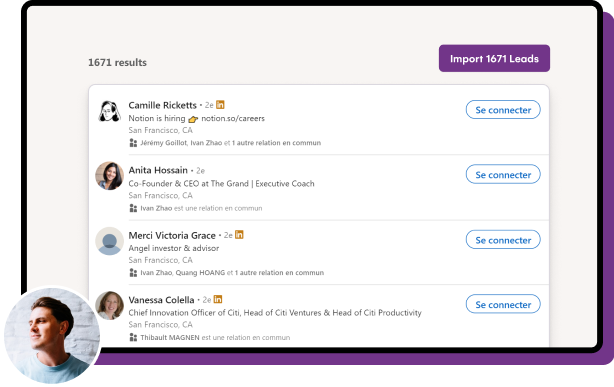
First, it shows that you are polite and that you know how to appreciate others’ gestures. Send a thank you email to someone who has helped you, and they will be delighted to have done so. Moreover, it will make them want to see you again and help you again.
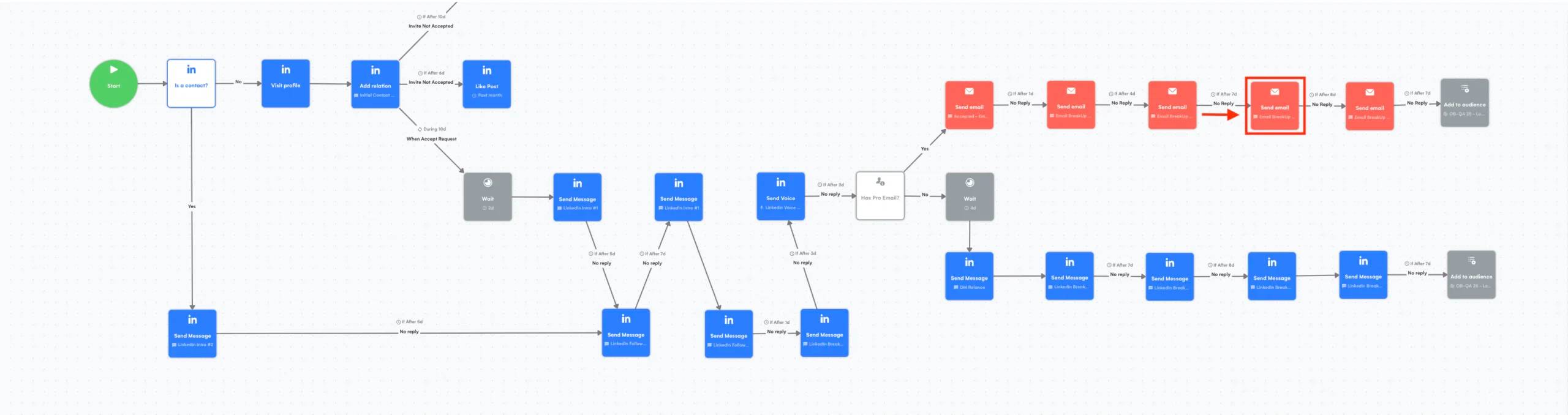
Good to know: with LaGrowthMachine, you can easily schedule a lead automation campaign aimed at sending thank you emails.

Furthermore, it can be a very good sales technique to reconnect with a former lead, a partner, a supplier with whom you would like to do business, etc…
Next, it helps build and maintain strong professional and personal relationships. Send a thank you email to a colleague or client after a successful collaboration, and you’ll show that you are reliable and friendly. These people will then be more likely to want to work with you in the future.
Finally, it can have an impact on your career. If you are polite and know how to appreciate others’ gestures, you will be perceived as a trustworthy and quality person. People will be more inclined to work with you, and you can quickly advance in your career.
When to Send a Thank You Email?
The timing of your thank you email is as important as its content. Sending your message at the right time maximizes its impact and demonstrates your professionalism.
The golden rule: 24 to 48 hours maximum
The ideal is to send your thank you email within 24 hours of the interaction. This timeframe allows you to:
- Stay fresh in your contact’s mind
- Show your responsiveness and motivation
- Leverage the still-present context of the exchange
If you cannot send your message within 24 hours, the absolute limit is 48 hours. Beyond that, the impact of your thank you diminishes considerably.
Timing mistakes to avoid
Sending too early (within the hour) can seem automatic and lack sincerity. Take the time to genuinely personalize your message. Conversely, waiting more than 3 days negates the entire purpose of the thank you email – your contact will have moved on, and your message will fall flat.
Specific case of job interviews
For a job interview, timing is even more crucial. Recruiters often make their decisions within 48-72 hours after interviews. Your thank you email, sent within 24 hours, can positively influence this decision by keeping you present in their thoughts.
If your interview takes place on a Friday afternoon, it’s better to send it on Monday morning rather than over the weekend – your message will have more impact during the week.
How to Write a Thank You Email?
There isn’t one single way to write a thank you email. Indeed, the content of the email will depend on the type of person you are addressing (a colleague, a client, etc.) and the goal you wish to achieve.

However, there are a few elements you should always include in your thank you email. Here is the list:
- The word “thank you”: It seems obvious, but don’t forget to thank your contact! This shows you are polite and appreciate their gesture.
- A short sentence explaining what you appreciated: Take the time to describe what you valued in your interaction with your contact. This will show them you paid attention and appreciated them.
- A brief reminder of what happened: If your email is professional, don’t forget to briefly recall what happened between you and your contact. This will help your contact remember the situation and understand why you are sending them this email.
- A mention explaining what you learned: Don’t hesitate to test your emails and take the opportunity to briefly mention what you learned. This will show your contact that you listened to their advice and applied it.
- Explain what you plan to do next: If your email is professional, take the opportunity to briefly explain what you plan to do next. This will allow your contact to look ahead and anticipate a potential future connection.
- The signature: Don’t forget to sign your thank you email! This shows you are polite and wish to maintain a courteous relationship with your contact.
If you use LaGrowthMachine and are unsure about your thank you message, you can always contact our support team, who will be happy to review your sequence.

By contacting us, we will review not only how you have configured your sequence but also your copywriting and the most well-known writing rules!
Thank You Email After a Job Interview
The thank you email after a job interview is a strategic tool often underestimated. In a context where candidates are similar in terms of skills, this message can make the difference.
Why it’s a critical moment
After an interview, the recruiter evaluates several candidates and must make a choice. Your thank you email allows you to:
- Reaffirm your interest in the position and the company
- Provide additional information that you didn’t have time to mention
- Correct or clarify a point from your discussion if necessary
- Demonstrate your professionalism and your ability to follow workplace norms
According to a CareerBuilder study, 22% of recruiters are less likely to hire a candidate who does not send a thank you email.
Recommended structure for a job interview
Your email should be concise (250-300 words maximum) and structured as follows:
- Personalized thank you: Mention a specific element of the discussion
- Reaffirmation of interest: Explain why the position suits you
- Added value: Include a new element (relevant article, post-interview reflection, concrete example)
- Availability: Offer to provide further clarification if needed
- Professional closing
Condensed example
Subject: Thank you for our discussion about the [Job Title] position
Hello [First Name],
Thank you for your time this morning discussing the [Job Title] position. Our conversation about [specific point discussed] has strengthened my interest in joining your team.
I particularly appreciated your vision on [project/company element]. This resonates with my experience in [relevant skill], especially when I [brief concrete example].
I remain available for any further information.
Sincerely,
[Your Name]
The element that makes the difference
The secret to an effective thank you email after an interview? Personalization. Avoid generic phrases. Mention a specific project you discussed, a company value that struck you, or an anecdote shared. This personalization shows that you were fully present during the interview.
5 Tips for Writing a Good Thank You Email
Here are some additional tips to help you write an even better thank you email:
1. Pay attention to your spelling and grammar
If you want to be taken seriously, pay attention to the spelling and grammar of your email. Indeed, spelling and grammar mistakes can give a bad impression of you and diminish the quality of your email.
2. Use an appropriate tone
The tone you use in your thank you email will depend on the type of person you are addressing. If you are communicating with a colleague or client, use a professional tone. If you are communicating with a friend, use a more informal tone.

3. Adapt the content to your contact
The content of your email should be adapted to the person you are addressing. Thus, if you send a thank you email to a colleague, focus on the collaboration and professional exchanges. If you send a thank you email to a friend, focus on the pleasant moments you spent together.
4. Be sincere
If you want your thank you email to be perceived as sincere, take the time to write a personalized email, from a custom email domain. Feel free to describe what you appreciated in your relationship with your contact and explain why you are grateful.
5. Don’t forget to follow up
If you want to maintain a good relationship with your contact, don’t forget to follow up regularly. This shows that you value staying in touch and appreciate your relationship.
Having trouble formulating your follow-ups? LaGrowthMachine allows you not only to schedule all your follow-ups in advance but also to set the necessary spacing between each email. In short, you have nothing left to do.

There are many conditions you can program with our tool (however, you won’t be able to schedule LinkedIn posts), to cover all eventualities!

Mistakes to Avoid in a Thank You Email
Even with the best intentions, some mistakes can ruin the impact of your thank you email. Here are the most common pitfalls and how to avoid them.
1. The email is too long
Your contact is busy. A thank you email that exceeds 300-350 words is likely not to be read in full. Get to the point: thank you, brief context, main message, closing. If you need 3 scrolls to read your message, it’s too long.
2. Spelling and grammar mistakes
Nothing discredits a professional email faster than a spelling mistake, especially in a thank you context where you are trying to polish your image. Always proofread, use a spell checker, and ideally, have someone else read it.
3. Inappropriate tone
The balance is delicate: too formal, you seem distant; too familiar, you lack professionalism. Adapt your tone to your contact and the context of your exchange. When in doubt, opt for a warm yet professional tone.
4. Lack of personalization
A generic email like “Thank you for your time, I learned a lot” is useless. It shows you’re using a template without thought. Always mention a specific element from your discussion that proves you were attentive and engaged.
5. Forgetting the final review
Before hitting “Send,” check: the spelling of your contact’s name, the email subject, any links, and attachments if mentioned. An error in your recruiter’s first name can negate the entire positive effect of your effort.
The trap of excessive automation
If you use a tool like La Growth Machine for your prospecting campaigns, be careful not to automate your thank you emails in the same way. These messages must remain authentic and personalized – that’s their added value.
Some Thank You Email Examples (Templates)
To help you, here are some free templates and examples you can use to guide you in your thank you emails.
Template 1: Thanking a colleague or partner
Template 2: Personal, very warm thank you
Template 3: Cordial thank you
Template 4: Formal thank you email
Template 5: Informal thank you email
Specific Cases: Video Call, Group, Internship Interviews
Certain interview contexts require adaptations in your thank you email. Here’s how to handle the most common situations.
Video conference interview
An interview conducted via video call deserves the same follow-up as an in-person interview. Some adaptations to include:
- Mention the format: “Thank you for this video conference discussion” shows you acknowledge the specificity
- Highlight the practical aspect: “I appreciated the flexibility offered by this format”
- Reference a visual detail: If the recruiter shared their screen or showed something specific, mention it
Video conferencing can sometimes create distance. Your email should compensate by being even warmer and more personalized.
Group interview: who to send to?
After an interview with several people, the question arises: send a group email or several individual emails?
Prefer individual emails if you have the contact details of each interviewer. Personalize each message by mentioning a specific exchange with that person. This demonstrates your attention and your ability to manage multiple relationships.
If you only have one contact address (e.g., HR), send a single email mentioning each participant by name: “I thank [Name 1] for their explanations on [topic], [Name 2] for their feedback on [technical point]…”
Thank you email for an internship or work-study program
For an internship or work-study program, the thank you email follows the same rules, with a few nuances:
- Highlight your motivation to learn rather than your expertise
- Mention concrete projects discussed during the interview
- Express your enthusiasm for the team and the learning environment
- Be more explicit about your availability (internship dates, academic constraints)
Example approach: “Our discussion about project [X] confirmed my desire to learn alongside you, particularly in [skill]. My [duration] internship starting [date] would fit perfectly with the schedule discussed.”
The case of technical interviews or practical tests
If your interview included a technical test or a practical exercise, your thank you email can:
- Provide clarification on your approach
- Share a relevant complementary resource
- Show that you have continued to think about the problem posed
This demonstrates your commitment and your ability to go above and beyond.