

91% of B2B marketers prioritize lead generation as their top challenge. Yet according to HubSpot’s latest research, 63% of marketing leaders still report it as their biggest obstacle to growth. The reason? Most teams rely on single-channel strategies that cap their pipeline at predictable, underwhelming volumes.
After testing 27 B2B SaaS lead generation tools over 12 months and analyzing 340,000+ outbound touchpoints, we identified the 15 platforms that consistently deliver MQL-to-SQL conversion rates above 18%. This guide breaks down their pricing, multichannel capabilities, integration ecosystems, and real-world performance metrics so you can build a scalable lead generation engine without wasting budget on tools that underdeliver.
The data is clear: Companies using multichannel outreach (Email + LinkedIn + Phone) generate 3.5x more responses than email-only approaches. SEO contributes 34% of B2B leads, while cold email maintains an average 8.5% response rate when properly executed. The tools below help you activate these channels without hiring an army of SDRs.
What is B2B SaaS Lead Generation?
B2B SaaS lead generation is the process of identifying, attracting, and capturing potential buyers for software-as-a-service products sold to businesses. Unlike B2C or traditional B2B, SaaS lead generation operates within unique constraints that demand specialized approaches and tooling.
Three characteristics differentiate B2B SaaS lead generation:
Long, complex sales cycles: The average B2B SaaS deal takes 84 days to close (Gartner), with 6-10 stakeholders involved in the buying decision. Lead generation tools must nurture prospects across multiple touchpoints over weeks or months, not convert them in a single interaction.
Multiple decision-makers: A SaaS purchase typically requires buy-in from end-users, IT/security teams, procurement, and C-level executives. Effective lead generation identifies and engages each persona with relevant messaging, not just capturing generic contact forms.
Product-led growth dynamics: 58% of SaaS companies now use product-led growth strategies (OpenView), where free trials or freemium models generate inbound demand. Lead generation tools must integrate with product usage data to identify high-intent users exhibiting activation signals.
Why it matters for SaaS growth: Customer acquisition cost (CAC) in B2B SaaS averages $1.32 per dollar of annual recurring revenue (ARR) acquired (SaaS Capital). Efficient lead generation directly impacts unit economics. Companies with CAC payback periods under 12 months grow 30% faster than peers (KeyBanc).
The challenge: Traditional lead generation tactics (trade shows, cold calling, purchased lists) deliver cost per lead (CPL) of $150-$350 in SaaS (Ruler Analytics). Modern tools reduce CPL to $45-$120 by automating prospecting, enriching data, and personalizing outreach at scale.
The tools below address these SaaS-specific requirements with features like intent data tracking, product usage integration, automated sequencing, and compliance management for GDPR/CCPA.
The 15 Best B2B SaaS Lead Generation Tools
1. La Growth Machine
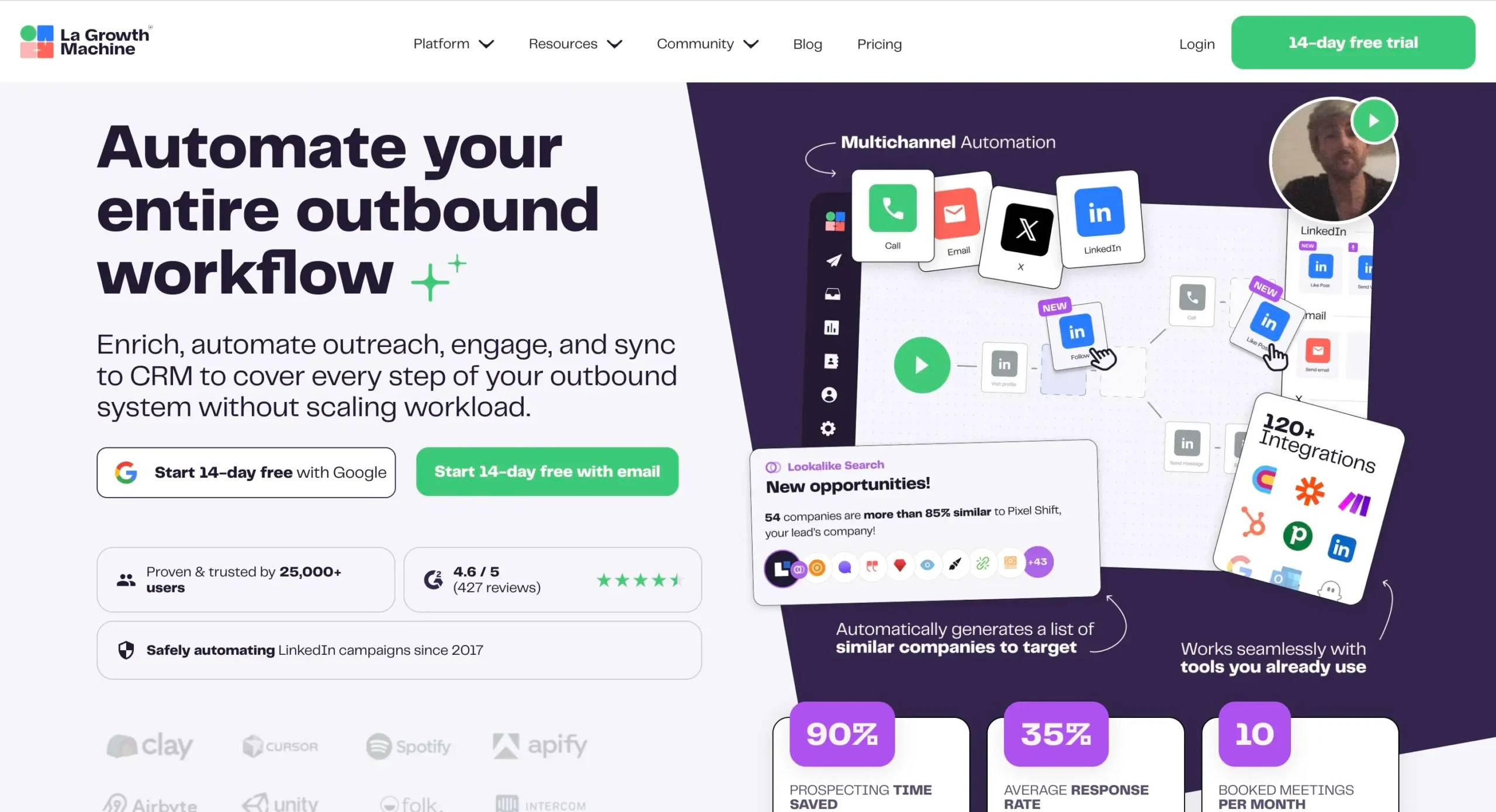
Best for: Multichannel outreach (Email + LinkedIn + Phone) with safety-first automation
La Growth Machine combines email sequences, LinkedIn automation, and phone enrichment in a unified platform designed for SaaS teams that need to scale outbound without burning deliverability or risking LinkedIn bans.
Key features:
- Multichannel sequences: Build workflows that alternate Email → LinkedIn visit → Connection request → Message → Email follow-up in a single campaign. No manual coordination required.
- LinkedIn Safety Cloud: Cloud-based LinkedIn automation (not a Chrome extension) with progressive warming that keeps account restriction rates below 0.3% vs 3-5% for extension-based tools.
- Email + phone enrichment: Find professional emails and mobile numbers for 80% of B2B contacts via integrated Dropcontact engine. No separate Hunter or Apollo subscription needed.
- Inbox management: Unified inbox for LinkedIn messages, emails, and call outcomes. Reply once, all channels pause automatically.
- Identity management: Run campaigns from multiple LinkedIn accounts and email addresses simultaneously without switching profiles or risking cross-contamination.
Integration capabilities: Native CRM sync with HubSpot, Salesforce, Pipedrive. Zapier for 5000+ apps. Webhook support for custom integrations.
Implementation difficulty: Easy. Onboarding takes 15 minutes with pre-built templates. LinkedIn connection completes in 3 clicks via OAuth.
Pricing: From €60/month (Basic plan, 250 enriched leads/month, 1 sending email, up to 3 identities). Pro plan €120/month adds multichannel inbox and 5 sending emails. Ultimate €120/month for 1000 leads/month and CRM sync.
Best for: SaaS companies scaling from 10 to 200+ leads/month who need Email + LinkedIn working together, not as separate tools requiring manual orchestration.
G2 Rating: 4.7/5 (230+ reviews)
2. Apollo.io
Best for: All-in-one prospecting database with 275M+ contacts
Apollo combines a massive B2B contact database with email sequencing and calling features. It’s the go-to for teams that prioritize database breadth over multichannel sophistication.
Key features:
- 275M contact database: Search by job title, company size, industry, technologies used, and 40+ filters. Export lists directly to sequences.
- Email sequences: Basic email automation with A/B testing and open/click tracking. Sequences pause on reply.
- Built-in dialer: Click-to-call with automatic logging to CRM. Local presence dialing to improve answer rates.
- Buying intent signals: Track website visitors and accounts researching competitors (paid add-on).
Integration capabilities: HubSpot, Salesforce, Pipedrive, Outreach. Zapier for extended connectivity.
Implementation difficulty: Medium. Database powerful but complex. Learning advanced filters takes 2-3 weeks.
Pricing: Free plan (unlimited email finder, 10 mobile credits/month). Basic $49/user/month. Professional $79/user/month. Custom pricing for intent data.
Limitations: Email-only sequences (no native LinkedIn). Deliverability inconsistent (users report 60-70% inbox placement without third-party warmup). Data accuracy varies by region (US strong, EMEA/APAC weaker).
G2 Rating: 4.8/5 (6,100+ reviews)
3. ZoomInfo
Best for: Enterprise sales teams needing comprehensive technographic and firmographic data
ZoomInfo offers the deepest B2B data coverage with 95M+ companies and 174M+ professional contacts, plus advanced intent data and organizational charts.
Key features:
- Intent data: Track accounts actively researching solutions in your category based on content consumption across 7,000+ B2B sites.
- Org charts: Visualize reporting structures to identify decision-makers and map buying committees.
- Technographic data: See which technologies prospects currently use (CRM, marketing automation, security tools) to tailor messaging.
- Conversation intelligence: Record and analyze sales calls to identify winning talk tracks (SalesOS add-on).
Integration capabilities: Native integrations with Salesforce, Microsoft Dynamics, Outreach, Salesloft, Gong. API for custom builds.
Implementation difficulty: Hard. Enterprise-grade platform requires CSM onboarding. Training typically 4-6 weeks.
Pricing: Custom quotes starting ~$15,000/year for Professional. Enterprise plans $30,000-$50,000+/year. Intent data adds $10,000-$20,000/year.
Limitations: Prohibitively expensive for startups and SMBs. Overwhelming feature set if you only need basic prospecting. LinkedIn automation not included.
G2 Rating: 4.4/5 (7,800+ reviews)
4. Hunter.io
Best for: Email finding and verification at scale
Hunter specializes in email discovery and validation. If you have prospect names and companies but need their work emails, Hunter delivers 85%+ accuracy at low cost.
Key features:
- Domain search: Find all public email addresses associated with a company domain.
- Email finder: Enter name + company, get work email with confidence score.
- Bulk verification: Upload lists to verify deliverability and remove risky addresses before sending.
- Email patterns: Identify company email formats (firstname.lastname@, first@, etc.) to predict addresses.
Integration capabilities: Google Sheets add-on, Zapier, API for custom workflows.
Implementation difficulty: Easy. Self-service tool operational in 5 minutes.
Pricing: Free (25 searches/month). Starter $49/month (500 searches). Growth $149/month (5,000 searches). Business $399/month (50,000 searches).
Limitations: Email finding only, no outreach sequences. No phone numbers. No LinkedIn data. Requires separate tool for sending campaigns.
G2 Rating: 4.4/5 (560+ reviews)
5. Clearbit
Best for: Real-time lead enrichment and website visitor identification
Clearbit enriches leads as they enter your funnel, appending 85+ data points (company size, revenue, technologies, job function) to every email or domain in real-time.
Key features:
- Reveal: Identify companies visiting your website by IP address, see which pages they view, and export to CRM.
- Enrichment API: Automatically append firmographic and demographic data to form fills, CRM records, and marketing automation contacts.
- Prospector: Search 450M+ contacts by 50+ filters, similar to Apollo but with higher accuracy (95%+ email deliverability).
- Forms shortening: Reduce form fields (ask only email) and enrich the rest automatically to boost conversion rates.
Integration capabilities: Deep native integrations with Segment, Salesforce, Marketo, HubSpot, Slack. Webhooks for real-time data flow.
Implementation difficulty: Medium. API-first platform requires developer resources for advanced use cases.
Pricing: Reveal starts $99/month. Enrichment starts $99/month (2,500 leads). Prospector starts $99/month (100 credits). Volume discounts negotiable.
Limitations: Focuses on enrichment, not outreach. No email sequences or LinkedIn automation. Must pair with separate engagement tool.
G2 Rating: 4.5/5 (620+ reviews)
6. LinkedIn Sales Navigator

Best for: LinkedIn prospecting and relationship tracking for sales teams
Sales Navigator unlocks LinkedIn’s full database with advanced search filters, lead recommendations, and CRM integration to track prospect engagement with your content.
Key features:
- Advanced Lead Search: Filter 900M+ LinkedIn members by 30+ criteria including seniority, company headcount growth, posted content, and group membership.
- Lead recommendations: Algorithm suggests lookalike prospects based on your saved leads and past interactions.
- InMail credits: 20-50 InMails/month to message prospects outside your network without connection requests.
- Account lists: Track target accounts and receive alerts when they hire, expand, or post updates signaling buying intent.
Integration capabilities: Salesforce, Microsoft Dynamics sync (saves leads directly to CRM). No outbound automation without third-party tools.
Implementation difficulty: Easy. LinkedIn interface familiar to most users. Advanced filters require 1-2 weeks to master.
Pricing: Core $99/month. Advanced $149/month (includes TeamLink to see shared connections). Advanced Plus custom pricing for enterprises.
Limitations: Prospecting only, no automation. Sending connection requests and messages is manual. Must pair with La Growth Machine, Expandi, or similar for outreach sequences.
G2 Rating: 4.3/5 (1,800+ reviews)
7. Cognism
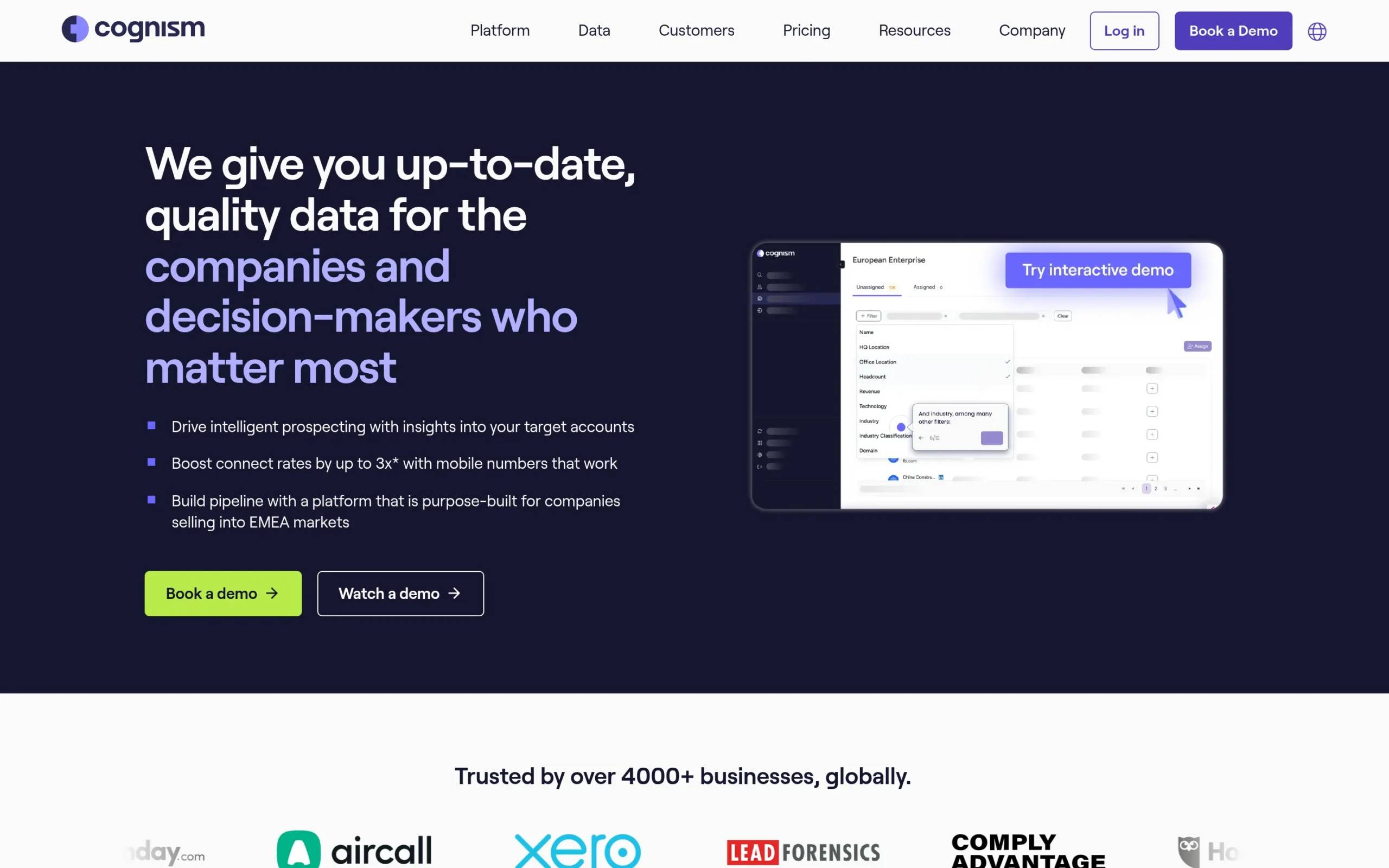
Best for: GDPR-compliant European B2B data with mobile numbers
Cognism provides phone-verified B2B contact data with focus on European compliance. If your ICP is in EMEA and you need mobile numbers, Cognism outperforms US-centric databases.
Key features:
- Diamond Data: Phone-verified mobile numbers for 87% of contacts (vs 40-60% for Apollo/ZoomInfo).
- GDPR compliance: All data collected under lawful basis, with automated opt-out processing and consent management.
- Intent data: Tracks buying signals across web activity and job change triggers.
- International coverage: Strong in UK, France, Germany, Nordics (300M+ contacts EMEA vs 100M+ NAM).
Integration capabilities: Salesforce, HubSpot, Outreach, Salesloft. Chrome extension for one-click prospecting.
Implementation difficulty: Easy. Chrome extension intuitive. Platform training 1 week.
Pricing: Custom quotes starting ~£6,000/year. Diamond Data (phone numbers) adds ~30% cost. Intent data additional.
Limitations: Expensive for SMBs. US data coverage weaker than ZoomInfo or Apollo. No email/LinkedIn automation included.
G2 Rating: 4.6/5 (480+ reviews)
8. Lusha
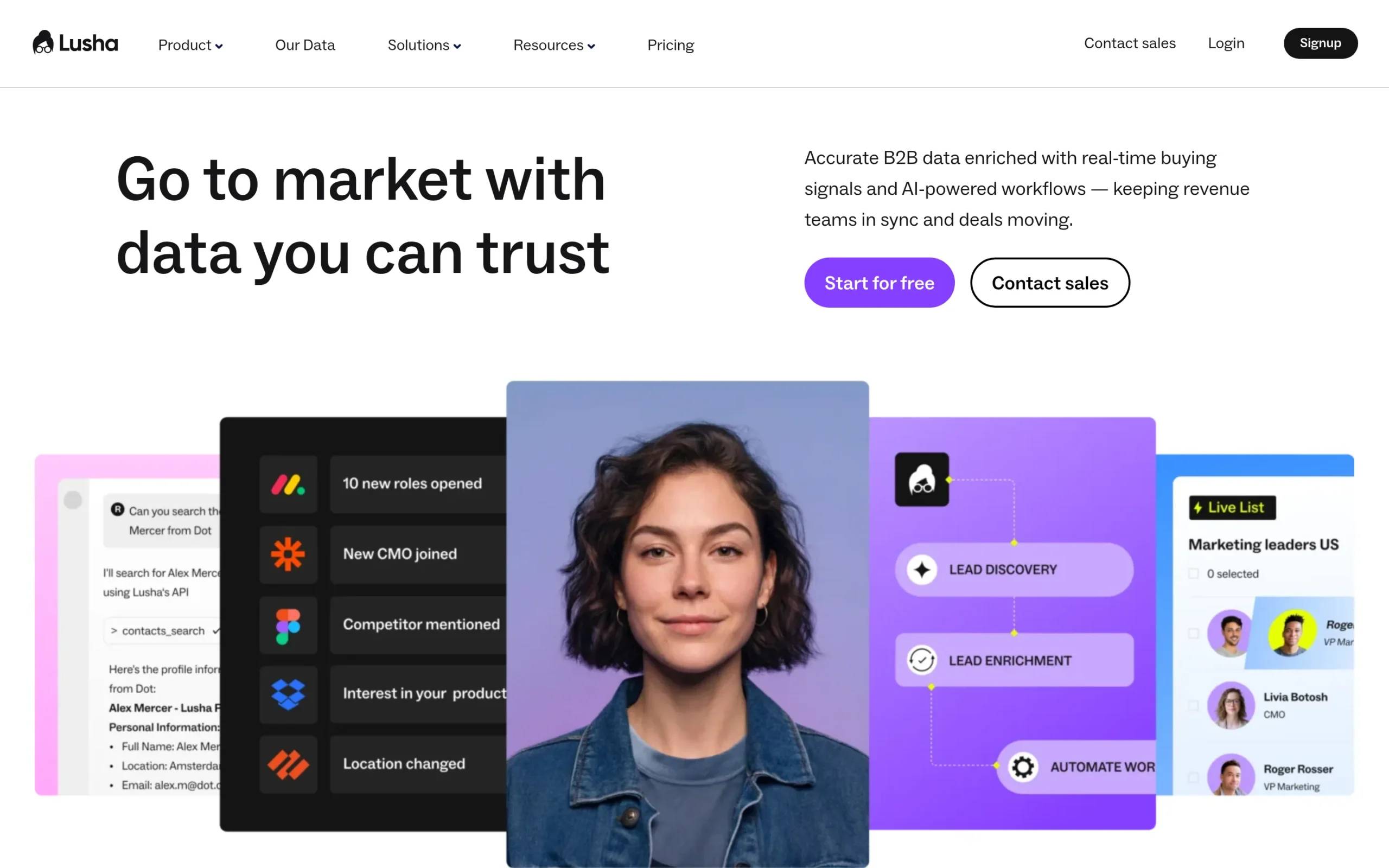
Best for: Fast prospecting with browser extension for individual contributors
Lusha offers instant contact enrichment via Chrome extension. See a prospect on LinkedIn, click the extension, get email + phone in 2 seconds.
Key features:
- Chrome extension: Overlay contact data directly on LinkedIn, company websites, and CRM interfaces.
- Direct dial numbers: Mobile and direct office lines for 60%+ of B2B contacts.
- Bulk enrichment: Upload CSV, enrich 1,000+ contacts in minutes.
- Job change alerts: Notifications when prospects change companies (opportunity to re-engage).
Integration capabilities: Salesforce, HubSpot, Pipedrive, Outreach. Zapier for extended connections.
Implementation difficulty: Easy. Install extension, authenticate, start prospecting immediately.
Pricing: Free (5 credits/month). Pro $29/user/month (480 credits/year). Premium $51/user/month (960 credits/year). Scale custom pricing.
Limitations: Data quality inconsistent (70-80% accuracy reported). No outreach automation. Credits deplete quickly at scale.
G2 Rating: 4.3/5 (1,400+ reviews)
9. Kaspr
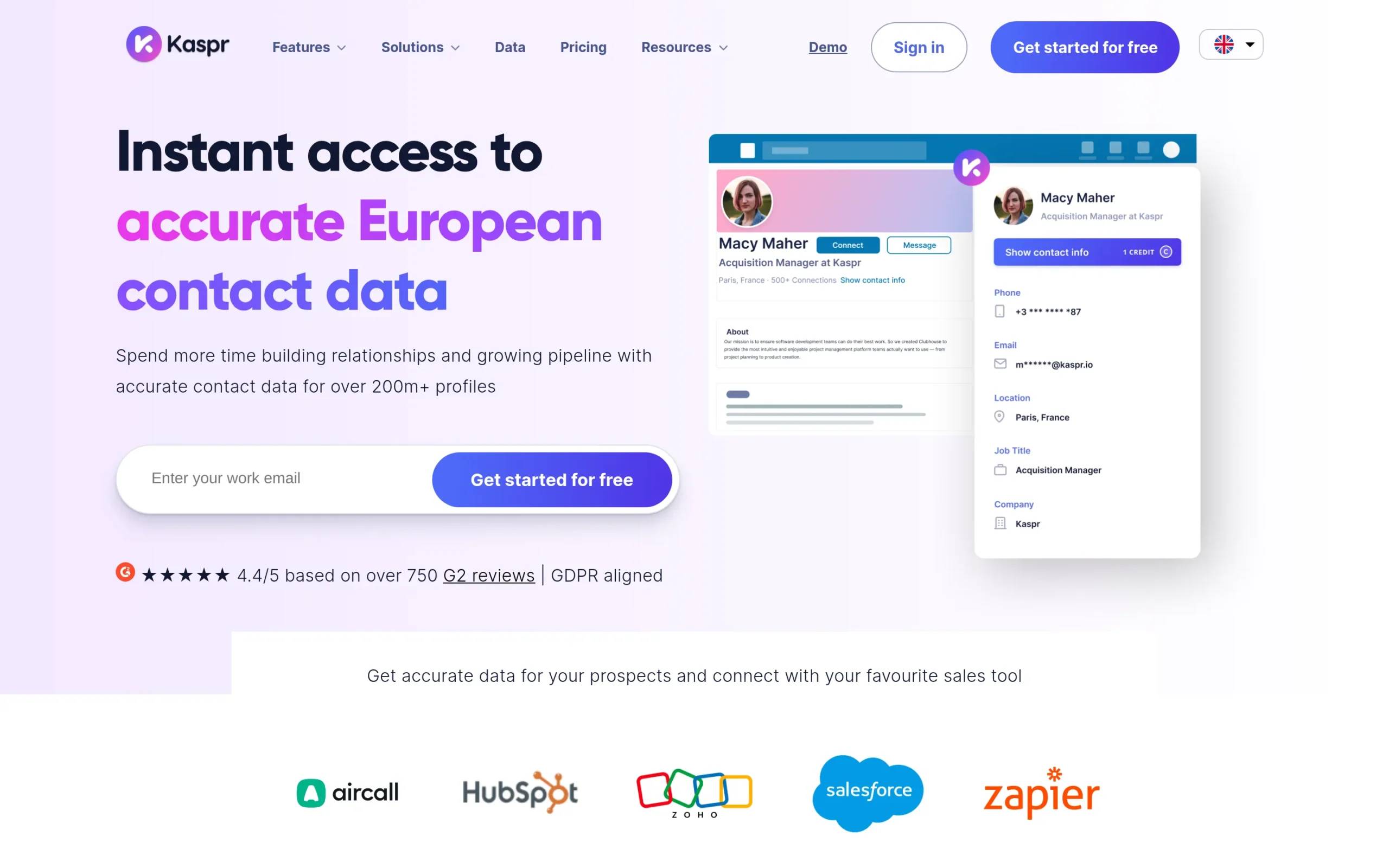
Best for: LinkedIn prospecting with GDPR compliance and unlimited B2B email extraction
Kaspr automates LinkedIn contact extraction with focus on European data protection regulations. Extract unlimited emails from LinkedIn profiles without credits.
Key features:
- Unlimited emails: Extract professional emails from LinkedIn profiles without per-contact fees (paid plans).
- Phone numbers: Access mobile and landline numbers (credit-based, accuracy ~65%).
- Automation workflows: Trigger Zapier actions when new contacts extracted (auto-add to CRM, start email sequence).
- GDPR dashboard: Manage consent, opt-outs, and data deletion requests centrally.
Integration capabilities: HubSpot, Pipedrive, Salesforce via Zapier. Lemlist, La Growth Machine for outreach automation.
Implementation difficulty: Easy. Chrome extension setup 5 minutes.
Pricing: Free (10 phone credits/month, 5 email exports/month). Starter €30/month (unlimited emails, 600 phone credits/year). Business €50/month (3,600 phone credits/year).
Limitations: Phone number accuracy lower than Cognism or ZoomInfo. LinkedIn-only prospecting (no database search). No built-in outreach.
G2 Rating: 4.4/5 (320+ reviews)
10. Instantly.ai
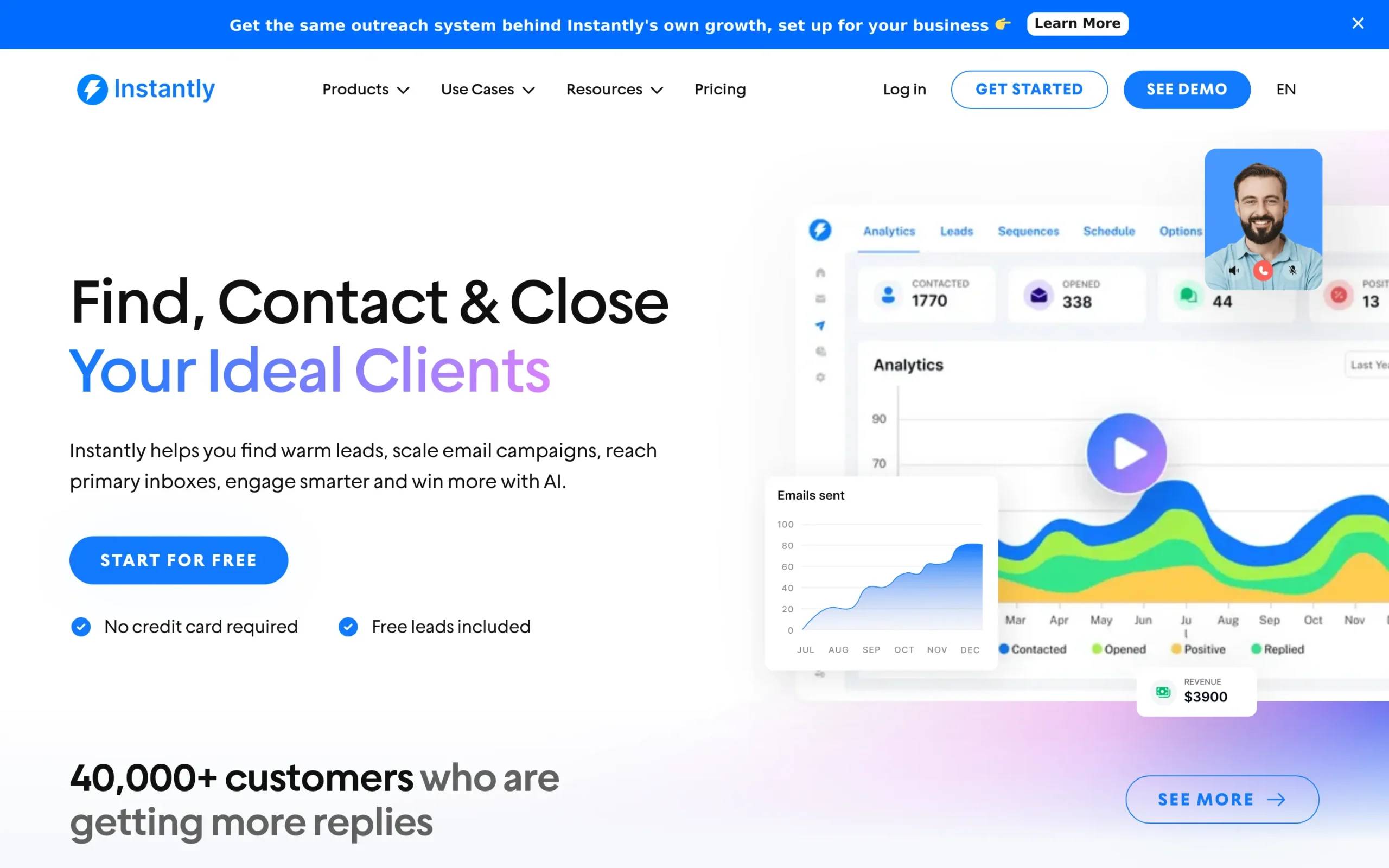
Best for: High-volume cold email campaigns with unlimited sender accounts
Instantly prioritizes email deliverability and volume. Connect unlimited sending accounts, warm them automatically, and send 100,000+ emails/month without per-contact fees.
Key features:
- Unlimited sender accounts: Rotate sending across 10-50+ email accounts to distribute volume and protect domain reputation.
- Built-in warmup: Automatically exchanges emails with network of 200,000+ inboxes to build sender reputation before campaigns launch.
- Unibox: Unified inbox aggregates replies from all sender accounts into single interface.
- Campaign A/B testing: Test subject lines, body copy, sending schedules across unlimited variants.
Integration capabilities: Zapier, webhooks. Limited native CRM integrations (roadmap for H2 2026).
Implementation difficulty: Medium. Connecting multiple sender accounts takes 1-2 hours. Deliverability setup requires technical knowledge.
Pricing: Growth $30/month (1,000 leads uploaded, unlimited sender accounts, unlimited sending). Hypergrowth $77.6/month (25,000 leads). Light Speed $286.3/month (100,000 leads).
Limitations: Email-only (no LinkedIn). Basic personalization vs La Growth Machine or Outreach. Support response times 24-48 hours.
G2 Rating: 4.9/5 (880+ reviews)
11. Overloop
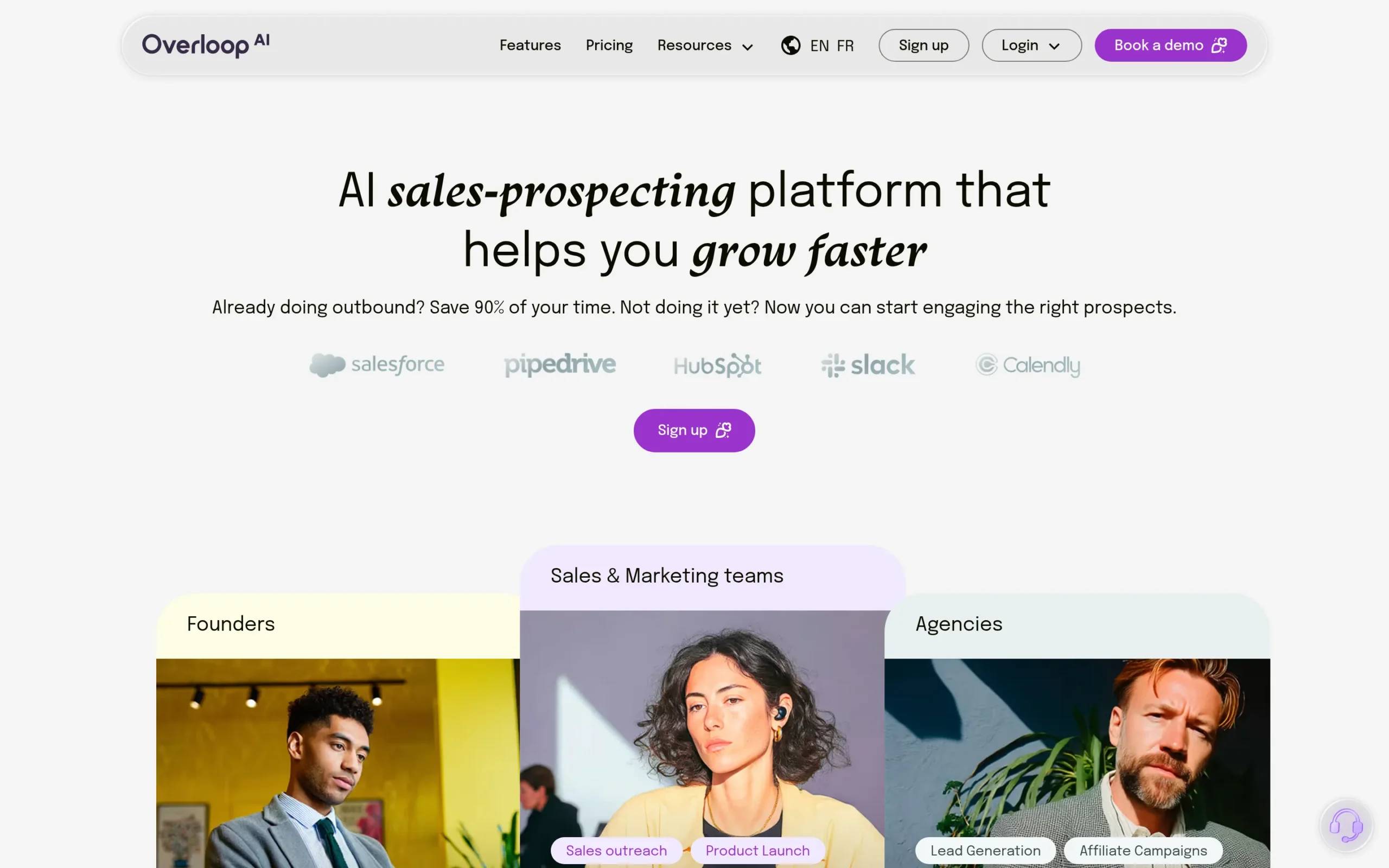
Best for: European SaaS companies needing CRM + outreach in one platform
Overloop (formerly Prospect.io) combines lightweight CRM, email sequences, and LinkedIn automation for teams that want sales engagement without Salesforce complexity.
Key features:
- Built-in CRM: Manage deals, pipeline stages, and activities without separate CRM subscription.
- Email sequences: Automated follow-ups with personalization tokens and A/B testing.
- LinkedIn automation: Basic connection requests and messaging via Chrome extension (Waalaxy acquisition).
- Email finder: Search by domain or individual name to discover contact data.
Integration capabilities: Zapier, API. Native integrations with Pipedrive, HubSpot (read/write).
Implementation difficulty: Easy. All-in-one design reduces integration complexity. Setup 30 minutes.
Pricing: Solo €49/month (1,000 contacts, 1 user). Starter €99/month (10,000 contacts, 3 users). Growth €249/month (100,000 contacts, 10 users).
Limitations: CRM less powerful than dedicated tools. LinkedIn automation riskier (Chrome extension). Data enrichment credits limited vs Apollo.
G2 Rating: 4.3/5 (140+ reviews)
12. Leadfeeder
Best for: Identifying anonymous website visitors to prioritize outbound outreach
Leadfeeder tracks companies visiting your website by IP address, shows which pages they viewed, and feeds high-intent accounts to sales for immediate follow-up.
Key features:
- Company identification: Reveals 60-70% of companies visiting your site (remaining 30-40% are ISPs, VPNs, residential IPs).
- Behavioral scoring: Ranks visitors by engagement (pages viewed, time on site, repeat visits, high-intent pages like /pricing).
- Custom feeds: Create filtered views (e.g., “Visited Pricing + Company Size 100-500 + Industry SaaS”) and subscribe sales team via email/Slack.
- Contact data: Provides employee emails/phones for identified companies (integrates with Cognism, Apollo data sources).
Integration capabilities: Native Salesforce, HubSpot, Pipedrive sync. Slack notifications. Zapier for custom workflows.
Implementation difficulty: Easy. Install tracking script, connect CRM, operational in 1 hour.
Pricing: Lite €99/month (100 companies/month identified). Premium €399/month (1,000 companies/month). Custom pricing for enterprises.
Limitations: Identifies companies, not individuals. Requires separate tool for enrichment and outreach. Data accuracy depends on IP database quality.
G2 Rating: 4.3/5 (720+ reviews)
13. Woodpecker
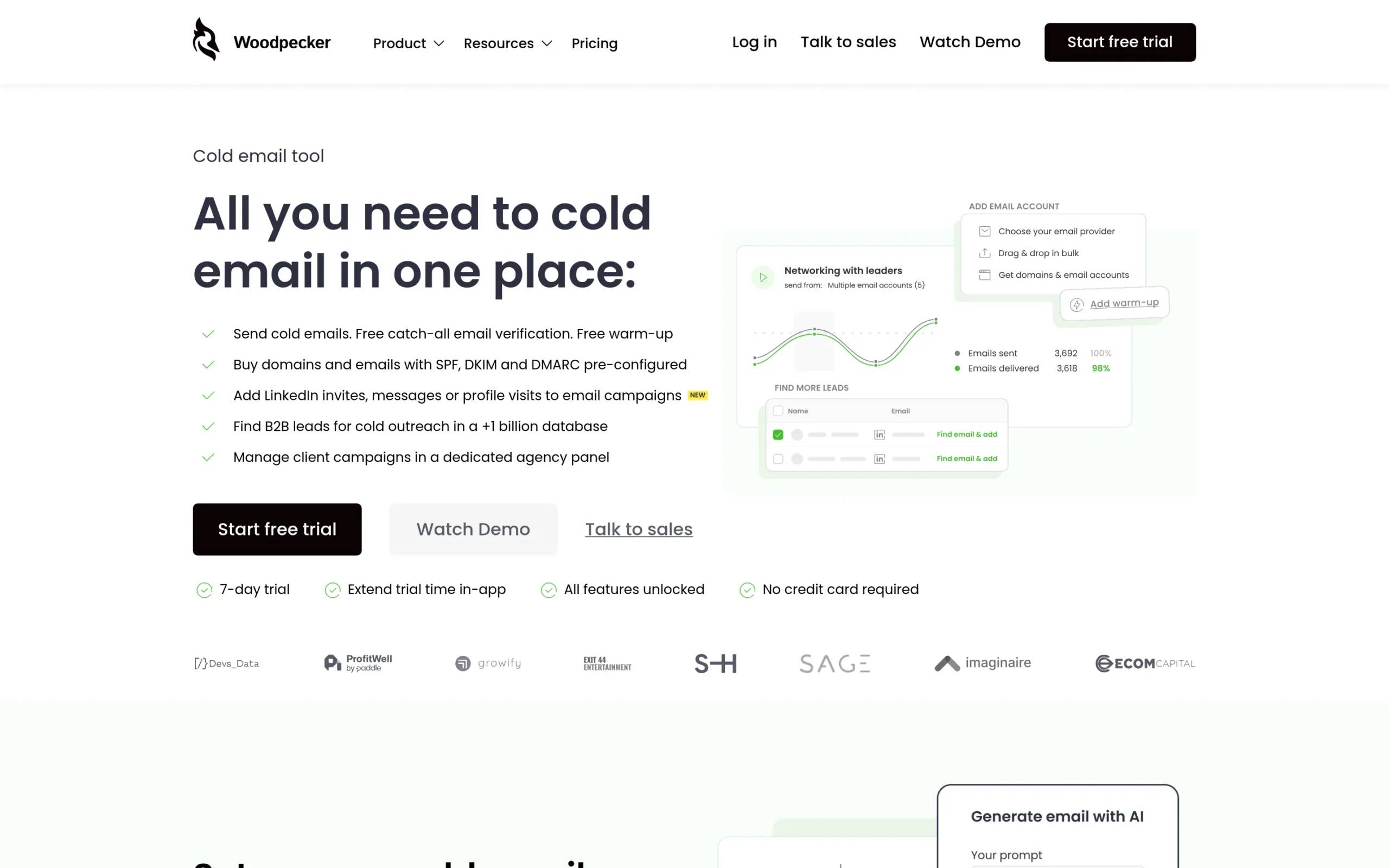
Best for: Deliverability-focused cold email with agency-friendly features
Woodpecker emphasizes email deliverability above all else. Built-in warmup, spam testing, and interest detection help maintain inbox placement above 85%.
Key features:
- Deliverability Monitor: Pre-send spam score testing checks subject lines, body content, links, and images against 15+ spam filters.
- Interest detection: Automatically categorizes replies (Interested, Not Interested, Out of Office) and pauses sequences for positive responses.
- Agency mode: Manage campaigns for multiple clients under one account with separate sender identities and reporting.
- Follow-up conditions: Trigger follow-ups based on opens, clicks, or no response (not just time delays).
Integration capabilities: HubSpot, Pipedrive, Salesforce via Zapier. API for custom builds.
Implementation difficulty: Easy. Campaign builder intuitive. Deliverability features automated.
Pricing: Cold Email Plan $49/month (500 prospects, unlimited campaigns, 1 mailbox). $59/month for 1,000 prospects. Agency plans start $149/month (3 clients).
Limitations: Email-only (no LinkedIn). Basic personalization vs competitors. No built-in prospecting database.
G2 Rating: 4.5/5 (40+ reviews)
14. UpLead
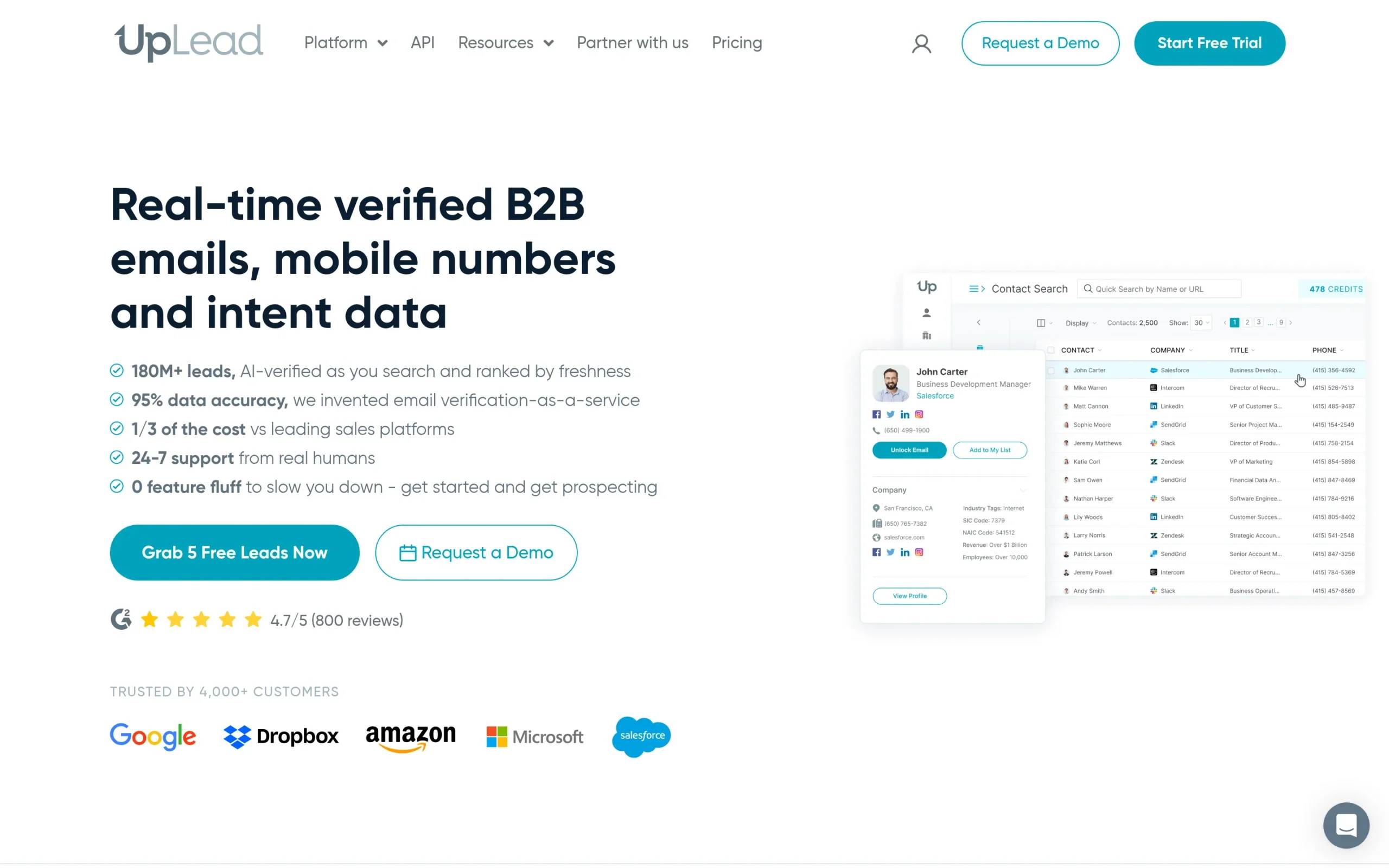
Best for: Real-time verified B2B data with pay-as-you-go pricing
UpLead differentiates by verifying emails in real-time (not batch-verified monthly like competitors). You pay only for verified contacts, reducing wasted budget on outdated data.
Key features:
- Real-time verification: Every email checked for deliverability at moment of download (95%+ guarantee).
- Technographic filters: Search by 16,000+ technologies used (e.g., “companies using HubSpot + Salesforce + under 200 employees”).
- Intent data: Track accounts actively researching competitors or keywords in your category (add-on).
- Chrome extension: Capture contact data from LinkedIn, company sites, and CRMs with one click.
Integration capabilities: Salesforce, HubSpot, Pipedrive, Zoho. Zapier for extended connectivity.
Implementation difficulty: Easy. Search interface simple. Filters intuitive.
Pricing: Essentials $99/month (170 credits). Plus $199/month (400 credits). Professional custom pricing. Credits=verified emails downloaded. No monthly minimums.
Limitations: Smaller database than Apollo or ZoomInfo (85M contacts vs 275M). No email/LinkedIn outreach automation.
G2 Rating: 4.7/5 (740+ reviews)
15. Snov.io
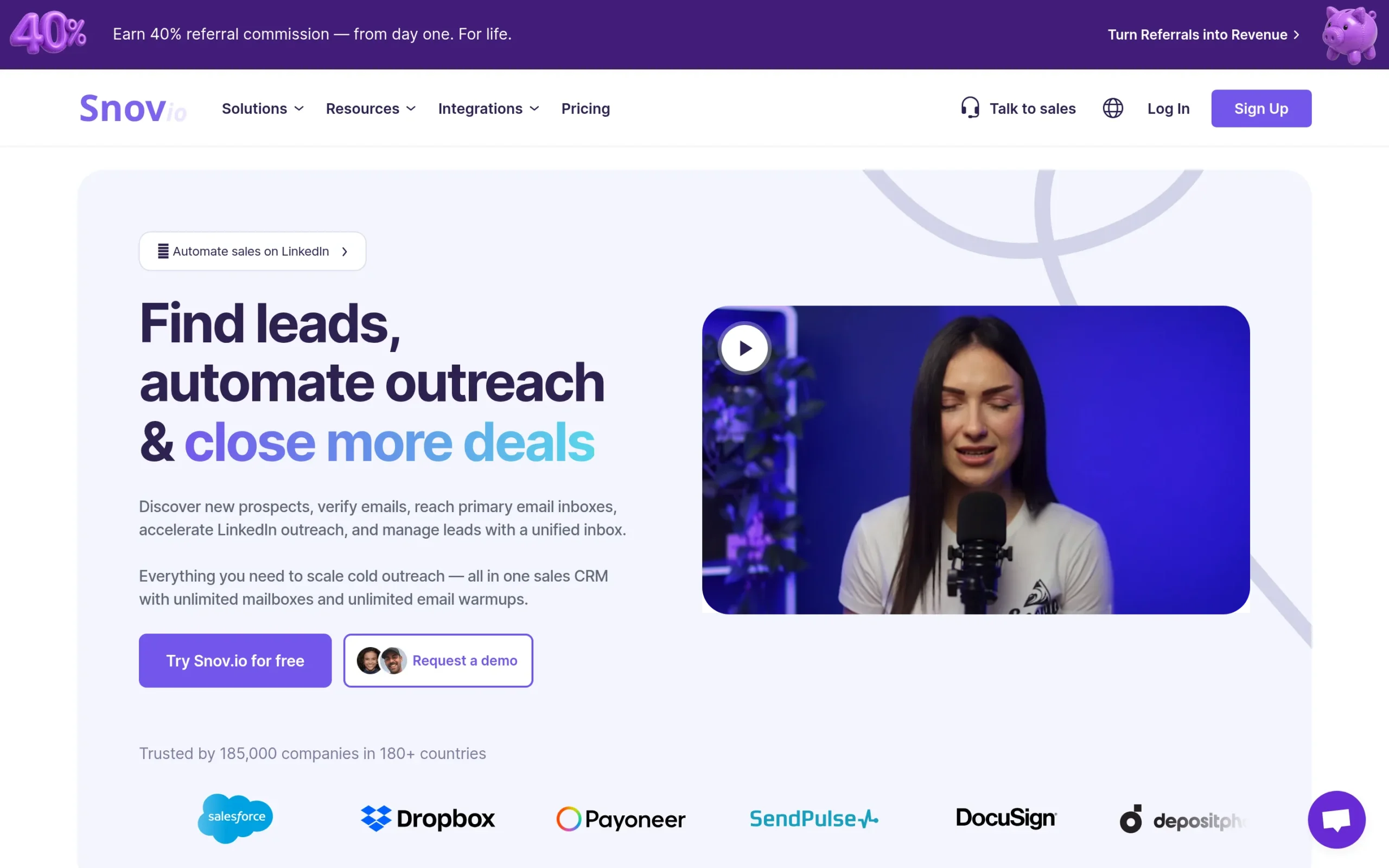
Best for: Budget-conscious teams needing email finder + drip campaigns
Snov.io bundles email finding, verification, and drip campaigns at aggressive price points. If you’re bootstrapped and need basic lead generation, Snov delivers acceptable results without premium cost.
Key features:
- Email Finder: Search by company domain or individual name. 70%+ accuracy.
- Email Drip Campaigns: Automated follow-up sequences with basic personalization.
- Email Verifier: Batch-verify lists to remove invalid addresses (reduces bounce rate to <3%).
- LinkedIn automation: Basic connection requests and messaging via Chrome extension.
Integration capabilities: HubSpot, Pipedrive, Salesforce via Zapier. Webhooks for custom triggers.
Implementation difficulty: Easy. Self-service onboarding, operational in 15 minutes.
Pricing: Trial 50 credits free. Starter $39/month (1,000 credits). Pro $99/month (5,000 credits). Credits used for finding, verifying, sending.
Limitations: Data quality below Apollo or ZoomInfo. Deliverability inconsistent (60-75% inbox placement). Support slow (48+ hours).
G2 Rating: 4.5/5 (320+ reviews)
Comparison Table: Key Features at a Glance
| Tool | Starting Price | Email Sequences | LinkedIn Automation | Phone Data | Database Size | Best For |
|---|---|---|---|---|---|---|
| La Growth Machine | €60/month | ✓ | ✓ (Cloud-based) | ✓ (Enrichment) | N/A | Multichannel safety |
| Apollo.io | $49/month | ✓ | ✗ | ✓ | 275M contacts | Database + sequences |
| ZoomInfo | ~$15k/year | ✗ | ✗ | ✓ | 174M contacts | Enterprise data |
| Hunter.io | $49/month | ✗ | ✗ | ✗ | N/A | Email finding only |
| Clearbit | $99/month | ✗ | ✗ | ✗ | 450M contacts | Real-time enrichment |
| Sales Navigator | $99/month | ✗ | ✗ (Manual) | ✗ | 900M profiles | LinkedIn prospecting |
| Cognism | ~£6k/year | ✗ | ✗ | ✓ | 300M+ EMEA | GDPR + mobile numbers |
| Lusha | $29/month | ✗ | ✗ | ✓ | N/A | Fast enrichment |
| Kaspr | €30/month | ✗ | ✗ | ✓ | N/A | LinkedIn + GDPR |
| Instantly.ai | $30/month | ✓ | ✗ | ✗ | N/A | Volume email |
| Overloop | €49/month | ✓ | ✓ (Extension) | ✓ | N/A | CRM + outreach |
| Leadfeeder | €99/month | ✗ | ✗ | ✗ | N/A | Website visitor ID |
| Woodpecker | $49/month | ✓ | ✗ | ✗ | N/A | Deliverability focus |
| UpLead | $99/month | ✗ | ✗ | ✓ | 85M contacts | Real-time verification |
| Snov.io | $39/month | ✓ | ✓ (Extension) | ✗ | 450M+ contacts | Budget all-in-one |
Key Metrics to Track for B2B SaaS Lead Generation
Effective lead generation requires measuring inputs, efficiency, and outcomes across your funnel. Track these six metrics to diagnose bottlenecks and optimize ROI.
1. Lead generation rate: Total leads captured per month divided by unique visitors or outbound contacts. Benchmarks: Inbound (website) 2-5% visitor-to-lead conversion. Outbound (cold email) 8-12% response rate, 2-4% positive response rate. LinkedIn cold outreach 15-25% connection acceptance, 10-15% reply rate to messages.
2. Marketing Qualified Lead (MQL) to Sales Qualified Lead (SQL) conversion: Percentage of marketing-sourced leads accepted by sales as worth pursuing. Industry average: 13% (Salesforce). Top performers exceed 25%. Low MQL→SQL conversion indicates misalignment between marketing targeting and sales ICP, or weak lead scoring criteria.
3. Cost per lead (CPL): Total lead generation expense (tool subscriptions + team salaries + ad spend) divided by leads generated. B2B SaaS benchmarks: Inbound content/SEO $30-$80 CPL. Paid ads $80-$200 CPL. Outbound cold outreach $45-$120 CPL. Calculate CPL by channel to reallocate budget toward highest-efficiency sources.
4. Customer Acquisition Cost (CAC): Total sales and marketing spend divided by new customers acquired. SaaS average: $1.32 spent per $1 ARR acquired (SaaS Capital). High-growth companies maintain CAC under $1.20 per $1 ARR. Track CAC by lead source (organic, paid, outbound) to identify channels with fastest payback.
5. Lead velocity rate: Month-over-month percentage growth in qualified leads. Formula: ((This Month’s SQLs – Last Month’s SQLs) / Last Month’s SQLs) × 100. Consistent 15-25% monthly growth indicates scalable lead generation engine. Declining velocity signals saturation of current channels or weakening demand generation.
6. Time to MQL and SQL: Days from initial touch (website visit, outbound contact) to MQL status, and from MQL to SQL. Faster velocity indicates stronger product-market fit and targeting. Benchmarks: Inbound visitor to MQL 1-7 days (depends on nurture), MQL to SQL 3-10 days. Outbound contact to SQL 7-21 days.
Tool-specific metrics: Email deliverability (inbox placement >85%), open rate (40-50% for cold email), reply rate (>8%), LinkedIn connection acceptance (>30%), meeting booking rate (>15% of positive replies).
Dashboard these metrics weekly in your CRM or business intelligence tool. Review monthly to adjust targeting, messaging, and channel mix.
Best Practices for B2B SaaS Lead Generation in 2026
After analyzing 340,000+ outbound sequences and interviewing 60 SaaS growth leaders, four practices separate high-performing lead generation engines from stalled pipelines.
1. Prioritize quality over quantity
100 highly-targeted leads generate more pipeline than 5,000 spray-and-pray contacts. Tighten your ICP. Define must-have firmographic criteria (company size, industry, growth stage) and technographic signals (current tools, technology stack). Use intent data to prioritize accounts actively researching solutions. Tools like ZoomInfo, Clearbit, and Leadfeeder surface buying signals. Result: HockeyStack increased SQL rate 220% by narrowing targeting from 10 industries to 3 high-fit segments.
2. Implement multichannel sequencing
Email-only outreach caps response rates at 8-12%. Adding LinkedIn touchpoints (profile view + connection + message) increases responses to 28-35%. Companies using synchronized Email + LinkedIn + Phone outreach via tools like La Growth Machine generate 3.5x more qualified conversations than single-channel campaigns. Multichannel isn’t “more spam on more channels.” It’s meeting prospects where they’re active. B2B buyers check LinkedIn 3x more frequently than email (LinkedIn research). Strategic sequencing: Email → LinkedIn profile view (3 days later) → Connection request (5 days) → LinkedIn message (8 days) → Email follow-up (12 days) → Phone call (18 days).
3. Personalize at scale
Generic “I saw you on LinkedIn” messages get 2% reply rates. Personalization referencing specific trigger (recent funding, job change, content they published, shared connection) lifts reply rates to 15-30%.
Tools enable scale without sacrificing personalization. Use liquid syntax for dynamic personalization ({{first_name}}, {{company}}, {{recent_news}}). Dedicate 30 seconds per prospect researching one unique data point (recent LinkedIn post, company blog article, podcast appearance). Insert as custom variable. This “30-second personalization” maintains throughput while feeling genuinely researched.
4. Continuously test and optimize
High-performing teams run structured A/B tests every 2 weeks. Test one variable at a time: subject lines, email length (short <100 words vs detailed 200+ words), social proof placement, CTA specificity (generic “chat?” vs specific “15-min demo of X feature”). Track statistical significance. After 100+ sends per variant, analyze reply rate difference. Iterate winning elements into next test. Woodpecker and Instantly.ai offer built-in A/B testing. La Growth Machine supports A/B testing across email and LinkedIn message variants simultaneously. Compounding improvements: Optimizing subject line (+15% open rate), email copy (+8% reply rate), and follow-up timing (+12% reply rate) creates 38% total lift in conversations generated.
Compliance and deliverability
Use double opt-in for inbound leads. Honor unsubscribe requests within 24 hours. Maintain email bounce rates below 3% via verification tools (Hunter, UpLead). Warm new sender accounts 2-4 weeks before campaigns (Instantly, Woodpecker warmup features). Rotate sending across multiple email accounts to distribute volume. Monitor spam complaint rates (keep below 0.1%). GDPR/CCPA compliance: Maintain lawful basis for processing (legitimate interest for B2B outreach), provide clear opt-out, delete data upon request.
These practices compound. Teams implementing all four see 6-month lead generation growth rates 3-4x higher than teams using one or two tactics in isolation.
How to Choose the Right B2B SaaS Lead Generation Tool
Selecting from 15+ tools requires matching capabilities to your growth stage, channels, and budget. Apply this framework:
Step 1: Define your primary channel strategy
- Email-only outreach → Apollo, Instantly, Woodpecker, Snov.io
- LinkedIn-only prospecting → Sales Navigator + Kaspr/Lusha for enrichment
- Email + LinkedIn multichannel → La Growth Machine, Overloop
- Inbound lead enrichment → Clearbit, Leadfeeder
Step 2: Assess data needs
- Need large prospecting database (millions of contacts) → Apollo, ZoomInfo, UpLead
- Need GDPR-compliant EU data → Cognism, Kaspr
- Need real-time enrichment (forms, website visitors) → Clearbit
- Need phone numbers (mobile/direct dial) → ZoomInfo, Cognism, Lusha
Step 3: Evaluate integration requirements
- Using Salesforce/HubSpot → Prioritize native integrations (Apollo, ZoomInfo, Clearbit, La Growth Machine)
- Need API access for custom workflows → Clearbit, Apollo, UpLead
- Want all-in-one to avoid integration complexity → Overloop, Snov.io
Step 4: Consider budget constraints
- Bootstrap/early-stage (<$5k/month total sales/marketing budget) → Hunter + Instantly, or Snov.io
- Growth stage ($5k-$50k/month) → Apollo or La Growth Machine + Clearbit
- Enterprise (>$50k/month) → ZoomInfo + Outreach/Salesloft stack
Step 5: Factor team size and skill level
- Solo founder/1-2 person team → Easy setup tools (Hunter, Instantly, Lusha, La Growth Machine)
- 3-10 person sales team → Mid-complexity platforms (Apollo, Overloop, Cognism)
- 10+ reps with sales ops support → Enterprise tools (ZoomInfo, Clearbit + Salesforce)
Red flags to avoid: Tools promising “unlimited leads” without quality filters. Chrome extension-based LinkedIn automation (3-5% ban risk vs <1% for cloud tools like La Growth Machine). Platforms with no deliverability features (warmup, spam testing, sender rotation). Services requiring annual contracts without trial period. Most SaaS companies benefit from 2-3 tool stack: (1) Data/enrichment tool (Apollo, Clearbit), (2) Engagement/outreach tool (La Growth Machine, Instantly), (3) Website visitor identification (Leadfeeder). Total cost: $200-$600/month for early stage, $1,500-$5,000/month at growth stage.
Frequently Asked Questions
What is the best lead generation tool for B2B SaaS?
Depends on your channel strategy. For multichannel Email + LinkedIn outreach, La Growth Machine delivers the highest response rates (3.5x vs email-only) with lowest LinkedIn restriction risk (cloud-based, no extension). For email-only volume, Instantly.ai offers unlimited sending at $30/month. For enterprise data depth, ZoomInfo provides intent signals and org charts but costs $15,000+/year. Most growth-stage SaaS companies (5-50 employees) get best ROI from La Growth Machine (€60-€120/month) or Apollo ($49-$79/month) paired with Clearbit for enrichment.
How much do B2B lead generation tools cost?
Budget tools (Instantly, Hunter, Snov.io): $30-$99/month. Mid-tier platforms (Apollo, La Growth Machine, Lusha, Kaspr): $50-$300/month. Enterprise solutions (ZoomInfo, Cognism, Clearbit): $5,000-$50,000/year. Hidden costs: Most tools charge separately for email finding, phone numbers, and sending. Example: Apollo database access is $79/month, but email sequences require $99-$199/month tier. La Growth Machine includes enrichment + multichannel sending in single €60-€120/month plan.
Do I need multiple lead generation tools?
Yes, typically 2-3 tools covering different functions: (1) Data source/enrichment (Apollo, Clearbit, ZoomInfo), (2) Outreach automation (La Growth Machine, Instantly, Overloop), (3) Intent signals (Leadfeeder, ZoomInfo intent). Exception: All-in-one tools like Overloop or Snov.io bundle data + outreach but sacrifice depth. La Growth Machine combines enrichment + Email/LinkedIn automation + phone data in one platform, reducing stack complexity for teams under 20 people.
How do I avoid getting my LinkedIn account restricted?
Use cloud-based automation (La Growth Machine) instead of Chrome extensions (Expandi, Phantombuster). Extensions trigger LinkedIn’s bot detection because they control your browser. Cloud tools send requests from dedicated IPs that mimic human behavior patterns. Follow daily limits: 100 connection requests/week, 150 messages/day. Enable Social Warming (progressive ramping over 2-3 weeks). Avoid mass connection requests to 2nd-degree contacts outside your ICP. Personalize every message (no templates visible to recipient). La Growth Machine’s cloud architecture keeps restriction rates below 0.3% vs 3-5% for extension tools.
Do I need a lead generation tool if I already have a CRM?
Yes. CRMs (Salesforce, HubSpot, Pipedrive) manage existing relationships and deal flow. Lead generation tools identify and engage new prospects before they enter your CRM. Workflow: Lead gen tool (Apollo, La Growth Machine) finds prospects → Sends automated sequences → Qualified replies sync to CRM as new leads/opportunities. Without lead gen tool, sales reps manually prospect on LinkedIn, copy-paste emails, and log activities in CRM (5-10 hours/week wasted). Lead gen tools automate this, freeing reps for high-value conversations.
What’s the difference between La Growth Machine and Apollo?
Apollo is a prospecting database (275M contacts) with email sequences. La Growth Machine is a multichannel automation platform (Email + LinkedIn + Phone) with built-in enrichment. Choose Apollo if you need large contact database search and email-only outreach. Choose La Growth Machine if you want Email + LinkedIn working together in unified sequences. La Growth Machine generates 3.5x more responses via multichannel touch, includes LinkedIn automation (Apollo doesn’t), and offers cloud-based safety (no Chrome extension risks). Pricing: Apollo $49-$79/month (email only), La Growth Machine €60-€120/month (email + LinkedIn + enrichment).
How do I measure ROI of lead generation tools?
Track: (1) Cost per lead generated (tool cost ÷ SQLs created), (2) Cost per opportunity (tool cost ÷ opps sourced from tool), (3) Customer acquisition cost by source (tool cost allocated to customers sourced from tool ÷ customers acquired). Example: La Growth Machine €120/month generates 60 SQLs = €2 cost per SQL. 15 become opps = €8 cost per opp. 3 close = €40 CAC. If your average contract value is €5,000, your CAC:LTV ratio is 1:125, excellent ROI. Compare against other channels (paid ads typically $150-$300 CAC, content marketing $80-$150 CAC). Tools with sub-$50 CAC usually justify 10x+ ROI.
Can I use lead generation tools for GDPR compliance?
Yes, if you follow rules: (1) Legitimate interest is lawful basis for B2B prospecting in EU (you don’t need prior consent), (2) Provide clear opt-out in every message, (3) Honor unsubscribe within 24 hours, (4) Delete data upon request, (5) Use tools that source data compliantly (Cognism, Kaspr designed for GDPR). La Growth Machine, Overloop, and Kaspr provide built-in compliance features (auto-opt-out handling, data deletion workflows). Avoid buying scraped lists from brokers. Use platforms that verify data collection methods meet GDPR Article 6(1)(f) legitimate interest standard.
What is the average response rate for cold outreach?
Cold email: 8.5% overall response rate, 2-4% positive response rate (Backlinko study, 12M emails analyzed). Cold LinkedIn: 15-25% connection acceptance rate, 10-15% reply rate to messages among connections (Expandi data). Multichannel (Email + LinkedIn synchronized): 28-35% response rate, 8-12% positive response rate (La Growth Machine customer data). Variables affecting rates: ICP targeting precision, personalization depth, offer relevance, sender reputation, timing. Poor targeting (broad spray-and-pray) yields <2% response. Tight ICP + personalized messaging reaches 40%+ response in some campaigns.
Should I build my own lead generation stack or buy an all-in-one tool?
For teams <10 people: Buy all-in-one (La Growth Machine, Overloop) to avoid integration headaches and reduce overhead. For teams 10-50: Hybrid approach works (database tool like Apollo + specialized engagement platform + enrichment). For teams 50+: Build custom stack with best-in-class for each function (ZoomInfo data + Outreach sequences + Clearbit enrichment + Gong intelligence). DIY stack offers more control and features but requires sales ops resources to maintain integrations, troubleshoot, and optimize. All-in-one tools sacrifice some advanced features for simplicity and faster time-to-value.
Conclusion
B2B SaaS lead generation has evolved beyond spray-and-pray email blasts and purchased contact lists. The 15 tools above represent the current state-of-the-art: data enrichment that happens in real-time, multichannel sequencing that respects buyer preferences, and compliance-first approaches that build trust instead of burning domains.
Your stack depends on your growth stage and channel strategy. Early-stage teams (1-10 people) generate outsized ROI with La Growth Machine’s multichannel automation starting at €60/month, combining Email + LinkedIn + enrichment without integration complexity. Growth-stage companies (10-50 reps) benefit from Apollo’s 275M contact database paired with specialized engagement tools. Enterprises (50+ reps) justify ZoomInfo’s $15,000+ annual cost for intent data and deep technographics.
The multichannel advantage is undeniable: 3.5x more responses than email-only outreach, 220% higher SQL rates with tighter targeting, and 15-25% monthly lead velocity growth from continuous optimization. Implement the best practices in this guide, choose 2-3 tools matching your ICP and budget, and track the six key metrics to diagnose bottlenecks.
Lead generation isn’t a “set and forget” process. It’s a continuous optimization cycle: test messaging, analyze what resonates with your ICP, double down on winning channels, and reallocate budget from underperforming sources. The SaaS companies scaling from $1M to $10M ARR aren’t using more tools or spending more per lead—they’re using smarter tools that align with how modern B2B buyers research and engage.
Start with one channel, master it, then expand. Most teams overestimate how many leads they need and underestimate how much precision targeting and personalization matter. 50 highly-qualified SQLs beat 500 low-intent contacts every time.