

TL;DR
– A high-converting sales email is under 125 words, opens with a specific insight about the prospect, and ends with one ask. Generic emails with multiple CTAs kill reply rates.
– 2026 benchmarks 8.5% average reply rate for cold outbound; sequences with 4–6 touchpoints generate 2x more replies than single-touch sends; Tuesday and Thursday are the top send days.
– La Growth Machine automates multichannel sales email sequences triggered by prospect behavior, generating on average 3.5x more pipeline than single-channel outreach. Basic plan at €60/month.
– Best for B2B sales and GTM teams running outbound at scale who want to maintain personalization without manual follow-up tracking.
Your prospects receive dozens of sales emails every day. Most get deleted in under three seconds. A few get replies. The difference is not luck. It is structure, relevance, and timing.
This guide covers everything your team needs to write B2B sales emails that generate pipeline: the anatomy of a high-converting message, 2026 benchmarks, the most common mistakes, and six templates you can adapt today.
What Is a Sales Email?
A sales email is a direct, one-to-one (or one-to-segment) message sent to a prospect or customer with a commercial objective: booking a meeting, generating a reply, or advancing a deal.
It is not a newsletter. It is not a marketing blast. A sales email is written for a specific person with a specific problem, and it asks for one specific thing.
In B2B, sales emails are the backbone of outbound prospecting. Used well, they open conversations with decision-makers who never heard of your company. Used poorly, they damage your domain reputation and waste your team’s time.
The question is not whether to use sales emails. It is how to write ones that actually work in 2026, when inboxes are noisier, spam filters are smarter, and AI-generated emails have trained prospects to delete generic messages on sight.
The 7 Types of Sales Emails B2B Teams Use
Not all sales emails have the same goal. Knowing which type to use and when determines whether your sequence moves deals forward or stalls them.
Prospecting email (cold intro)
Your first contact with someone who does not know you. Short, specific, and built around one relevant insight about their company or role. The goal is not to sell. It is to earn a reply.
Follow-up email
Most replies come from follow-ups, not first touches. A follow-up email adds new context (a relevant article, a case study, a statistic) rather than just repeating “just checking in.” Each touchpoint should give the prospect a reason to respond.
Nurture email
Sent to prospects who are not ready to buy yet but have shown interest. Shares useful content such as a guide, a benchmark, or a framework to keep your company top of mind without pushing for a meeting.
Re-engagement email
For cold leads or contacts who went quiet after a meeting or demo. The goal is to revive the conversation without being pushy. It acknowledges the silence and offers a clear, low-friction next step.
Break-up email
The last email in a sequence. It is honest: you are closing the thread unless they want to reconnect. Counter-intuitively, break-up emails often generate replies from prospects who were interested but busy. A well-written one generates a 10 to 30% reply rate on sequences that had gone cold.
Referral request email
Sent to existing customers or warm contacts, asking for a specific introduction. Works best when the request is narrow: “Do you know anyone at [company] who owns the SDR function?”
Closing email
Sent when the deal is almost done, or when you need to create urgency without being aggressive. One sentence on the offer, one clear action, one deadline. Nothing else.
The Anatomy of a High-Converting Sales Email
Every sales email that gets a reply has four components working together. Missing one of them tanks the whole message.
Subject line: the 4-second test
Your subject line has one job: get the email opened. If it fails, nothing else matters.
What works in 2026 is short (4 to 7 words), specific, and tied to something real about the recipient’s situation. Avoid clickbait. Avoid “Quick question” (everyone uses it). Avoid subject lines that could apply to anyone.
Good: {{FirstName}}, saw your team just expanded to DACH Bad: Thought this might be relevant for you
Keep subject lines under 50 characters so they render fully on mobile. Personalized subject lines increase open rates by up to 50%.
If you need help generating subject lines at scale, La Growth Machine’s AI-powered email copywriting feature writes and A/B tests variants automatically based on your prospect data.
Opening line: ditch “I hope this email finds you well”
The opening line is the first sentence after the subject. It either earns the next three seconds or loses them.
The only opening lines that work are ones that prove you did actual research. Reference something specific: a LinkedIn post they wrote, a product launch, a funding announcement, a job posting that signals a pain point.
Good: Saw you posted about scaling your SDR team from 4 to 12 last quarter. Bad: I hope you're doing well.
For a deeper breakdown of the structure and principles behind persuasive outbound messages, see our guide on how to write a compelling sales pitch email.
Body: value in 3 sentences
The body of a sales email should be three to five sentences. Not three paragraphs. Three sentences.
Sentence 1: the problem you identified. Sentence 2: why it matters (the stakes). Sentence 3: why you are relevant.
You are not selling the product here. You are selling the reason to reply.
If you need more than 125 words to make your point, you are trying to close too fast. Emails between 50 and 125 words generate the highest reply rates.
CTA: one ask, not three
Every sales email ends with one clear, specific call to action. Not three options. Not a paragraph of possibilities. One ask.
The ask should be low-friction: a reply, a 15-minute call, a simple yes/no question.
Good: Worth a 15-minute call this week? Bad: Let me know if you want to schedule a call, check out our website, or download our case study.
Sales Email Benchmarks in 2026
Before you optimize, know what good looks like.
Average open rate
Cold email open rates average between 20 and 28% for well-targeted B2B campaigns. Below 15% typically signals a deliverability problem (domain reputation, spam folder placement) rather than a subject line problem.
Average reply rate
The average cold email reply rate is 8.5% across B2B industries. Below 5% is a red flag. Sequences combining 4 to 6 touchpoints reach reply rates of 8.3% compared to 4.1% for single-touch sends.
Optimal length
50 to 125 words per email generates the highest reply rates. Emails under 150 words with specific company or role references outperform generic long-form emails by 35%. The shorter, the better, as long as the message is complete.
Best days and times to send
For B2B outreach, Tuesday and Thursday generate the highest open and reply rates. Avoid Monday (too much inbox noise) and Friday (low availability). Best windows: 8:00 to 10:00 AM and 4:00 to 6:00 PM in the recipient’s time zone. Read the full data on the best time to send a sales email for a breakdown by industry and timezone.
These are baselines. The only way to know what works for your specific audience is to A/B test send times across a minimum of 200 contacts per variant.
7 Sales Email Mistakes That Kill Your Reply Rate
1. Starting with “I” or “We”. Prospects care about their problems, not your company. Start with them.
2. Sending the same email to 10,000 people. Volume without targeting produces spam, not pipeline.
3. Three CTAs in one email. One email, one ask. Always.
4. Subject lines that sound like a marketing pitch. “Transform your sales process overnight” gets deleted immediately. Be specific, not hypey.
5. No follow-up sequence. 80% of replies come from follow-ups. Single-touch campaigns leave most of your pipeline untouched. A proper multi-touch cadence is table stakes — build automated sales email sequences if you are managing more than 50 prospects at once.
6. Pitching before connecting. Asking for a demo in the first email, before establishing any relevance, signals low effort.
7. Ignoring deliverability. A perfectly written email that lands in spam has a 0% reply rate. Warm up your domain, keep bounce rates below 3%, and monitor your sender score regularly.
Sales Email Deliverability: Why Your Emails Never Reach the Inbox
You can write the perfect sales email and still get zero replies if it lands in spam. Deliverability is the layer most teams ignore until it breaks, and by then the damage is done.
Three things determine whether your emails reach the inbox:
Domain reputation. Google and Microsoft score your sending domain based on engagement history, spam reports, and bounce rates. A new domain with no warmup, or an old domain that has sent mass campaigns, will land in spam regardless of content quality. Warm up new sending domains gradually over 4 to 6 weeks before launching full sequences.
Bounce rate. Keep your hard bounce rate below 3%. Above that, inbox providers flag your domain as a bulk sender with poor list hygiene. Verify your prospect lists before importing them into any sequencing tool. Services like Apollo or Clay include email verification at the contact enrichment stage.
Email content signals. Spam filters scan for patterns: too many links, image-heavy emails, certain trigger words, large attachments. Stick to plain text for cold outbound. One link maximum per email. No attachments in the first three touchpoints.
A practical rule: if your open rate drops below 15% without any change to your subject lines, check your deliverability before touching your copy.
6 B2B Sales Email Templates That Actually Work
These are starting points, not copy-paste solutions. Personalize each one with something specific to the recipient before sending.
Cold intro email
Subject: {{FirstName}}, quick thought on {{Company}}'s outbound
Hi {{FirstName}},
Noticed {{Company}} is hiring three SDRs right now — scaling outbound fast.
One thing that usually slows teams down at that stage: reps spend 40% of their time on manual tasks (research, LinkedIn, email) instead of actual conversations.
We help GTM teams automate that layer without losing the personalization that gets replies. Curious if it’s a fit for what you’re building?
[Your name]
Follow-up #1 (add value)
Subject: One stat that might be useful, {{FirstName}}
Hi {{FirstName}},
Following up on my note from last week. One thing that comes up consistently with teams at your stage: sequences with 5 or more touchpoints generate 2x the meetings of single-touch sends.
Happy to share how other GTM teams at your scale have structured their sequences. Worth a 15-minute call?
[Your name]
Follow-up #2 (shorter, different angle)
Subject: Still relevant?
{{FirstName}}, still worth connecting?
Totally understand if the timing is off. Just let me know and I will stop reaching out.
[Your name]
Break-up email
Subject: Closing the loop, {{FirstName}}
Hi {{FirstName}},
I will take your silence as a sign the timing is not right, which is completely fine.
I will close this thread. If outbound efficiency becomes a priority down the road, you know where to find me.
Wishing {{Company}} a strong quarter.
[Your name]
Re-engagement email
Subject: {{FirstName}}, it has been a while
Hi {{FirstName}},
We spoke briefly [X months] ago about [topic]. Checking back in because a few things have changed on our end that might be relevant: [one specific update, new feature, or case study].
Still worth a 20-minute conversation?
[Your name]
Closing email
Subject: Last step, {{FirstName}}
Hi {{FirstName}},
Everything looks good on our end to move forward. The only thing I need is your sign-off before [date].
[Link to proposal or next step]
Let me know if there are any open questions before then.
[Your name]
How La Growth Machine Automates Your Sales Email Sequences
Writing great sales emails is only half the problem. The other half is executing sequences consistently across hundreds of prospects, across multiple channels, without losing personalization.
La Growth Machine lets you build multichannel sequences combining email, LinkedIn, and voice where each step is triggered by prospect behavior. If a prospect opens your email but does not reply, the next touchpoint is automatically queued. If they reply, the sequence stops and the conversation moves to your inbox.
The result: your team focuses on conversations, not on manually tracking who received what and when. For a full breakdown of what the platform costs, see La Growth Machine pricing plans.
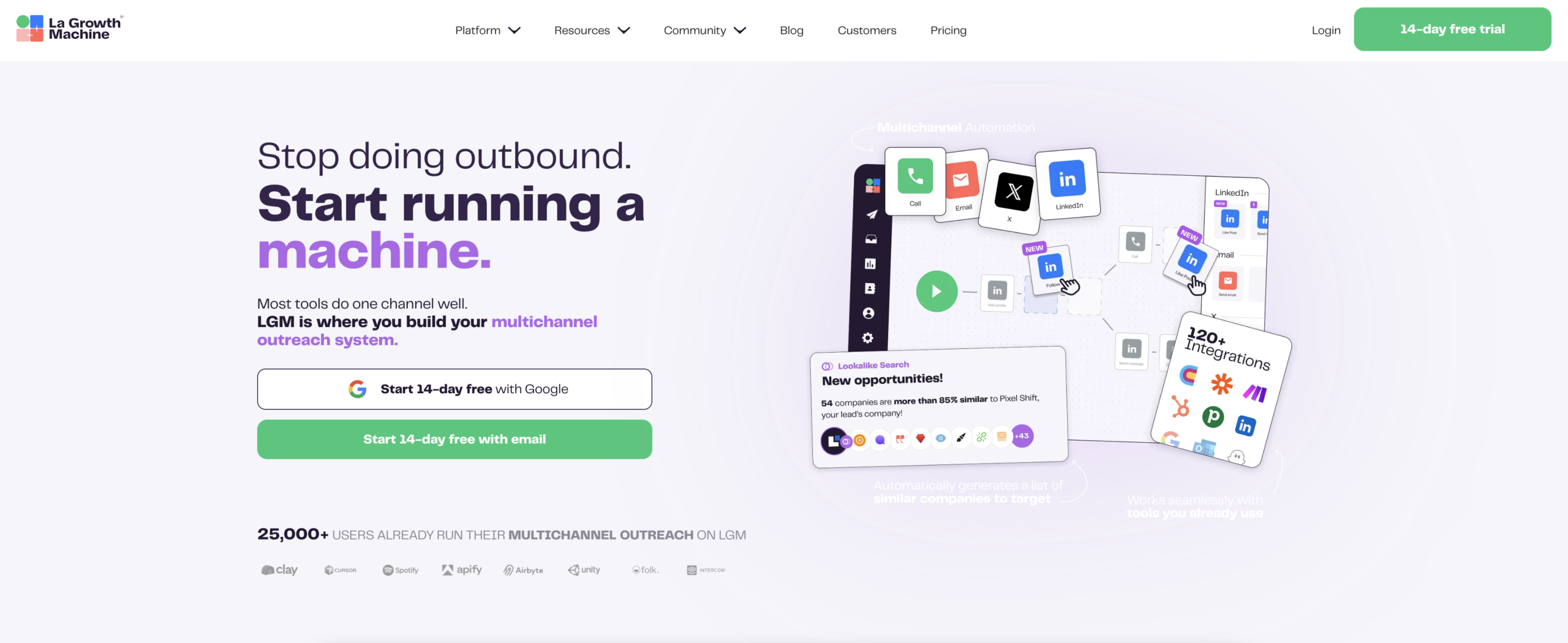
On average, teams using La Growth Machine generate 3.5x more pipeline from outbound compared to single-channel email sequences. The Basic plan starts at €60/month.
Conclusion
The best sales email is the one that makes your prospect feel seen, not sold to. That means a subject line tied to something real, an opening that proves you did your homework, a body that fits in three sentences, and one clear ask.
Apply the anatomy framework, use the benchmarks to know when something is broken, and run your sequences through multiple touchpoints. Most booked meetings come from the fourth or fifth email, not the first.
La Growth Machine automates the sequence so your team can focus on the conversations that close deals. Try it free for 14 days.
FAQ
How long should a sales email be?
50 to 125 words is the optimal range for B2B cold sales emails. This length is short enough to respect your prospect’s time and long enough to establish relevance. Emails above 200 words see significantly lower reply rates. If you need more than 125 words to make your point, simplify your value proposition first.
What is a good reply rate for sales emails in 2026?
A reply rate above 8% is strong for cold outbound. The industry average is around 8.5%. Below 5% signals a problem with targeting, personalization, or deliverability. In warm sequences (following a LinkedIn connection or event), reply rates of 15 to 25% are achievable with proper personalization.
Should I use AI to write sales emails in 2026?
AI is useful for research and first drafts, not for final copy. Teams that use AI to send more generic emails faster see reply rates drop. Teams that use AI to research prospects faster and write sharper, more personalized messages see reply rates improve. The rule: if the email could have been sent to anyone, it should not be sent to anyone.
How many follow-up emails should I send?
4 to 6 touchpoints is the right range for most B2B outbound sequences. Beyond 6, returns diminish unless you have a meaningful new trigger such as a product update, a news mention, or a mutual connection. Each follow-up should add something: new information, a different angle, or a lower-friction ask.