

TL;DR
Which email checker should you pick? The short answer, based on feedback from 19 practitioners in the LGM community (consensus from early 2024, to be re-tested on your own lists):
| Your need | The practitioners’ pick | Why |
|---|---|---|
| Best standalone email finder | Enrow or Icypeas | Strong real discovery rate with catch-all detection built in |
| Best waterfall enrichment | BetterContact or FullEnrich | Maximum discovery rate by chaining multiple providers |
| Best catch-all solution | BounceBan for verification, Enrow or Icypeas for detection | Named in both threads for settling “risky” addresses |
An email checker verifies that an email address exists and accepts messages, before you send anything. It’s the link that separates a clean campaign from a burned domain.
The numbers below come straight from the field. By running a full email verification process, one practitioner in our community holds 70 to 90% enrichment and less than 1% bounce on his campaigns. Without a process, the same list ships with its dead addresses and its unresolved catch-alls.
This guide compiles what practitioners tell each other when no tool vendor is listening:
- which email finder delivers real addresses, not plausible patterns
- when waterfall enrichment is worth the extra cost
- how to handle catch-all emails, the topic that actually divides people
Where these recommendations come from
This comparison is built on two discussions from La Growth Machine’s French-speaking Playground community: 49 posts, 19 practitioners, over 1,000 combined views. These are real usage reports traded between peers, not rewritten product sheets.
The two source threads:
- “Best email finder right now” (February 2024): 34 posts, 61 likes, a poll across 6 tools, and a long debate on catch-alls
- “Best email checker” (April 2024): 15 posts, including a full process for getting under 1% bounce
⚠️ These verdicts date from early 2024. This market moves fast: when a finding still holds structurally in 2026, we say so. When it deserves a fresh test, we flag it explicitly as “to be re-tested.”
Transparency: La Growth Machine publishes this blog and offers its own email enrichment features. The practitioners quoted are not paid, and their criticisms were kept as is. One tool founder took part in the thread: he is quoted as a founder, never as a neutral testimonial.
Email finder, email checker, waterfall: who does what
An email finder discovers a prospect’s address from their name and company. An email checker (or mail checker, as it’s often called) verifies that an address exists and won’t bounce. Waterfall enrichment chains multiple finders to maximize the discovery rate. The three solve different problems, and practitioners combine them rather than pit them against each other.
Brice, founder of La Growth Machine, framed it in the February 2024 thread:
“Waterfall tools will always be mechanically better than tools that search directly. Chaining multiple providers costs more money and takes more time. But it also lets you validate more emails.”
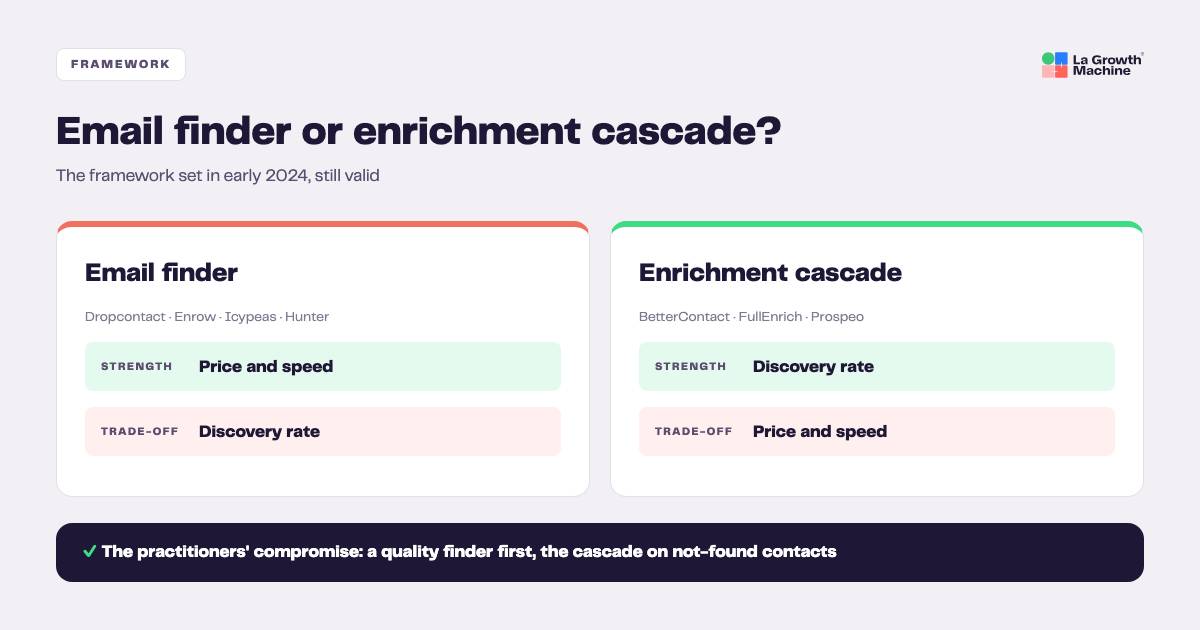
His summary table, still valid in 2026 because it describes a mechanic, not a moment in time:
| Solution | Examples | Pros | Cons |
|---|---|---|---|
| Email finder | Dropcontact, Enrow, Icypeas, Hunter | Price, speed | Discovery rate |
| Waterfall enrichment | BetterContact, FullEnrich, Prospeo | Discovery rate | Price, speed |
The third player, the pure email checker (Emailable, BounceBan, ZeroBounce), comes in afterward: it validates the addresses you already found, before sending.
Then there’s the case that fills half the threads: the catch-all email. A catch-all domain accepts every incoming email, including messages to addresses that don’t exist. A classic checker answers “valid” without being able to guarantee it. This is where tools truly separate from each other.
The comparison: 14 email verification tools at a glance
For solo use with high quality standards, Enrow and Icypeas are the email finders rated best by LGM community practitioners in early 2024, because they detect catch-alls natively. Here are the 14 tools named in the threads, grouped by family.
| Tool | Family | Price positioning* | Catch-all handling | Speed | Made in France | Practitioner verdict (early 2024) |
|---|---|---|---|---|---|---|
| Enrow | Finder | Budget-friendly | Native detection | Fast | Yes | “TOP,” praised for its real discovery rate. To be confirmed in 2026 |
| Icypeas | Finder | Budget-friendly | Native detection, “very promising” | Fast | Yes | “TOP,” excellent value for money. To be confirmed in 2026 |
| Dropcontact | Finder | Budget-friendly | V2 announced at the time | Fast | Yes | The OG, flattering discovery rate but less reliable. To be re-tested |
| Hunter | Finder | Budget-friendly | Not specified | Fast | Yes | “Not bad, without being exceptional.” To be re-tested |
| Findymail | Finder | Budget-friendly | Not specified | Fast | Yes | Positive word of mouth, few direct tests. To be re-tested |
| Prospeo | Finder | Budget-friendly | Not specified | Fast | Yes | Results deemed disappointing in the benchmark. To be re-tested |
| Datagma | Finder | Budget-friendly | Not specified | Fast | Not specified | Simply listed, no usage feedback |
| BetterContact | Waterfall | Higher | Via Scrubby, integrated in early 2024 | Slower | Not specified | Most-cited waterfall in the thread. To be confirmed in 2026 |
| FullEnrich | Waterfall | Higher | Flags catch-alls in the export | Slower | Not specified | Solid, phone numbers on top of emails. To be confirmed in 2026 |
| Emailable | Checker | Not disclosed | Flags “risky,” doesn’t settle them | Fast | No | Used for full-list verification. To be confirmed in 2026 |
| BounceBan | Checker | Not disclosed | Catch-all verification specialist | Fast | No | Recommended twice for catch-alls. To be confirmed in 2026 |
| Scrubby | Checker | Not disclosed | Verification via real sends | 48 to 72 hrs | No | Disputed verdict: see the practitioner section. To be re-tested |
| ZeroBounce / NeverBounce | Checker | Not disclosed | No | Fast | No | Deemed outdated by the benchmark of the time. To be re-tested |
*Relative positioning based on the finder-vs-waterfall framework. ⚠️ Exact pricing changes: check each vendor’s official page before committing.
The “Made in France” column reflects the list shared by Charles, growth consultant, who recommended favoring a French solution for GDPR compliance and accessible support.
Which email checker for your use case
The right tool depends on your volume, your quality bar, and your budget. Practitioners in the threads think in three profiles, and their recommendations differ sharply from one to the next. Here’s the summary, dated early 2024.
Under 10,000 verifications per month
At this volume, a finder-plus-checker duo is enough. No need to build a full waterfall.
The consensus at the time: a French finder with catch-all detection (Enrow or Icypeas), then BounceBan on the addresses flagged “risky.” One member verifying 10,000 to 25,000 emails per month was told that at this level, a packaged solution was still the simplest option.
Maximum quality: getting under 1% bounce
Here, email verification becomes a multi-step process, not a single tool. This is the use case detailed below in the reference process from Martin, growth marketer: two-stage enrichment, double verification, manual review.
⚠️ This quality bar has a cost: every step adds credits and delay. It’s justified when your sending domain is an asset worth protecting.
Tight budget
One budget-friendly finder, and acceptance of a lower discovery rate. The thread’s framework is explicit: price and speed are the advantage of simple finders, discovery rate is the advantage of waterfalls.
In that case, practitioners advised picking a finder that at least detects catch-alls, so you don’t pay for verification twice.
What practitioners actually say
The threads contain verdicts no product page will ever print. This section restores them as is, dated, with their disagreements. It’s the most useful part of this guide if you need to choose between two tools this week.
The real discovery rate, the metric that changes everything
Charles, growth consultant, ran a benchmark of email finders in early 2024. His methodological conclusion goes beyond any specific tool:
“Don’t look at the emails delivered, but at the emails that don’t actually bounce, which means really sending them.”
His test for gauging how serious a finder is: search for a common name at a very large company, like IBM. Most tools return a plausible pattern (jsmith@, js@, john@) that works technically but doesn’t belong to the right person.
Serious finders prefer to abstain. The others inflate their discovery rate with addresses that are valid but wrong. This test is still doable in 2026, on any tool.
The catch-all debate: detection vs. verification
On catch-alls, two schools clashed in the threads:
- Upstream detection: Guillaume, growth, found Icypeas “very promising” at discriminating catch-alls, and Enrow “not bad either.” Jerome, growth marketer, confirmed: “Enrow and Icypeas are TOP.”
- Downstream verification: Martin, growth marketer, and Victor, growth, both recommended BounceBan to settle catch-alls already collected.
The Scrubby case illustrates the limits of the exercise. Martin got “great results” from it. Charles tore it apart: results in 48 to 72 hours, worn-out sending inboxes, repeated false invalids. Two serious practitioners, two opposite verdicts, early 2024. Re-test on your own lists before choosing.
Tier-1 checkers, deemed outdated
The sharpest verdict in the April 2024 thread comes from Charles, on classic verifiers:
“You have tier-1 deliverability tests like ZeroBounce and NeverBounce, but they’re not enough anymore, it’s become bullshit.”
Thomas, founder of Enrow, agreed: “Debouncers are dated tech that fails over and over.”
⚠️ That’s the position of a founder whose tool competes with checkers: weigh it accordingly. But the overlap with Charles’s independent benchmark gives the point real weight. To be re-tested in 2026, since these vendors have had two years to evolve.
The February 2024 consensus
Josselin, growth, summed up the finder thread in four lines that became the community’s reference:
- standalone solutions that perform: Icypeas, Enrow
- waterfalls: BetterContact, FullEnrich
Nathan, growth marketer, and Stephen, growth, championed the waterfall option: BetterContact “runs all these tools in a cascade and gets the best out of them.” With a practical tip from Stephen: adding the company website to your input data makes “your results shoot up.”
For a do-it-yourself stack, Charles proposed a French waterfall: Enrow for quality, then Icypeas, then Dropcontact. Kevin, growth, had run a public head-to-head between Enrow and Icypeas: both held up well.
The reference process: under 1% bounce in 5 steps
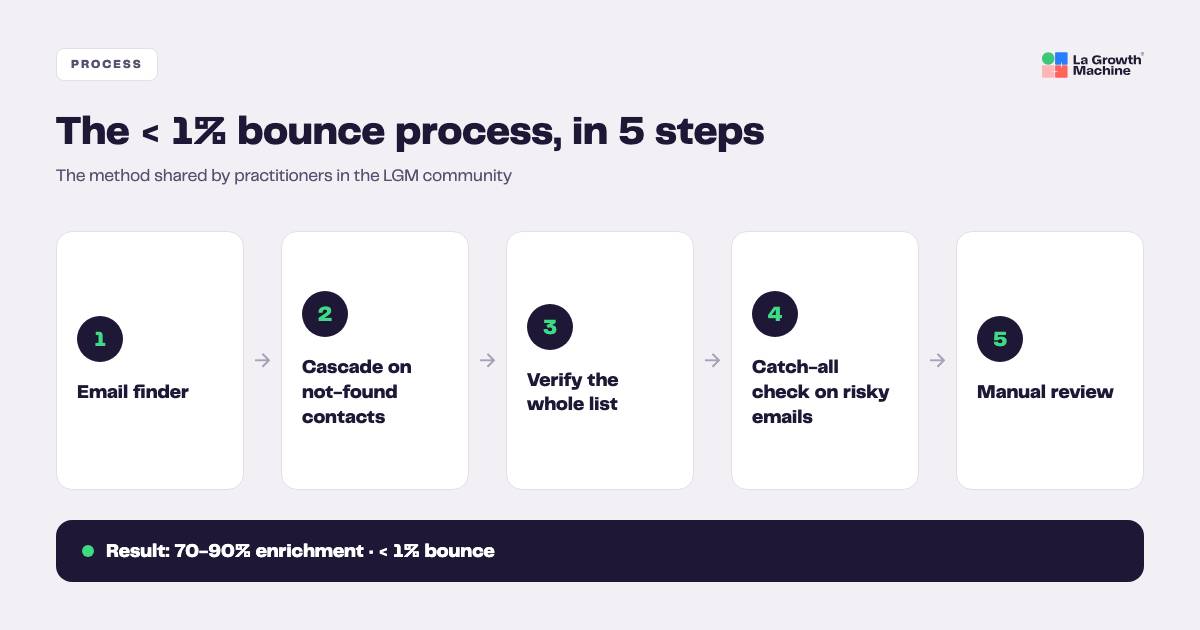
The most complete process in the two threads comes from Martin, growth marketer. Claimed results: 70 to 90% enrichment depending on the list, and a bounce rate under 1%, sometimes zero. Here it is as he shared it in April 2024.
- Enrichment via Enrow: first pass on the whole list, with catch-all detection included.
- Enrichment via BetterContact: only on the contacts not found in step 1. The waterfall serves as a safety net, not a first filter.
- Full-list verification on Emailable: every address, including those found in step 1, goes through the check.
- “Risky” verification on BounceBan: doubtful addresses and catch-alls are settled by the specialized tool.
- Quick manual review: one last human pass to weed out visibly abnormal addresses.
The logic of the process: pay for the waterfall only on the finder’s misses, and pay for specialized verification only on the doubtful addresses. Every dollar goes where it has the most impact.
⚠️ The tools named are the early 2024 picks. The structure of the process, though, remains the right model in 2026: finder, waterfall as a safety net, full verification, catch-all verification, human review. Swap each block for whichever tool wins your own tests.
Email enrichment inside La Growth Machine
La Growth Machine builds email enrichment directly into outreach campaigns, which spares you the CSV round trips between a finder, a checker, and your sending tool. Two features cover the chain described in this guide.
Lead Enrichment enriches the contacts imported into your audiences, before the sequence starts.
Waterfall Enrichment applies the very principle the thread practitioners defended: multi-provider waterfall enrichment, built into your sequences. Several providers are queried in succession to maximize the discovery rate, without building the waterfall by hand.
The historical wink: in the February 2024 thread, Brice replied that at the time LGM relied on a single provider and “could see its limits.” The waterfall the community was asking for has since become a product feature.
How to choose your email checker in 2026
Charles, growth consultant, listed three parameters to watch, plus a bonus. They still make a solid decision grid in 2026, rounded out by two criteria from the rest of the threads.
- Value for money: compare the cost per valid email delivered, not the cost per credit.
- The real discovery rate: emails that don’t actually bounce, not emails delivered. Run the common-name test at a large company.
- The bounce rate: measure it on a real sample before moving your whole volume over.
- Speed: in bulk and one by one. A tool that returns verdicts in 72 hours breaks your campaign rhythm.
- Catch-all handling: native detection or specialized verification, but never skip it. A “valid” on a catch-all domain is not a guarantee.
- GDPR compliance and support: a European solution with accessible support gets debugged faster than a black box.
A verified email is only useful if your sending infrastructure keeps up. Before any campaign, your email deliverability also depends on a properly warmed domain: that’s the job of email warmup, the complement to email verification.
Frequently asked questions about email verification
Is a catch-all email risky for my deliverability?
Yes, if you send to it without specialized verification. A catch-all domain accepts every incoming email, so a classic checker marks it “valid” with no guarantee the mailbox exists. Practitioners settle these addresses with a dedicated tool like BounceBan, or a finder that detects catch-alls upstream, before adding them to a campaign. One avoided hard bounce is worth more than one extra contact.
Waterfall enrichment or a simple email finder: which one?
The waterfall wins on discovery rate, the simple finder wins on price and speed. It’s mechanical: chaining multiple providers finds more addresses, but costs more and takes longer. The practitioners’ compromise: a quality finder for the first pass, the waterfall only on the contacts it missed.
Are free email checkers enough in 2026?
No, not for a serious B2B campaign. Tier-1 verifiers were already deemed insufficient by practitioners in early 2024, especially against catch-alls, which they mark “valid” without real verification. A free check can rough-clean a list, but the final verdict requires dedicated catch-all verification.
What’s the difference between an email finder and an email checker?
The finder discovers the address, the checker verifies it. An email finder starts from a name and a company to uncover the email address. An email checker takes an existing address and confirms it accepts messages. In a clean process, the two chain together: discovery, then verification, then catch-all verification on the doubtful addresses.
How do you verify a catch-all email?
With a real send or a specialized tool, never with a classic checker alone. Practitioners cited two approaches in early 2024: dedicated tools like BounceBan, and the homemade test that sends a neutral email from a warmed secondary domain to watch for the bounce. The second requires dedicated infrastructure, so your main domain is never exposed.
Conclusion: verification is a process, not a tool
The best email checker of 2026 doesn’t exist in the singular. The 19 practitioners in these threads converge on a chain: a reliable finder with catch-all detection, a waterfall as a safety net on the not-founds, specialized verification on the doubtful addresses, a human review.
Their tool picks date from early 2024 and deserve your own tests. Their method hasn’t aged a day: measure the real discovery rate, settle the catch-alls, protect the sending domain.
And if you’d rather have the waterfall run directly inside your sequences instead of a spreadsheet, that’s exactly what Waterfall Enrichment does in La Growth Machine.