
TL;DR
– Claude Skills for GTM run sourcing, sequencing, reply handling and pipeline reporting from the assistant; Anthropic publishes 19 official skills and none of them do go-to-market work
– ColdIQ, YALC GTM-OS and agent-gtm-skills lead upstream on signals, sourcing and positioning, but two of the seven libraries here ship no licence file and one has had no commit since February 2026
– La Growth Machine publishes 11 MIT-licensed skills covering the execution layer, campaigns, replies and pipeline attribution, and pairs with the upstream libraries rather than replacing them
– Install the execution loop first, add signals and positioning when replies flatten, and check the last commit date and the licence file before installing anything
Anthropic ships 19 official Claude Skills. Zero of them do go-to-market work. No prospecting, no sequencing, no reply handling, no pipeline reporting. Every GTM skill you can install today was built by a vendor or by the community, and the seven libraries in this guide publish 300 of them between them.
That is the good news and the problem in one sentence. The bad news sits underneath: two of those seven repositories ship no licence file at all, one has not received a commit since February, and one points every skill it contains at its publisher’s paid product. We checked each repository on 21 August 2026 and publish the counting rule below, so the numbers here can be recomputed rather than believed.
This guide covers the 25 Claude Skills worth installing for GTM, RevOps and growth work, what each one does, who maintains it, and what it quietly costs you.
For skills outside go-to-market, see our general list of the best Claude Skills. New to the format? Start with how to use Claude Skills.
Which Claude Skills are the best for GTM?
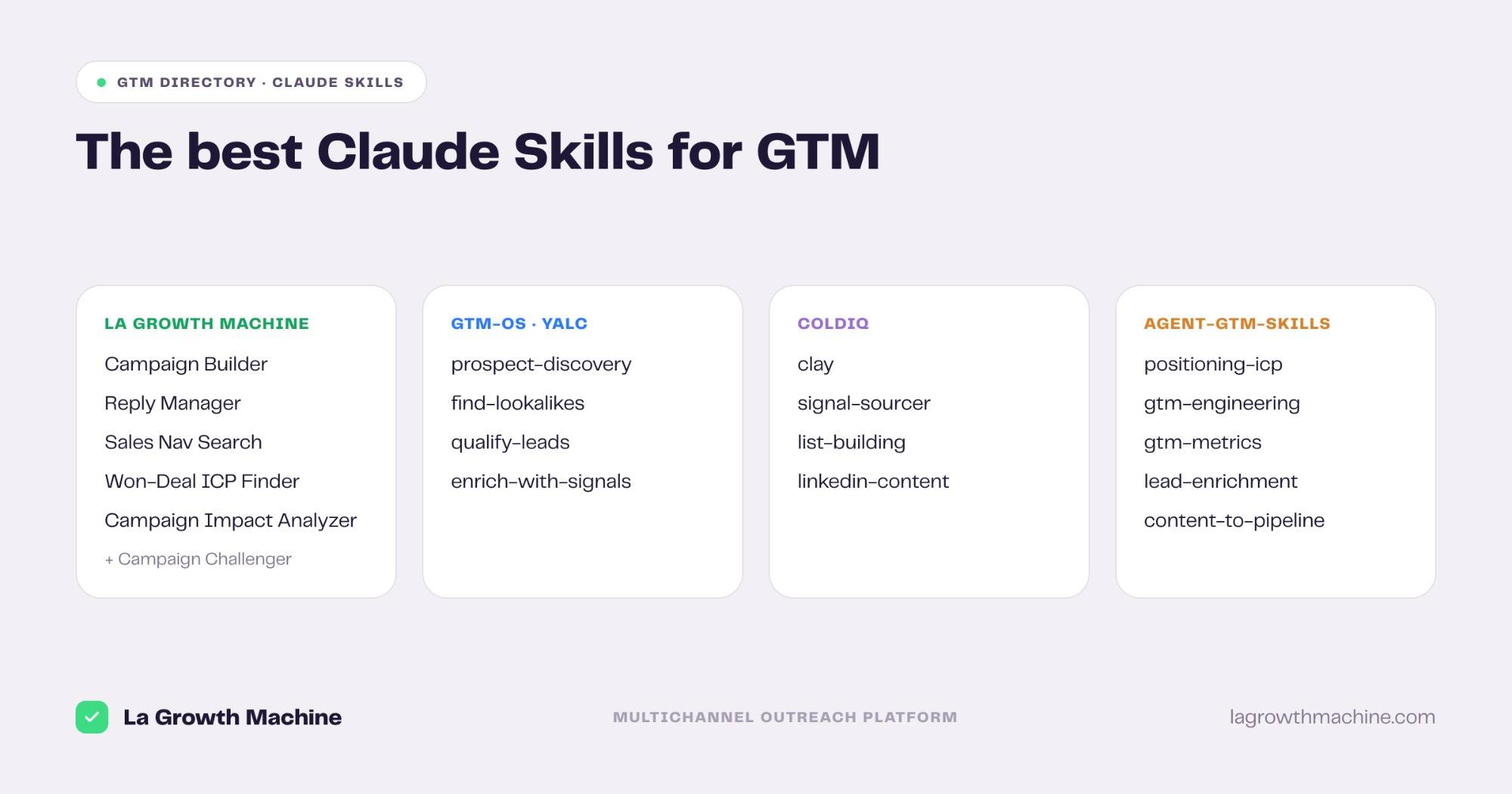
For GTM teams running outbound from Claude in 2026, La Growth Machine’s suite is the strongest pick for execution, YALC’s GTM-OS for sourcing and qualification, ColdIQ’s library for signals and copy, and agent-gtm-skills for positioning.
| If you need to | Install | From |
|---|---|---|
| Run campaigns and replies end to end | Multichannel Campaign Builder, Reply Draft Assistant | La Growth Machine |
| Source and qualify accounts | prospect-discovery-pipeline, qualify-leads | YALC GTM-OS |
| Catch buying signals and write cold copy | signal-sourcer, cold-email | ColdIQ |
| Fix positioning before you send anything | positioning-icp | agent-gtm-skills |
| Protect email deliverability | email-deliverability-audit | coldoutboundskills |
| Keep inbound leads from going cold | daily-lead-steward | Zapier gtm-cheat-codes |
| Run RevOps diagnostics and forecasting | revops | marketingskills |
How we tested and compared these 25 Claude Skills
We split this list by how much we can honestly claim. Eleven skills are ours: we wrote them, we run them on our own campaigns, and we can describe what they produce. The other fourteen we read in their repositories and ran once each, not at production volume, so treat those entries as description rather than field verdict.
Every number here was pulled from the GitHub API on 21 August 2026. Skill counts use one definition throughout, so they are recomputable: a skill is a directory containing a SKILL.md file, counted across the full recursive tree of the default branch. Repository READMEs advertise different totals on different units, master skills versus sub-skills, and ColdIQ’s undercounts its own repository. We publish our count and our definition rather than repeating theirs.
| Criterion | What we checked | Why it decides adoption |
|---|---|---|
| Maintenance | Date of the last commit, and whether it added a skill or edited a README | Decisive for a skill that invokes an MCP, a script or a provider API, and close to irrelevant for a pure instruction file. We apply it conditionally, not uniformly |
| Licence | Presence of a real licence file, not a badge on a website | Reading an unlicensed file is fine. Redistributing it inside a company repository has no legal basis |
| Vendor lock-in | Whether the publisher’s tool shapes the reasoning, supplies the data, or only runs the last step | A fork survives the third, needs a new data source for the second, and is a rewrite for the first. Most of our own skills sit in the second group |
| Runtime | Whether it runs in Claude.ai or only in a terminal | Decides whether a sales team can use it, or only an engineer |
| Output | The artefact type it returns, published per skill in the table below | A skill that produces advice is a prompt with extra steps. The real test is what it returns when the CRM is empty |
Disclosure. La Growth Machine publishes eleven of the twenty-five skills below, and this is our blog, so treat our own entries as informed rather than neutral. Two libraries beat us outright on axes we do not compete on: ColdIQ ships far more copywriting and signal material, and marketingskills covers RevOps diagnostics, pricing and SEO we do not touch at all.
The 7 GTM skill libraries, and who maintains them
Seven libraries supply every skill in this guide. Read the counts as scope rather than quality, and treat a large one with some suspicion: ninety skill descriptions are ninety candidates competing to trigger. Two of these repositories cannot be redistributed safely by a company that reads licences, and one stopped moving six months ago.
| Library | Skills | Maintained by | Licence | Last commit |
|---|---|---|---|---|
| La Growth Machine | 11 | La Growth Machine | MIT | 18 Aug 2026 |
| ColdIQ GTM Skills | 90 | ColdIQ | None | 18 Aug 2026 |
| YALC GTM-OS (1.0) | 61 | Othmane Khadri | MIT | 20 Aug 2026 |
| coldoutboundskills | 50 | Growth Engine | MIT | 18 Aug 2026 |
| marketingskills | 49 | Corey Haines | MIT | 19 Aug 2026 |
| Zapier gtm-cheat-codes | 21 | Zapier | MIT | 13 Jul 2026 |
| agent-gtm-skills | 18 | Chad Boyda | None | 13 Feb 2026 |
Three caveats belong with that table, and all three are checkable.
ColdIQ ships no licence file, so it is source-available rather than open source, and its repository carries a COLDIQ-FIRST.md mandate stating that every skill is built to execute on ColdIQ first, with third-party tools demoted to labelled fallbacks. The material is strong. The default path runs through a paid ColdIQ API key.
agent-gtm-skills has exactly two commits, both dated 13 February 2026, and no licence file despite the site advertising MIT. It is a static reference set, not a maintained library. We kept it because the content is still useful, but installing it means accepting that nothing in it will be updated.
YALC GTM-OS is the 1.0 generation. Its own README describes it as feature complete and open source, while the team’s active work has moved to a commercial 2.0. The last commit that added a skill landed on 26 June 2026. Fork and self-host it, which is what its authors now recommend.
All 25 Claude Skills for GTM compared at a glance
The table is ordered by the stage of the GTM cycle each skill serves, from positioning through to measurement, rather than by rank. Two columns decide most installations: the tool surface a skill needs, which tells you whether a fork is a repoint or a rewrite, and the artefact it actually returns.
| Skill | Library | What it does | Tool surface | Output | Runs in Claude.ai |
|---|---|---|---|---|---|
positioning-icp | agent-gtm-skills | ICP definition and messaging architecture | None, instruction file | ICP doc and messaging map | Yes |
| Won-Deal ICP Finder | La Growth Machine | Proven ICP from closed-won deals | LGM MCP and CRM, data source | Ranked archetypes and searches | Yes |
| Sales Nav Search Builder | La Growth Machine | ICP into a Sales Navigator search | LGM MCP and Sales Navigator, last step | Search URL and boolean string | Yes |
prospect-discovery-pipeline | YALC GTM-OS | End-to-end account sourcing | Provider keys, data source | Scored account list | CLI first |
signal-sourcer | ColdIQ | Intent and trigger signals | ColdIQ MCP, shapes the reasoning | Trigger list and outbound angles | Yes |
| Multichannel Campaign Builder | La Growth Machine | Full LinkedIn and email sequence | None to write, LGM MCP to launch | Sequence copy, three angles | Yes |
email-deliverability-audit | coldoutboundskills | Inbox and domain health audit | None, instruction file | Scored audit and fix list | Yes |
| Reply Draft Assistant | La Growth Machine | Reply triage and on-brand drafts | LGM MCP, data source and send | Draft replies grouped by intent | Yes |
daily-lead-steward | Zapier gtm-cheat-codes | Inbound lead routing hygiene | Zapier, data source | List of missed leads with reasons | Yes |
| Campaign Impact Analyzer | La Growth Machine | Campaign ranking against CRM deals | LGM MCP and CRM, data source | Ranked table with verdicts | Yes |
find-lookalikes | YALC GTM-OS | Lookalike account expansion | Provider keys, data source | Scored account list | CLI first |
list-building | ColdIQ | Prospect list construction | ColdIQ MCP, shapes the reasoning | Prose playbook | Yes |
| Audience ICP Filter | La Growth Machine | Audience split into ICP segments | LGM MCP, data source | Segmented audience | Yes |
google-maps-list-builder | coldoutboundskills | Local business list building | None, instruction file | Contact list | Yes |
enrich-with-signals | YALC GTM-OS | Intent layered onto a list | Provider keys, data source | Enriched list | CLI first |
lead-enrichment | agent-gtm-skills | ICP scoring waterfalls | None, instruction file | Prose playbook | Yes |
list-quality-scorecard | coldoutboundskills | List health scoring before send | None, instruction file | Scorecard with risk flags | Yes |
cold-email | ColdIQ | Cold email frameworks and sequences | ColdIQ MCP, shapes the reasoning | Copy plus prose playbook | Yes |
linkedin-content | ColdIQ | Organic LinkedIn content | ColdIQ MCP, shapes the reasoning | Post drafts | Yes |
| Post to Campaign | La Growth Machine | LinkedIn post engagers into a campaign | LGM MCP, last step | Audience and draft sequence | Yes |
| Campaign Challenger | La Growth Machine | Pre-launch benchmark and fixes | LGM MCP, data source | Twelve-point score and three fixes | Yes |
| Team Performance Dashboard | La Growth Machine | Per-rep outreach cockpit | LGM MCP, data source | Per-rep dashboard | Yes |
| Weekly Performance Advisor | La Growth Machine | Weekly what-to-do cockpit | LGM MCP, data source | Two-tab cockpit | Yes |
| Objection Analyzer | La Growth Machine | Objection analysis from your own threads | LGM MCP, data source | Ranked table plus battle cards | Yes |
revops | marketingskills | RevOps diagnostics and forecasting | None, instruction file | Prose playbook | Yes |
The 10 best Claude Skills for GTM, compared in depth
These ten are ordered by where they sit in the GTM cycle, not by preference. Five are ours and five are not, and the numbering is a sequence rather than a ranking. Read it as a motion: fix positioning, find the ICP, build the list, layer signals, write the sequence, protect the inbox, handle replies, then measure.
1. positioning-icp (agent-gtm-skills), best for locking positioning and ICP
Overview. A dense positioning playbook that forces an agent to produce an ICP definition, a competitive position and a messaging architecture before it writes a single outbound line.
Key features. ICP definition with enrichment signals, competitive positioning frameworks, messaging architecture, and a treatment of perishable product-market fit.
Pros and cons. Unusually specific frameworks for a free skill file, and it runs anywhere with no dependencies. Against that, the repository has two commits, both from 13 February 2026, and carries no licence file, so a company that vets dependencies will struggle to approve it.
Pricing. Free. No licence file in the repository despite the MIT claim on the project site.
Best for. Founders and heads of marketing who need a defensible position written down before outbound starts.
2. Won-Deal ICP Finder (La Growth Machine), best for finding your proven ICP
Overview. Audits closed-won deals to surface the ICP you actually sell to rather than the one on the strategy slide, identifies the channel that won each archetype, and outputs lookalike searches per segment.
Key features. Closed-won audit across the CRM, archetype clustering, winning channel per archetype, and lookalike searches ready to run.
Pros and cons. It answers the question with evidence instead of opinion, and the output feeds straight into list building. It needs a connected account and enough closed-won history to be meaningful, so a team in its first quarter of outbound will get thin results.
Pricing. Free and MIT licensed. Running it needs a La Growth Machine account, from €60/month per identity on Basic with monthly billing, verified August 2026.
Best for. Teams with two or more quarters of closed-won data who suspect their stated ICP and their real one have drifted apart.
4. prospect-discovery-pipeline (YALC GTM-OS), best for end-to-end account sourcing
Overview. Runs a full sourcing pass, from a described segment through to a scored account list, chaining company discovery, research and qualification inside one skill.
Key features. Company discovery, per-account research, an explicit qualification pass, and handoff into the rest of the GTM-OS routines such as find-lookalikes and qualify-leads.
Pros and cons. The chaining is well designed and the qualification gates are explicit. It is CLI-first rather than a drop-in Claude.ai skill, it needs provider API keys to return anything, and it belongs to the 1.0 generation its authors have declared feature complete.
Pricing. Free, MIT licensed. Data provider keys are billed separately by those providers.
Best for. GTM engineers comfortable in a terminal who want a sourcing pipeline they can fork and self-host. Pair it with dedicated AI prospecting tools when the data layer underneath needs to be stronger.
5. signal-sourcer (ColdIQ), best for intent and trigger signals
Overview. A master skill covering buying signals end to end: which triggers are worth watching, how to source them, and how to turn a trigger into an outbound angle rather than a generic mention of a funding round.
Key features. Trigger taxonomies, inbound and outbound trigger sets, signal-to-angle mapping, and sub-skills covering funding, hiring, job changes, tech changes and website visitors.
Pros and cons. The depth on signals is the best in this list by a wide margin. The repository ships no licence file, and its COLDIQ-FIRST.md mandate points the default execution path at ColdIQ’s own paid MCP server, with other tools as labelled fallbacks.
Pricing. Free to read. The documented execution path needs a paid ColdIQ API key.
Best for. Outbound teams whose reply rates have flattened on static lists and who need a trigger layer.
6. Multichannel Campaign Builder (La Growth Machine), best for writing the sequence
Overview. Turns a one-line brief into a complete sequence across LinkedIn and email, with three distinct angles and every message written out ready to copy or push into a campaign.
Key features. Three angle variants per brief, day-by-day step planning across channels, copy for every step including connection notes and break-ups, and direct setup into the platform.
Pros and cons. The copy rules are encoded from real campaigns rather than generic best practice, and three angles make testing the default rather than an afterthought. It writes for LinkedIn and email specifically, so teams running calls or ads as primary channels will use only part of it.
Pricing. Free and MIT licensed. Pushing the sequence live needs a La Growth Machine account.
Best for. Anyone who writes sequences by hand and wants three testable angles instead of one.
→ Multichannel Campaign Builder
Cold outbound to Heads of Sales at French B2B SaaS startups. Lead angle: “your reps spend 40% of the week on manual prospecting.”
7. email-deliverability-audit (coldoutboundskills), best for protecting the inbox
Overview. Audits the technical and behavioural health of a cold email setup, covering authentication records, domain reputation, sending patterns and the content signals that route mail to spam.
Key features. SPF, DKIM and DMARC checks, domain and inbox warm-up review, sending volume patterns, plus a spam word checker and an incident response routine for when placement collapses.
Pros and cons. The only skill here that treats deliverability as an operational discipline with an incident path rather than a checklist. It is email-only, so it does nothing for LinkedIn-led motions.
Pricing. Free, MIT licensed, no paid dependency.
Best for. Teams sending cold email at volume who have seen reply rates drop without a copy change.
8. Reply Draft Assistant (La Growth Machine), best for triaging replies at volume
Overview. Triages every reply across active campaigns, classifies each by intent, and drafts an on-brand response ready to approve before it sends.
Key features. Cross-campaign reply triage, intent classification, on-brand draft generation, and approval before send so nothing leaves without a human seeing it.
Pros and cons. It solves the failure mode that kills most outbound programmes, which is replies going cold because nobody had time. It needs a connected account, and drafts still need reading: the approval step is deliberate, not a limitation to engineer around.
Pricing. Free and MIT licensed. Requires a La Growth Machine account to read conversations and send.
Best for. Teams past roughly fifty replies a week, where triage has become the bottleneck.
9. daily-lead-steward (Zapier gtm-cheat-codes), best for inbound lead hygiene
Overview. A daily routine that reviews inbound leads for routing errors, missed follow-up and ownership gaps, then lists the leads that fell through the cracks with the reason each one did.
Key features. Daily inbound sweep, routing and ownership checks, missed-treatment detection, and a companion audit skill that looks back across a longer window.
Pros and cons. Brand-backed by Zapier and part of a well-organised set spanning GTM ops, sales and RevOps, legal and support. It assumes a Zapier-centred stack, so the value drops sharply if your routing lives elsewhere.
Pricing. Free, MIT licensed. Assumes a Zapier account for the workflows it references.
Best for. RevOps teams with meaningful inbound volume and a Zapier-based routing layer.
10. Campaign Impact Analyzer (La Growth Machine), best for ranking by CRM pipeline
Overview. Ranks campaigns by the pipeline they actually generated, by cross-referencing campaign data with deals in your CRM, and returns a Scale, Keep or Stop verdict for each.
Key features. Campaign-to-deal cross-referencing, ranking by pipeline rather than reply rate, per-campaign verdicts, and a breakdown by channel and by sequence step.
Pros and cons. It moves the optimisation target from reply rate to revenue, which changes which campaigns survive. Deal values come from your CRM, so the output is only as good as your CRM hygiene, and it needs both systems connected.
Pricing. Free and MIT licensed. Requires a La Growth Machine account and a connected CRM.
Best for. Heads of sales and RevOps who need to defend or kill campaigns with pipeline numbers.
14 La Growth Machine campaigns cross-referenced against your HubSpot deals — ranked by the pipeline each one actually generated.
15 more Claude Skills for GTM worth installing
The fifteen below are grouped by the job they do rather than by the library they come from, because that is how they get chosen in practice. Several return prose rather than an artefact, and earn their place on the reasoning they encode rather than on what they hand back.
Sourcing and list building
find-lookalikes (YALC GTM-OS) expands a seed set of accounts into a scored lookalike list using firmographic and signal overlap. Best for teams that already know which accounts convert and want more of them.
list-building (ColdIQ) is a master skill covering list construction end to end, from source selection through segmentation. Best for SDRs building lists from scratch each week, if a ColdIQ key is acceptable.
Audience ICP Filter (La Growth Machine) filters an audience or lead list against your ICP and splits it into ready-to-sequence segments. Best for teams sitting on a large unsegmented list. → Audience ICP Filter
google-maps-list-builder (coldoutboundskills) builds local business lists from map data with address, category and contact fields. Best for local services and agency prospecting where LinkedIn coverage is thin.
Enrichment and data quality
enrich-with-signals (YALC GTM-OS) layers intent and trigger data onto an existing list rather than sourcing a new one. Best for teams whose list is fine but whose timing is not.
lead-enrichment (agent-gtm-skills) documents ICP scoring waterfalls and how to sequence providers so you stop paying twice for the same record. Best for anyone designing an enrichment waterfall, accepting that the repository is frozen.
list-quality-scorecard (coldoutboundskills) scores a list for deliverability and fit risk before you send to it, flagging the records likely to bounce or complain. Best for teams importing bought or scraped lists.
Copywriting and content
cold-email (ColdIQ) is the master copy skill: frameworks, sequence structure, subject lines and variation generation, with a large set of template sub-skills underneath. Best for teams whose cold email reads like every other cold email.
linkedin-content (ColdIQ) covers the organic side, from hooks and formats through to repurposing and scheduling. Best for founders and reps building a LinkedIn presence alongside outbound.
Post to Campaign (La Growth Machine) turns a LinkedIn post into a campaign by scraping its likers and commenters into an audience and filling a sequence calibrated to the post. Best for anyone whose posts get engagement that goes nowhere. → Post to Campaign
Campaign Challenger (La Growth Machine) benchmarks a new sequence against the campaigns that already performed, returns a verdict and a twelve-point score, and names the three fixes that matter. Best for the hour before you press launch. → Campaign Challenger
Reporting, RevOps and GTM ops
Team Performance Dashboard (La Growth Machine) turns outreach data into a per-rep cockpit and surfaces the practices behind top campaigns so they can be copied across the team. Best for managers with more than three reps. → Team Performance Dashboard
Weekly Performance Advisor (La Growth Machine) produces a two-tab weekly cockpit: what to do this week, and how each campaign is really performing. Best for the Monday review. → Weekly Performance Advisor
Objection Analyzer (La Growth Machine) ranks the objections your conversations actually produce, grades how the team answered them, and writes battle cards from your own threads. Best for enablement leads who want battle cards built from evidence. → Objection Analyzer
revops (marketingskills) covers RevOps diagnostics, forecasting and pipeline metrics, inside the largest general marketing skill library available. Best for RevOps teams wanting diagnostics not tied to a vendor.
Best Claude Skills by team
Which skills earn their place depends far more on the team installing them than on the library they came from. The four groups below cover the roles that actually ask this question, and each one gets a different starting set. Install the first three, not all twenty-five, or none of them get used.
For outbound sales teams and SDRs
Start with Sales Nav Search Builder to build the list, Multichannel Campaign Builder to write the sequence, and Reply Draft Assistant to handle what comes back. That is the full loop. Add cold-email when the copy needs a rethink, and signal-sourcer when static lists stop replying.
For RevOps teams
The RevOps set is different: revops for diagnostics and forecasting, daily-lead-steward for inbound routing hygiene, and Campaign Impact Analyzer to tie campaigns back to CRM pipeline. Add Audience ICP Filter when segmentation is the bottleneck, and Team Performance Dashboard when the question becomes which rep rather than which campaign.
For growth and demand generation
Growth teams get more from the upstream skills. positioning-icp first, because most growth experiments fail on positioning rather than execution, then Won-Deal ICP Finder to check it against closed-won evidence, then Post to Campaign to turn organic engagement into pipeline.
For GTM engineers building their own
Engineers want the pipeline, not the packaged output. prospect-discovery-pipeline and enrich-with-signals are the most forkable things here, meaning the parts you swap are provider keys, the MCP endpoint and the frontmatter description, with the reasoning left intact. lead-enrichment documents the waterfall logic well. For the terminal-native side of this stack, see our list of the best Claude Code skills for GTM engineers.
Run your outbound from Claude: the La Growth Machine suite
La Growth Machine publishes eleven open-source GTM skills under an MIT licence, covering the execution layer specifically: building audiences, writing and running multichannel sequences, handling replies, and tying campaigns back to pipeline. They are built to pair with upstream sourcing and enrichment skills rather than replace them.
The eleven are Sales Nav Search Builder, Audience ICP Filter, Won-Deal ICP Finder, Post to Campaign, Multichannel Campaign Builder, Campaign Challenger, Campaign Impact Analyzer, Team Performance Dashboard, Weekly Performance Advisor, Reply Draft Assistant and Objection Analyzer.
The skills tell Claude what to do. The La Growth Machine MCP server lets it act: more than forty actions covering audiences, campaigns, live stats, conversations and sending, working with any MCP client including Claude, ChatGPT, Claude Code, Codex, Cursor, Windsurf, GitHub Copilot and n8n. Write actions ask for explicit confirmation by default, and a read-only mode exists.
Who this is for. B2B teams of roughly eleven to five hundred people in software, tech, finance and agencies, running LinkedIn and email in the same sequence, where one contact history per person needs to reach the CRM. Single-channel teams, or those needing sourcing more than execution, will get more from the upstream libraries above.
Pricing starts at €60/month per identity on Basic with monthly billing, verified August 2026, with a fourteen-day free trial and no card required. Enrichment runs on a monthly credit allowance: 1,250 credits a month on Basic, which is 250 fully enriched leads. The REST API begins at the Pro plan and is not on Basic.
How to install a Claude Skill
Installation depends on where you run Claude, and the two paths are genuinely different. In a terminal, a skill is a folder you drop in place. In Claude.ai, it is an upload gated behind a paid plan. Neither requires writing code, and both work with every library in this guide.
Method 1: Claude Code and other CLI agents
A skill is a directory containing a SKILL.md file. Copy the folder into ~/.claude/skills/ for personal use or .claude/skills/ inside a project, and Claude discovers it automatically. Cloning a whole library into that directory works the same way. Libraries packaged as plugins install through /plugin marketplace add and /plugin install instead, and /skills lists what is currently loaded.
The La Growth Machine suite installs with one command:
npx skills add lagrowthmachine/gtm-systemMethod 2: Claude.ai and Claude Desktop
Enable skills under Settings, then Capabilities, and upload a SKILL.md there. This needs a Pro, Max, Team or Enterprise plan, since skills depend on code execution, and is not available on the free plan. Team and Enterprise administrators can provision skills organisation-wide, and skills enabled on Claude.ai also appear in Claude Desktop.
One gotcha: Claude Code supports frontmatter fields that Claude.ai does not, and a SKILL.md using them fails validation on upload. If a skill written for the CLI refuses to load in the browser, that is usually why.
How to build your own GTM skill
A GTM skill is a folder with a SKILL.md file, so the barrier is editorial rather than technical. What separates a skill that gets used from a prompt someone pasted once is not the prose, it is whether the instructions encode a decision the team already argued about and settled.
Three things make the difference. A description precise enough that Claude knows when to reach for it, since a vague one means the skill never triggers. A definition of good output written as a shape rather than an adjective: a table with named columns beats “be thorough”. And a boundary, meaning what the skill must refuse to do, which is what stops it inventing numbers.
The practical route is to fork an existing skill rather than start from an empty file. Every library here is public, the MIT-licensed ones can be forked freely, and reading three or four SKILL.md files teaches the format faster than any guide. Anthropic also publishes a skill-creator among its nineteen official skills, which scaffolds the structure for you.
How to choose the right Claude Skill for your GTM stack
Five questions settle most of these decisions, and they are worth asking before installing anything, because an unused skill is not free: it still competes to trigger, and ninety descriptions in one library will make Claude reach for the wrong one. They are ordered by how often each matters.
- What is your bottleneck? Sourcing, copy, replies and measurement need different skills, and installing all four sets at once means none of them get learned.
- Does it invoke anything, and if so who maintains it? A skill that calls an MCP or an API drifts when that surface changes, so the commit date matters. A pure instruction file can sit untouched for a year and still be correct.
- Is there a licence file? Not a badge on a website, an actual file in the repository. Two of the seven have none, which makes them source-available rather than open source.
- Is the vendor in the reasoning or only in the last step? Several skills default to their publisher’s paid product. When only the final step is vendor-bound you repoint it and fork; when the reasoning is built around the vendor, you are rewriting it.
- Where will it run? A skill that only works in a terminal will not reach the sales team, whatever its quality.
Frequently asked questions
What are the best Claude Skills for GTM?
For execution, meaning campaigns, replies and pipeline reporting, La Growth Machine’s eleven skills are the most complete set that both writes and runs the campaign. For sourcing and qualification, YALC’s GTM-OS. For signals and cold copy, ColdIQ. For positioning, positioning-icp.
Are Claude Skills for GTM free?
The skill files are free in every library here. What varies is the licence and the dependency: five of the seven repositories carry an MIT licence, two carry none, and several skills default to their publisher’s paid product, which is where the real cost appears.
Which Claude plan do I need to run skills?
In Claude Code, any plan works, since skills are folders the client reads locally. On Claude.ai and Claude Desktop they require Pro, Max, Team or Enterprise, because they depend on code execution, and are not available on the free plan.
Can I combine skills from different libraries?
Yes, and it is the normal setup. Claude chains skills through the conversation rather than through a schema, so the handoff is whatever the first skill wrote, not a structured record. The thing to watch is overlapping skills claiming the same trigger, which is what actually breaks a large install.
Do Claude Skills replace my outreach tool?
No. A skill is a set of instructions, not an execution engine. It writes the sequence, but sending it, rotating inboxes, respecting LinkedIn limits and recording the reply still happen in a platform. The same distinction applies to AI agents for sales automation: the agent decides, the platform executes.
What is the difference between a Claude Skill and an MCP server?
A skill is instructions, an MCP server is a connection. The skill tells Claude what to do, in what order, and what a good result looks like. The server lets Claude read and write in an external system. Most useful GTM setups need both.
Conclusion: our top picks
If you install three skills this week, make them Multichannel Campaign Builder, Reply Draft Assistant and Campaign Impact Analyzer: write the sequence, handle what comes back, then find out which campaigns produced pipeline. That is the loop most teams are missing.
Add positioning-icp if outbound is not working and you suspect the message rather than the motion, and signal-sourcer if the message is fine but the timing is not.
The full suite is open source at LaGrowthMachine/gtm-system, and the platform it runs against starts at €60/month per identity with a fourteen-day free trial. See La Growth Machine pricing for the plan comparison.