

TL;DR
– Dynamic conditions transform outreach sequences from static message chains into adaptive workflows that respond to real prospect behavior: LinkedIn accepted, email opened twice, no reply after 7 days.
– The 3-channel architecture (Email + LinkedIn + SMS) maximizes reply rates when each channel is used correctly: email for context-rich async communication, LinkedIn for social-proof-backed connection, SMS reserved for warm prospects only.
– Waterfall enrichment (LinkedIn URL to professional email to mobile phone) via tools like Clay ensures you have the right contact data to reach each prospect through their most responsive channel.
– La Growth Machine provides a visual workflow builder with conditional branches, Social Warming for LinkedIn, and native CRM sync with HubSpot, Pipedrive and Salesforce — from 60 euros per month per identity.
Most outreach sequences are built around a single assumption: that every prospect behaves the same way. You send a LinkedIn connection request on day one, an email on day three, a follow-up on day seven. The problem is that your prospect already replied to your email on day two, and your sequence kept going anyway. That gap between what the prospect did and what your sequence assumed they did is where deals fall apart.
Dynamic conditions fix this. Instead of a linear chain of messages, you build a sequence that responds to prospect behavior in real time. If a prospect accepts your LinkedIn connection, the sequence skips the cold intro and sends a warmer message. If they opened your email twice without replying, the sequence triggers a LinkedIn follow-up. If seven days pass with no engagement at all, the sequence switches to a short SMS nudge. The message adapts to what actually happened, not to what you hoped would happen.
This guide covers how to build that kind of sequence: three channels working together, branching logic that responds to real events, and enrichment that ensures you always have the right contact data to reach each prospect through their most responsive channel.
Outreach Approaches Compared
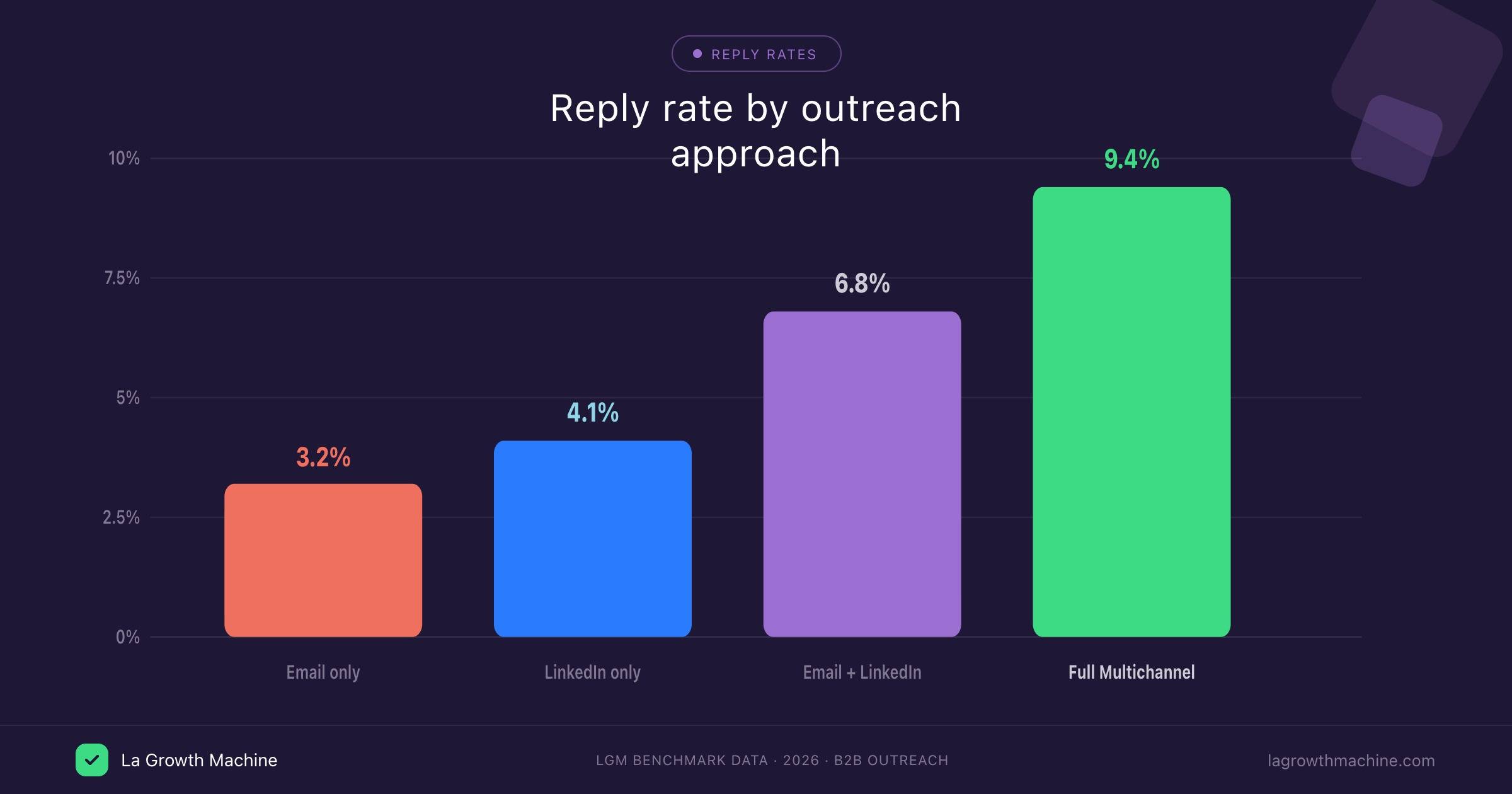
Before diving into the setup, here is how different approaches stack up:
| Approach | Channels | Dynamic Logic | Enrichment | Best For |
|---|---|---|---|---|
| Single-channel static | Email only | None | Email address | High-volume cold email at scale |
| Multichannel static | Email + LinkedIn | None | Email + LinkedIn URL | General B2B outreach with no conditional logic |
| Multichannel with dynamic conditions | Email + LinkedIn + SMS | Full if/then branching on behavior | Waterfall: LinkedIn URL to email to phone | High-value accounts, complex B2B sales cycles |
The third approach requires more setup upfront, but the reply rate difference is significant. Sequences that adapt to prospect behavior consistently outperform static sequences because they deliver the right message through the right channel at the right moment.
What “Dynamic Conditions” Actually Mean in Outreach
Dynamic conditions are if/then rules that change what happens next in a sequence based on what a prospect does or does not do. They turn a straight line into a decision tree.
The most useful event triggers in practice are:
- Connection accepted on LinkedIn – the prospect accepted your request, which signals interest and changes what the next message should say
- Email opened two or more times – repeated opens without a reply often mean the prospect is interested but not sure how to respond; a LinkedIn touchpoint at this moment often converts
- Link clicked in email – high-intent signal that warrants an immediate follow-up on the channel most likely to get a reply
- No reply after X days – absence of engagement triggers a channel switch or a different message angle
- Reply received – sequence stops automatically and the prospect moves to a replied status in your CRM
Without dynamic conditions, you are essentially guessing. You pick a channel sequence, write your messages, and hope the timing lines up with what the prospect is thinking. With dynamic conditions, the sequence reacts. A prospect who clicks your pricing link gets a different message than one who opened the email and ignored it. That specificity is what drives conversion.
The conversion math is straightforward: dynamic sequences typically improve reply rates by 30 to 60 percent over static multichannel sequences, because the message the prospect receives is contextually relevant to what they just did.
The 3-Channel Architecture: Email + LinkedIn + SMS
Email is the primary async channel for B2B outreach. It supports long-form content, rich personalization, and file attachments. It is the right channel for context-heavy messages where you need to explain your value proposition in full.
Deliverability is the main technical constraint. Sending volume, domain age, warm-up status, and authentication records (SPF, DKIM, DMARC) all affect whether your emails land in the inbox. For cold outreach, limit daily send volume per inbox, warm up new domains before ramping volume, and keep your email copy clean of spam triggers. La Growth Machine handles sending limits and timing automatically within its sequences.
Personalization at scale requires variable fields connected to enriched contact data. First name, company name, job title, and a custom contextual line (a recent funding announcement, a new hire, a LinkedIn post they published) all increase reply rates meaningfully.
LinkedIn provides social context that email cannot. When a prospect sees your outreach, they can check your profile, your shared connections, and your company in the same click. That social proof lowers the barrier to reply.
Connection-based trust is the most important mechanism. A LinkedIn message from a connected contact lands in the main inbox. A message from an unconnected contact lands in the message requests folder and is often ignored. This is why building the connection before sending a message is the standard first step in LinkedIn-first sequences.
For prospects you cannot reach via connection request, InMail provides a fallback for cold reach. InMail credits are limited, so use them selectively for high-value targets.
La Growth Machine’s Social Warming feature visits and likes a prospect’s profile and recent posts before sending a connection request. This creates a footprint that makes the subsequent request feel less cold.
SMS
SMS has the highest open rate of any outreach channel, often cited at 95 percent or above. But it is also the channel with the strictest norms around appropriate use. Sending a cold SMS to a prospect who has never heard of you will damage your reply rate and your brand.
SMS works best as a late-stage trigger in a sequence: after email and LinkedIn touchpoints have established some familiarity, a short SMS nudge can be the message that finally gets a response. Keep SMS messages under 160 characters, include your name and company, and make the action you are asking for obvious and easy.
Compliance requirements for SMS are covered in the compliance section below.
How to Build a Dynamic Multichannel Sequence (Step by Step)
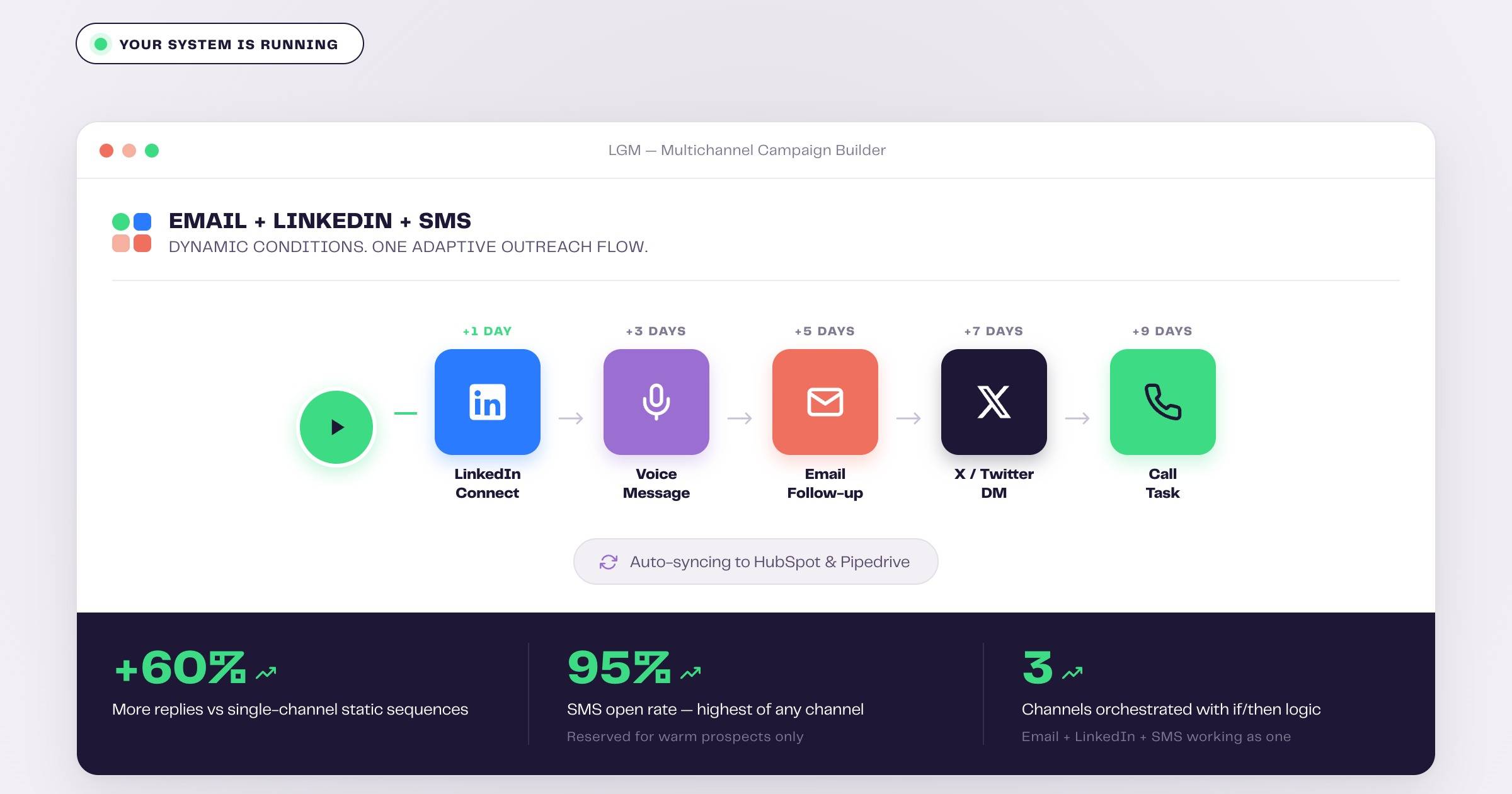
Building a dynamic multichannel sequence requires upfront planning before you touch any tool. The seven steps below take you from prospect data to a live sequence that adapts to behavior in real time.
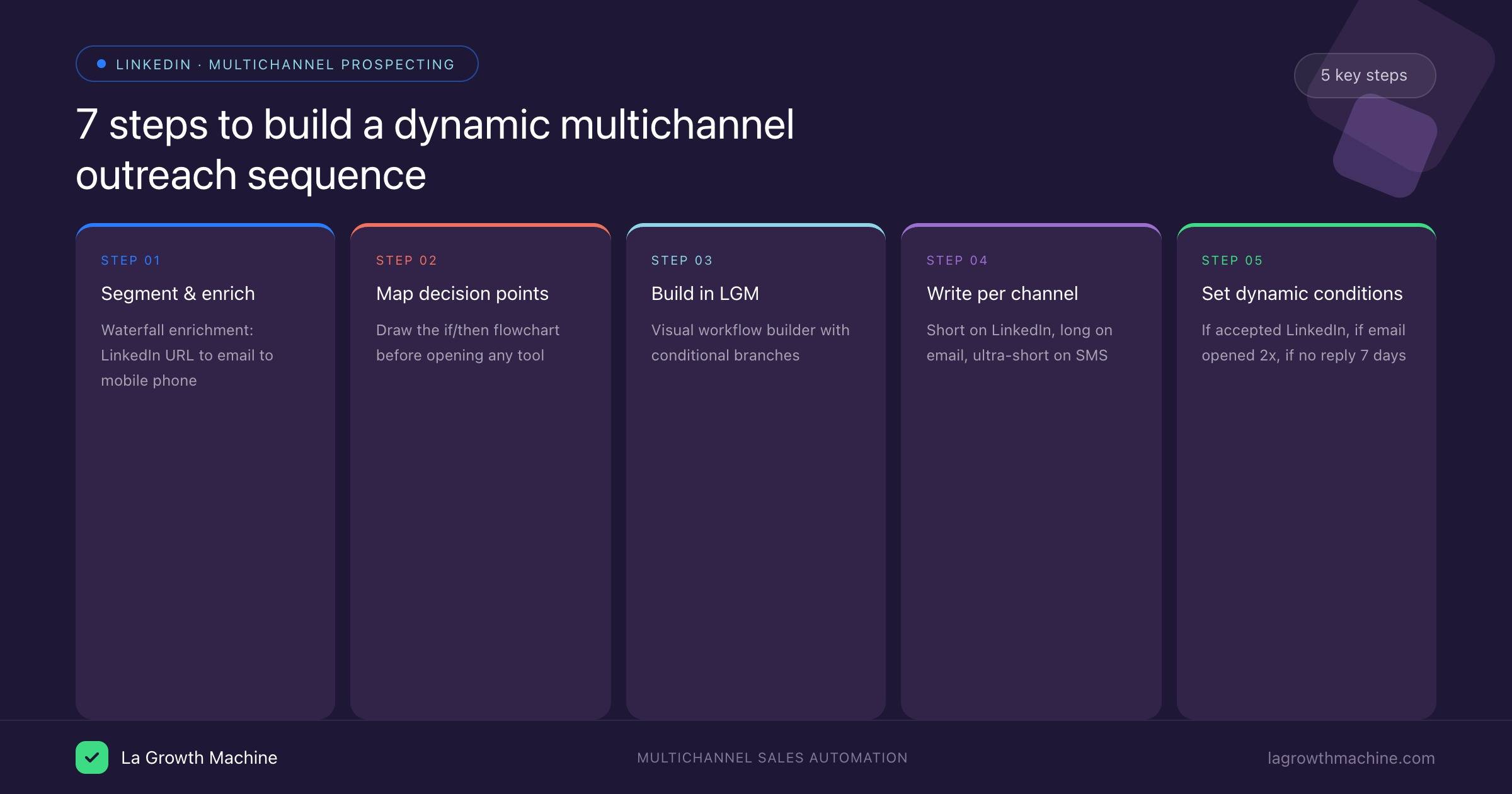
Step 1: Define Your Prospect Segments and Enrich Contact Data
Segment your prospect list before building the sequence. Different segments warrant different channel priorities and message angles. A VP of Sales at a 200-person SaaS company requires a different sequence than an SDR at an enterprise. The dynamic conditions and message content should reflect those differences.
Once segments are defined, enrich each contact with the data needed to reach them across all three channels. The standard enrichment waterfall runs: LinkedIn URL to confirmed professional email address to mobile phone number.
Clay is the most flexible tool for waterfall enrichment. You build a table of contacts, then run enrichment providers in sequence, falling back to the next provider only if the previous one returns no result. The output is a clean contact file with LinkedIn URL, email, and phone where available. This file feeds directly into La Growth Machine as an audience.
Enrichment quality determines channel coverage. If 40 percent of your contacts have no phone number, SMS is not a viable channel for those contacts. Build your sequence logic with realistic channel coverage assumptions.
Step 2: Map Your Channel Sequence with Decision Points
Before opening any outreach tool, draw the if/then flowchart. Paper and pen works fine. The question you are answering is: given what the prospect just did, what should happen next?
A basic decision map for a LinkedIn-first sequence looks like this: send LinkedIn connection request. If accepted within 3 days, send a LinkedIn message. If LinkedIn message gets no reply in 4 days, send email. If email opened twice with no reply, send LinkedIn follow-up. If no reply after 7 days total, send SMS nudge. If reply received at any point, stop and move to CRM.
Map every branch before building. The branches you miss are the ones where prospects fall through and get the wrong message.
Step 3: Build the Sequence in La Growth Machine
La Growth Machine provides a visual workflow builder where each step in the sequence is a node, and branches connect nodes based on conditions. You can drag nodes into position, connect them with conditional arrows, and see the full sequence as a flowchart.
Create a new campaign, select your enriched audience, and start adding nodes. Each node type corresponds to an action: send LinkedIn connection request, send LinkedIn message, send email, send SMS, wait X days, check condition. The condition node is where dynamic logic lives: you define the event to check (accepted LinkedIn, email opened, replied) and connect different outgoing paths for each outcome.
La Growth Machine’s interface makes this visual. You are literally drawing the decision tree you mapped on paper in Step 2.
Step 4: Write Channel-Specific Messages
Each channel has its own register. Writing the same message in three formats and sending them across channels is one of the most common mistakes in multichannel outreach.
LinkedIn messages should be short and conversational. Three to four sentences maximum. No pitch in the connection request note. The first LinkedIn message after acceptance is a soft opener, not a sales pitch. It references something specific to the prospect and ends with a low-friction question.
Email messages can be longer and carry more context. Use the subject line to earn the open, the first paragraph to establish relevance, the second to explain the value, and a clear call to action at the end. Personalization variables should appear in the first line. Keep formatting clean: no heavy HTML, no image-heavy templates for cold email.
SMS messages must be under 160 characters and cannot sound like marketing copy. Include your name, a reference to your previous outreach on another channel, and one clear action. “Hi [first name], this is [your name] from [company]. Sent you an email last week about [topic]. Would a quick call this week make sense?” is the right register.
Step 5: Set Dynamic Conditions
This is where the sequence becomes adaptive. Return to each condition node in your La Growth Machine workflow and configure the specific event and threshold that triggers each branch.
The most effective dynamic conditions to configure are:
- If accepted on LinkedIn, skip cold email intro. The prospect has already shown willingness to engage. Jump to a warm LinkedIn message and skip any email that assumes they do not know who you are.
- If email opened 2 or more times, trigger LinkedIn follow-up. Repeated opens signal interest without commitment. Appearing on LinkedIn at this moment creates a second touchpoint that often converts.
- If no reply after 7 days, switch to SMS nudge. Use SMS as the last-resort channel for prospects who have been through email and LinkedIn without responding.
- If replied on any channel, stop the sequence. This condition must be set on every branch to avoid sending automated messages to prospects who have already responded.
La Growth Machine applies these conditions automatically as the sequence runs. You set them once; the tool evaluates them for each prospect in real time.
Step 7: Connect to CRM and Activate
Before activating the sequence, connect La Growth Machine to your CRM. HubSpot, Pipedrive, and Salesforce all integrate natively. Zapier provides a fallback connection for other CRMs.
When a prospect replies, their status updates in La Growth Machine and syncs to your CRM automatically. When a prospect moves to a new stage in your CRM (from prospect to opportunity, for example), that change can trigger or stop sequences in La Growth Machine. The two systems stay in sync without manual updates.
Once CRM sync is confirmed, activate the sequence. La Growth Machine begins processing the audience, running each contact through the sequence at the pace you have configured, applying dynamic conditions as events occur.
Dynamic Condition Templates That Work in 2026
Template A: LinkedIn-First with Email Fallback (B2B Decision Makers)
This template works for reaching VP-level and C-suite contacts at companies between 50 and 500 employees. LinkedIn is the primary channel because decision makers are more responsive to social outreach than cold email at this level.
Sequence: Social Warming (3 days) – LinkedIn connection request – Wait 3 days – If accepted: LinkedIn message – Wait 4 days – If no reply: Email – Wait 5 days – If opened 2x no reply: LinkedIn follow-up – Wait 7 days – SMS nudge – Stop.
The key condition here is the LinkedIn acceptance check. If the prospect accepts, the entire email intro is skipped and replaced with a warmer LinkedIn opener. If they do not accept within 3 days, the sequence pivots to email as the primary channel.
Template B: Email-First with LinkedIn Warm-Up (High-Volume Outbound)
This template works for SDR teams running high-volume outbound at mid-market companies. Email handles volume efficiently; LinkedIn adds social context for prospects who do not respond to email.
Sequence: Email (day 1) – Wait 3 days – If no reply: Email follow-up – Wait 4 days – If opened no reply: LinkedIn connection request – Wait 3 days – If accepted: LinkedIn message referencing email – Wait 5 days – If no reply: SMS nudge – Stop.
The critical condition in this template is the “email opened, no reply” trigger for the LinkedIn connection request. You are only investing LinkedIn effort in prospects who have already shown interest by opening the email. This makes the LinkedIn touchpoint feel relevant rather than random.
Template C: Full 3-Channel for High-Value Accounts
This template is for named accounts in enterprise sales where each deal is worth significant revenue. Every channel is active, the sequence runs longer, and the messaging is more personalized at each step.
Sequence: Social Warming (5 days) – LinkedIn connection – Wait 3 days – If accepted: LinkedIn opener – Wait 3 days – If no reply: Email with case study – Wait 4 days – If email opened 2x: LinkedIn follow-up with social proof – Wait 5 days – If no reply: Email with different angle – Wait 3 days – If no reply: SMS nudge – Wait 7 days – Final LinkedIn message – Stop.
The investment in this template is higher, but so is the revenue potential. For accounts where a single closed deal justifies the attention, the 3-channel approach with full dynamic branching maximizes conversion probability.
Compliance and Safety
Automated outreach across three channels means three separate compliance frameworks, and violating any of them creates legal and reputational risk.
Email: GDPR and CAN-SPAM. Under GDPR, you need a lawful basis for processing the contact data of EU-based prospects. For B2B cold outreach, legitimate interest is the most commonly used basis, but it requires a genuine assessment that your outreach is relevant to the prospect’s professional role. Include an opt-out mechanism in every email and honor unsubscribe requests immediately. CAN-SPAM requirements include a physical address and a working unsubscribe link.
LinkedIn: Platform rules. LinkedIn prohibits automation that violates its User Agreement. Tools that connect to LinkedIn via browser automation (rather than official API) carry risk if used at high volume. La Growth Machine is built to operate within safe volume limits: typically 80 to 100 connection requests per week and similar limits on messages. Exceeding LinkedIn’s implicit thresholds risks account restriction. Never run LinkedIn automation 24 hours a day; La Growth Machine applies realistic human-like timing by default.
SMS: Opt-in requirements. In the United States, the Telephone Consumer Protection Act (TCPA) requires prior express written consent for automated text messages. In the EU, similar consent requirements apply under GDPR and national ePrivacy regulations. For B2B outreach, SMS is safest when used with contacts who have already engaged with your other channels and where you can document legitimate interest. Never purchase phone lists for SMS outreach. Twilio provides compliant SMS infrastructure with built-in opt-out handling.
Across all three channels, maintain a suppression list. When a prospect opts out or asks not to be contacted, remove them from all active sequences and add them to the suppression list before running any future campaigns.
FAQ
Can I automate LinkedIn outreach safely?
Yes, with appropriate volume limits and human-like timing. La Growth Machine is designed to operate within LinkedIn’s acceptable use thresholds: around 80 to 100 connection requests per week, with pauses between actions that mimic human behavior. Avoid running automation overnight, do not scrape LinkedIn data at scale, and always use a well-established LinkedIn account with a complete profile. Accounts with less than 500 connections or less than 6 months of activity carry higher risk of restriction.
Is SMS outreach legal for B2B?
It depends on the jurisdiction and how you obtained the contact data. In the US, TCPA applies to automated text messages and requires prior express written consent in most cases. In the EU, GDPR and ePrivacy rules require a lawful basis. For B2B prospects in professional roles, legitimate interest can provide a basis in some EU member states, but practices vary by country. The safest approach is to use SMS only for contacts who have already engaged with your outreach on other channels, and to include an easy opt-out in every message.
What is the best tool for multichannel automated outreach?
La Growth Machine is the most complete platform for multichannel outreach combining LinkedIn, email, and SMS with dynamic conditional branching. It includes a visual workflow builder, native CRM integrations with HubSpot, Pipedrive, and Salesforce, Social Warming for LinkedIn, and built-in safety limits. Pricing starts at Basic for 60 euros per month per identity, with Pro at 120 euros and Ultimate at 180 euros per identity.
How many touchpoints should a dynamic sequence have?
For most B2B sequences targeting cold prospects, 6 to 10 touchpoints spread over 3 to 4 weeks is the effective range. Below 5 touchpoints, you leave conversions on the table because most prospects need multiple contacts before they respond. Above 12 touchpoints, you risk irritating prospects and damaging your brand. Dynamic sequences are more efficient than static ones because each touchpoint is triggered by a relevant event, which means fewer wasted touches and better use of the available contact window.
What is waterfall enrichment?
Waterfall enrichment is a data enrichment method where you run multiple data providers in sequence, using the output of each provider only if the previous one returned no result. The standard waterfall for multichannel outreach starts with the LinkedIn URL to find the professional profile, then finds the confirmed professional email address, then attempts to find a mobile phone number. Tools like Clay let you configure waterfall enrichment across dozens of providers in a single workflow. The output is a contact file with the best available data from every provider, without duplicating costs by running all providers on every contact.
How do dynamic conditions improve reply rates?
Dynamic conditions improve reply rates by ensuring that each message a prospect receives is contextually relevant to what they just did. A prospect who accepted your LinkedIn connection receives a message that acknowledges that acceptance, not a cold intro that assumes they do not know who you are. A prospect who clicked a link in your email receives a follow-up that references what they were interested in, not a generic nudge. This relevance signals that the outreach is attentive and personalized, which reduces the likelihood of being ignored and increases the likelihood of a reply. In practice, teams using dynamic multichannel sequences report reply rates 30 to 60 percent higher than static sequences targeting similar prospect profiles.
Start Building Adaptive Sequences Today
Static sequences are table stakes. Every sales team running outreach has them. The competitive advantage in 2026 comes from sequences that respond to what prospects actually do: accept the LinkedIn request, open the email twice, click the case study link. When your outreach adapts to those signals, you are having a conversation with the prospect’s behavior rather than talking past it.
La Growth Machine provides the infrastructure to build this kind of sequence without engineering resources: a visual workflow builder, native channel integrations, dynamic conditions on any event, Social Warming for LinkedIn, and CRM sync that keeps your pipeline current automatically.
Start your 14-day free trial at lagrowthmachine.com and build your first dynamic multichannel sequence this week.