
TL;DR
– Apollo.io ($65/seat/month) and Clay (from $167/month) sit upstream of the sequence: they source and enrich contacts, and neither executes multichannel outreach
– Salesloft and Outreach add coaching and deal forecasting on top of sequences, both quote-only, while Instantly ($47/month) and Lemlist ($69 email, $109/user multichannel) cover email volume and personalization
– La Growth Machine runs LinkedIn, email and calls as one sequence per person with native two-way CRM sync, from €60 per identity per month, which works out at roughly €0.24 per fully enriched lead on Basic
– Choose by stack layer rather than feature list: sourcing, enrichment, execution, phone and CRM are five different purchases, and most stack bloat comes from buying the same layer twice
Last updated: August 2026 · 14 min read · By Erwann Lefevre
Comparing outbound sales tools has a data problem before it has a tool problem.
Of the twelve tools below, four publish no price at all. Two of the eight that do show the annual rate by default, ours included, which is how a comparison list ends up quoting €50 for a €60 plan. And all twelve publish a public API, but the plan it unlocks on ranges from the free tier to an enterprise contract, which is the most common post-purchase surprise in this category.
So this list does the boring part. Every price was read on the vendor’s own pricing page on 21 August 2026 with the billing cycle named, every developer portal was opened, and every tool is placed in the layer it actually works in. Half the redundancy in a bloated stack comes from buying the same layer twice.
Which outbound sales tool is the best?
La Growth Machine is the best outbound sales tool for B2B teams working LinkedIn and email against one buyer in 2026, because it runs a single sequence per person and syncs it natively to HubSpot or Salesforce, from €60 monthly.
| If you are | Best pick | From | Why |
|---|---|---|---|
| Working LinkedIn and email against the same buyer | La Growth Machine | €60/identity/mo | One sequence per person across channels, native two-way CRM sync |
| Building lists and sequencing in one place | Apollo.io | $65/seat/mo | Database plus sequencer, usable free tier |
| Composing enrichment waterfalls yourself | Clay | $167/mo | 50+ sources chained, AI research agent |
| Calling senior buyers in Europe | Cognism | Quote only | Phone-verified mobiles, GDPR framework |
| Buying data and intent at enterprise scale | ZoomInfo | Quote only | Broadest US coverage plus intent |
| Coaching reps and forecasting pipeline | Salesloft or Outreach | Quote only | Conversation intelligence, deal health scoring |
| Sending cold email at high volume | Instantly | $47/mo | Inbox rotation and deliverability tooling |
| Running LinkedIn across many senders, or an agency | HeyReach | $79/mo, $999 agency | Unlimited senders on the entry plan |
| Adding a phone layer to an existing stack | Ringover | $15/user/mo | Power dialer, connects to the outreach layer |
| Missing the system of record | HubSpot Sales Hub | $20/seat/mo | Free tier to start, standard integration target |
⚠️ Most of these twelve tools sit in different layers and do not compete with each other. Apollo, Clay, Cognism and ZoomInfo source and enrich before a sequence starts. La Growth Machine, Salesloft, Outreach, Instantly, Lemlist and HeyReach execute it. Ringover carries the calls. HubSpot stores the outcome. Reading this list as twelve substitutes for one job is the mistake that produces an 8.3-tool stack.
How we tested and compared these 12 tools
Proof levels, stated plainly:
- 1 tool we build ourselves: La Growth Machine. We know its limits from the inside and we say them below.
- 11 tools compared on public evidence: vendor documentation, feature pages, API references and pricing pages, all read on 21 August 2026.
No tool here gets a hands-on performance verdict we did not earn. Where a claim would need us to have run campaigns on a competitor’s platform, we describe what the product does instead of scoring how well it does it.
Disclosure. La Growth Machine is our product and it is ranked first. It wins on one axis: LinkedIn, email and calls against the same person in a single sequence, with the reply history syncing back to the CRM. It loses on others, and we name them. Apollo and ZoomInfo beat it on database size, because it has none. Clay beats it on enrichment depth. Salesloft and Outreach beat it on forecasting and conversation intelligence. Instantly beats it on raw sending volume.
| Criterion | The question we asked | What separates the tools |
|---|---|---|
| Layer | Does it source, execute, dial or store? | Most confusion in this category is layer confusion |
| Channel coverage | Which channels live inside one sequence? | Email-only, LinkedIn-only, or genuinely multichannel |
| Programmable surface | Is there a public API, webhooks, an MCP server? | The line between a tool and a component of a system |
| CRM sync | Native two-way, or through Zapier? | Middleware is where outbound attribution breaks |
| Pricing transparency | Is a price published at all? | Four of the twelve publish nothing |
| Entry cost and cycle | What does month one actually cost? | Annual rates quoted as monthly are the norm |
Quick comparison: all 12 outbound sales tools at a glance
| Tool | Layer | Best for | From (monthly cycle) | Public API | Free plan or trial |
|---|---|---|---|---|---|
| La Growth Machine | Execution | Multichannel sequences with CRM sync | €60/identity | Yes, from Pro | 14-day trial, no card |
| Apollo.io | Data + execution | Database and email sequencing together | $65/seat | Yes | Free plan, 75 credits/seat/mo |
| Clay | Enrichment | Composing enrichment waterfalls | $167 | Yes | Free plan, 6,000 actions/yr |
| Cognism | Data | Phone-verified mobiles in Europe | Quote only | Yes | No |
| ZoomInfo | Data + intent | Enterprise coverage and intent signals | Quote only | Yes | No |
| Salesloft | Execution | Enterprise coaching and forecasting | Quote only | Yes | No |
| Outreach | Execution | AI deal insights and forecasting | Quote only | Yes | No |
| Instantly | Execution | High-volume cold email | $47 | Yes | Trial |
| Lemlist | Execution | Visual personalization, multichannel | $69 email, $109/user multichannel | Yes | Trial |
| HeyReach | Execution | LinkedIn across many sender accounts | $79 | Yes | No |
| Ringover | Phone | Adding a dialer to an existing stack | $15/user | Yes | Trial |
| HubSpot Sales Hub | CRM | System of record for outbound | $20/seat | Yes | Free up to 2 users |
All prices read on the vendors’ own pricing pages on 21 August 2026, on the monthly billing cycle where one is published. Annual cycles are cheaper across the board and are noted in each card.
The 12 best outbound sales tools
1. La Growth Machine: best for multichannel sequences with CRM sync
Overview. La Growth Machine is a multichannel outreach platform for B2B teams working the same buyer across LinkedIn, email and phone. The unit of work is one sequence per person rather than one campaign per channel, so a prospect who replies on LinkedIn stops receiving the email follow-up.
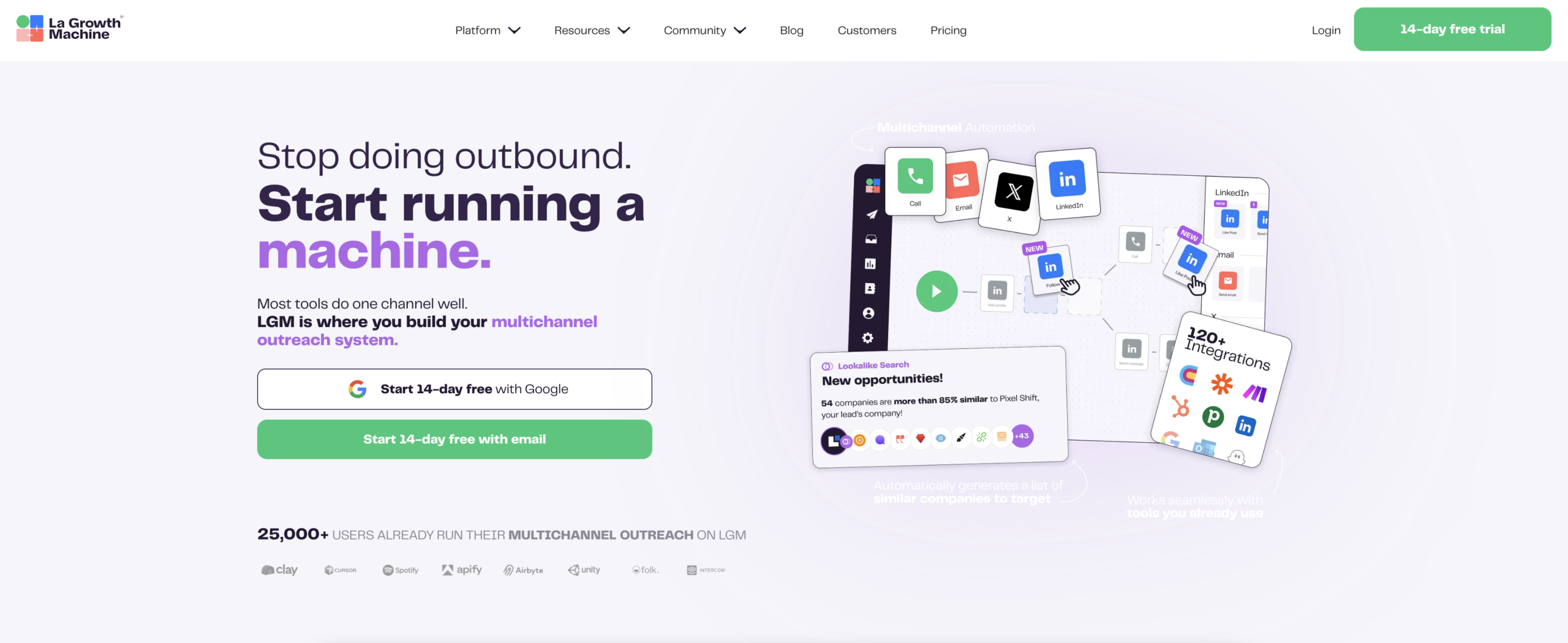
Key features. Sequence builder with if/then conditions. LinkedIn, email, X and calls in one sequence. LinkedIn voice messages. Waterfall enrichment across 9 email providers and 2 verification tools. Inbox rotation. Social warming. A shared inbox where LinkedIn, email and X replies land together. Performance tracking by campaign, message, channel and sender. Native two-way sync with HubSpot, Pipedrive, Salesforce, Folk and Recruit CRM, with no middleware in between.
The programmable surface is the part most reviews skip: a REST API, webhooks, an open-source MCP server exposing 40+ actions to any MCP client including Claude, ChatGPT and n8n, and 11 published GTM skills under an MIT licence.
Pros and cons.
- ✅ One contact story per person across channels, which is what makes the CRM record readable afterwards
- ✅ Cloud infrastructure with dedicated IPs, not a browser extension running in a rep’s session
- ✅ Enrichment inside the workflow, so a sequence does not stall on a missing email
- ⚠️ No contact database of its own. Sourcing stays upstream, by design
- ⚠️ The API and webhooks start at Pro. They are not on Basic
- ⚠️ Enrichment runs on a monthly credit allowance, not unlimited: 1,250 credits on Basic, 2,000 on Pro, 5,000 on Ultimate, at 1 credit for lead data and 5 for a verified email
Pricing. From €60 per identity per month on the monthly cycle, €50 on annual (the page shows annual by default). Pro €120, Ultimate €180 monthly. 14-day free trial, no card required. Agency and custom plans exist.
Converted to the unit a GTM engineer budgets in: Basic is €60 for 1,250 credits, and a fully enriched lead costs 5 credits, so 250 fully enriched leads at roughly €0.24 each. Pro works out near €0.30 and Ultimate near €0.18. That is arithmetic on published allowances, not a benchmark. It is also the only per-lead figure in this article that can be computed at all, because Apollo and Clay price in credits whose per-record cost depends on which provider answers.
Best for. B2B teams of 11 to 500 people whose buyers are reachable on LinkedIn and email, and who need every touch to land in the CRM.
2. Apollo.io: best for a database and a sequencer in one place
Overview. Apollo pairs a large B2B contact database with an email sequencer, so a team goes from ICP definition to running campaign without leaving one tab. It is less a rival to an execution platform than an upstream layer that also sends email.
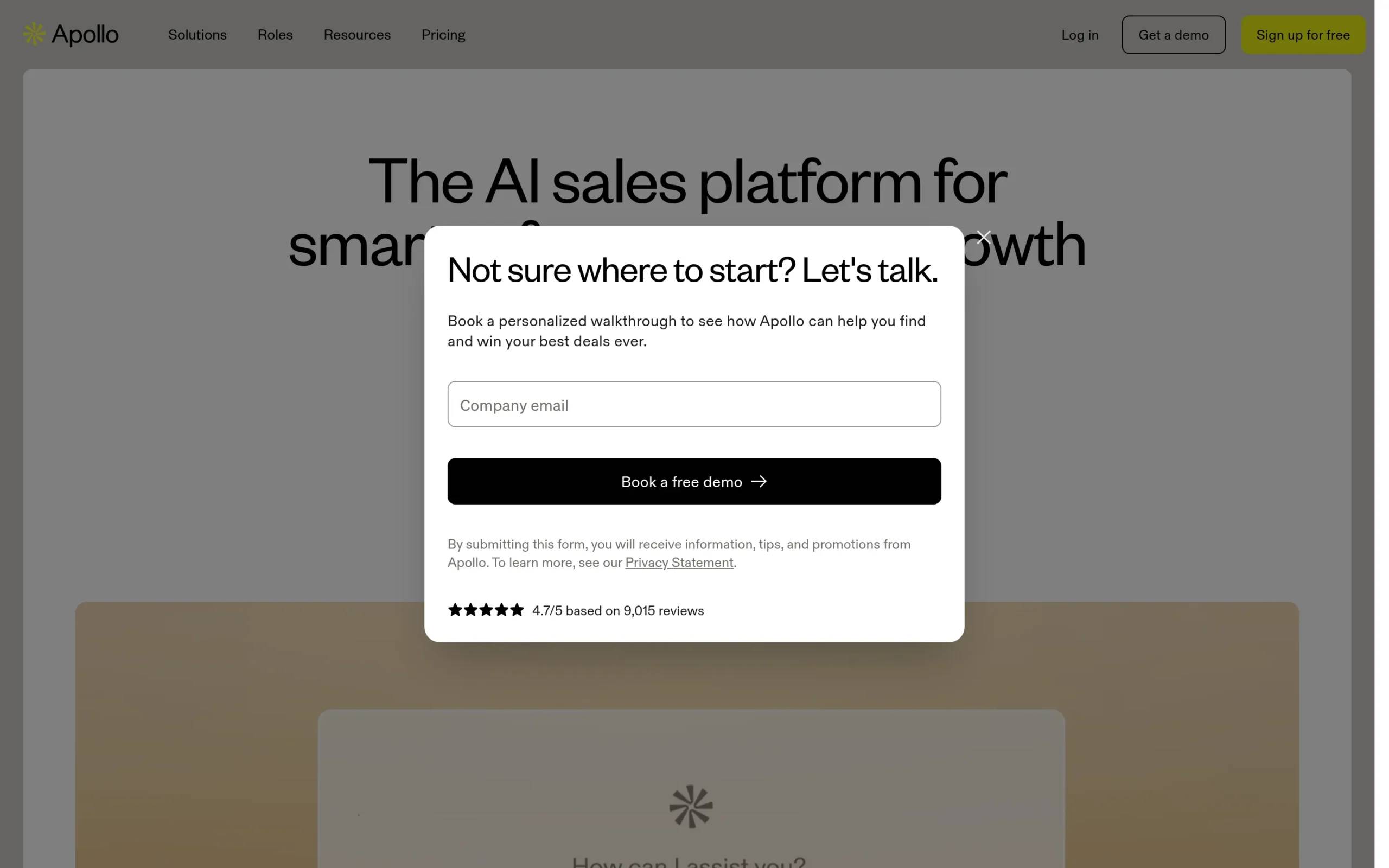
Key features. Firmographic and technographic filters, intent topics, AI lead scoring, waterfall enrichment, a deliverability suite with inbox warmup, CRM enrichment, a US dialer on paid plans, and a public API on every tier including Free.
Pros and cons.
- ✅ The free tier is genuinely usable, which is rare in this category
- ✅ API access from the free plan, unusual among data vendors
- ⚠️ Sequencing is email-first. LinkedIn steps are not part of the same sequence
- ⚠️ Mobile number quality varies by geography, which matters most outside the US
Pricing. Free plan with 75 credits per seat per month. Basic $65 per seat per month on monthly billing ($49 annual). Professional $99 monthly ($79 annual). Organization $149 per seat, minimum 3 seats, annual only.
Best for. Teams whose outbound motion is email-led and who want list building and sending under one contract.
3. Clay: best for composing enrichment waterfalls
Overview. Clay chains data providers in sequence and layers AI research on top. Its users are Growth Engineers and RevOps architects rather than reps, because the output is a table you design, not a campaign you launch.
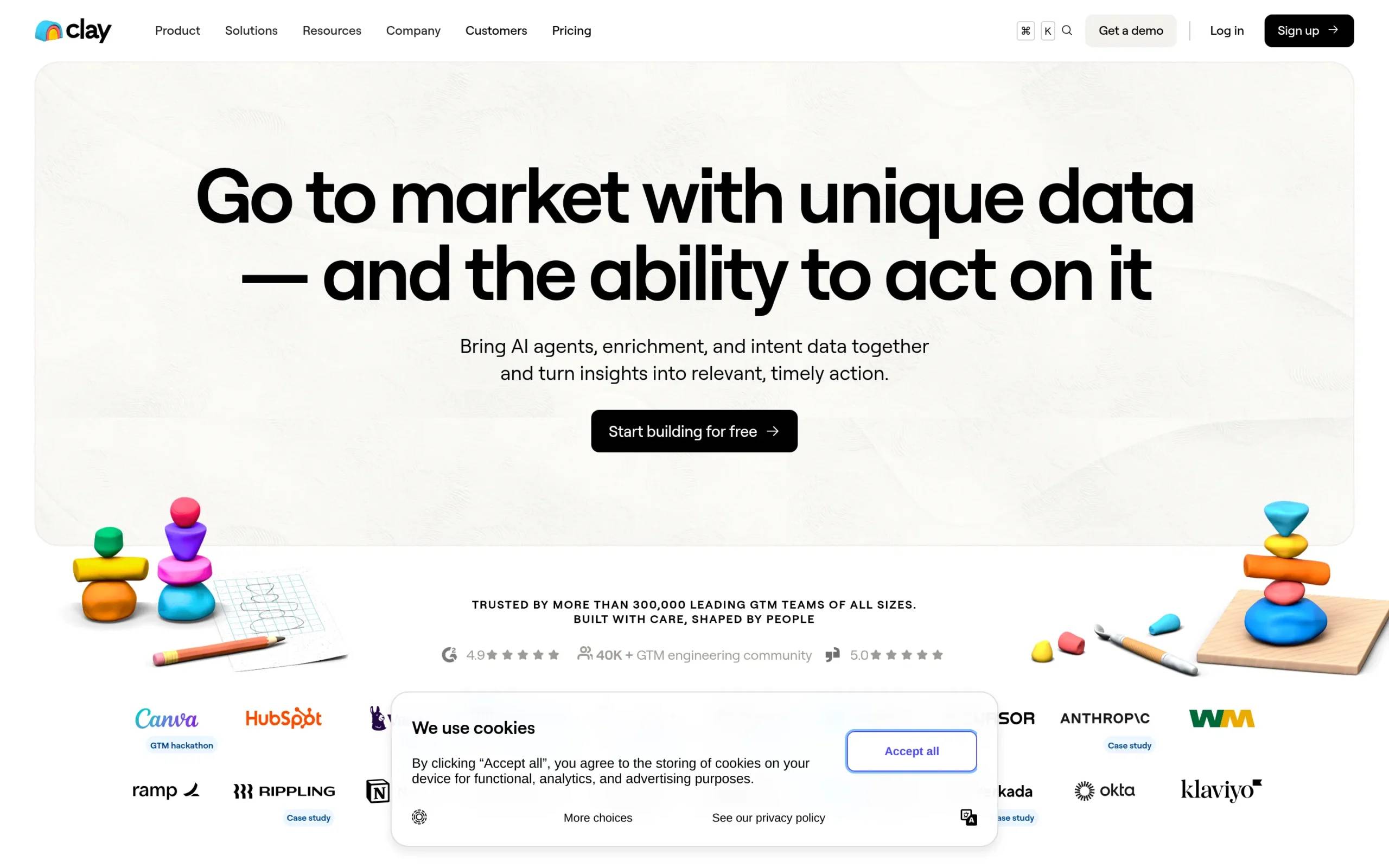
Key features. Waterfall enrichment across 50+ providers. Claygent, an AI agent that visits a site, reads it and returns structured fields. Signal tracking on job changes, promotions, new hires and company news. Audiences search. A native email sequencer, plus integrations that push enriched lists into an execution platform.
Pros and cons.
- ✅ The deepest enrichment composition available, and it fits any upstream source
- ✅ Bring-your-own API key on the free plan
- ⚠️ Credit consumption is the real cost driver, and it is easy to misjudge on the first month
- ⚠️ The learning curve is closer to a spreadsheet-plus-scripting tool than to a sales app
Pricing. Free plan with 6,000 actions and 1,200 data credits per year. Launch from $167 per month. Growth from $446 per month. Enterprise on quote. Annual billing saves 10%.
Best for. RevOps and Growth Engineers who want to design the data layer themselves rather than accept a vendor’s defaults.
4. Cognism: best for phone-verified mobiles in Europe
Overview. Cognism competes on verification rather than volume. Its mobile numbers go through a human verification step on top of algorithmic matching, which is what shows up in connect rates on senior European contacts.
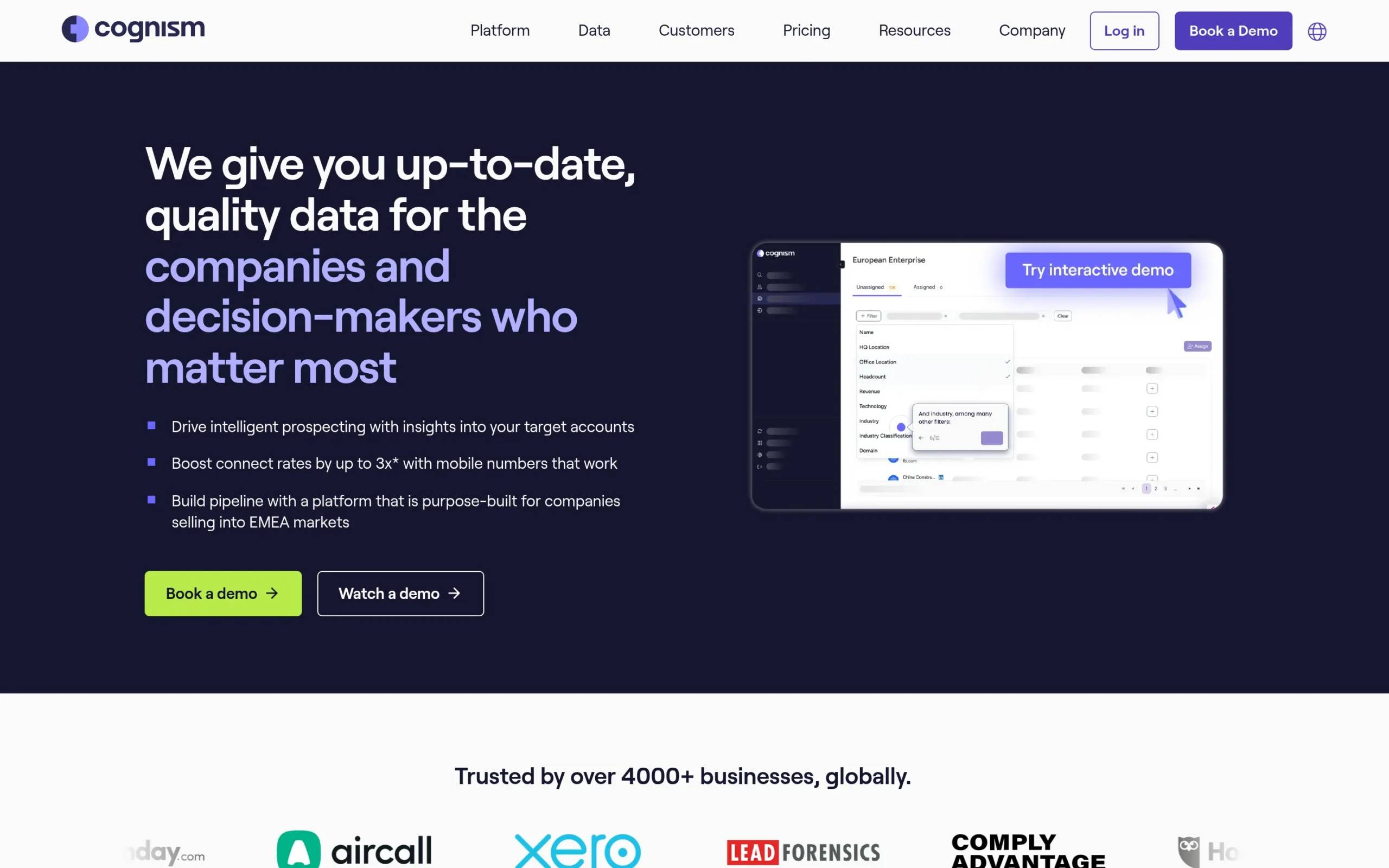
Key features. Phone-verified mobiles. GDPR and CCPA frameworks with consent signals where available. Intent data. CRM enrichment as add-on or standalone. Data-as-a-Service priced on volume.
Pros and cons.
- ✅ The default choice when compliance in EMEA is a buying criterion
- ✅ Sits cleanly upstream of any execution platform
- ⚠️ No published pricing at all, so budgeting requires a sales conversation
- ⚠️ Priced above general-purpose databases, which only pays back if phone is a real channel for you
Pricing. Quote only. Two packages are named publicly, Standard and Pro, each with 5 seats included.
Best for. European sales teams whose motion includes calling, and regulated industries where consent provenance is checked.
5. ZoomInfo: best for enterprise coverage and intent
Overview. ZoomInfo is the incumbent enterprise data platform in North America, and the one this list was missing. It sells breadth of coverage plus behavioural intent, and it is bought by RevOps rather than by a rep.
Key features. Contact and company data at enterprise scale, intent topics built on web activity, website visitor identification, conversation intelligence, and scheduled enrichment into Salesforce or HubSpot.
Pros and cons.
- ✅ The broadest US coverage of the five data vendors here
- ✅ Intent signals that a smaller provider cannot match on volume
- ⚠️ No public pricing, and contracts are annual with a seat minimum
- ⚠️ The most expensive line in most stacks that carry it
Pricing. Quote only. ZoomInfo publishes no rates.
Best for. Enterprise revenue teams selling into the US where coverage gaps cost more than the licence.
6. Salesloft: best for manager coaching and pipeline visibility
Overview. Salesloft is one of the two enterprise sales engagement platforms. It runs sequences across email, phone and LinkedIn, then layers conversation intelligence and forecasting on top so managers see what is happening before it reaches the close rate.
Key features. Cadence engine across email, phone and LinkedIn. Call recording and transcription. Deal health scoring. Coaching workflows tied to recordings. Pipeline forecasting. Deep Salesforce integration.
Pros and cons.
- ✅ Built for organisations that run weekly pipeline reviews off the data
- ✅ Coaching workflows that a rep-facing tool does not attempt
- ⚠️ No published pricing, annual contracts, per-seat licensing
- ⚠️ Setup and enablement cost is real, and it is not worth carrying below roughly 10 reps
Pricing. Quote only. The pricing page publishes no rates.
Best for. Sales organisations with a dedicated enablement function and enough volume to justify per-seat cost.
7. Outreach: best for AI deal insights and forecasting
Overview. Outreach competes with Salesloft in the same segment, weighted toward deal intelligence rather than sequence execution. Worth noting for anyone auditing an old vendor list: the company now operates on outreach.ai, and outreach.io redirects there.
Key features. Multi-step sequences across email, phone and LinkedIn. Kaia, the call AI that joins live calls, takes notes and pushes summaries into Salesforce or HubSpot. Deal health scoring and risk flagging. Forecasting on full engagement history. Packaging is organised around AI credit tiers: Amplify Essentials, Core, Plus and Pro.
Pros and cons.
- ✅ The strongest deal-risk tooling of the twelve
- ✅ Hybrid pricing model with no separate platform fee
- ⚠️ Quote only, and the AI credit dimension makes cost harder to predict
- ⚠️ Value compounds with historical data, so month one is the worst month
Best for. Enterprise teams running complex multi-stakeholder deals where early intervention is worth more than sending volume.
Pricing. Quote only, per user, with AI credits packaged by tier.
8. Instantly: best for high-volume cold email
Overview. Instantly is built for email volume. Inbox rotation across sending domains and an inbox warmup system are the core, and everything else serves those two.
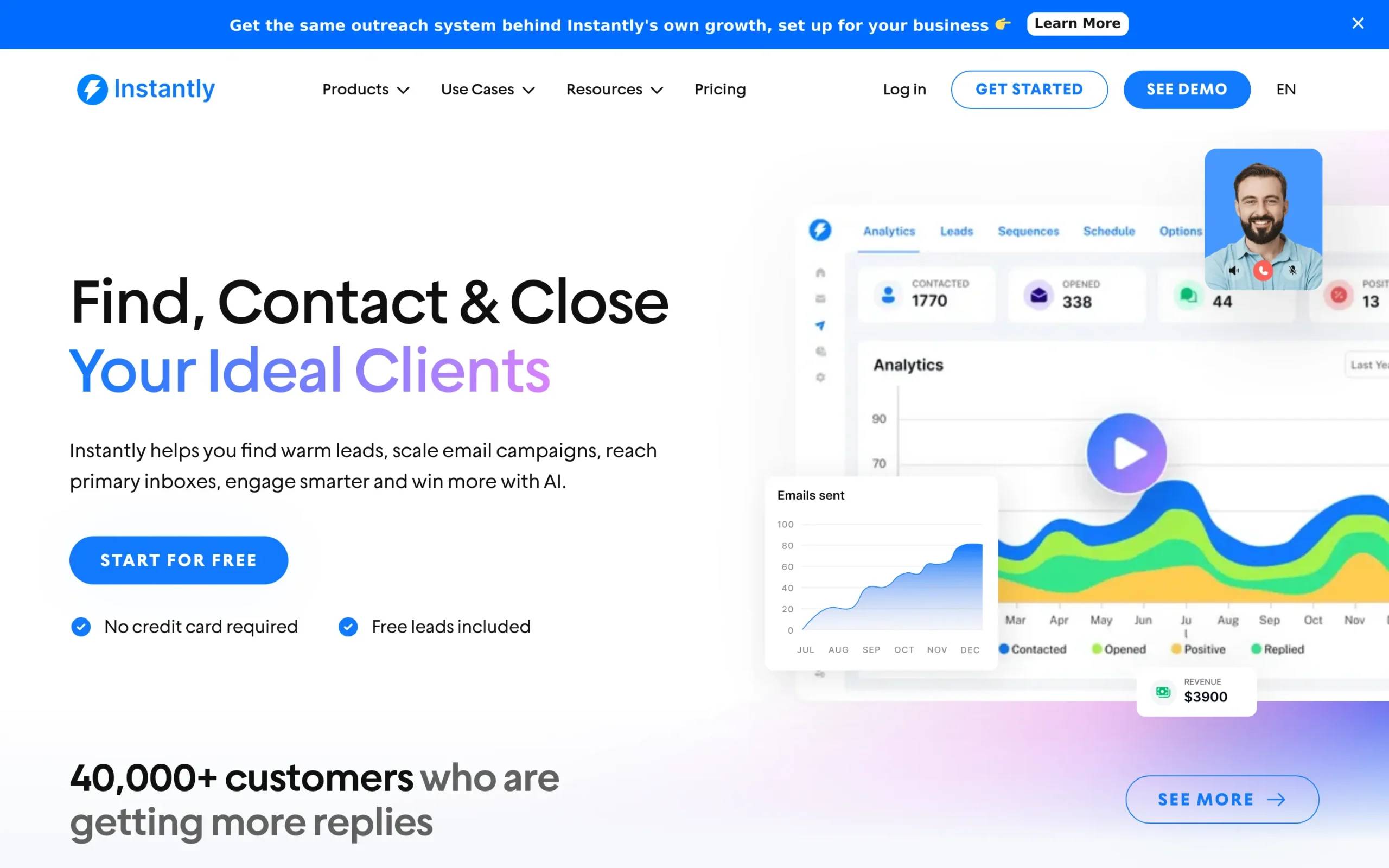
Key features. Unlimited email accounts on the entry plan. Inbox rotation. Warmup. A 450M-record lead database on the bundle plans. AI reply handling on higher tiers. Deliverability reporting.
Pros and cons.
- ✅ The clearest deliverability tooling in the list for pure email motions
- ✅ Unlimited sending accounts from the entry tier
- ⚠️ Email only. There is no LinkedIn or phone step inside the sequence
- ⚠️ Two parallel pricing structures, bundles and outreach-only, which makes comparison work
Pricing. Growth (outreach-only) $47 per month. Starter bundle $94, Scale $194, Agency $555, all monthly. Annual billing saves 10%.
Best for. Teams whose outbound is email-led and measured in tens of thousands of sends per month.
9. Lemlist: best for visual personalization across channels
Overview. Lemlist started as a cold email tool with a personalization layer and is now multichannel. A correction we owe readers: an earlier version of this article called Lemlist email-only, and that has not been true for some time.
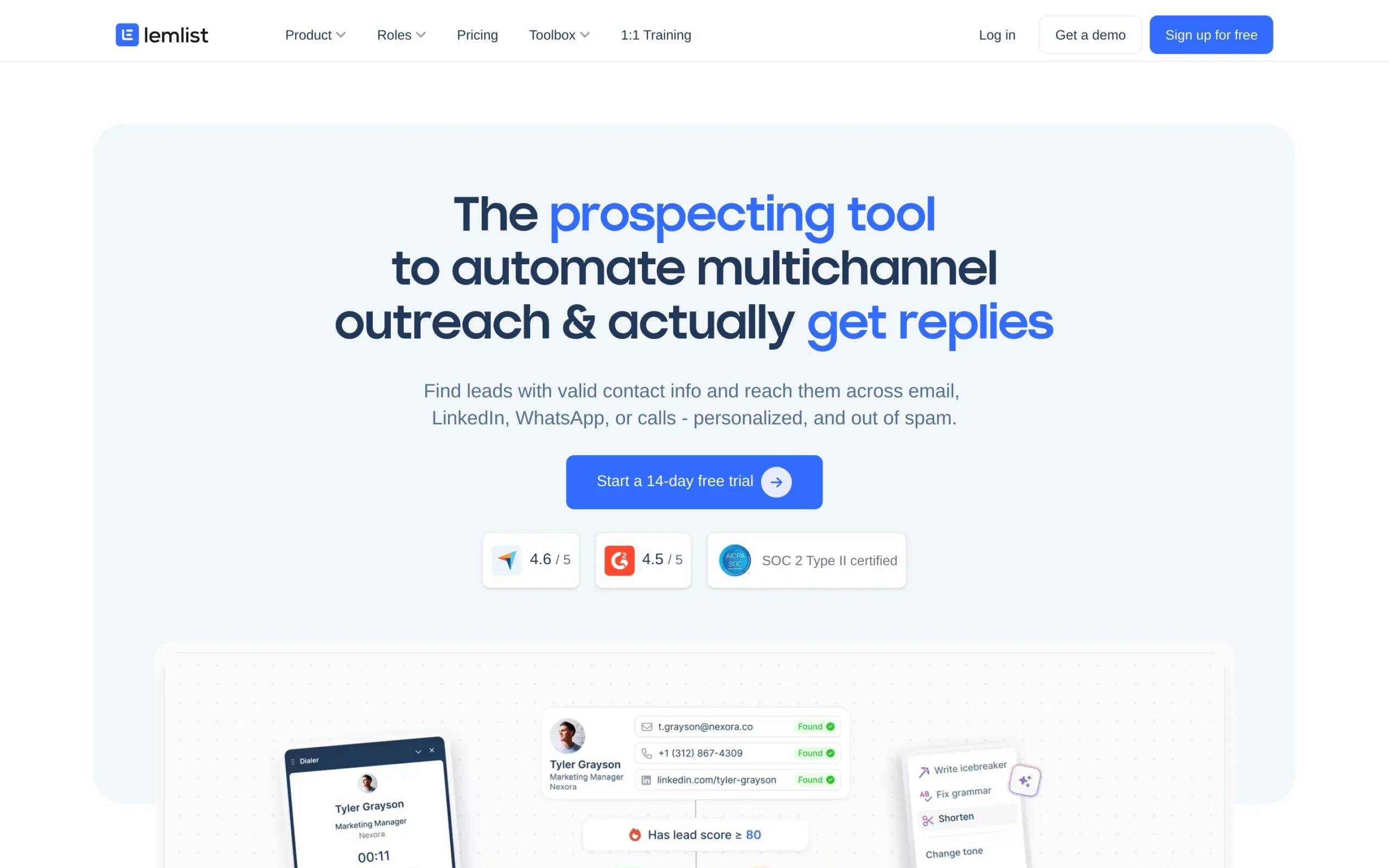
Key features. Custom images, videos and dynamic variables inside email templates. On the Multichannel plan: LinkedIn steps, SMS, a WhatsApp add-on and a built-in call dialer with VoIP integrations, plus five senders per user. A lead database and an inbox warmup product.
Pros and cons.
- ✅ The strongest visual personalization of the twelve
- ✅ Genuinely multichannel on the paid tier, including a native dialer
- ⚠️ Multichannel is priced per user on top of the email plan, so the entry price is not the working price
- ⚠️ The email-only plan is a different product from the one most comparison lists describe
Pricing. Email $69 per user per month, $55 annual. Multichannel $109 per user per month, $87 annual. Enterprise on quote.
Best for. Teams selling to buyers who respond to creative, visually distinct outreach, and who want channels beyond email without moving to an enterprise platform.
10. HeyReach: best for LinkedIn across many sender accounts
Overview. HeyReach is built around one constraint: running LinkedIn outreach from many accounts at once without tripping platform limits. That makes it a multi-sender and agency tool more than a single-team one.
Key features. Unlimited LinkedIn senders on the entry plan. Centralised inbox across senders. Account-level limit management. Enrichment credits per sender for email discovery. Native email sending is not part of the product and is handled through integrations.
Pros and cons.
- ✅ Unlimited senders from $79, which no other tool here matches
- ✅ Purpose-built for multi-account and multi-client work
- ⚠️ LinkedIn only. Email requires another tool and another sequence
- ⚠️ The jump from Growth to Agency is $79 to $999, with nothing in between
Pricing. Growth $79 per month, $63 annual. Agency $999 per month with 25 senders, $799 annual. Unlimited $2,999 monthly, $2,399 annual.
Best for. Lead generation agencies and teams running LinkedIn at scale across many identities.
11. Ringover: best for adding a phone layer
Overview. Ringover is a cloud phone system rather than an outbound platform. It earns its place because the phone layer is the one most stacks bolt on last and worst, and it integrates with the execution layer instead of replacing it.
Key features. Cloud telephony with local numbers across 65 countries on annual plans. Power dialer. Call recording, transcription and summaries. Advanced IVR and routing. Call campaigns and local presence dialing on the top tier. 100+ integrations, including a native connection to La Growth Machine.
Pros and cons.
- ✅ The cheapest entry point in this list at $15 per user per month
- ✅ Slots into an existing stack without displacing anything
- ⚠️ Not an outbound platform. It carries calls, it does not build sequences
- ⚠️ Several of the country-coverage features are annual-plan only
Pricing. Talk $15 per user per month excluding tax. Business $47. Advanced on quote.
Best for. Teams adding calls to an existing LinkedIn and email motion.
12. HubSpot Sales Hub: best as the system of record
Overview. Every tool above produces activity. HubSpot is where that activity becomes pipeline you can report on. It belongs in an outbound list for the same reason a warehouse belongs in a logistics stack: nothing above it is measurable without it.
Key features. Contact and deal management, sequences, meeting scheduling, quotes, forecasting, and reporting that ties outbound activity to closed revenue. A documented public API. Native two-way connections from most execution platforms, including La Growth Machine.
Pros and cons.
- ✅ A free tier for up to 2 users, which makes it the lowest-friction way to start measuring
- ✅ The most common integration target, so almost anything connects to it
- ⚠️ Professional carries a one-time $1,500 onboarding fee, and Enterprise $3,500
- ⚠️ The gap between Starter and Professional is $20 to $100 per seat, which surprises teams that grow into it
Pricing. Free for up to 2 users. Starter $20 per seat per month, $7 on annual. Professional $100 per seat monthly, $90 annual. Enterprise on quote.
Best for. Any outbound team that cannot currently answer which campaign produced which closed deal.
Best outbound sales tool by use case
…for GTM and RevOps teams
You are not choosing a tool, you are choosing which components you can still swap in eighteen months. That makes the programmable surface the criterion, not the feature list.
Pick Clay for the data layer, the only one that lets you compose providers rather than accept one. Pick an execution layer with a real API and webhooks, so the sequence becomes a step in your system rather than a destination. Keep the CRM as the boundary: the contact layer and the CRM are the two parts a team does not want to re-platform every year.
If your team already drives work from an AI client, check what the execution layer exposes to it. La Growth Machine publishes 11 GTM skills under an MIT licence alongside its MCP server, which is a different level of access from a REST endpoint alone.
…for growth-stage B2B SaaS
Two constraints collide: the ICP is still moving, and the budget is real. An enterprise platform locks you into a playbook you have not written yet.
Start with La Growth Machine at €60 per identity for LinkedIn and email execution, add Apollo on the free or Basic tier for sourcing, and keep HubSpot free until reporting demands more. That is a working stack under $130 a month before enrichment overages. Move to Salesloft or Outreach when you have managers who need coaching data, not before.
…for small B2B teams and founders
Under five people, the failure mode is not picking the wrong tool. It is buying four and using one.
La Growth Machine covers LinkedIn and email execution from €60 per identity, with 1,250 enrichment credits a month on Basic, which is 250 fully enriched leads. HubSpot free covers the record. Two tools, one integration. Add a data source when you can name the specific list you cannot build, and not before.
…for high-volume SDR teams
Volume changes which constraint binds. Deliverability and sender capacity become the ceiling, not sequence logic.
For email-led volume, Instantly at $47 with unlimited sending accounts and inbox rotation is built for exactly this. For LinkedIn-led volume across many identities, HeyReach at $79 is the only entry-tier tool here with no sender cap. Work both channels against the same buyer and the sequence has to be shared, or the prospect gets two disconnected conversations. That is the case for a multichannel outreach platform rather than two specialists.
Working LinkedIn, email and calls against the same buyer? Meet La Growth Machine
Most stacks end up with a LinkedIn tool, an email tool and two separate reply inboxes. The prospect experiences that as two strangers from the same company, and the CRM records it as two unrelated activity streams.
La Growth Machine keeps one sequence per person. A reply on LinkedIn stops the email branch. Every touch on every channel lands on the same CRM record through a native two-way sync with HubSpot, Pipedrive, Salesforce, Folk and Recruit CRM, with no Zapier step in between. That is what makes outbound attributable afterwards.
To drive it from your own systems there is a REST API and webhooks from the Pro plan, plus an open-source MCP server exposing 40+ actions to any MCP client and 11 GTM skills published under an MIT licence.
Who this is for. B2B companies in software, tech, finance and agencies, 11 to 500 people, with a sales team scaling its motion or a GTM team building it. It is not the right pick if you need a contact database, because there is not one, and it is not the right pick if your only channel is bulk email.
The integration layer nobody compares
Every list in this category compares features. Almost none compare the thing that decides whether a stack survives contact with a real revenue team: how the tools talk to each other.
Which of these tools you can actually build on
All twelve publish an API. What differs is what it costs to reach it and what it exposes.
| Tool | Developer portal | API unlocks on |
|---|---|---|
| Apollo.io | docs.apollo.io | Free plan |
| HubSpot | developers.hubspot.com | Free tier |
| Clay | docs.clay.com | Paid plans |
| La Growth Machine | lagrowthmachine.com/api | Pro plan, not Basic |
| Instantly | developer.instantly.ai | Paid plans |
| Lemlist | developer.lemlist.com | Paid plans |
| HeyReach | Postman collection, X-API-KEY header | Paid plans |
| Ringover | developer.ringover.com | Paid plans |
| Salesloft | developer.salesloft.com | Paid contract |
| Outreach | developers.outreach.io | Paid contract |
| ZoomInfo | api-docs.zoominfo.com | Enterprise contract |
| Cognism | developers.cognism.com | Paid contract |
The practical read: prototyping is free on Apollo and HubSpot, and on nothing else here. Building something durable means checking the tier before you sign, because API access is the feature most often one plan above the one on the banner. La Growth Machine is a fair example of the trap, since its API and webhooks start at Pro and Basic has neither.
⚠️ We verified that each portal exists and which plan gates it. We did not benchmark rate limits, payload shapes or webhook reliability across all twelve, and we are not going to pretend otherwise.
Why native CRM sync is not the same as a CRM integration
A logo on an integrations page means three different things. A native two-way sync writes activity into the CRM and reads status back. A one-way push writes and never reads. A middleware connection through Zapier or Make is a third system with its own quotas, its own failure modes and its own retry behaviour, which means it is one more thing to monitor rather than one less.
Outbound attribution breaks at exactly that seam. If the reply that changed a deal’s trajectory lives in a tool the CRM never heard about, the pipeline report credits the wrong source and next quarter’s budget follows it.
How to choose the right outbound sales tool
- Name the layer before you shortlist. Sourcing, enrichment, execution, phone and CRM are five different purchases. Most stack bloat comes from buying the same layer twice.
- Start with the channel your buyers answer on. If your ICP replies on LinkedIn, an email-only tool caps reply volume no matter how good the copy is. If they only answer email, a multichannel platform is capacity you will not use.
- Check the plan the feature is actually on. APIs, webhooks, call steps and extra senders sit on higher tiers across this category. Price the tier you need, not the one on the banner.
- Read the billing cycle. Nearly every vendor here displays annual by default. Comparing an annual rate against a monthly one is how a stack ends up 25% over budget.
- Decide where the record lives, first. Pick the CRM before the outreach tool, then keep only tools that write to it natively. Anything needing middleware is a future outage.
Frequently asked questions
What is the best outbound sales tool for a small B2B team?
For a team under five people, La Growth Machine at €60 per identity per month covers LinkedIn and email execution, with 1,250 enrichment credits in the monthly allowance, which is 250 fully enriched leads. Pair it with HubSpot’s free tier for the record. Two tools, one native integration, and it avoids the most common small-team mistake: buying four tools and running one.
Do I need a separate CRM for outbound sales?
Yes, and it should be chosen first. Outbound tools record activity; the CRM records outcomes, and only the CRM connects a sequence to closed revenue. HubSpot Sales Hub is free for up to two users and $20 per seat per month on Starter, so cost is rarely the blocker. The question is whether your outreach platform writes to it natively or through middleware.
What is the difference between an outreach tool and a sales engagement platform?
An outreach tool is built for the rep running campaigns: sequence building, sending across channels, handling replies. A sales engagement platform adds a manager layer with conversation intelligence, coaching workflows, deal health scoring and forecasting. La Growth Machine, Instantly, Lemlist and HeyReach sit in the first group, Salesloft and Outreach in the second. What matters when buying is whether you are equipping reps or instrumenting a sales organisation.
Which outbound sales tools have a public API?
All twelve do, and we opened each developer portal on 21 August 2026 to check. What differs is the plan it unlocks on. Apollo and HubSpot expose an API on their free tiers. La Growth Machine’s API and webhooks start at Pro and are not on Basic. Salesloft, Outreach, ZoomInfo and Cognism gate access behind a paid or enterprise contract. If you intend to build on top of the tool, verify the tier before signing.
How much does a full outbound sales stack cost per month?
For a small team, roughly €60 to €130 per month: one execution platform, a free-tier data source, a free-tier CRM. For a growth-stage team, roughly $500 to $1,500 once enrichment and the CRM are paid. Enterprise stacks combining ZoomInfo or Cognism with Salesloft or Outreach and Salesforce run into five and six figures annually, and none of those four vendors publishes a rate.
The more useful unit is cost per enriched lead. On La Growth Machine’s Basic plan that is computable from the published allowance, €60 for 250 fully enriched leads, or about €0.24 each. On Apollo and Clay it is not, because a credit buys a different amount depending on which provider returns the record. Prices verified 21 August 2026.
Is Lemlist email-only?
No. Lemlist’s Multichannel plan, at $109 per user per month on monthly billing, includes LinkedIn steps, SMS, a WhatsApp add-on and a built-in call dialer alongside email. Its $69 Email plan is email-only, which is the source of the confusion in most comparison articles, including an earlier version of this one.
Conclusion: our top picks
If your buyers answer on LinkedIn and email and you need those touches on one CRM record, La Growth Machine is the pick, from €60 per identity per month with a 14-day free trial and no card required.
Need a database and a sequencer under one contract: Apollo.io. Designing the data layer yourself: Clay. Calling senior European buyers: Cognism. Managers who need coaching data rather than reps who need throughput: Salesloft or Outreach.
If you are not sure which layer your next purchase belongs to, answer that before comparing any two tools on this page.