
TL;DR
– La Growth Machine is the top pick for B2B outreach: native multichannel sequences (LinkedIn, email, Twitter), waterfall enrichment, and CRM sync built in from the start.
– HubSpot Sales Hub is the strongest option for teams already in the HubSpot ecosystem who want CRM-native email sequences and pipeline automation.
– Salesloft and Outreach are enterprise-grade sales engagement platforms with conversation intelligence and AI deal insights — best for large, managed sales teams.
– Apollo.io and Clay sit upstream as data layers: Apollo combines a contact database with email sequences, while Clay is a pure enrichment platform pulling from 50+ sources.
– Zapier fills the integration gaps in best-of-breed stacks, connecting tools that lack native sync without requiring custom development.
Sales automation software is not a single thing. The term covers prospecting databases, multichannel outreach sequences, CRM sync, follow-up triggers, call intelligence, and workflow connectors. Ask five RevOps leaders what it means and you will get five different answers, each shaped by the tools they already run.
That ambiguity is expensive. Most B2B teams end up stitching together three, four, or five point solutions — a data enrichment tool here, an email sequencer there, a LinkedIn automation layer on top — and paying the fragmentation tax: duplicated contacts, broken handoffs, no clear line from outreach activity to booked meetings, and revenue attribution that falls apart the moment a rep closes a tab.
The better question is not “which sales automation software should I use?” but “where in my pipeline does the fragmentation hurt most?” Answering that shapes which tools belong in your stack and which ones you can cut.
This guide covers the eight platforms worth evaluating in 2026 — what each one actually does, where it fits, and what it costs.
TL;DR comparison table
| Tool | Best For | Channels | Enrichment | CRM Sync | Starting Price |
|---|---|---|---|---|---|
| La Growth Machine | Multichannel outreach + enrichment | LinkedIn, Email, Twitter | Native waterfall | HubSpot, Pipedrive, Salesforce | €60/month per identity |
| HubSpot Sales Hub | CRM-native sales teams | No | Native | Starts free | |
| Salesloft | Enterprise sales engagement | Email, Phone | No | Native | Custom |
| Outreach | Enterprise AI deal intelligence | Email, Phone | No | Native | Custom |
| Apollo.io | Prospecting database + sequences | Partial | Yes | Free tier available | |
| Clay | AI-powered data enrichment layer | No outreach | 50+ sources | Via integrations | Starts at $149/month |
| Zapier | Custom workflow automation | Depends on stack | No | Via integrations | Starts free |
| Reply.io | Multichannel outreach (SMB) | Email, LinkedIn, Calls | No | Yes | From $59/month |
1. La Growth Machine
La Growth Machine is the top pick for B2B teams that want outreach execution and data enrichment in a single platform. Instead of buying a separate enrichment tool, connecting it to a sequence tool, and hoping the sync holds, La Growth Machine handles the full loop: find the contact data, run the multichannel sequence, and push the activity back to your CRM.
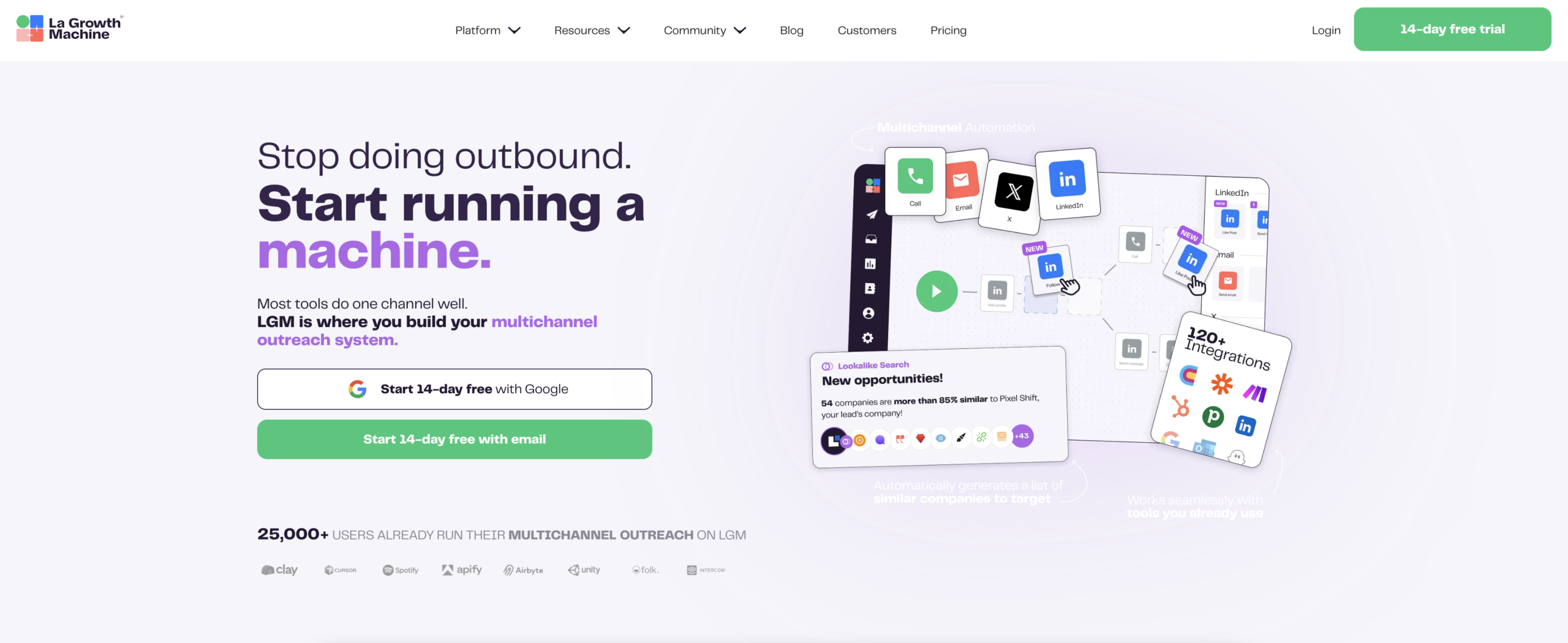
The outreach layer covers LinkedIn, email, and Twitter (X) in a single sequence editor. You build a campaign once and La Growth Machine orchestrates the touchpoints across channels, with timing and conditions you control. Voice messages via AI are available for LinkedIn, which almost no competing platform offers natively.
The enrichment layer is a waterfall model: La Growth Machine queries multiple data sources in sequence and stops when it finds a verified result. That means you start a campaign with a LinkedIn URL and end up with a validated professional email, without touching a separate enrichment tool or burning credits on bad data.
CRM sync covers HubSpot, Pipedrive, and Salesforce natively. Activities, replies, and lead status flow back to your CRM in real time, so RevOps gets clean data and managers can report on pipeline contribution without manual exports.
Pricing on annual billing: Basic at €60/month per identity, Pro at €120/month per identity, Ultimate at €180/month per identity.
Best for: B2B sales teams and Growth engineers who want outreach and enrichment in one platform, with CRM sync that actually works out of the box.
2. HubSpot Sales Hub
HubSpot Sales Hub is the natural choice for teams already running their CRM on HubSpot. The automation sits inside the CRM rather than connecting to it, which eliminates an entire category of sync problems.
Email sequences, deal pipeline automation, task creation, and meeting scheduling all operate from the same contact record. The AI email assistant helps reps draft personalized outreach without leaving the CRM. Enrollment triggers can kick off sequences automatically when a contact hits a lifecycle stage, a deal property changes, or a form is submitted.
The trade-off is channel coverage. HubSpot Sales Hub is primarily an email and phone tool. Teams that need structured LinkedIn outreach will need a separate layer. It also requires the broader HubSpot ecosystem to deliver its best value — using it as a standalone tool underdelivers.
Best for: Teams already on HubSpot CRM who want email sequence automation and pipeline workflows without introducing a third-party connector.
3. Salesloft
Salesloft is a sales engagement platform built for enterprise teams with structured sales processes and coaching requirements. The core product covers email and call cadences, but the differentiation is above the sequence layer.
Conversation intelligence records and transcribes calls, surfaces key moments, and flags coaching opportunities for managers. Pipeline forecasting uses historical data and deal signals to project close rates. For a Head of Sales managing a team of 15 reps, that visibility is worth more than another sequence template.
Salesloft operates at enterprise pricing with custom contracts, which puts it out of range for teams under 50 people. The platform assumes you have a RevOps function to configure it properly — it rewards investment in setup.
Best for: Enterprise sales teams that need conversation intelligence and pipeline forecasting alongside email and call automation, with budget for a premium platform.
4. Outreach
Outreach competes directly with Salesloft at the enterprise tier and has pushed further into AI-powered deal intelligence. The Kaia AI call assistant transcribes calls in real time, surfaces objection-handling cues, and logs activity automatically.
The sequence layer handles email and call automation with sophisticated branching logic. AI deal insights surface risk signals across open opportunities — stalled deals, missing contacts in the buying committee, response pattern changes. For enterprise teams with complex, multi-stakeholder deals, that layer of deal intelligence translates directly to conversion rates on late-stage pipeline.
Like Salesloft, Outreach runs on custom enterprise pricing and requires a meaningful implementation investment. It is not the right tool for a team that needs to get running in a week.
Best for: Enterprise sales organizations running complex, multi-threaded deals who need AI-powered deal intelligence and call intelligence at scale.
5. Apollo.io
Apollo.io combines a prospecting database with an email sequence engine. The database covers over 275 million contacts with job titles, company data, and intent signals. The sequence tool lets you build email cadences directly from the database, which shortens the time from list to first touch.
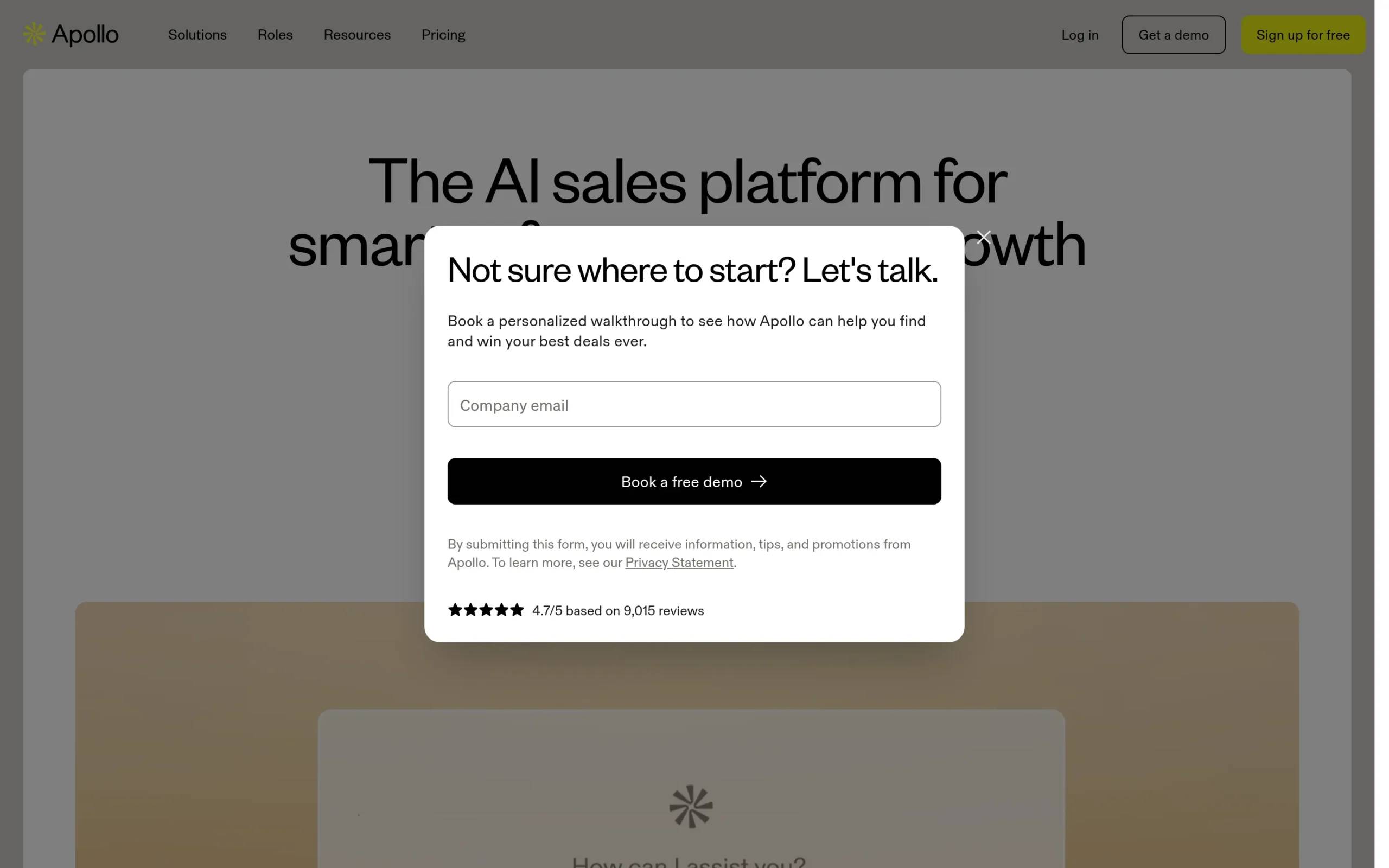
Apollo’s AI scoring surfaces which contacts in your database show buying intent based on web activity and job change signals. That makes the tool useful not just for building lists but for prioritizing which contacts your reps work first.
The main limitation is LinkedIn. Apollo does not offer native LinkedIn automation. Teams that want multichannel outreach — LinkedIn plus email in a coordinated sequence — will need to add a separate tool. Apollo works best as a prospecting data layer rather than a full outreach execution platform.
Best for: Teams that need a large B2B contact database with built-in email sequencing and AI-powered lead scoring, and are comfortable running LinkedIn outreach through a separate tool.
6. Clay
Clay is not an outreach tool. It is a data enrichment and lead building platform that sits upstream of your outreach execution. Understanding that distinction matters before evaluating it.
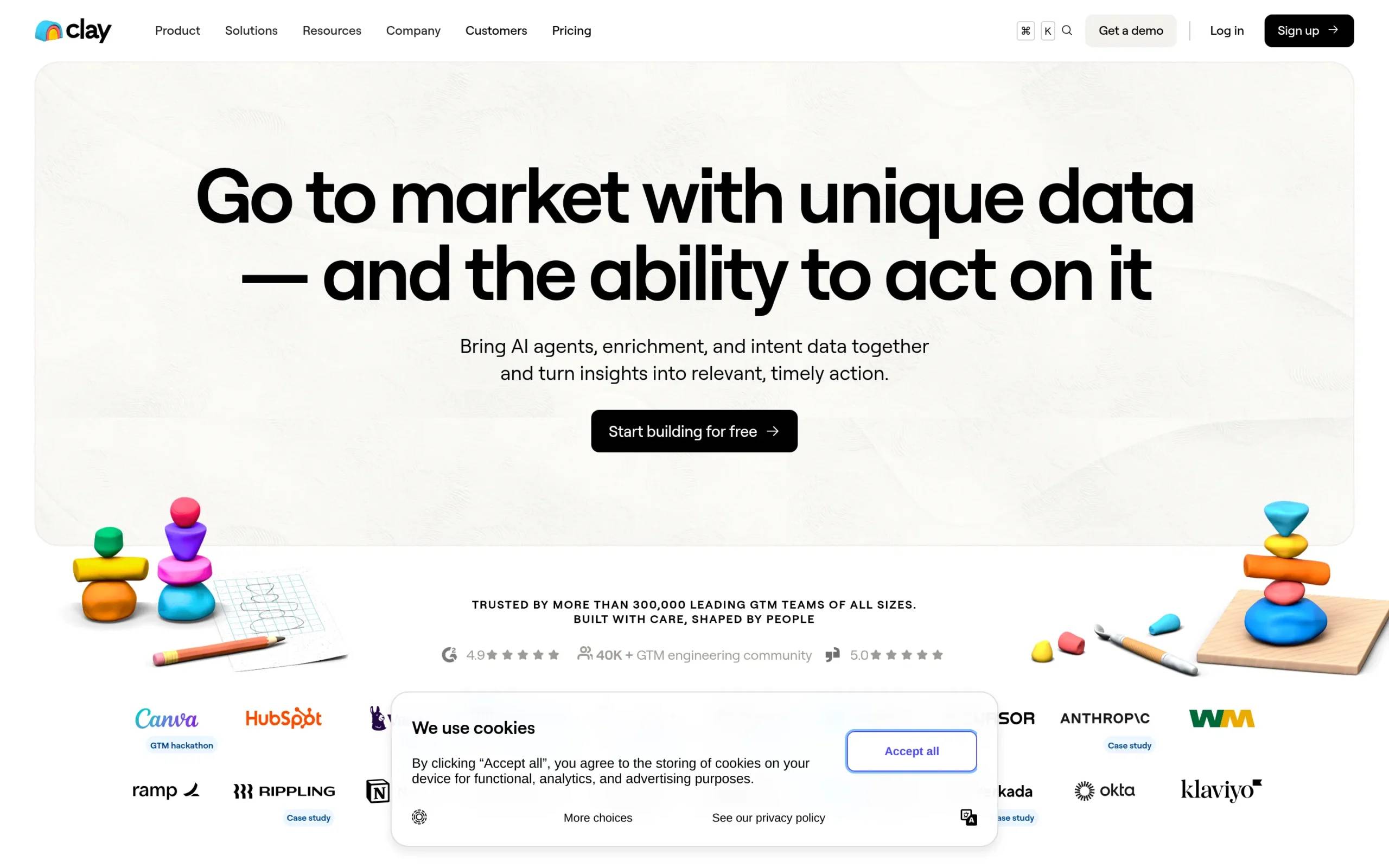
Clay pulls from 50+ data sources — Apollo, Clearbit, LinkedIn, web scraping, AI enrichment — and lets you build enriched lead tables with custom logic. You can identify companies that match your ICP, enrich them with contact data, score them against custom signals, and push the output to your outreach tool of choice. Teams that run Clay alongside La Growth Machine or another outreach platform typically see higher conversion rates because they start with better-qualified, better-enriched lists.
The learning curve is real. Clay rewards users who understand data logic and workflow building. It is a tool for the Growth or RevOps engineer, not a tool you hand to a new SDR.
Best for: RevOps and Growth engineers who want to build highly customized lead enrichment workflows pulling from multiple data sources before passing lists to an outreach platform.
7. Zapier
Zapier is a workflow automation layer, not a sales tool in itself. Its value in a sales automation stack is connecting tools that do not talk to each other natively — triggering a sequence when a deal stage changes, syncing a form submission to your CRM, or routing a reply to a Slack channel.
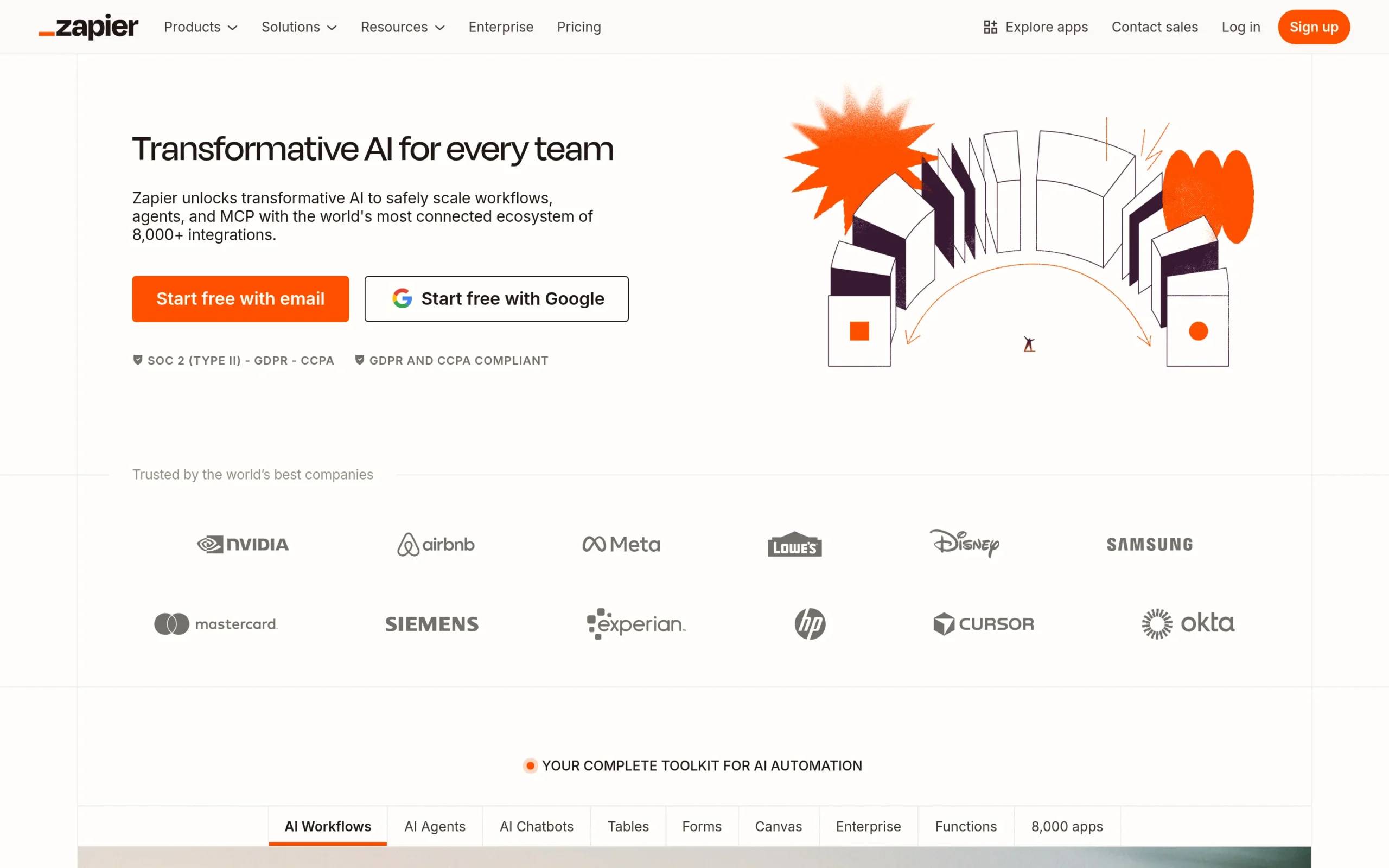
For teams building a best-of-breed sales stack, Zapier fills the gaps between point solutions. A company running Apollo for prospecting, La Growth Machine for outreach, and Salesforce for CRM can use Zapier to automate the handoffs that would otherwise require manual work or custom API development.
The limitation is reliability at scale and complexity. Zaps that work for 100 leads per week start showing edge cases at 1,000. Teams with high volume or complex conditional logic eventually hit the ceiling of what Zapier handles cleanly and need to move to a more robust integration layer.
Best for: Teams assembling a best-of-breed sales stack who need no-code automation to connect tools that lack native integrations.
8. Reply.io
Reply.io is a multichannel outreach platform covering email, LinkedIn, and calls. The AI email writer generates personalized first lines and full sequences. The platform sits in the SMB segment and is accessible without an enterprise procurement process.
Reply.io covers the basics of multichannel outreach at a price point that works for smaller teams. It lacks the enrichment depth of La Growth Machine and the enterprise-grade intelligence of Salesloft or Outreach, but it gets the job done for teams that need a straightforward outreach tool without complexity.
Best for: Smaller sales teams that need multichannel outreach across email and LinkedIn at an accessible price point.
How to choose your sales automation stack
The single-platform vs. best-of-breed debate does not have a universal answer. It depends on where you sit on the growth curve.
If you are a team of 5 to 30 reps building your outbound motion, consolidation wins. Managing three separate tools with manual syncs burns time your team does not have. A platform like La Growth Machine that handles enrichment, outreach, and CRM sync natively reduces operational overhead and gives you clean data without a dedicated RevOps engineer to maintain the plumbing.
If you are a team of 50-plus reps with a dedicated RevOps function, best-of-breed starts to make sense. You can justify the integration cost because you have the headcount to manage it. Clay for enrichment, La Growth Machine for outreach execution, Salesforce as the CRM of record — each tool does one thing well and the integrations are worth maintaining.
Whatever the stack size, prioritize these four factors:
Channels. Where are your buyers actually reachable? LinkedIn is non-negotiable for B2B outreach in most industries. If your tool does not cover LinkedIn natively, you are adding complexity.
Enrichment. Starting a sequence with incomplete or stale contact data kills deliverability and conversion rates. Either run a tool with built-in enrichment (La Growth Machine) or build a dedicated enrichment step upstream (Clay) before your sequences fire.
CRM sync. Revenue attribution only works if activity data flows to your CRM reliably. Native integrations beat webhook-based connectors. Ask vendors to show you exactly which fields sync and how often.
AI. In 2026, AI capabilities in outreach tools range from cosmetic (email subject line suggestions) to substantive (deal risk signals, conversation intelligence, waterfall enrichment logic). Evaluate what the AI actually improves in your workflow, not what the marketing page claims.
FAQ
What is sales automation software? Sales automation software refers to any tool that removes manual work from the sales process: prospecting, outreach, follow-up, CRM data entry, and pipeline reporting. The category includes everything from email sequence tools to AI-powered deal intelligence platforms. Most B2B teams use multiple tools covering different parts of the workflow.
What is the difference between a sales engagement platform and an outreach tool? Sales engagement platforms (Salesloft, Outreach) are enterprise-grade systems that manage the full rep workflow: sequences, call recording, coaching, pipeline forecasting, and CRM integration. Outreach tools (La Growth Machine, Reply.io) focus on executing multichannel sequences and getting replies. Sales engagement platforms assume a managed sales team; outreach tools work for leaner setups.
Do I need both a prospecting database and an outreach tool? Yes, in most cases. Prospecting databases (Apollo, Clay) give you the contact data. Outreach tools execute the sequences. Some platforms combine both — La Growth Machine has built-in waterfall enrichment, Apollo has built-in email sequences — but the best results usually come from using a strong enrichment layer upstream of a strong outreach layer.
How does multichannel outreach improve booked meetings? Multichannel sequences reach buyers through the channels they actually respond to. A prospect who ignores an email may reply to a LinkedIn message. Coordinated sequences — where the timing and messaging across channels reference each other — perform better than parallel, disconnected touches. Teams using LinkedIn plus email typically see higher meeting rates than email-only sequences against the same target list.
Is LinkedIn automation safe? It depends on the tool and how it is configured. Native LinkedIn automation built with safety limits (human-like sending speeds, daily action caps, detection avoidance) is standard in mature platforms. La Growth Machine has built its LinkedIn layer specifically to protect account safety. Tools that promise unlimited volume or aggressive scraping carry more risk. The rule: buy from a platform that treats LinkedIn safety as a product feature, not an afterthought.
What should I expect to pay for a full sales automation stack? A lean stack for a 5-person team might run €300-500/month: La Growth Machine for outreach (starting at €60/month per identity), a CRM like HubSpot (free tier or Starter), and optional Clay credits for enrichment. Enterprise stacks with Salesloft or Outreach, Salesforce, and Clay can run $5,000-15,000+/month depending on seat count. The question is not the cost in isolation but the pipeline contribution per dollar spent.
Conclusion
The fragmentation tax is real, but the solution is not necessarily buying fewer tools. It is buying the right tools at the right layer of your stack.
For outreach execution — the moment of contact and everything that follows — La Growth Machine is the strongest option for B2B teams that want multichannel coverage, built-in enrichment, and CRM sync without managing three separate integrations. The platform runs LinkedIn, email, and Twitter in coordinated sequences, enriches contacts via waterfall logic before the sequence fires, and pushes every activity back to HubSpot, Pipedrive, or Salesforce natively.
If you want to see what structured, multichannel outreach looks like in practice, start a 14-day free trial and run a campaign against a list you already have.