
TL;DR
– MQL (Marketing Qualified Lead) shows interest via downloads, sign-ups but isn’t ready to buy yet.
– SQL (Sales Qualified Lead) is qualified by sales as ready for a demo and immediate purchase discussion.
– Lead scoring rates contacts based on behavior, demographics, and engagement to prioritize sales efforts effectively.
– Lead nurturing automates personalized email sequences to gradually transform MQLs into SQLs over time.
– LaGrowthMachine automatically enriches and qualifies leads via LinkedIn, email, and Twitter for optimal conversion rates.
Marketing lead, sales lead, prospect, client… these are all concepts you need to master to grow your business. For each of them, dedicated strategies must be implemented.
Many companies make the mistake of lumping them all together and miss out on potential sales.
LaGrowthMachine is the ideal solution to generate leads more effectively and move them through your conversion funnel. All while reducing your time spent and radically cutting your marketing expenses. However, you still need to know how to manage them.
What is the definition of a marketing lead? How to differentiate its qualification stages? What strategy to adopt to convert leads into customers?
These are the questions we will answer in our marketing lead guide. Let’s start by detailing the different types of leads you will encounter.
What is a lead in marketing?
A lead is the genesis of a prospect. Concretely, it refers to any individual who has shown interest in your company or services, without being qualified.
Initially, you know very little about your lead. Their first name, last name, email, or even phone number, in the best-case scenario… but that’s it.
Concretely, a lead:
- is interested in and discovers your services
- has a problem to solve
- exclusively concerns marketing teams
Unlike a prospect, they are not yet looking to convert. This is why it’s crucial not to confuse a lead with a prospect.
If you do, you risk being a bit too pushy and scaring them away before they’ve even shown interest in your brand.
This is also why we differentiate between a marketing lead and a sales lead, even though the two are closely linked.
Marketing Qualified Lead (MQL)
This is a lead that you have successfully moved further down your sales funnel.
Through the content you’ve offered them, you’ve gathered valuable personal information about their behavior, their socio-professional category, etc…
Their needs are identified, and they know you have the answer to their problems.
Sales Qualified Lead (SQL)
Once your MQL is sufficiently enriched, you have the opportunity to move them into this second category.
At this point, the marketing teams hand over to the sales teams. The latter can then leverage all the previously gathered information to convert the prospect into a customer.
As you’ve understood, this is simply the act of making the sale.

Now that you know how to differentiate between a marketing lead, a sales lead, and a prospect, the next step is to learn how to move them from one stage to the next.
This is what we will explore together.
What are the stages of a lead’s evolution to becoming a customer?
For them to become a qualified prospect, you need to gather as much information about them as possible by offering them the best possible user journey.
The further you guide them through your conversion funnel, the higher your chances of converting your lead into a customer.
To help you visualize their progression, you can refer to the TOFU (Top of The Funnel), MOFU (Middle of the Funnel), BOFU (Bottom of the Funnel) method.

Below, we will look at the different stages they go through.
Lead Acquisition
There are several ways to acquire leads:
- Prospecting mailings
- Social media acquisition (SEA)
- Community management
- SEO (by creating a blog, for example)
- Online or offline advertising
- Radio, TV advertising…
Once this is done, you still have no information about them, other than what they’ve chosen to give you. In most cases, this is very little.
It’s logical! Neither you nor I want to reveal all our private information to a company that contacts us. In the best-case scenario, we leave our contact details. Without indicating our interests, purchasing habits, professional situation…
Yet, it is all this information that will help us refine our offer and make sales. Let’s go fishing.
Lead Qualification
There are many ways to qualify a lead. This is an integral part of your lead generation strategy.
To gather valuable information about your potential customer, you must design a dedicated conversion funnel.
As soon as you identify your lead’s trigger, it’s time to show that you can meet their needs.
To avoid mistakes, it’s best to develop precise mapping before diving into the action phase. Determine the content you will present to your audience and its timing.
The more logical and relevant the sequence is for your prospect, the higher the probability they will progress through your funnel.
LaGrowthMachine sits halfway between the mid-funnel and the bottom-funnel. Our action methods stem from outreach.
However, when programming your campaigns, you are engaged in a purely marketing approach: strategic targeting, lead database creation, copywriting, etc…
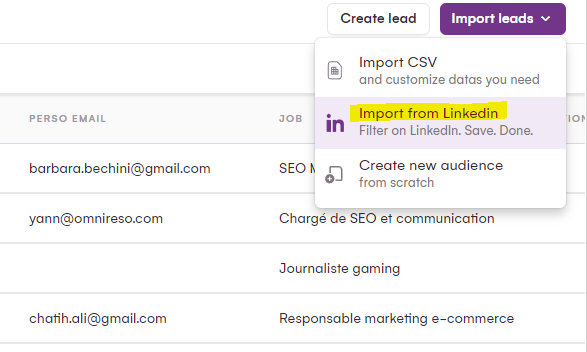
In short, it’s the junction between marketing and sales.

Once your leads are imported and your campaigns launched, when the first leads start appearing in your CRM interface (configured with LaGrowthMachine), the sales team takes over, in the bottom funnel.
Lead Nurturing
Also known as lead maturation, lead nurturing has become the favorite stage for growth marketers.
Although the name sounds technical, this stage simply involves encouraging your lead’s progression through your funnel by relying on a strong content strategy.
Prepare a content framework in advance and imagine trigger scenarios.
What content best suits a particular lead action? What tool will allow you to multiply contact points?
This is a fundamental question when you consider that converting a prospect into a customer requires an average of 5 to 20 contact points.
Here are some examples of content that can help you enrich your lead:
- A white paper
- A newsletter
- A webinar
- A conference
- A blog post addressing their issues
- A tailored social media post
- A marketing email
- Retargeting (SEA or SMA)
- …
Lead Activation: Transition to Customer Status
Remember? This is when your MQL becomes an SQL. Hence the importance for a company to align its sales force with its marketing teams.
Once you have gathered enough information about your lead, they are theoretically in the purchase decision phase.
This is where LaGrowthMachine comes in: by activating your leads with automation outreach techniques, you can handle a large volume while respecting impeccable targeting.
For your information, here are the results of one of our campaigns:

Sales then only need to schedule a meeting or send an email to close the deal.
How to generate qualified leads?
Now that we’ve reviewed the different lead qualification stages, let’s move on to lead generation methods.
Unlike the outreach strategy, inbound marketing is the perfect solution for qualifying leads. It is broken down into several stages.
Identify your buyer personas
Without knowing who you are addressing, how can you deliver relevant content to them?
By anticipating the purchasing behaviors of your potential customers and their socio-demographic data, you will know precisely how to speak to them.
For each target, define their potential problems and find ways to meet their needs.
Segment your contact lists
Once you’ve generated leads, you’ll likely end up with a large number of contacts.
Each of them cannot be treated individually… and you cannot contact them all in the same way.
The simplest approach is to group them into segmented contact lists based on the information gathered, such as:
- Age
- Profession
- Hierarchical level
- Profession
- Interests
- Purchasing behaviors…
Optimize your retention and conversion rates
As we saw earlier, the ultimate goal of your lead generation strategy is to convert MQLs into SQLs before triggering a purchase.
This is where the implementation of content tailored to each target (lead nurturing), as well as lead scoring, comes into play.
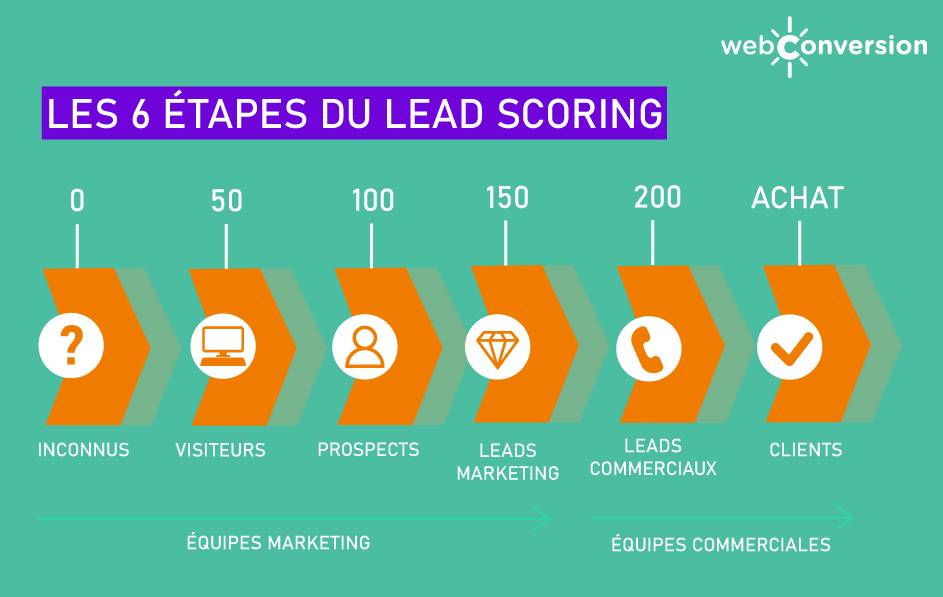
The latter will help you qualify your prospects’ propensity to take action. For each lever used by your potential customer, assign them points.
Let’s take a concrete example, which you can adapt as you wish:
- 0 to 5 points (lead): You share a blog post on LinkedIn. A user on the platform clicks on it (+5 points)
- 5 to 50 points (marketing lead): A call-to-action within the article directs them to a white paper on the subject. They click on it (+5 points) and fill in their contact details to download it (+20 points). You send them a satisfaction email which they open (+5 points). You have cleverly included a video call offer to present your products. They click on the Calendly link and select a slot (+15 points).
- 50 points and more: (sales lead): The sales teams take over and conduct a demo of your service (+30 points). At the end of the call, they send a summary with the link to the page to subscribe to your product. The prospect clicks on it (+50 points) then abandons the cart. A follow-up email is sent, which is also clicked. The prospect converts. They then become a customer.
Customer Loyalty
You have successfully generated your first customers thanks to a well-thought-out conversion funnel. Congratulations! Now, it would be a shame to let them go.
The greatest strength of a company is a won customer, known as a promoter. On average, retaining a loyal customer costs five times less than acquiring new ones.
To retain them, there are many solutions:
- Organizing exclusive events (VIP evenings, workshops)
- Satisfaction surveys
- Birthday gifts (promotions, goodies…)
- Exclusive content…
LaGrowthMachine is very suitable for upselling. In the same way that you set up a B2B lead generation campaign, you can create a very precise audience of existing customers using your CRM data.

It’s up to you to adapt the message to optimize upsells. If you have any doubts, you can always ask us to review your campaign!

Analyze your results
At LaGrowthMachine, we can’t stress enough how important (what am I saying, vital!) it is to measure your actions.
If you don’t know which strategy worked well and which lever underperformed, it’s like throwing bags full of money into an incinerator.
Cut campaigns that don’t prove effective, find ways to optimize those that generate business. And iterate as soon as you’ve found the perfect recipe.
All these actions require a lot of time. Fortunately, you can greatly simplify your life by choosing the right B2B lead gen tool.
LaGrowthMachine: A Sales Automation Software to Boost Your Leads
Just look at our customer testimonials to realize the effectiveness of an automation tool.
By automating your lead generation strategy, you will save an enormous amount of time on your daily routine. And for every minute saved on tedious tasks, you can instead focus on increasing your revenue.
With our tool, you can:
- Create a multi-channel prospecting workflow (Email, Twitter, LinkedIn)
- Automatically enrich your leads
- Manage your leads in the way that seems most appropriate for your business
- Set KPIs and measure all the performance of your campaigns
- Integrate numerous complementary tools (including your CRM) to improve your data
This is the fastest and most effective solution to ensure you set up and monitor your lead generation strategy correctly.
Get 3.5X More Leads!
Looking to improve your sales team’s performance? LaGrowthMachine allows you to generate an average of 3.5X more leads while saving incredible time on all your processes. By signing up today, you get a 14-day free trial to test our tool!
Key Takeaways:
Each marketing lead has its specifics.
Between the different qualification stages, the various content to push to them, and the timing to consider… it’s best to be well-equipped before going into battle. Here’s a quick way to revise your battle plan:
- A lead is a person who shows interest in your services
- It is necessary to qualify them to convert them into a prospect
- A marketing lead is a cold or lukewarm lead
- A sales lead is close to making a purchase
- To qualify a lead, it is essential to map out your prospecting plan
- The TOFU-MOFU-BOFU method can help you see more clearly
- Don’t forget to combine lead nurturing and lead scoring
- Customer loyalty significantly reduces your expenses compared to lead acquisition