
TL;DR
– Define clear KPIs such as conversion rate, sales cycle length, and average order value.
– Analyze individual and collective performance to identify strengths and areas for improvement.
– Regularly train teams on modern sales techniques and essential digital tools.
– Optimize processes by eliminating friction and unnecessary steps in the customer journey.
– Leverage CRM and analytics for data-driven decisions and real-time performance monitoring.
Sales are the lifeblood of any business.
You can have the best product, the best service offering, or the most unique expertise in the world. If your prospects aren’t qualified, if your salespeople perform poorly — in short, if you’re not selling enough — your company’s development will stagnate.
It’s obvious.
This is why the concept of sales performance is essential.
Especially today when companies face increasingly fierce competition in virtually all sectors.
In the following lines, you will understand what sales performance consists of, why it’s important to track it, how you can improve it, and how to measure it.
What is Sales Performance?
Sales performance — to put it simply — is nothing more than a company’s ability to sell better and sell more within a given timeframe.
The notion of sales performance is intimately linked to that of sales effectiveness, meaning the results observed in sales teams.
Sales performance is closely related to your sales recruitment. If you hire the best salespeople, you will necessarily get the best results.
It goes without saying: good sales performance is a reassuring indicator for any leader concerned about their company’s financial health.
That said, the stakes of a company’s sales performance go far beyond its impact on revenue.

What are the Stakes of Sales Performance?
Very often, sales results reveal more than just the quality of a company’s salespeople.
Indeed, the stakes of sales performance go far beyond those related to the competence of sales teams. Most often, sales performance says a lot about the overall performance of the company.
Thus, the observation of a lack of sales effectiveness serves to reflect on other essential aspects of a company, such as:
- Coordination between sales and marketing teams
- Sales strategy and management
- The company’s overall strategy
In this regard, using a tool like LaGrowthMachine can solve many problems: thanks to sales automation, you automate most prospecting tasks, from prospect research to information retrieval in the CRM.

With our B2B lead generation tool, you can schedule multi-channel sequences and lead qualifications in advance that will sync directly into your CRM interface.

Get 3.5X More Leads!
Looking to improve your sales department’s performance? LaGrowthMachine allows you to generate an average of 3.5X more leads while saving a tremendous amount of time on all your processes. By signing up today, you get a 14-day free trial to test our tool!
Coordination Between Sales and Marketing Teams
Poor sales performance can also be linked to a lack of leads or qualified prospects.
And often, this lack is linked to another lack: that of fluid communication between the sales and marketing teams, respectively.
Competition for budgets, misunderstood roles, inter-departmental rivalries, or a simple lack of adequate information management tools… Several factors can contribute to falling sales, even if the product is excellent.
Sales Strategy and Management
When salespeople have low conversion rates, one might start to question their individual competence. But often, a good part of the problem lies in their management.
Having the best salespeople in the world doesn’t guarantee the best sales. If they work with a cumbersome and complicated CRM tool, if they are forced to follow a vague sales action plan, or if they endure outdated and authoritarian sales management methods for a long time, they can quickly become mediocre salespeople.

The Company’s Overall Strategy
Finally, when all of a company’s sales performance indicators are in the red, it’s often wise to reconsider its overall strategy.
Where do you want to go as a company? Has your target’s preference changed? Is your target still the right one? Should you consider radically changing your service offering? Is your company’s activity aligned with your brand values?
These are some questions a leader can and should ask before drawing definitive conclusions about the value of their sales or marketing teams.
What are the Levers for Sales Performance?
Once you understand everything that sales performance can reveal, you might wonder how to improve it.
As you’ve guessed, there are many levers for sales performance.
Among these, two essential levers deserve to be mentioned:
- The attractiveness of the product or service offering
- The quality of leads generated by marketing or your LinkedIn Automation actions
The Attractiveness of the Product or Service Offering
When your product isn’t selling, it might sometimes be that it’s not as “good” as you initially thought.
Good to know 💡
Most of the time, the question to ask is not necessarily about the intrinsic or “technical” quality of your product. It’s more about its attractiveness to your target customer. In other words: how your product or service is perceived in terms of both form and value by your customers.
One of the most common mistakes when designing an offering is to do so without having properly defined, studied, and understood the preferences and deep psychology of the target customer beforehand.
Typically, a company’s product teams spend months designing a new offering without truly listening to customer feedback. This customer feedback is, in turn, typically provided by the marketing and sales teams.
Therefore, when your company’s sales performance indicators are no longer satisfactory, ask yourself these questions:
- To what extent can you better adapt your service or product offering to the deep expectations of your prospects?
- How can you ensure better communication between your product teams, on the one hand, and your marketing and sales teams, respectively?
The Quality of Leads Generated by Marketing
When your sales effectiveness falters, the quality of leads you generate deserves just as much of your attention.
Indeed, if your sales teams spend too much time working on poorly qualified leads from the marketing side, their effectiveness will suffer.
So, consider how your company’s marketing team can improve its outbound lead generation processes.
A hint? Think about the benefits of implementing a good marketing automation system.
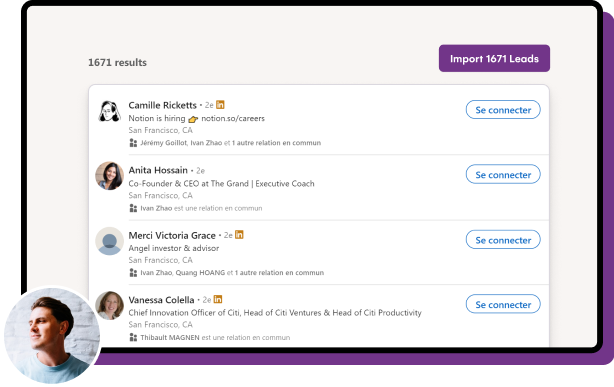
Similarly, in B2B, one of the best workflows you can implement is the LaGrowthMachine + LinkedIn Sales Navigator combo:
1. You create highly targeted lead audiences via Sales Nav.
2. You import them into LaGrowthMachine, which will scrape your leads’ email addresses from LinkedIn.
3. You create your automated multi-channel sequence in LaGrowthMachine.
4. Thanks to synchronization with your CRM software, every lead that responds to one of your messages will be captured and qualified in the CRM.
For your information, here are the results of one of our cold outreach LinkedIn + Email campaigns:

The gains in time and process reliability may surprise you. The same applies to the impact on your sales performance.
Get 3.5X More Leads!
Looking to improve your sales department’s performance? LaGrowthMachine allows you to generate an average of 3.5X more leads while saving a tremendous amount of time on all your processes. By signing up today, you get a 14-day free trial to test our tool!
How to Measure Sales Performance?
When we talk about “performance” — sales or otherwise — we are necessarily talking about results. And when we talk about results, we naturally think about tracking them. In this context, it is essential to choose a certain number of key indicators or KPIs (“key performance indicators”).

These indicators form the basis of your sales dashboard. As you’ve understood, they will allow you to track your sales performance and take the necessary steps to maintain or improve it.
The number of indicators to track should not be excessive, otherwise you risk getting lost. Their choice depends, among other things, on the nature of your company’s business and should be carefully considered.
That said, there are a number of essential KPIs that deserve to be included in any sales dashboard. Here are a few:
- Revenue
This is perhaps the most obvious of all sales performance indicators. It simply corresponds to the total number of sales made by your company within a given timeframe.
This indicator is the first KPI to consider and the foundation for all other indicators on your sales dashboard.
- Number of Opportunities
This indicator is the result of lead qualification work, both by marketing and by your sales teams. It results from filtering and organizing prospects by the amount at stake in the deal and by the probability of closing (= sale). By knowing both your revenue and the number of opportunities over a given period, you can start talking about “conversion”.
- Conversion Rate
Also called “transformation rate,” the conversion rate is, in a way, the ultimate sales effectiveness indicator. It corresponds to the ratio between the number of identified opportunities and the number of concluded sales. This indicator helps, among other things, to evaluate the relevance of sales actions and the discourse of your salespeople.
- Revenue per Salesperson
Another basic indicator that can provide a lot of information. Not only about the individual performance of each salesperson but also about general needs or difficulties of your sales team.
This is a KPI that should be cross-referenced with others, such as the one that follows.
- Average Number of Calls per Opportunity (and per Salesperson)
As you’ve understood, these are two indicators, not just one. In reality, it’s important to always cross-reference them when analyzing them. This allows you to understand both the degree of attractiveness of the offer and the ability of your salespeople to convey its added value to already qualified prospects. It can also provide clues about the existence of certain objections that need to be addressed.
- Average Order Value per Customer
This indicator corresponds to the average amount spent by each customer on products or services provided by your company and helps to better understand your company’s ability to retain customers. Furthermore, by analyzing the average order value, you can estimate how many customers — and of what type — you need to have to achieve your revenue goals.
- Customer Acquisition Cost (CAC)
CAC corresponds to the ratio between, on the one hand, the total costs with the Marketing and Sales teams, and on the other hand, the number of new customers acquired (or “closed”) during a given period.
In principle, the lower your CAC, the more effective your sales strategy is in terms of allocated resources.
This is a very important KPI, which nevertheless deserves to be cross-referenced with other indicators, such as the average order value per customer.
It will thus be possible for you to understand whether a particular type of customer warrants more acquisition efforts than others.
Ultimately, you will also be able to understand whether, to improve your digital prospecting, you should focus on your teams’ skills or rather on your sales strategy in a broader sense.